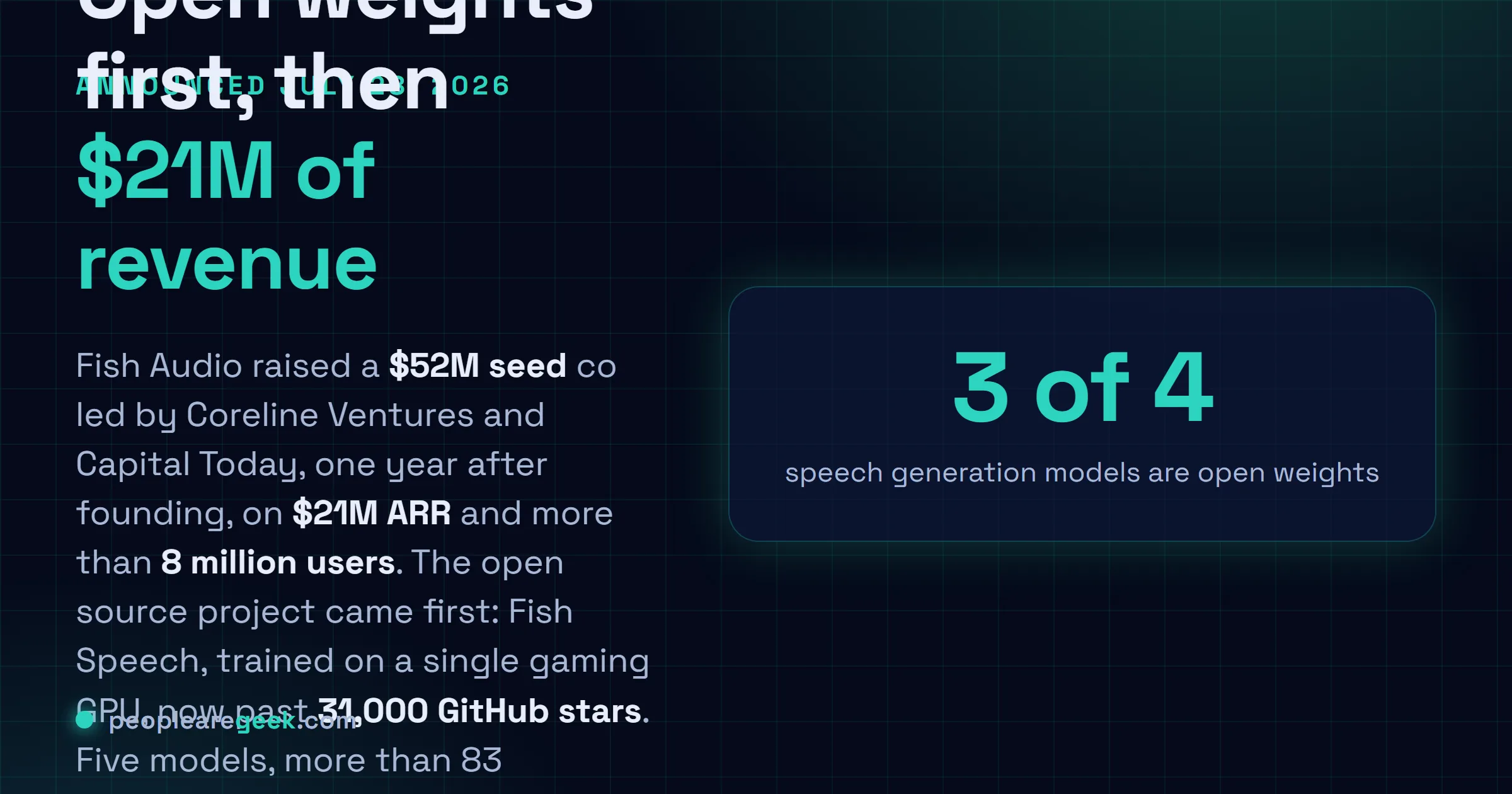
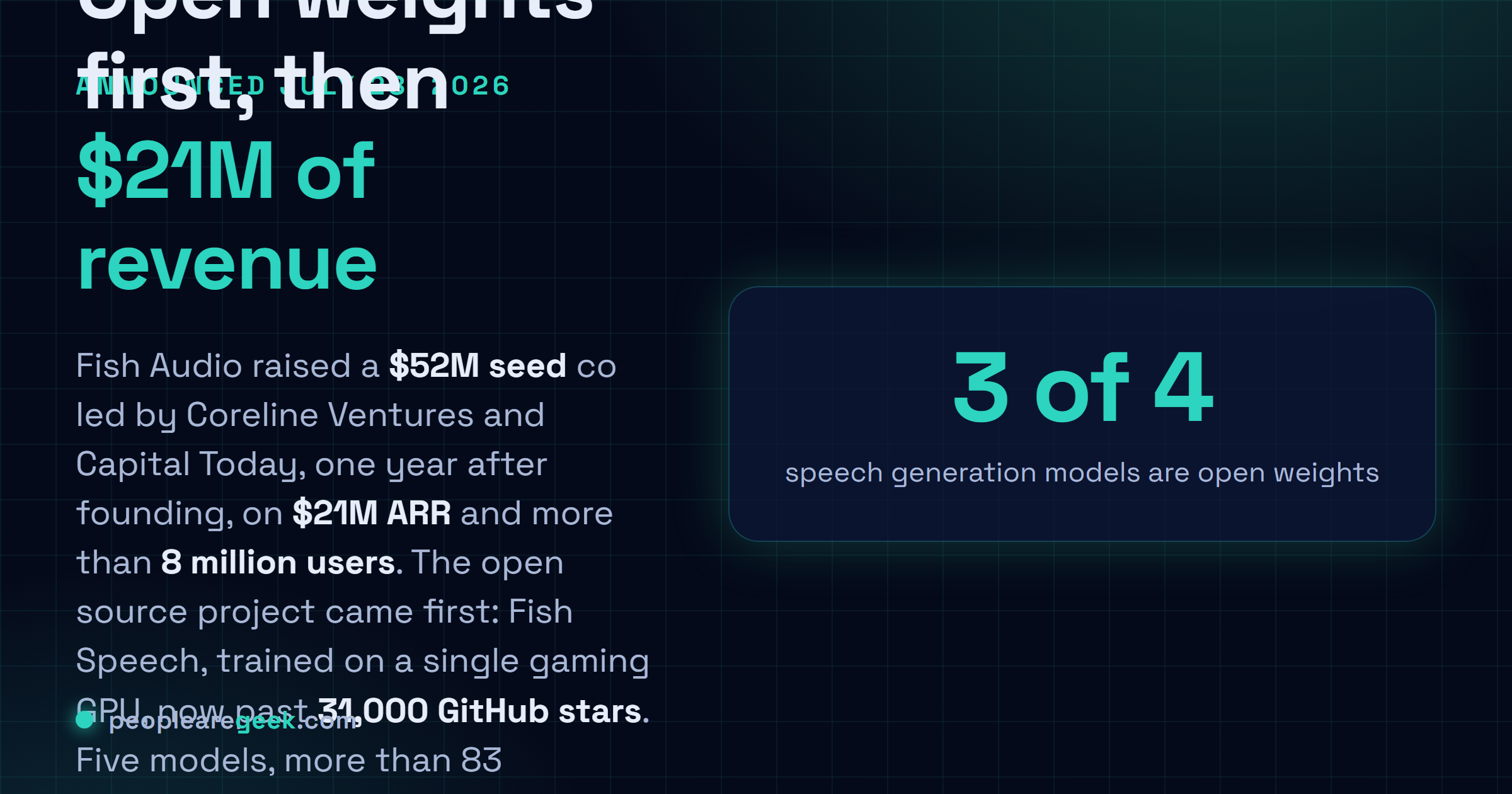
Fish Audio announced a $52 million seed round on Tuesday, one year after the company was founded, with $21 million in annual recurring revenue and more than 8 million users behind it. The path there is the part worth reading: a former NVIDIA researcher trained voice models on a single gaming GPU, released the result as Fish Speech, and watched it collect more than 31,000 GitHub stars. The company now ships five models covering text to speech and speech to text across more than 83 languages. Three of them are open and self hostable. The best one is paid API only, which is the whole business in one sentence.
The short answer
Fish Audio announced a $52 million seed round on Tuesday July twenty eighth, co led by Coreline Ventures and Capital Today, with participation from 359 Capital, Play Time, HF0, 645 Ventures, Parable, Carya Venture Partners, Alphalist Partners and Bayhouse Ventures. The company reports $21 million in annual recurring revenue and more than 8 million users at its first anniversary. It ships five models, four for speech generation and one for speech to text, covering more than 83 languages, with three of the four generation models released as open weights and S2.1 Pro available only through the paid API.
The founding story here is doing a lot of work in the coverage, and for once it is load bearing rather than decorative. Shijia Liao, a former NVIDIA researcher, was annoyed enough by flat synthetic voices to train his own models on a single gaming GPU. The result went out as Fish Speech.
Open weights came first, the company came second
That ordering explains almost everything else. Fish Speech collected more than 31,000 GitHub stars before there was much of a business attached to it. By the time Liao and Rissa Cao, now chief executive, had a company, they had a user base that most seed stage startups spend the round trying to buy.
One year on, the numbers reported alongside the raise are $21 million in annual recurring revenue and more than 8 million users across the open and hosted versions. The round is $52 million, co led by Coreline Ventures and Capital Today, with 359 Capital, Play Time, HF0, 645 Ventures, Parable, Carya Venture Partners, Alphalist Partners and Bayhouse Ventures alongside.
Calling that a seed round is a formality. What investors bought was distribution that already existed.
The part that matters if you are building something

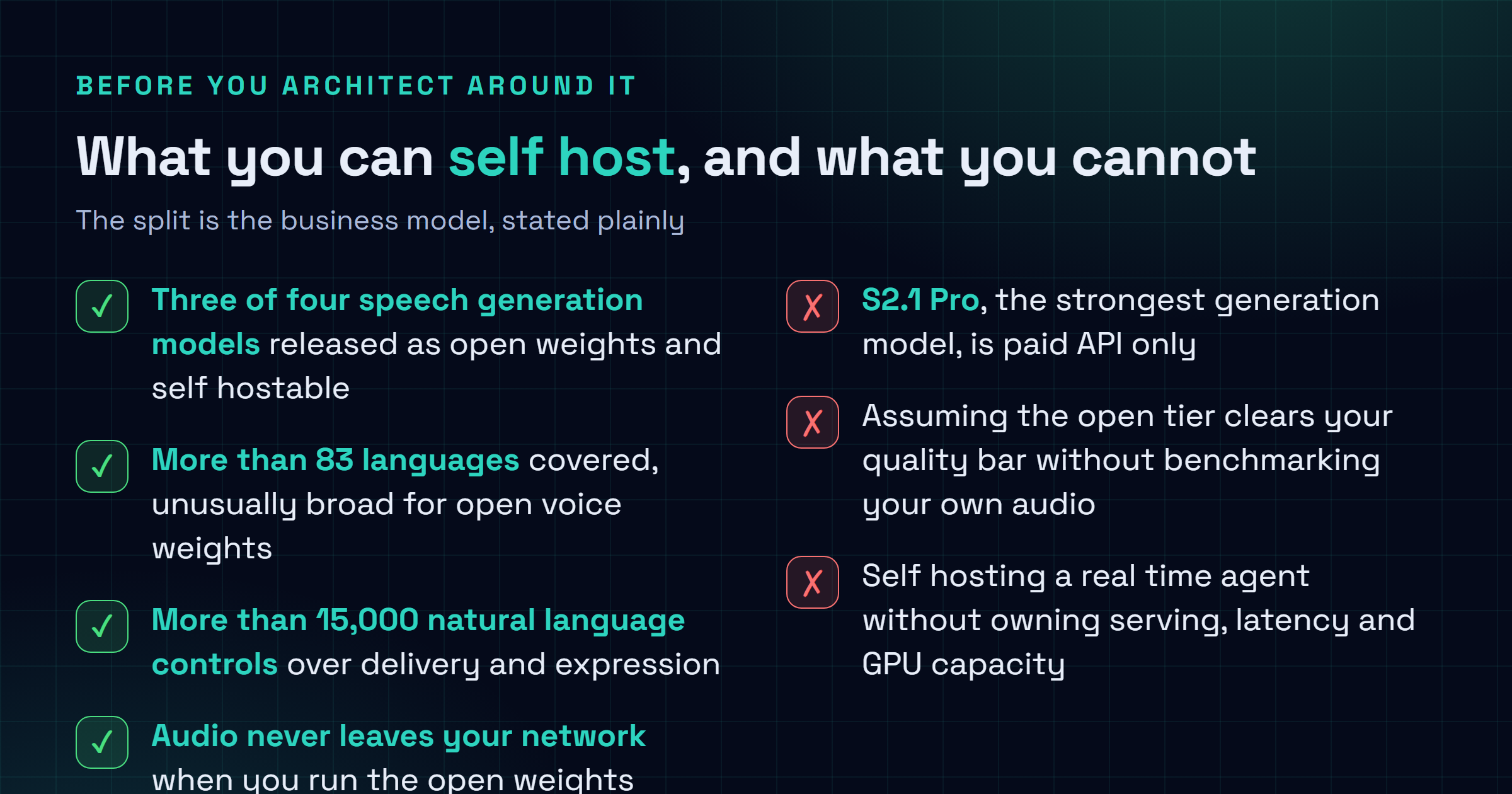
Five models. Four generate speech, one transcribes it. Three of the four generation models are open and can be self hosted. S2.1 Pro, the strongest, is paid API only.
That split is the business model stated plainly, and we would rather see it stated plainly than blurred. It also tells you exactly what your first experiment should be. If you have a workload that produces or consumes speech at volume, run the open weights against your own audio and find out whether they clear your bar. That single test decides whether per request API pricing is a cost you are stuck with or one you were paying out of habit.
Two details are worth knowing before you start. The models cover more than 83 languages, which is unusually broad for open voice weights and is the kind of coverage that is expensive to replicate. And the platform exposes what the company describes as more than 15,000 natural language controls over delivery, which is a large surface to learn but the reason the output does not sound flat.
Where voice work is different from the rest of the AI stack
Most arguments about self hosting a model come down to cost. Voice is the case where they usually come down to the data.
The input to a speech pipeline tends to be personal in a way that a prompt is not: recorded support calls, meeting audio, a person's own voice submitted for cloning. In a regulated environment, the question of whether that audio leaves your network is often settled before anyone looks at a price list. An open weights option that runs on your own hardware changes what is possible there, and that is the practical significance of this announcement rather than the size of the cheque.
The trade is real. Self hosting means you own serving, latency and GPU capacity, and you are running the open tier rather than the best model. For a batch transcription pipeline that is an easy call. For a real time voice agent where latency budget is measured in tens of milliseconds, it is a project.
What the money is for
The stated plan is to move beyond text to speech into what the company calls the full audio native stack: voice native language models where speech is the input and output rather than a wrapper around a text model, speech to speech translation, and an audio understanding model this year.
The less glamorous half of the plan is more informative. An enterprise sales team, plus deeper developer tooling and integrations with voice infrastructure partners. A company with 8 million users and $21 million of revenue does not have a distribution problem. It has a conversion problem, and that is what a sales team and better integrations are for.
Sources and further reading
- TechCrunch: Fish Audio raises $52M seed to build AI voice models for creators and enterprises
- Fish Audio announcement on PR Newswire
- SiliconANGLE: Fish Audio makes a splash after raising $52M seed funding for AI voices
- Unite.AI: Fish Audio lands $52M seed to turn open voice models into revenue
- Fish Audio
Frequently asked questions
Which Fish Audio models are actually open?
Five models exist. Four generate speech and one transcribes it. Three of the four speech generation models are open sourced and can be self hosted, which covers the common text to speech and voice cloning cases. The fourth, S2.1 Pro, is not open and is reachable only through the paid API. If you are evaluating this for a product, that split is the first thing to test rather than the last, because the quality gap between the open tier and the paid tier is the thing that will decide your architecture. Benchmark the open weights on your own audio before you assume either that they are sufficient or that they are not.
What does self hosting buy you here?
Control over where the audio goes and what the marginal cost of a request is. Voice work is unusual among AI workloads because the input is often personal: recorded calls, customer support audio, a person's own voice for cloning. Running the model on your own hardware means none of that leaves your network, which is frequently the deciding factor in regulated environments regardless of what the vendor promises. The trade is that you own the serving problem, the latency tuning and the GPU capacity planning, and that you are on the open tier rather than the best model. For a batch pipeline that trade is usually easy. For a real time agent it is less so.
Is $52 million unusual for a seed round?
It is very large for the label, and the label is doing less work than the metrics. A company reporting $21 million in annual recurring revenue and 8 million users is not at the stage the word seed normally describes, whatever the round is called. What the size reflects is that the open source project came first and the company second: Fish Speech had accumulated more than 31,000 GitHub stars and a real user base before there was much to invest in. Investors were pricing distribution that already existed rather than a plan to acquire it.
What is the company planning to build next?
The stated direction is to move past text to speech into what the company calls the full audio native stack. That means voice native large language models, where speech is the input and output rather than a layer bolted onto a text model, plus speech to speech translation and an audio understanding model due this year. The other stated use of the money is unglamorous and more telling: an enterprise sales team, and deeper developer tooling and integrations with voice infrastructure partners. A company with 8 million users and $21 million of revenue has a conversion problem, not a distribution problem.
Should this change what I build with today?
Only if you were already unhappy with your current voice stack. The useful takeaway is not the funding number, it is that a credible open weights option now exists in a category where the defaults have been closed APIs. If you have a pipeline that generates or transcribes speech at volume, running the open Fish Speech weights against your real audio is a cheap experiment that tells you something concrete: whether the open tier clears your quality bar, and therefore whether per request pricing is a cost you actually have to keep paying.