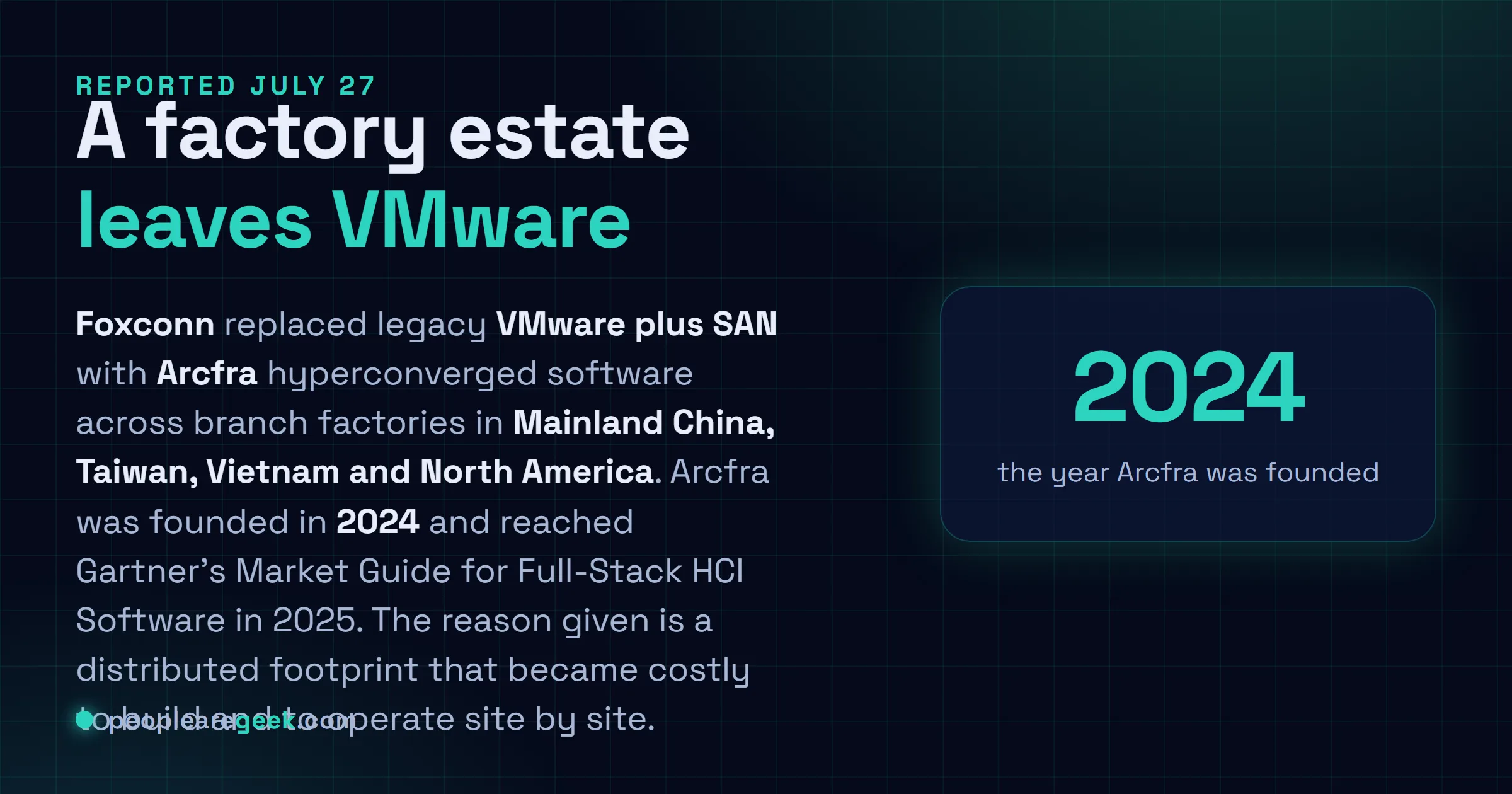
Foxconn has replaced its VMware and SAN estate across branch factories in Mainland China, Taiwan, Vietnam and North America with hyperconverged software from Arcfra, a Singapore company founded in 2024. The Register reported it on Monday July twenty seventh, drawing on Arcfra's own case study. The workloads that moved are not edge experiments: intranet, manufacturing management, ERP, production line management, DevTest environments and virtual desktop infrastructure, which is to say the systems that stop the factory if they stop. Foxconn also picked up Arcfra's Neutree platform for GPU virtualization and model serving. For anyone still running the same evaluation, the reasoning is more useful than the headline.
The short answer
Foxconn has replaced legacy VMware virtualization and SAN storage with Arcfra's hyperconverged platform across branch factories in Mainland China, Taiwan, Vietnam and North America. The migration covers intranet, manufacturing management, ERP, production line management, DevTest and VDI. Arcfra, founded in Singapore in 2024, made Gartner's Market Guide for Full-Stack HCI Software in 2025. Foxconn also adopted Neutree, Arcfra's model serving layer, which added native GPU virtualization in a July 2026 update. The Register reported the deployment on July twenty seventh.
Most VMware departure stories are about licensing arithmetic. This one is about geography, and that makes it more useful to read.
What moved
Foxconn's estate here is not a data centre. It is branch factories, spread across Mainland China, Taiwan, Vietnam and North America, each running the systems a factory needs to keep running.
The old shape was the one everybody recognises: VMware for virtualization, SAN arrays underneath for storage, replicated at each site. The new shape is Arcfra's hyperconverged platform, which puts compute and storage on the same nodes and takes the separate array out of the design.
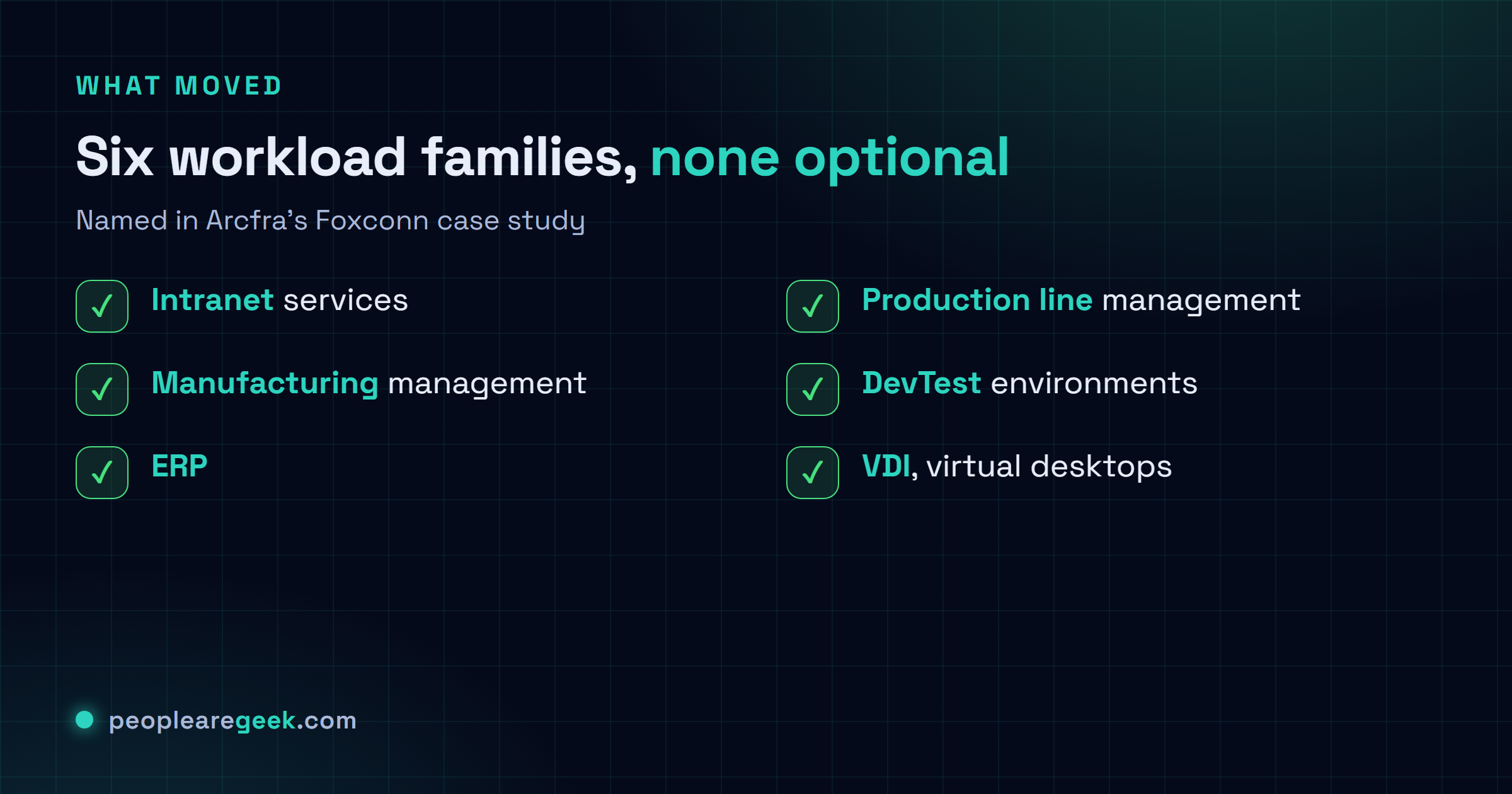
The workload list from Arcfra's case study is the part that establishes how serious this is. Intranet services. Manufacturing management. ERP. Production line management. DevTest environments. Virtual desktop infrastructure. There is no category on that list you can describe as low stakes, and production line management in particular is the kind of system where downtime is measured in units not built.

The reasoning, which is the transferable part
Arcfra's account of why Foxconn moved does not lead with licence cost. It describes an architecture that had become increasingly difficult to manage and scale across a distributed global footprint, with high construction costs and a significant increase in operations and maintenance overhead.
Read that with the word distributed carried through and it stops being generic vendor language. A three tier design, hosts plus fabric plus array, is a perfectly sensible thing to build once. The cost profile changes when you build it thirty times.
Each site needs its own array, which is capital spent before a single VM runs. Each site needs fabric, which is a second thing that can break and a second thing that needs firmware discipline. And each site needs somebody who understands both, or a support contract that pretends someone does. Multiply by the number of factories and the recurring cost is not really the licences. It is the operational surface.
Hyperconverged infrastructure answers that specific problem well. Fewer parts per site, one management plane across sites, and expansion that looks like adding a node rather than provisioning storage. Whether it answers your problem depends almost entirely on whether your estate looks like thirty sites or one.
The vendor risk question, asked honestly
Arcfra was founded in 2024. It earned a place in Gartner's Market Guide for Full-Stack HCI Software in 2025, and in 2026 it is running ERP for Foxconn.
That is a fast path, and pretending otherwise would be silly. Handing production line management to a two year old company is a risk decision, not a technical one, and it is worth being clear that Foxconn made a judgement here that many organisations would not.
What it signals is how much the ground has shifted. Foxconn joins Tesco, Western Union and Allstate on the list of large customers who have publicly left VMware since the Broadcom acquisition. When enough customers reach the same conclusion about the incumbent, the bar a challenger has to clear stops being trust built over a decade and starts being something considerably lower. That is the actual market news in this story.
The AI piece
Alongside the infrastructure migration, Foxconn adopted Neutree, Arcfra's model-as-a-service platform, which picked up native GPU virtualization and model governance in a July 2026 update.
This is worth separating from the virtualization move rather than reading as one decision. Serving models across distributed factory sites has the same shape as the original problem: you want one control plane over many locations, and you want GPUs shared rather than pinned to a single workload per card. A vendor already running your compute is the obvious place to ask for that, which is exactly the platform consolidation dynamic that made VMware valuable in the first place.
If you are running this evaluation
Count sites before you compare licences. The number of physical locations in your estate is the variable that decides most of this, and it is the one that tends to get left out of the spreadsheet in favour of per socket pricing.
Then check the workload fit honestly. Hyperconverged platforms are strong for general purpose virtual machines, VDI and test environments, which covers most of what Foxconn moved. If a large share of your estate is something with unusual storage behaviour, a database with a specific latency profile or an application certified against a particular array, that part needs testing rather than assuming.
And take the reference for what it is. A named deployment at this scale is genuine evidence that the platform works at scale. It is not evidence that a two year old vendor will still be there in ten years, and both of those things can be true at once.
Sources and further reading
- The Register: Foxconn drops VMware, adopts hyperconverged upstart Arcfra for workloads including AI
- Arcfra: Foxconn reimagines global manufacturing, the journey of factory distributed cloud
- Blocks and Files: say hello to VMware alternative Arcfra
- Arcfra 2026 Q1 wrap-up: next generation HCI and MaaS
Frequently asked questions
What exactly did Foxconn replace?
A legacy architecture of VMware virtualization sitting on top of SAN storage, deployed across branch factories rather than in one central data centre. The replacement is Arcfra's hyperconverged stack, which collapses compute and storage onto the same nodes and removes the separate storage array from the picture. The workloads named in Arcfra's case study are intranet services, manufacturing management, ERP, production line management, DevTest environments and virtual desktop infrastructure. That list is worth reading twice, because it is not a pilot. Those are systems where an outage is measured in stopped production lines.
Who is Arcfra?
A Singapore based hyperconverged infrastructure company founded in 2024, so it was roughly two years old when this deployment was announced. It appeared in Gartner's Market Guide for Full-Stack HCI Software in 2025, which is the analyst recognition that usually precedes a vendor showing up on enterprise shortlists. Its platform is AECP, and it also ships Neutree, a model-as-a-service layer that gained native GPU virtualization and model governance in a July 2026 update.
Why did they leave VMware?
Arcfra's case study attributes it to operational and cost pressure rather than to any single event. The legacy VMware and SAN architecture was described as increasingly difficult to manage and scale across a distributed global footprint, with high construction costs and a significant increase in operations and maintenance overhead. That distributed shape is the specific detail: a design that is reasonable in one large data centre becomes expensive when you replicate it across dozens of factory sites, each needing its own storage array and its own local expertise.
Is this part of a broader move away from Broadcom?
Foxconn joins a list of large customers that have publicly left since the Broadcom acquisition, including Tesco, Western Union and Allstate. What makes this one notable is less the name than the profile of the replacement: a vendor two years old taking over ERP and production line systems for one of the world's largest manufacturers. That is a level of risk tolerance that would have been unusual a few years ago, and it says something about how the licensing changes have shifted the calculation.
What should I take from this if I am running the same evaluation?
The distributed footprint argument is the transferable part. If your estate is one big site, the economics of hyperconverged versus traditional three tier are genuinely arguable. If it is thirty small sites, the maths changes: every site that no longer needs a storage array, a fabric and someone who understands both is a recurring saving in money and in scarce attention. Start by counting sites rather than by comparing licence line items, then check whether your actual workloads fit what the replacement platform does well.