The FreeBSD ROCm port was approaching a vector-addition milestone in the Foundation’s 24 August interview. A driver linking and loading is real progress, but it does not establish a complete, supported machine-learning stack.
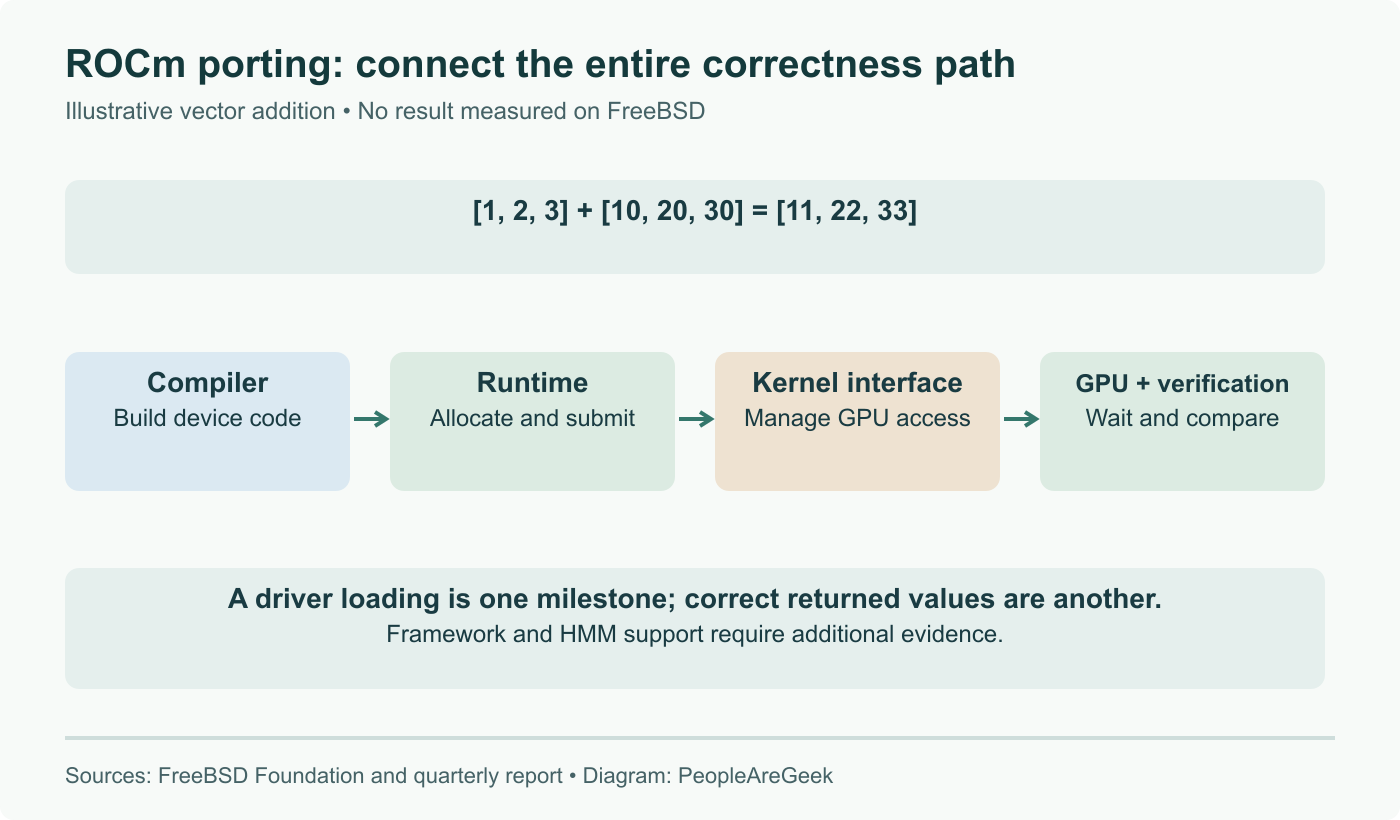
Read the milestones in order
The Foundation interview describes Sourojeet Adhikari’s work across AMD’s LLVM fork, ROCm runtimes, drm-kmod and LinuxKPI. It still identifies userspace issues and presents vector addition as an approaching goal. The quarterly report gives earlier component-level progress and source branches; the later interview should not be read as proof that every remaining component is finished.
The diagram separates compilation, host runtime, kernel interface and GPU execution. A compiler accepting a program validates a different boundary from the runtime submitting it or the device returning correct results.
Why a tiny calculation is useful
A simple correctness case can use A = [1, 2, 3] and B = [10, 20, 30], expecting C = [11, 22, 33]. This is an illustrative arithmetic example, not output obtained from the FreeBSD port.
A real test would have to allocate the buffers, make inputs available to the GPU, submit work, wait for completion and compare returned values. A successful launch without checking output misses a crucial part of that chain. After the first small case, vary sizes and repeat allocation and cleanup to look for lifetime or synchronization errors. A successful vector test would still not certify an entire framework, GPU family or production workload.
Compatibility includes behaviour
The interview’s class_register example involves code expecting a const structure while FreeBSD’s compatibility implementation still expected mutable data. Our old sentence saying nothing in the signature could reveal the issue was too absolute: constness is part of the interface contract. Matching a function’s name is insufficient if the implementation treats its arguments differently.
HMM is a further memory-management task
The kernel HMM documentation explains infrastructure for mirroring process address spaces and migrating memory between system RAM and device memory. It is not a statement that a simple explicitly copied vector program requires every HMM feature, or that HMM alone makes every GPU pointer usable everywhere.
For anyone tracking adoption, keep separate checks for toolchain builds, runtime correctness, supported hardware, memory behaviour and framework compatibility. Test development branches on recoverable lab systems. We have not run this port, and the sources cited do not justify presenting it as an end-user installation recommendation.
Sources
Reviewed Foundation interview and quarterly status; kept vector addition as a target, corrected const-interface explanation and separated simple compute from HMM support.