Munich Regional Court I ruled on Friday that Suno infringed German copyright twice over, once by storing six GEMA represented songs inside its model weights and again by serving outputs derived from them. The 42nd civil chamber found all six works reproducibly contained in Suno versions 3.5 and 4, which the court treated as memorisation rather than pattern learning. It rejected the text and data mining exception on that basis, granted GEMA injunctive relief, disclosure of revenue and damages, and applied the same reasoning it used against OpenAI in November 2025. Suno says the judgment mischaracterises its technology and is weighing an appeal.
The short answer
The 42nd civil chamber of Munich Regional Court I ruled on July thirty first that Suno infringed the copyrights of works represented by GEMA, the German collecting society. Presiding judge Elke Schwager granted injunctive relief, disclosure of revenue and damages. The chamber found six works reproducibly contained inside Suno models 3.5 and 4, held that storing them there infringes the reproduction right, and held that serving outputs from them infringes the right of making works available to the public. The text and data mining exception was rejected on the ground that it does not cover memorised copies. The judgment is not final and Suno is considering an appeal.
Most of the arguments about training data have been arguments about outputs. Did the model produce something too close to the source, and if so, whose fault is that. This ruling goes somewhere else. It looks at the file on disk and asks whether the protected work is in there.
What the chamber found
Munich Regional Court I decided on Friday, July thirty first, in favour of GEMA on essentially every point. The bench was the 42nd civil chamber under presiding judge Elke Schwager, the same chamber that ruled against OpenAI in a parallel case in November 2025.
Six works formed the test catalogue: Atemlos durch die Nacht, Forever Young, Big in Japan, Mambo No. 5, Daddy Cool and Rasputin. The court found all six reproducibly contained in Suno versions 3.5 and 4. Suno's position was that its models hold mathematically learned patterns and generalised features rather than songs, and that a user's prompt breaks the chain between the model and any infringing output. The chamber did not accept either argument.
The finding splits into two infringements. Keeping the works inside the model infringes the reproduction right. Making outputs derived from them available to users infringes the right of making works available to the public. GEMA was granted injunctive relief, an order to disclose revenue, and damages that have not yet been quantified.
GEMA chief executive Tobias Holzmüller said that AI models built on the theft of intellectual property are not protected by law. Suno said the decision rests on a fundamental mischaracterisation of how its technology works, and that it is evaluating all available options including an appeal.
Memorisation is the whole case
The interesting part is not that a court sided with a collecting society. It is where the court drew the line.
European text and data mining rules exist precisely so that you can run analysis over lawfully accessible works without clearing rights for every one of them. That is the exception every training pipeline in the EU leans on. The chamber accepted the exception as a concept and then held that it stops at memorisation: once a protected work can be reconstructed from the model, you are no longer extracting patterns, you are holding a copy, and a copy needs a licence.
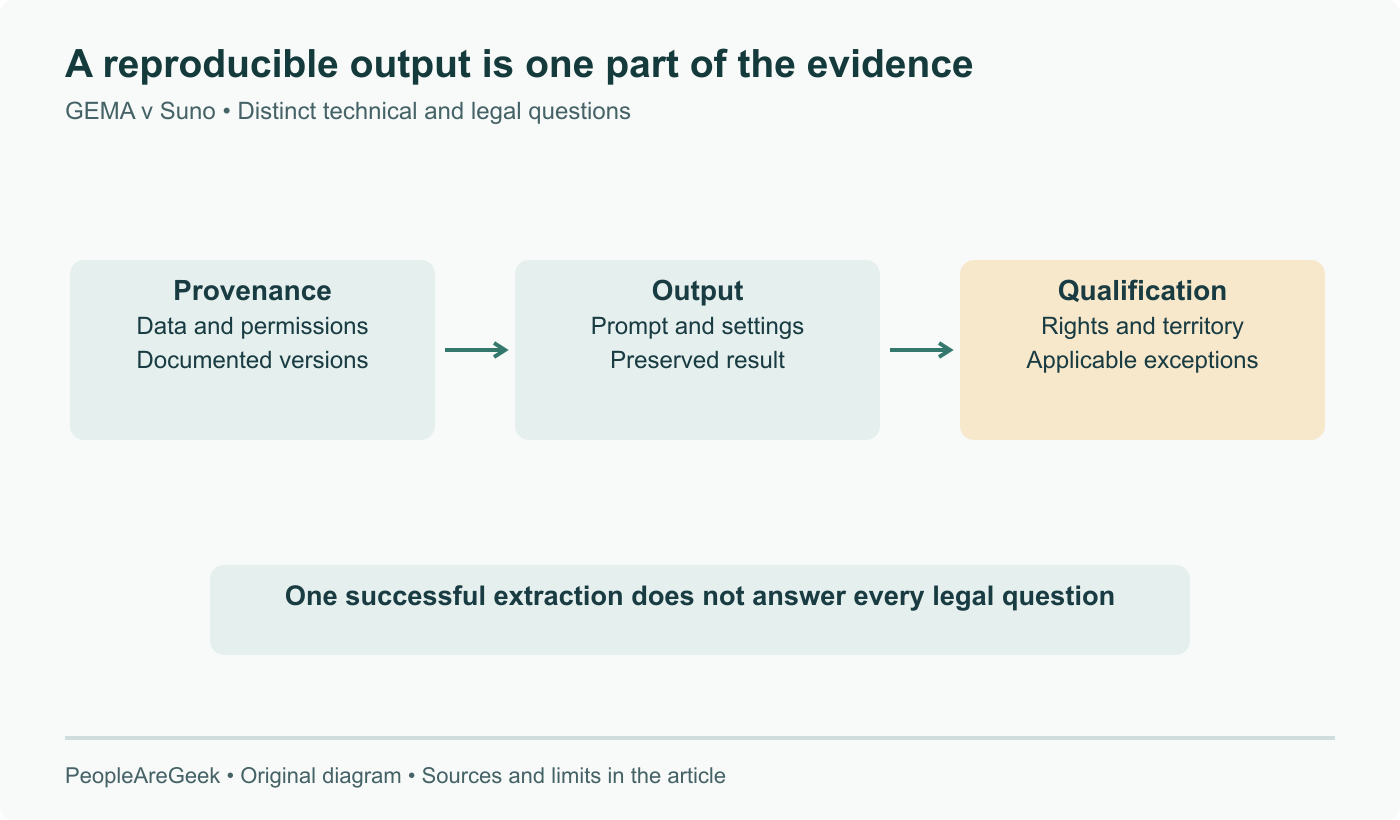
That is a technical test, not a philosophical one. It turns on whether extraction succeeds. GEMA's evidence was reproducible generation matching the originals in melody, harmony and rhythm across all six works, which is the kind of thing you can attempt against any model you have access to.
Because the same chamber reached the same conclusion against OpenAI eight months earlier, there are now two decisions from one bench saying the same thing about a different modality. The reasoning is not about music.
What it changes for people who ship models
If you train, fine tune or distribute weights, the practical consequence is that your artefact is now something a rights holder can test.
That reframes a few habits. Provenance records for training data stop being a compliance formality and become the thing you reach for when someone asks what is in a checkpoint. Extraction probing, running targeted prompts against your own model to see whether known material comes back verbatim, becomes part of release testing rather than a research curiosity. Deduplicating training data and the other standard mitigations against verbatim retention gain a concrete reason to exist, because they change the outcome of the test that decided this case.
None of that is new engineering. It is all published technique. What changed is that a court has now accepted the output of that technique as proof.
The parts that are not settled
Plenty is still open. The judgment is not legally binding yet and Suno can appeal to the Higher Regional Court, with a route beyond that to the Federal Court of Justice and potentially to the Court of Justice of the European Union on the interpretation of the mining exception. Damages have not been quantified, so nobody knows what the number looks like.
There is also no threshold in the ruling for how much reconstruction counts. Six songs came back cleanly enough to satisfy a court. Where the line sits between a fragment and a copy is the question the appeals will spend their time on, and it is the question that decides how much of this reasoning transfers to text and code models.
Sources and further reading
- Music Ally: GEMA wins its copyright infringement lawsuit against Suno
- Variety: Suno loses landmark AI lawsuit to GEMA
- The Decoder: German court rules Suno violated copyrights and rejects the fair use defence
- GEMA, the German collecting society
Frequently asked questions
What did the court actually decide, in plain terms?
Two separate things, and the split matters. First, that the six songs are physically present in Suno's models in a form that can be reproduced, which makes the model file itself a copy under German law and infringes the reproduction right. Second, that letting users generate and receive those outputs infringes the right of making works available to the public. The first finding is the novel one. Courts have looked at AI outputs before. Deciding that the weights themselves carry copies moves the infringement upstream from what the model does to what the model is.
Why did the text and data mining exception not save Suno?
Because the exception covers analysis, not retention. European text and data mining rules let you process lawfully accessible works to extract patterns, correlations and statistical structure. The chamber held that once a protected work can be reconstructed from the model, you have gone past extracting patterns and into keeping a copy, and the exception no longer applies to that copy. This is the same line the chamber drew when GEMA won against OpenAI in November 2025. Two rulings from the same bench now say the exception ends where memorisation begins.
How did GEMA prove the songs were inside the models?
By generating outputs and comparing them against the originals. GEMA's side showed that prompts against Suno 3.5 and 4 returned material matching the source works in melody, harmony and rhythm, reproducibly rather than as a one time coincidence. Six works were used as the test catalogue, including Atemlos durch die Nacht, Forever Young, Big in Japan, Mambo No. 5, Daddy Cool and Rasputin. It was not disputed that the works were used in training. The contested question was whether that use left copies behind, and the reproducibility of the outputs is what settled it.
Does this bind anyone outside Germany?
Not directly. A Munich Regional Court judgment binds the parties, and it is not final because Suno can appeal to the Higher Regional Court and beyond. But the reasoning rests on the European text and data mining framework rather than on anything unique to Germany, so other EU courts have a worked example to point at. The practical effect arrives sooner than the legal effect. Rights holders now have a template for how to build the evidence, and any provider licensing into the EU has to assume the same test could be run against its models.
If we train or fine tune models, what should we take from this?
Treat memorisation as a measurable property of your artefact, not a theoretical risk. The evidence in this case was reproducible extraction, so the defensible position is being able to show you tested for it. That means keeping records of what went into training, running extraction probes against your own checkpoints for the material most likely to be memorised, and treating a positive result as a build problem rather than a legal one. Deduplication of training data and the usual mitigations against verbatim retention stop being nice to have once a court accepts that the weights can be a copy.