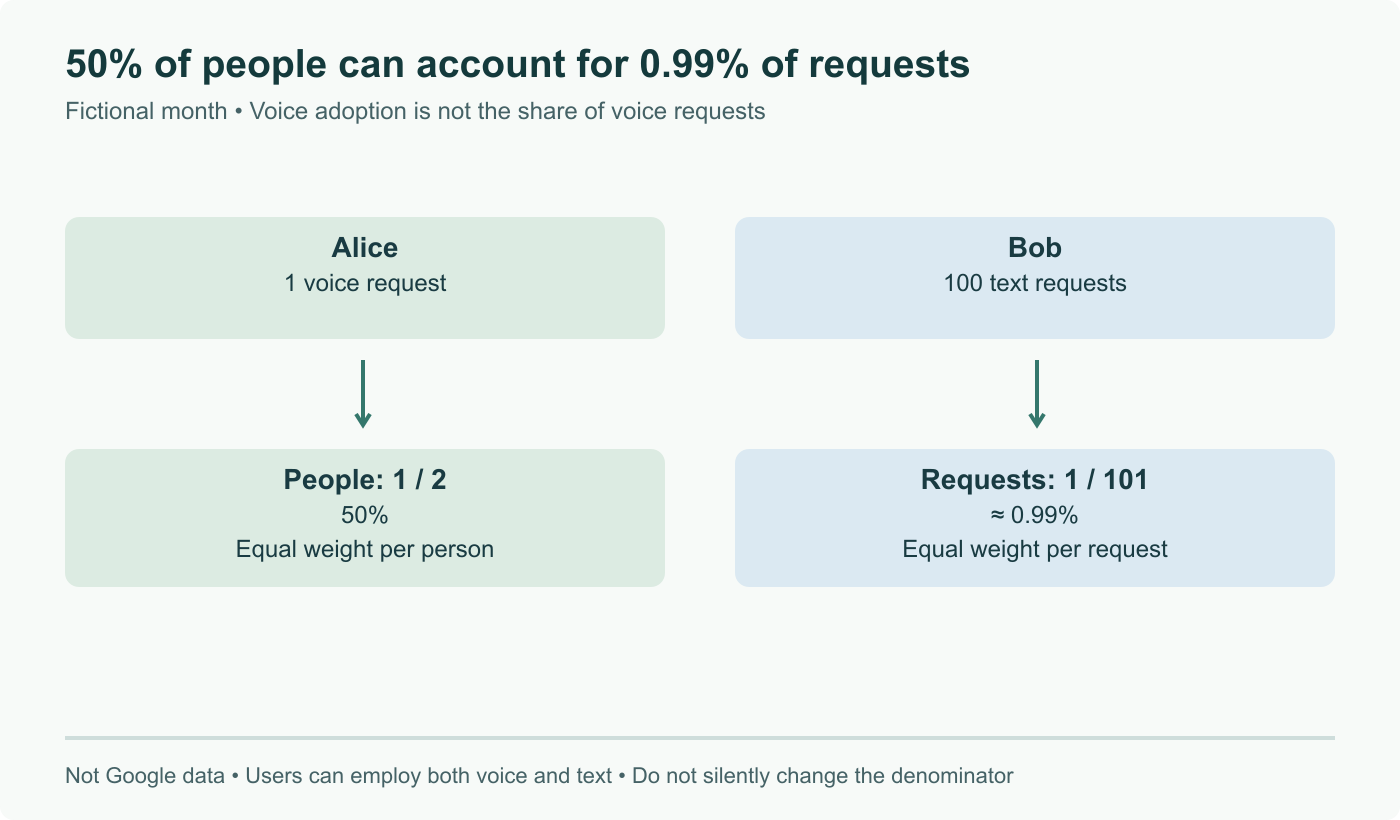
Google announced on August 11, 2026 that the Gemini app passed 1 billion monthly active users, making it the company's fastest growing product and the fourteenth to reach that mark. The headline number is the least useful part. What we would keep is the usage breakdown: 63% of users now talk to Gemini rather than type, one in five Gemini Live sessions goes beyond voice into live camera or screen sharing, and the app generates more than 150 million images a day. If you build interfaces, those three figures say more about where input is heading than the user count does.
The short answer
Google announced on August 11, 2026 that the Gemini app crossed 1 billion monthly active users, its fourteenth product to reach that scale and, by the company's own description, its fastest growing ever. The usage detail is the useful part: 63% of users talk to Gemini rather than type, one in five Gemini Live sessions extends beyond voice into live camera or screen sharing, and the app produces more than 150 million images a day.
Round numbers are marketing. The numbers underneath a round number are sometimes engineering, and this announcement has three of those worth keeping.
The milestone and the curve
Sundar Pichai announced on August 11, 2026 that the Gemini app had passed 1 billion monthly active users. Google calls it the fastest growing product in its history and the fourteenth to hit a billion, alongside Search, Gmail, Android, Maps, Chrome, Play and YouTube.
The trajectory is documented well enough to be checked rather than taken on trust. Four hundred million monthly users at Google I/O in May 2025. Six hundred and fifty million by October 2025. Seven hundred and fifty million in February 2026. Nine hundred million at I/O in May 2026. Nine hundred and fifty million in the second quarter earnings report on July 22, and past a billion three weeks later.
For scale, OpenAI reported the same milestone in June 2026, roughly two months earlier.
One caveat worth stating plainly: monthly active users of an app counts anyone who opened it once in thirty days. Neither company published subscriber numbers next to the milestone, and Google's omission was noticed. This is a reach figure.
The number we would actually keep
Sixty three percent of Gemini users talk to it.
That inverts how most of us design. Text is the assumed interaction model, and voice gets treated as an accessibility path or a driving mode. If two thirds of a billion people are speaking instead of typing, the assumption is backwards, and the consequences are practical rather than philosophical.
Spoken input arrives with disfluencies, self corrections and no punctuation, so the parsing and error handling in front of a model are doing different work. Spoken output cannot use a table, a code block or a nested list, which means the response formatting a text interface relies on has to be rebuilt as prose that survives being read aloud. And latency stops being a nice to have: a person waiting through silence experiences delay very differently from a person watching tokens stream into a box.
Google also notes a growing population of voice only users, and that power users on the macOS app prompt roughly twice as often as users on other surfaces.
Multimodal has stopped being a demo
One in five Gemini Live sessions goes beyond voice into live camera or screen sharing.
That is a fifth of live sessions where the model receives a video stream of what the person is looking at, at the same time as their voice. The weight of that context compared to a chat message is not a small difference, and it changes what people ask. They stop describing the problem and start showing it.
If you maintain documentation, support tooling or anything diagnostic, that is the shift to plan for. The question arriving at your system is increasingly a camera pointed at a thing rather than a written description of what the thing is doing. The pace of Gemini model releases over the past year has been the enabling half of this, and the usage numbers are the other half finally showing up.
What is queued next
Google previewed more than sixty additional regional dialects arriving soon, more study features over the coming weeks, and task automation across forty Android applications, with further detail at Made by Google 2026.
Dialect coverage is the item worth tracking for anyone building speech interfaces. When a first party assistant handles a dialect well on a device, every other voice interface on that device gets measured against it, and that comparison is not usually kind.
Sources and further reading
- Google's Gemini app surges to 1 billion users, TechCrunch, August 11, 2026
- Gemini app hits 1 billion monthly users, Google teases what's next, 9to5Google, August 11, 2026
- Gemini Reaches 1 Billion Users: Subscriber Count Left Out of Announcement, Tech Times, August 12, 2026
- Google's Gemini App Surpasses 1 Billion Monthly Active Users, The AI Insider, August 12, 2026
- Top Tech News Today, August 12, 2026, Tech Startups
Frequently asked questions
What did Google actually announce?
That the Gemini app passed 1 billion monthly active users, announced by Sundar Pichai on August 11, 2026. Google describes it as the fastest growing product in the company's history and the fourteenth to reach a billion users, joining Search, Gmail, Android, Maps, Chrome, Play and YouTube. The growth curve is documented: 400 million monthly users at Google I/O in May 2025, 650 million by October 2025, 750 million in February 2026, 900 million at I/O in May 2026, and 950 million reported in the second quarter earnings on July 22 before crossing the line in August.
Why is the 63% voice figure the interesting one?
Because it inverts an assumption that most of us build against. Text is the default interaction model for these systems, and voice is treated as an accessibility feature or a car use case. If nearly two thirds of a billion person user base is speaking rather than typing, then latency budgets, error handling and output formatting all need rethinking. Spoken input arrives with disfluencies and no punctuation. Spoken output cannot use tables, code blocks or bullet lists. An interface designed for a text box and then given a microphone is not the same product as one designed for speech from the start.
What does one in five Gemini Live sessions using camera or screen actually mean?
It means a fifth of live sessions are multimodal in the strict sense: the model is receiving a video stream of what the user is looking at, or of their screen, at the same time as their voice. That is a much heavier context than a chat message, and it changes the class of question people ask. Instead of describing a problem, they show it. For anyone building support, documentation or diagnostic tooling, the relevant consequence is that users increasingly expect to point a camera at a thing rather than to write down what the thing is doing.
How does this compare to ChatGPT?
OpenAI reached 1 billion monthly active users in June 2026, so Gemini crossed the same line roughly two months later. Both figures are vendor reported and count monthly active users of an application, which is a generous metric: it includes anyone who opened the app once. Neither company published subscriber counts alongside the milestone, and Google's announcement was noted for leaving that number out. Treat the billion as a reach figure, not a revenue one.
What is Google shipping next?
Google previewed more than sixty additional regional dialects, further study features over the coming weeks, and task automation across forty applications on Android, with more announced at Made by Google 2026. The dialect expansion is the one to watch if you build anything that consumes speech, because broader dialect coverage in a first party assistant tends to reset user expectations for every other voice interface on the same device.