DevNews

Gemini Adds a Toggle to Hide Visible AI Watermarks

On this page
  1. What changed
  2. What did not change
  3. The jurisdictions carve out
  4. What we would do about it
  5. Sources and further reading

Google started rolling out a Media Watermark toggle in the Gemini app and in Flow on August 14, 2026, letting users switch off the visible sparkle mark that Google stamps on AI generated images, videos and songs. Search is next. What stays is the part that matters if you build anything that has to tell synthetic media apart from the rest: the invisible SynthID signal and the C2PA provenance metadata are embedded in every generation regardless of the setting, with no user facing way to disable either. So the human eye loses a cue, and machine readable provenance does not change. If your moderation or ingest pipeline was keying on the visible corner mark, it stops working this week.

The short answer

Google began rolling out a Media Watermark toggle on August 14, 2026 in the Gemini app and in Flow, letting users switch the visible sparkle mark off for images, videos and songs, with Search named as the next surface. The invisible SynthID watermark and C2PA provenance metadata remain embedded in every generation with no way to disable them. The toggle is withheld where local law requires a visible mark, and in India, South Korea and Vietnam it is limited to Google AI Ultra subscribers.

3model families covered: Nano Banana, Omni, Lyria
2invisible signals that stay: SynthID and C2PA
0ways for a user to remove those invisible signals
Answer card explaining that from August 14, 2026 Gemini and Flow users can switch off the visible AI watermark on images, videos and songs, while the invisible SynthID signal and C2PA provenance metadata remain embedded in every generation.
The change in one card. Source: Josh Woodward's announcement on X, August 14, 2026, and reporting by TechCrunch and Engadget. PNG

Two days ago we wrote about a vendor making its watermark impossible to switch off. This week the largest AI media generator on the planet went the other way, and the interesting part is what it kept.

What changed

On August 14, 2026, Josh Woodward, Google's vice president for Gemini, announced a Media Watermark setting rolling out over several days across the Gemini app and Flow, Google's video editor. Users open settings, find Media Watermark, and turn the visible mark on or off. The choice applies to new generations in that product. Search is named as the next surface to get it.

The announcement from Google's vice president for Gemini, August 14, 2026.

The coverage is three model families wide: images from Nano Banana, videos from Omni and songs from Lyria. Woodward's framing was a usability one, that a visible mark is fine on a quick social post and unwelcome on a client deck or a printed poster.

What did not change

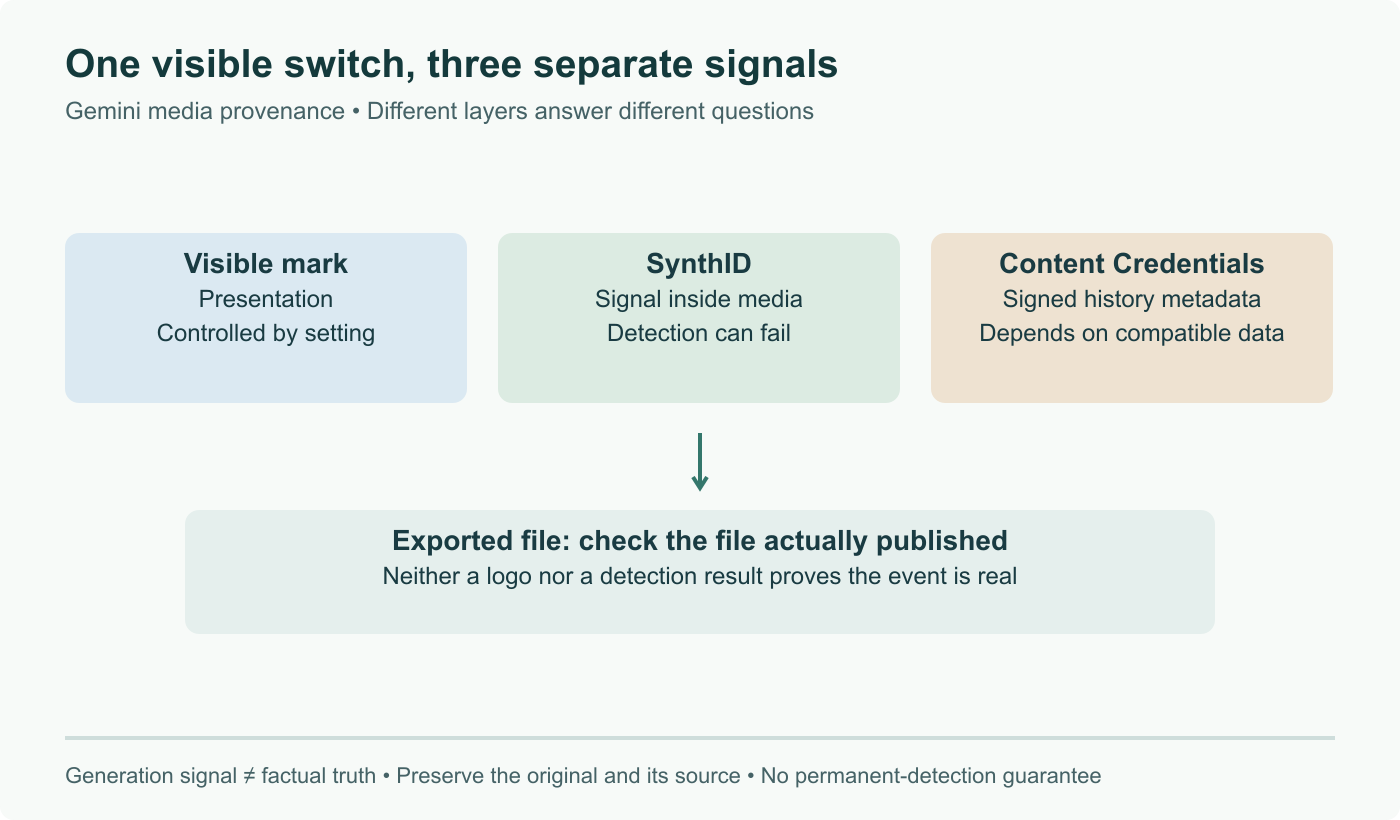
This is the paragraph to keep. The invisible SynthID watermark and the C2PA provenance metadata are embedded in every generation regardless of the toggle, and there is no user facing way to disable either one.

That distinction is doing all the work. Google removed a signal aimed at a human looking at the picture and kept both signals aimed at software inspecting the file. If your detection strategy already reads C2PA manifests or verifies SynthID, nothing about your pipeline changed on Friday. If your strategy was that AI images have a sparkle in the corner, your strategy is now wrong.

Checklist showing what survives the Gemini watermark toggle: the visible sparkle can be switched off, while the invisible SynthID signal, the C2PA manifest and the legal requirement in some jurisdictions all remain in place.
What the toggle actually removes, and what it leaves untouched in every generated file. PNG

It is worth putting next to Anthropic's decision to watermark every Claude output with no opt out, reported four days ago. Two vendors, two directions, same underlying split: the invisible layer is where the industry is putting its trust, and the visible layer is being treated as a presentation preference.

The jurisdictions carve out

The toggle is not global. Woodward wrote that it excludes countries where the law requires the mark to stay, and Engadget reported the European Union among them, given transparency rules that mandate a visible label on synthetic media that is hard to distinguish from reality. We covered the Article 50 transparency obligations when they came into application on August 2, 2026, and this is the first consumer scale product change to visibly bend around them.

Three markets get a different treatment again. In India, South Korea and Vietnam the option exists but is limited to Google AI Ultra subscribers, and content generated on other plans keeps the visible mark automatically. A safety affordance sold as a paid tier feature is an unusual product decision, and one worth watching if you ship in those markets.

What we would do about it

Go and find every place in your stack where a missing visible watermark is treated as a signal. Content moderation heuristics, editorial checklists, contributor guidelines, ingest filters. That inference was already weak, since a crop removes a corner mark in one click, and it now has an official supported off switch behind it.

Then move the check to the layer that survived. Parse C2PA manifests on ingest and log what you find, because it costs almost nothing and it gives you data before you need it. Verify SynthID where the tooling is available to you. Most importantly, decide what you do with a file that carries no provenance at all: the correct answer is unknown, not human, and building that distinction into your data model now saves an awkward retrofit later.

If you publish AI assisted media yourself, this is a good moment to write down your own disclosure rule rather than relying on whatever a vendor stamps by default. Gemini is past a billion monthly users, so a default that flips on a Friday is a large amount of media changing appearance at once.

Sources and further reading

Frequently asked questions

What exactly can users switch off?

Only the visible mark, the small sparkle Google places in the corner of generated media. The control lives in settings under Media Watermark, it is a simple on or off switch, and the choice applies to new generations made in that product from then on rather than retroactively to files already created. It covers images from Nano Banana, videos from Omni and songs from Lyria. It is live in the Gemini app and in Flow, Google's video editor, with Search named as the next surface.

Does this affect SynthID or C2PA?

No, and Google was explicit about it. The invisible SynthID watermark and the C2PA standard metadata are embedded in every generation whatever the toggle says, and there is no user facing setting to remove either. That is the whole design: the visible mark is presentation, the invisible mark is provenance. A detection pipeline built on SynthID verification or on reading C2PA manifests is unaffected by this change. A pipeline built on spotting a sparkle in the bottom right corner just lost its input.

Where is the toggle unavailable?

In countries whose law requires the visible mark to stay. Google did not publish a jurisdiction list in the announcement itself, and Engadget reported the European Union among them, on the basis of transparency rules that require a visible label on synthetic media hard to distinguish from reality. Three markets have a different restriction rather than a ban: in India, South Korea and Vietnam the option is limited to Google AI Ultra subscribers, and content generated on other plans keeps the visible mark automatically.

Why would Google remove a safety signal it added on purpose?

The framing from Google is usability rather than retreat. Josh Woodward, the vice president for Gemini, presented it as a papercut fix: a visible mark makes sense on a quick social post and gets in the way on a client deck or a printed poster, where a logo in the corner reads as sloppy rather than honest. Whether you accept that reasoning depends on what you think the visible mark was for. If it was there to inform the person looking at the image, it just became optional for the person publishing it, and those are not the same party.

What should we change in our own systems?

Audit anything that treats the absence of a visible watermark as evidence of human authorship, because that inference was always weak and is now broken. Move detection to the machine readable layer: verify SynthID where you have access to it, and parse C2PA manifests on ingest, since those survive the toggle. Expect the manifest to be missing on files that have been through a screenshot, a re encode or a metadata stripping upload path, and treat missing provenance as unknown rather than as human. If you publish AI assisted media yourself, decide your own disclosure policy rather than inheriting whatever the vendor default happens to be this quarter.