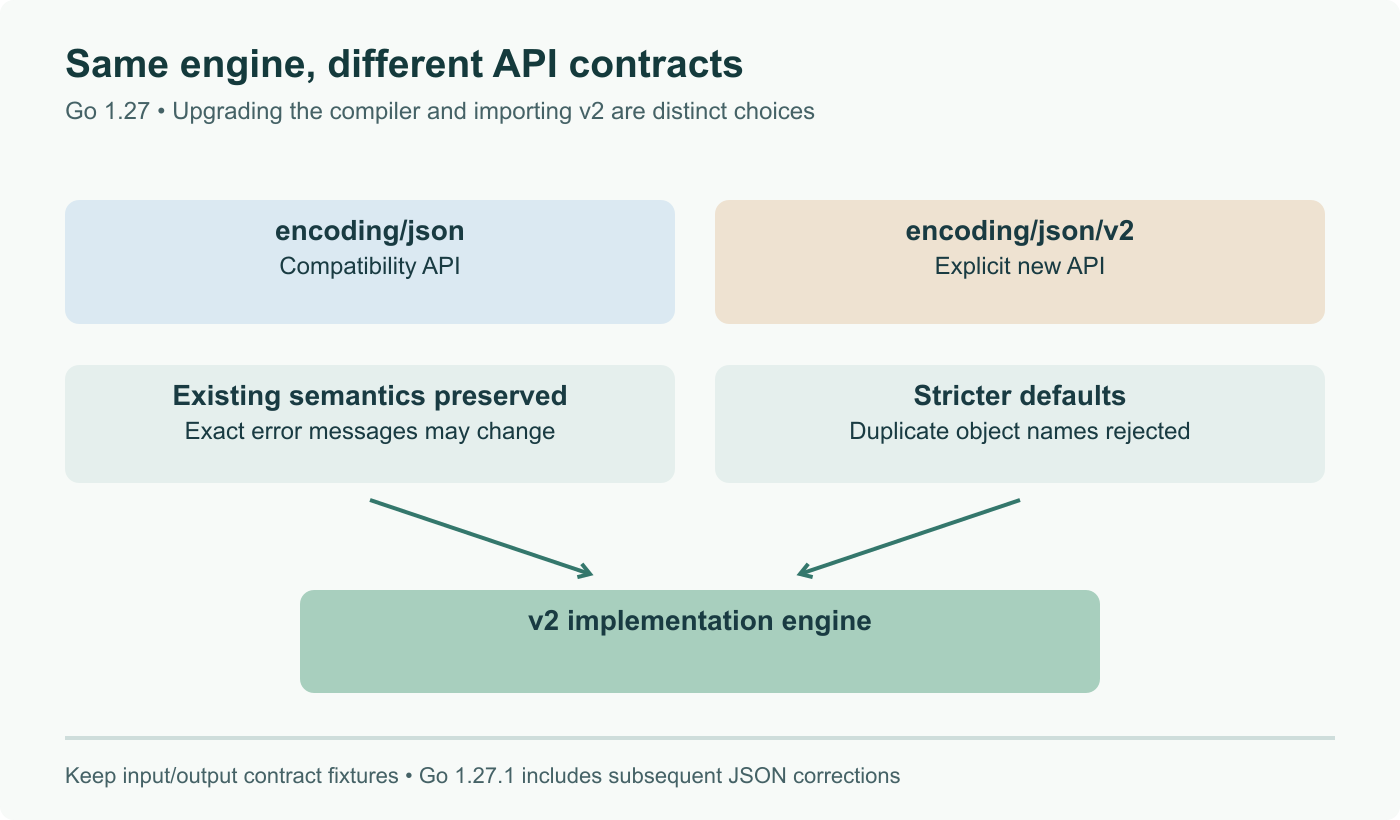
Go 1.27 was released on Wednesday, August nineteenth, 2026, and the headline feature is generic methods, but the change most likely to reach your build is the one nobody announces loudly. The existing encoding/json package is now implemented on top of the new encoding/json/v2 engine. Behaviour is preserved and the old API keeps working, so no migration is required, yet error messages can differ and unmarshalling gets significantly faster. Add size specialized allocation that cuts small allocation cost by around thirty percent, a uuid package in the standard library, and four new go fix modernizers, and this is a release worth reading before you bump the toolchain.
The short answer
Go 1.27 shipped on Wednesday, August nineteenth, 2026. Methods can now declare their own type parameters, struct literals accept any valid field selector, and the standard library gained uuid, encoding/json/v2 and encoding/json/jsontext. The existing encoding/json package is now backed by the v2 implementation with behaviour preserved, though error messages may differ. Size specialized allocation cuts small allocation cost by up to thirty percent for about sixty kilobytes of extra binary.
Read the Go 1.27 announcement quickly and you come away thinking the release is about generic methods. Read the release notes properly and you find a standard library package quietly rebuilt underneath an API that millions of lines of code already import.
The JSON engine changed, the import path did not
Go 1.27 adds two packages. The first is encoding/json/v2, a major revision offering Marshal, MarshalWrite, MarshalEncode, Unmarshal, UnmarshalRead and UnmarshalDecode, all taking variadic Options arguments so behaviour is configurable rather than fixed. The second is encoding/json/jsontext, which handles the syntactic layer with Encoder, Decoder, Token and Value types for people who want to stream JSON without building Go values at all.
Then comes the part that matters to everyone else. The existing encoding/json package is now implemented on top of v2. You do not change an import, you do not change a struct tag, and the release notes state plainly that the v1 API continues to be supported and that migration is not required.
Behaviour is preserved. Error messages may differ.
That second sentence is the whole upgrade risk in five words. Go codebases match on error text more often than anyone admits, usually in tests, occasionally in a handler that tries to tell a client which field was malformed. Those are the places to grep before you bump the toolchain, not the marshalling code itself.
The performance shape is worth knowing too. Marshal is at parity with the old implementation. Unmarshal is significantly faster. Most services parse more JSON than they emit, so the win lands where the load usually is.
Where the strictness lives
The v2 package picks stricter and more interoperable defaults than v1. It rejects invalid UTF-8 inside JSON strings and it rejects duplicate names within a JSON object. Both are things v1 accepts, and both are things a well behaved producer should never emit.
The important detail is that these defaults belong to v2, not to the v1 shim. Keep importing encoding/json and you keep v1 semantics on a v2 engine. Change your import to encoding/json/v2 and you take the stricter behaviour with it.
That makes the migration path pleasantly boring. You can upgrade the toolchain across a fleet without touching JSON semantics, then move services to v2 one at a time when you are ready to find out which upstream has been sending you duplicate object keys for years.
If something does go wrong, building with GOEXPERIMENT=nojsonv2 restores the original v1 implementation. The notes say the flag is expected to be removed in a future release, so it buys you a deploy window rather than a permanent opt out.
Generic methods, and the smaller language changes
Methods can now declare their own type parameters. The standard library example is math/rand/v2, where N was previously only available as a package level function and is now also a method on Rand. Interface methods are excluded, since they cannot declare type parameters, which keeps method sets tractable and avoids the class of problems that kept generic methods out of Go 1.18 in the first place.
Two quieter changes will show up in ordinary code faster than that one will. Struct literals now accept any valid field selector for the struct type, so you can initialise a nested or embedded field directly instead of writing the intermediate literal by hand. And function type inference now applies in all assignment contexts, including composite literals, conversions and channel sends, which removes another set of places where you had to spell out a type argument the compiler could clearly work out.
The generics story here is incremental rather than dramatic, which is consistent with the direction of travel. We looked at the same pattern when the standard library proposal for sets and ordered maps surfaced for a later release.
Allocation, and the one percent that matters at scale
The compiler now generates size specialized memory allocation routines. The measured effect is up to a thirty percent reduction in the cost of small allocations, defined as under eighty bytes, which the release notes convert into an expected improvement of roughly one percent for allocation heavy programs.
One percent sounds like nothing. Read it as one percent off the compute bill of every Go service you run, achieved by recompiling, and it reads differently. The cost is about sixty kilobytes of additional binary size, and the notes are clear that this is independent of workload, so it is sixty kilobytes whether you are shipping a control plane or a sidecar. GOEXPERIMENT=nosizespecializedmalloc opts out and is expected to be removed in Go 1.28.
Alongside it, the goroutine leak profile in runtime/pprof is now generally available after being experimental in Go 1.26. If you have ever chased a slow leak in a long running service and given up because the tooling was not ready, it is ready now. The asynctimerchan GODEBUG setting has been permanently removed.
The rest of the standard library
A uuid package now lives in the standard library, which retires one of the most common single purpose dependencies in Go projects.
The crypto/mldsa package implements ML-DSA, the signature scheme standardised as FIPS 204. Having a post quantum signature primitive in the standard library rather than in a third party module is the kind of change that only matters on the day you need it, and then matters a great deal.
The experimental simd package arrives with portable, vector size agnostic types such as Int8s and Float32s, available on all architectures and gated behind GOEXPERIMENT=simd at build time. The architecture specific simd/archsimd continues from Go 1.26 with revised amd64 APIs, new arm64 Neon support at 128 bits and new WebAssembly support at 128 bits. Vectors of 256 and 512 bits remain limited to selected amd64 processors. Neither package has a stable API yet.
Testing gained net/http/httptest.NewTestServer, which builds an in memory fake network rather than binding a real port. Anyone who has watched a CI runner fail because two parallel test packages both wanted an ephemeral port will understand the appeal.
What to do this week
Upgrade a non critical service first and read its error output rather than its latency graph. The JSON engine swap is designed to be invisible, and it usually will be, but the one documented difference is the exact place your tests are most likely to be strict.
Then grep for error string matching around JSON decoding across the codebase. That single search covers most of the realistic upgrade risk in this release.
After that, the wins are free. Recompile everything for the allocator change, drop your uuid dependency, and keep GOEXPERIMENT=nojsonv2 written down somewhere as the thing you reach for at three in the morning rather than the thing you add to the Dockerfile today.
Sources and further reading
- Go 1.27 is released, The Go Blog, August 19, 2026
- Go 1.27 Release Notes, go.dev
- Go Language 1.27 Adds Generic Methods, Struct Improvement and More SIMD, Phoronix, August 2026
- Go 1.27 Released with Generic Methods, JSON v2, and Faster Memory Allocation, Linuxiac, August 2026
Frequently asked questions
Do I have to migrate to encoding/json/v2?
No, and that is the point of how it shipped. The v1 API at encoding/json continues to be supported and the release notes are explicit that users are not required to migrate. What changed is the implementation underneath: encoding/json is now backed by the v2 engine. Behaviour is preserved, so your struct tags, your custom marshallers and your round trips keep doing what they did. The one caveat worth writing on a sticky note is that error messages may differ. If any test or any runtime code path matches on the text of a JSON error rather than on its type, that is where a silent upgrade turns into a failing build.
What is actually stricter in v2, and does that strictness reach v1?
The v2 package chooses stricter and more interoperable defaults than v1. It rejects invalid UTF-8 inside JSON strings and it rejects duplicate names within a JSON object, both of which v1 tolerates. Those defaults apply when you import encoding/json/v2 directly, not when you keep using encoding/json, which retains its own semantics. So the strictness is opt in. That matters if you consume JSON from systems you do not control, because a payload that quietly worked for years can start returning an error the day you switch the import path. Switch one service, watch it, then move the next.
What is the escape hatch if the new engine causes trouble?
Build with GOEXPERIMENT=nojsonv2 and the toolchain restores the original v1 implementation. It is deliberately temporary: the release notes say the flag is expected to be removed in a future release, so treat it as a way to unblock a deploy while you find the real cause, not as a permanent setting in your build pipeline. The same pattern applies to the allocator change, where GOEXPERIMENT=nosizespecializedmalloc opts out and is expected to disappear in Go 1.28. Both flags exist because the Go team expects a small number of programs to notice, not because they expect trouble at scale.
How much faster is Go 1.27 in practice?
Two separate numbers, and neither is a headline multiplier. On JSON, marshal performance is at parity with v1 while unmarshal performance is significantly faster, which suits the common case where a service parses far more JSON than it produces. On allocation, the compiler now generates size specialized memory allocation routines that cut the cost of small allocations under eighty bytes by up to thirty percent, which the notes translate to roughly one percent overall for allocation heavy programs. The tradeoff is about sixty kilobytes of extra binary size, independent of workload. One percent is real at fleet scale and invisible on a laptop benchmark.
What changed in the toolchain that I will notice day to day?
Four new go fix modernizers land: atomictypes, embedlit, slicesbackward and unsafefuncs. The fmtappendf modernizer was removed over stylistic concerns and waitgroup was renamed to waitgroupgo to remove ambiguity, so a CI job that pins modernizer names needs a look. Beyond go fix, go doc now accepts package and version queries, which means you can read the documentation for a version you have not vendored yet, and go mod tidy consolidates multiple require blocks into one. On macOS the linker gained two new options to set the versions recorded in the LC_BUILD_VERSION load command.