Google announced on August twenty first that Antigravity, its agentic coding platform, now runs as an extension inside Visual Studio Code, Visual Studio, the JetBrains suite and Zed, instead of requiring you to move a project into its own desktop application. The same announcement folds Antigravity into eligible Gemini Enterprise subscriptions, which is the part that will decide whether it gets deployed anywhere with a procurement process. Administrators get project level monthly budget caps, pooled token quotas across the organisation, optional overage billing, audit logging of prompts and agent responses, and policy controls over what the agent may touch.
The short answer
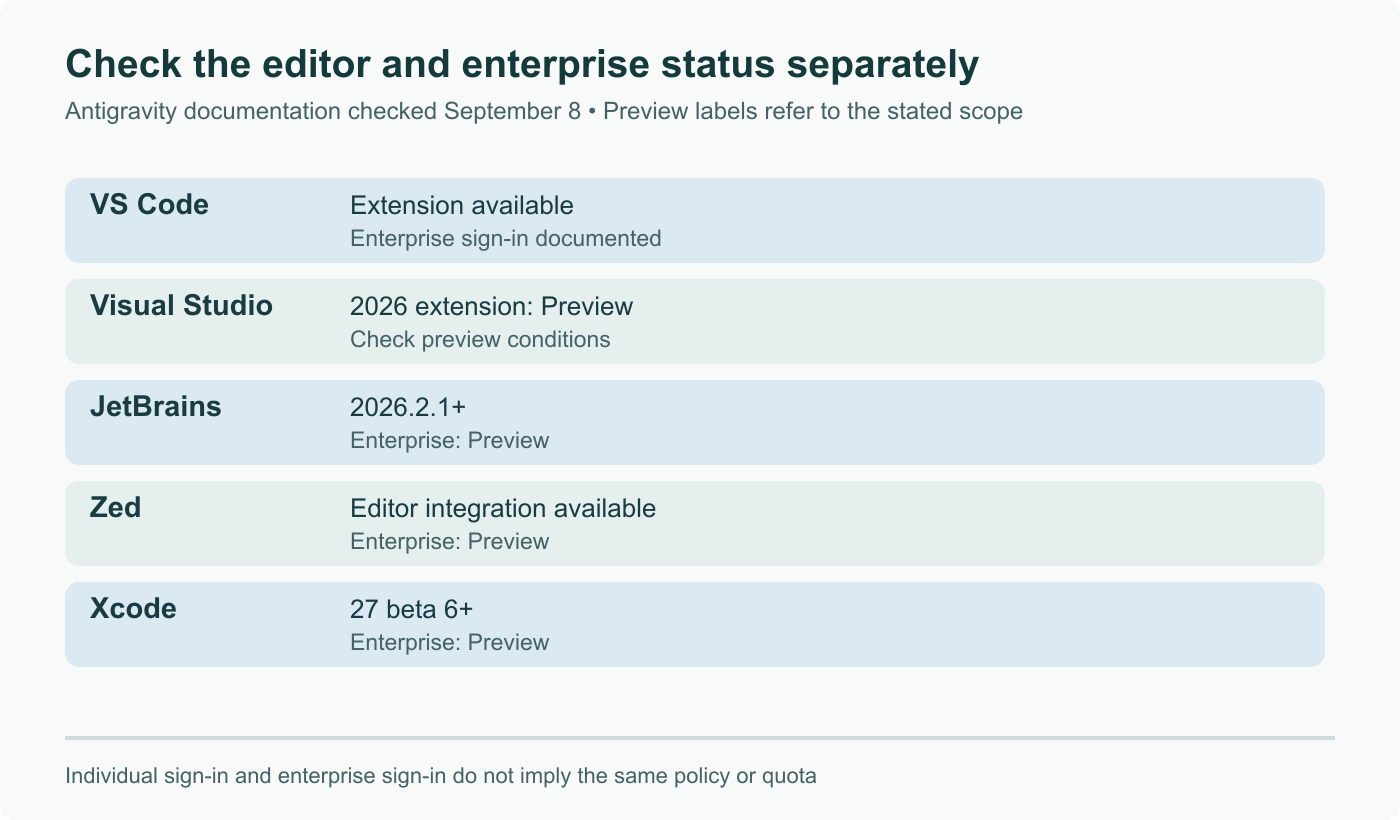
Google announced on Friday, August twenty first, 2026 that Antigravity now runs as an extension inside Visual Studio Code, Visual Studio, the JetBrains suite from version 2026.2.1 and Zed, alongside the existing desktop app and CLI. It also joins eligible Gemini Enterprise subscriptions, bringing project level budget caps, pooled token quotas, optional overages, audit logging of prompts and responses, and policy controls over file, terminal, browser and MCP server access.
Asking developers to change editor is one of the harder sells in this industry, and shipping an agent as its own IDE was always going to run into that. Google has stopped asking.
Where it runs now
Antigravity started inside DeepMind and has been available as the Antigravity 2.0 desktop app, an Antigravity CLI and an SDK. What it did not have was a way into the editor people already use.
That is what changed. The Visual Studio Code extension is generally available through Microsoft's marketplace on macOS, Linux and Windows. The JetBrains suite is supported from version 2026.2.1, which covers IntelliJ IDEA, PyCharm, WebStorm, GoLand, CLion and Rider, installable in one click from inside the IDE. Zed works the same way. The Visual Studio extension, aimed at Visual Studio 2026 and .NET solutions, is in preview and appears in the main toolbar.
Google is honest that these are lightweight integrations rather than a full port of the desktop experience. You get agent conversations in a side panel, inline diffs, plan inspection and multi agent orchestration, which the company frames around inspecting a specific code path, reviewing compiler diagnostics or making a localised change. Heavier work still lives in Antigravity 2.0.
That framing is the right one. The value of an extension is not that it matches the standalone app, it is that the friction of getting an agent to look at your actual repository drops to zero.
The controls are the actual announcement
Google says enterprise customers asked for two things after Antigravity appeared in the Gemini Enterprise Agent Platform in May: more security, compliance and governance controls, and availability in familiar tools. The extensions answer the second. The Gemini Enterprise integration answers the first, and it is the half that determines whether this tool gets past a security review.
On cost, the controls are unusually concrete for an AI product:
- monthly budget caps set per Google Cloud project in the billing console, with per user and per team controls arriving later in 2026
- pooled token quotas across the organisation, so unused allocation from light users covers heavy ones instead of expiring
- optional overages, which move consumption past the cap onto standard rates rather than stopping work mid task
- dashboards covering token usage, API calls and developer activity
Anyone who has watched a team hit a hard quota ceiling at four in the afternoon will recognise why the overage toggle exists, and anyone who has explained a surprise cloud bill will recognise why it is a toggle rather than a default.
What the agent is allowed to touch
The behavioural policies are where this stops being a billing story and starts being an agent security story, and they are set centrally rather than per developer.
File access can be configured to deny everything outside the agent's working folders. Terminal command execution has three settings: always ask before running, run in a sandbox, or always proceed. Browser access can be granted, denied, or limited to specific websites. MCP server access can be restricted, which matters because MCP is how agents reach the rest of your infrastructure and is the least examined part of most current setups.
Read those four together and they describe a reasonable default posture: an agent confined to the working tree, asking before it runs anything, with a named list of sites it may read and a named list of servers it may call. Most teams running agents today have none of that, not because they decided against it but because nobody offered them a console with the switches in it.
The audit log deserves a conversation
Audit logging is a single toggle, and it captures prompts, agent responses and related metadata for compliance reporting.
For a regulated environment that is exactly what you need, and its absence is the usual reason these tools get blocked. It is also worth stating plainly what the log contains. Developer prompts are candid in a way that code review comments are not, because people describe what they do not understand, what they suspect is broken, and what they are trying to avoid touching. A complete record of that is now something your organisation holds and may be obliged to produce.
That is not an argument against enabling it. It is an argument for deciding who can read it, how long it is kept and under what circumstances it is queried, before it starts filling up rather than after.
The context around it
The announcement arrives during a visible reshuffle at Google. Chief scientist Jeff Dean and three colleagues left earlier this month, DeepMind's Demis Hassabis has moved into a chairman role with Koray Kavukcuoglu taking over as an SVP rather than as chief executive, and Gemini 3.5 Pro remains unreleased while Gemini 3.6 Flash and 3.7 Flash have both shipped. Sundar Pichai has acknowledged publicly that there are areas where the company needs to improve.
None of that changes what the extensions do. It does explain the shape of the move: this is a distribution and governance release rather than a capability release, aimed at the buyers who were never going to adopt a separate IDE, and it is a sensible thing to ship while the model roadmap catches up.
Worth trying if
You already run JetBrains or VS Code and have been evaluating agentic tools without wanting to standardise your team on a new editor. Install the extension, point it at a real repository, and set terminal execution to always ask for the first week. If you are on Gemini Enterprise, the budget cap and the file access policy are worth configuring before the first developer opens it, because both are much easier to set as a starting position than to introduce later.
Sources and further reading
- Expanding Google Antigravity for enterprise customers, Google Cloud Blog, August 21, 2026
- Introducing IDE Extensions, Google Antigravity Blog
- Google tethers Antigravity to enterprise controls amid AI shakeup, The Register, August 21, 2026
- Google's AI coding agent just escaped its own IDE, The New Stack
Frequently asked questions
Which editors can run Antigravity now?
Visual Studio Code, through Microsoft's extension marketplace on macOS, Linux and Windows, is generally available. The JetBrains suite is supported from version 2026.2.1, covering IntelliJ IDEA, PyCharm, WebStorm, GoLand, CLion and Rider among others, with one click installation from inside the IDE, and Zed is supported the same way. The Visual Studio extension, aimed at Visual Studio 2026 and .NET solutions, is in preview. The Antigravity 2.0 desktop application and the Antigravity CLI both continue as before.
Do the extensions do everything the desktop app does?
Google describes them as lightweight integrations rather than a full port. They give you agent conversations in a side panel, inline diffs, plan inspection and multi agent orchestration without leaving the editor, which covers inspecting a specific code path, reading compiler diagnostics or making a localised change. The heavier multi agent work still belongs to Antigravity 2.0. The point of the extensions is that you no longer have to relocate a project to get an agent to look at it.
Which Gemini Enterprise plans include it?
Gemini Enterprise Standard, Gemini Enterprise Plus and Gemini Enterprise Standard Emerging Market are eligible today, and Google says broader support is coming without naming the plans. Individual developers can still sign in with a Google account. Enterprise teams authenticate through Gemini Enterprise or Google Cloud credentials, with Workforce Identity Federation and Application Default Credentials supported, and those deployments run under the Google Cloud Terms of Service.
What can an administrator actually control?
Spending and behaviour, from one console. On cost there are monthly project level budget caps in the billing console, pooled token quotas so unused allocation does not sit idle in one team while another runs out, optional overages that fall back to consumption pricing instead of cutting developers off, and dashboards for token usage and API calls. On behaviour there are policies for workspace and file access, including denying everything outside the agent working folders, terminal execution set to always ask, sandboxed or always allow, browser access limited to specific sites, and MCP server access restrictions. Per user and per team controls are due later in 2026.
What does the audit logging capture?
Audit logging is a single toggle in the admin console and captures prompts, agent responses and the associated metadata for compliance reporting. That is a genuinely useful control for regulated environments, and it is also worth reading as a policy question rather than a feature: developer prompts are unusually candid, and a log of everything your engineers asked an agent is a record your organisation now holds. Decide who can read it before you switch it on, not after.