Google says its Gemma family of open models has passed one billion cumulative downloads, announced on Thursday, August twentieth, 2026 by DeepMind vice president Clement Farabet and product director Olivier Lacombe. Developers have published more than one hundred thousand variants on the open weights in the two years since the first release, an ecosystem Google calls the Gemmaverse. The figure carries a caveat worth knowing: a Google developer relations engineer confirmed it excludes Gemma running inside Android and Chrome, so real deployment is higher than the headline. For scale, Alibaba claimed three billion Qwen downloads five days earlier. Google also opened an Awesome Gemma repository as the official community directory.
The short answer
Google announced on Thursday, August twentieth, 2026 that its Gemma open weight models have passed one billion cumulative downloads, with more than one hundred thousand community variants published in two years. The total excludes Gemma running inside Android and Chrome, so actual deployment is higher. Alibaba claimed three billion Qwen downloads five days earlier. Google launched an Awesome Gemma repository as the official community directory.
Round number announcements are usually the least interesting part of a model family's story. This one is worth a few minutes anyway, because of what Google chose not to count and what a competitor published five days earlier.
What the number is, and what it is not
Clement Farabet, a vice president at Google DeepMind, and product director Olivier Lacombe published the total on August 20. It is cumulative across the whole family since Gemma launched in early 2024, and it is the first time Google has put a figure on adoption at all.
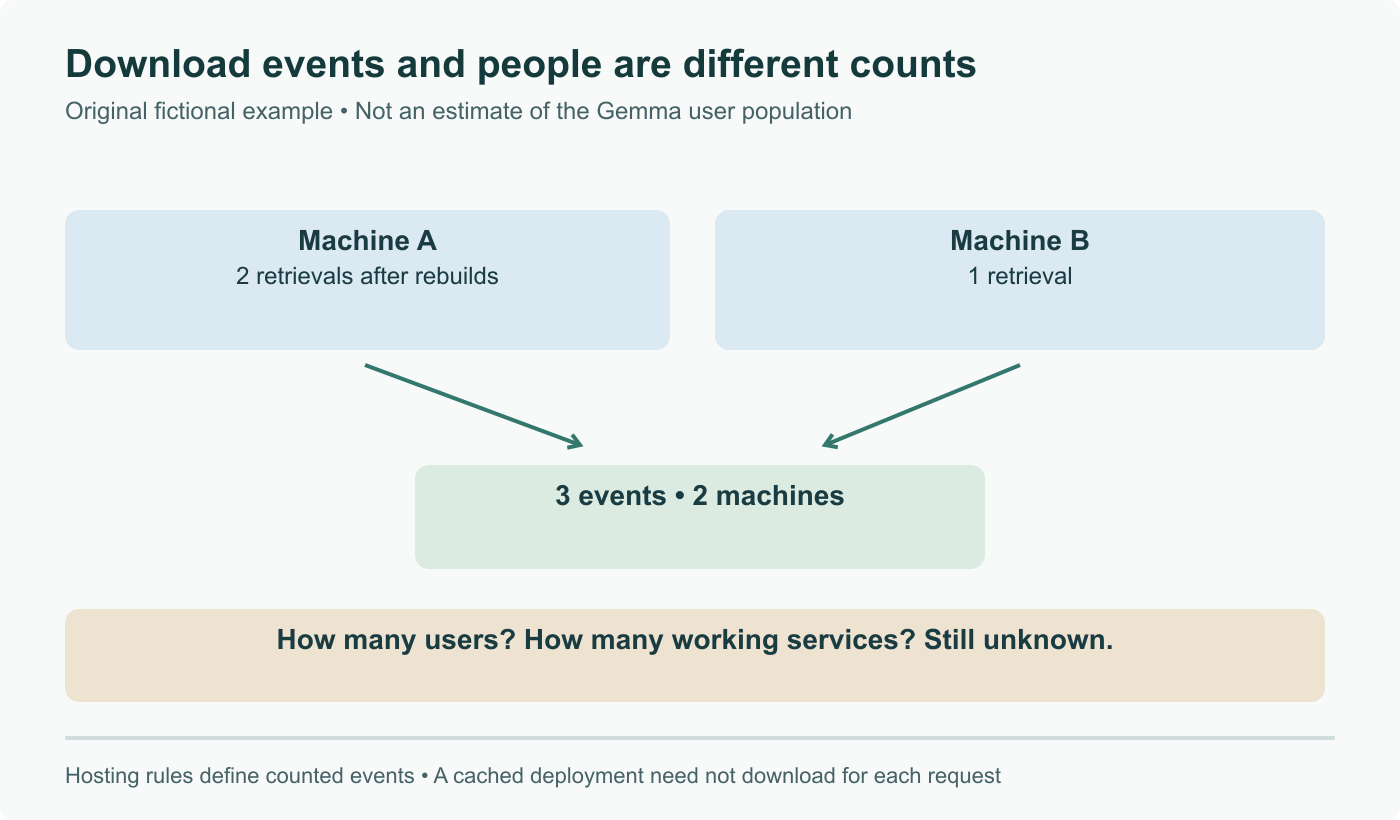
What Google did not publish is nearly as informative. There is no split by model size, no split by generation, no breakdown by hosting platform, and no methodology for what counts as a download. That is normal for vendor adoption numbers and it is also why nobody should treat the figure as a device count. A download is a pull of a weight file. Continuous integration pipelines pull weights. Mirrors pull weights. So does anyone comparing three quantisations of the same checkpoint before picking one.
Then there is the caveat pointing the other way. A Google developer relations engineer confirmed the billion does not include Gemma shipped inside Android or Chrome. Those are the two largest distribution channels Google controls, which means the headline number reflects deliberate developer pulls from model hosts and nothing that arrives through a platform update.
The comparison Google did not make
Five days before this announcement, Alibaba claimed three billion Qwen downloads and more than three hundred thousand derivative models. Both counts are roughly three times Google's.
Neither number is audited, and the two companies are almost certainly counting different things across different platform mixes, so the ratio is not a measurement. What it does reflect is something visible to anyone who browses model hosting sites: Qwen derivatives dominate fine tune listings, and have for a while.
The more useful conclusion is not who is winning. It is that there are now at least two open weight families with ecosystems dense enough that the practical things you need arrive on their own: GGUF conversions, AWQ and GPTQ quantisations, llama.cpp support, vLLM configs and a dozen domain fine tunes, usually within days of a release. That is the difference between an open weight model you can evaluate and one you can actually run in production, and it is not something a benchmark score tells you.
Where the weights ended up
Google's list of deployments is more specific than these announcements usually are, and the interesting ones share a constraint.
NASA, Satlyt and Starcloud run Gemma on hardware in orbit. NASA's Jet Propulsion Laboratory put a four bit compressed Gemma 3 4B on a Loft Orbital satellite and reported 88 percent accuracy on an image classification benchmark. A satellite has a hard power budget, a hard thermal budget and a downlink that costs more than the compute, so classifying on board and sending results rather than raw imagery is the whole point. You cannot call an API from orbit at a sensible latency, and you cannot fit a frontier model in the mass budget.
India's National Health Authority built Gemma 4 into Aarogya Setu 2.0, an app with more than one hundred million Android downloads, converting medical reports into standardised digital records. MedGemma is in use at the All India Institute of Medical Sciences and with frontline health workers in rural Uganda. Yale researchers built C2S-Scale on Gemma for single cell data interpretation and reported a novel cancer therapy pathway. DolphinGemma, built with Georgia Tech and the Wild Dolphin Project, analyses dolphin vocalisations.
Strip out the press release framing and the pattern is consistent: these are places where sending data to a hosted API is impossible, prohibited, or too expensive. Orbital hardware, patient records under residency rules, field deployments without reliable connectivity. That is the durable argument for open weights, and it does not depend on the open model matching a frontier model on any leaderboard.
What this means if you are choosing a model
The adoption figure itself should not move your decision. What it usefully signals is ecosystem depth, and that is a real selection criterion that benchmark tables do not capture.
When we evaluate an open weight family for something that has to run on our own hardware, the questions that decide it are practical. Does llama.cpp support the architecture, or is there an open pull request that has been sitting for two months? Are there quantisations at the sizes that fit the GPU we actually have? Has anyone published a working vLLM configuration? Is there a domain fine tune close enough to the task to start from? A hundred thousand variants and three hundred thousand variants both answer yes to all of that. A family with two thousand variants often does not.
The other thing worth taking from this is the licence question, which Google did not address in the announcement and which you should check yourself before building on any of these weights. Open weights and open source are not the same thing, and the terms differ across families in ways that matter if you plan to redistribute a fine tune.
Sources and further reading
- Gemma passes 1 billion downloads, Google blog, August 20, 2026
- Google's Gemma Open Models Pass 1 Billion Downloads as Variants Top 100K, Unite.ai, August 20, 2026
- Gemma has passed a billion downloads, Google says, TNW, August 21, 2026
Frequently asked questions
What exactly did Google count to reach a billion?
Google published a cumulative download total across the whole Gemma family since the first release in early 2024, without breaking it down by model size, by generation, or by distribution platform. It has not published a counting methodology either, so a download means whatever a download means on Hugging Face, Kaggle, Ollama and the other places the weights live. That is worth holding lightly, because a download is not a deployment: continuous integration systems, mirrors and people trying three quantisations of the same model all add to the number.
Why does the Android and Chrome exclusion matter?
A Google developer relations engineer confirmed the billion figure does not include Gemma models shipped inside Android or Chrome. Those are the two largest software distribution channels Google owns, so the number understates how many devices actually run Gemma derived weights, possibly by a wide margin. It also tells you something about how the count was assembled: it reflects deliberate developer pulls from model hosts, not passive delivery through a platform update. If you are comparing this against another vendor's claimed total, that difference in what is being counted matters more than the totals do.
How does this compare with other open weight families?
Alibaba claimed three billion Qwen downloads five days before Google's announcement, alongside more than three hundred thousand derivative models. On the raw numbers Qwen is ahead on both counts. Neither company publishes an audited methodology, so treating the gap as precise would be a mistake, but the direction is consistent with what most people see on model hosting sites, where Qwen derivatives dominate the fine tune listings. The useful reading is that there are now at least two open weight families with ecosystems large enough that tooling, quantisations and community fine tunes appear within days of a release.
Where is Gemma actually being deployed?
Google named several production uses. NASA, Satlyt and Starcloud run Gemma on hardware in orbit, and NASA's Jet Propulsion Laboratory put a four bit compressed Gemma 3 4B on a Loft Orbital satellite, reporting 88 percent accuracy on an image classification benchmark. India's National Health Authority built Gemma 4 into Aarogya Setu 2.0, an app with more than one hundred million Android downloads, to turn medical reports into standardised digital records. MedGemma is deployed at the All India Institute of Medical Sciences and with frontline health workers in rural Uganda.
What is the Awesome Gemma repository?
It is a GitHub repository Google launched with the milestone announcement, positioned as the official directory for the Gemmaverse. It collects community projects, fine tunes, tutorials and tooling in one place rather than leaving people to find them through model host search. Practically it is the same pattern as any awesome list, with the difference that the vendor maintains it, which usually means entries stay current for longer than a community list does. Google also pointed at its Kaggle Gemma Challenge, which drew more than 1,600 project submissions.