SysadminNews

Groq Raises $350M at $3.5B, Half Its 2025 Valuation

On this page
  1. The deal that reshaped the company
  2. Attention on the GPU, feed forward on the LPU
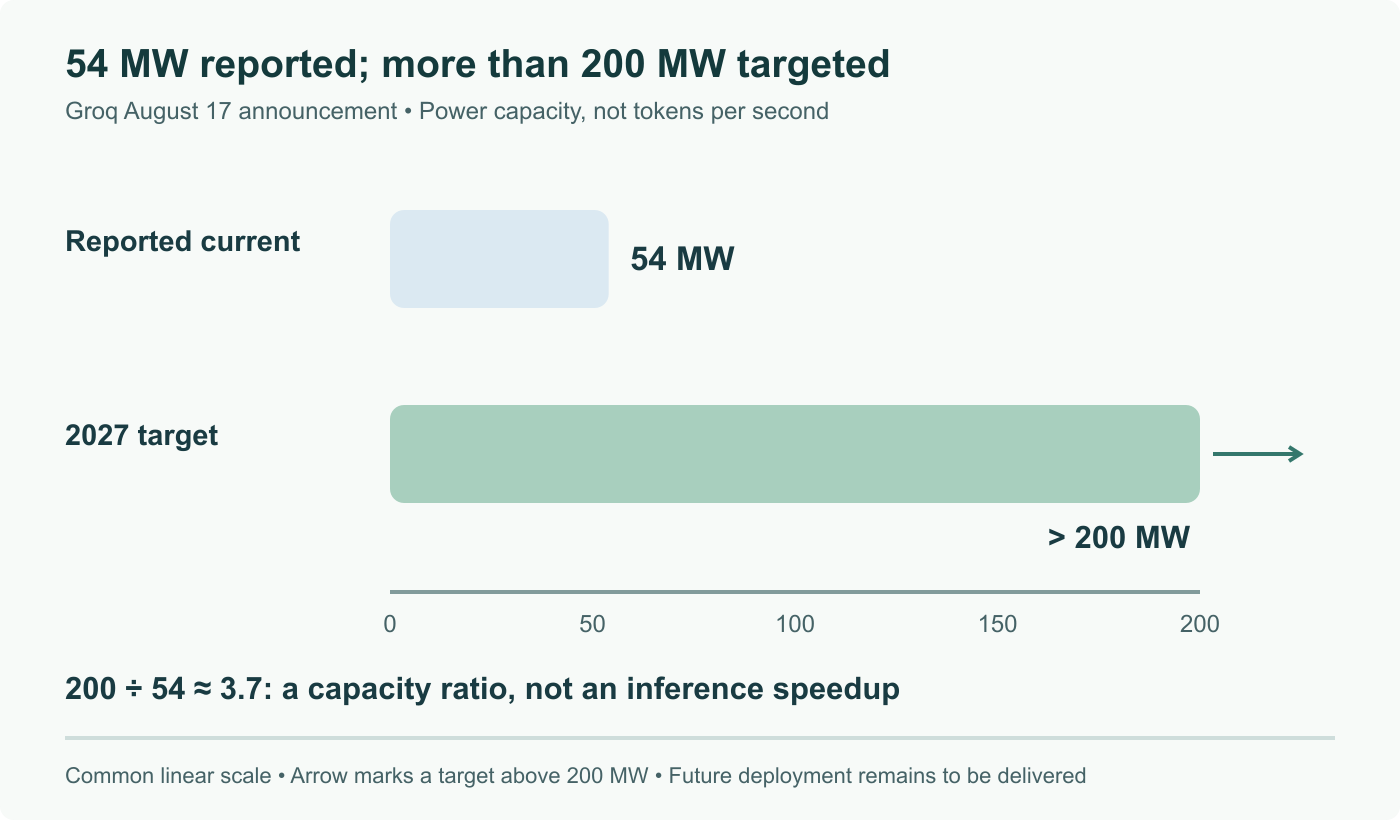
  3. Fifty four megawatts, and why the target is plausible
  4. What to do with this if you ship on GroqCloud
  5. Sources and further reading

Groq closed a three hundred fifty million dollar Series A on August seventeenth, 2026, at a three and a half billion dollar valuation, roughly half what the company was worth in September 2025. Disruptive led the round, with planned participation from Nvidia, the company that licensed Groq's LPU technology last December and hired away its founder and chief executive. For anyone actually running inference, the down round is not the interesting part. The interesting part is the architecture Groq now sells: attention on Nvidia GPUs, feed forward layers on LPUs, racks of two hundred fifty six accelerators, and thirteen datacenters that have to grow from about fifty four megawatts to over two hundred.

The short answer

Groq raised three hundred fifty million dollars in a Series A led by Disruptive, with planned participation from Nvidia. The valuation is roughly half the September 2025 mark, which is what happens when the company that licensed your chip design also hires your chip team. Groq now sells inference capacity rather than accelerators: thirteen datacenters, about fifty four megawatts installed, a target above two hundred megawatts during 2027, and a rack design that runs attention on Nvidia GPUs and feed forward layers on its own LPUs.

$350MSeries A, announced August 17, 2026
$3.5Bvaluation, down from $6.9B in September 2025
200+ MWcapacity target during 2027, from about 54 today
Answer card: Groq closed a 350 million dollar Series A on August 17, 2026 at a 3.5 billion dollar valuation, down from 6.9 billion in September 2025, led by Disruptive with planned participation from Nvidia, funding a build from about 54 megawatts across 13 datacenters toward more than 200 megawatts during 2027.
The round, the price, and the capacity plan the money is meant to pay for. PNG

There is a version of this story that is only about the valuation, and it is the less useful version. Groq raised three hundred fifty million dollars on Monday at three and a half billion, against six point nine billion less than a year ago, and the arithmetic on that is not subtle. What is worth an engineer's attention is what the company chose to become in the meantime.

The deal that reshaped the company

In December 2025, Nvidia signed a non exclusive licensing agreement for Groq's language processing unit technology, reported at twenty billion dollars, and hired co founder and chief executive Jonathan Ross, president Sunny Madra and other senior staff. Groq kept the money and the customers. Nvidia got the design and the people who understood it.

What was left had to become something, and what it became is a neocloud. Groq now runs thirteen datacenters across North America, Europe, the Middle East and Asia Pacific, serving more than six million developers, enterprises and AI native companies according to TechCrunch. It sells through GroqCloud, which exposes bare metal environments, and GroqStack, an automation toolkit for the infrastructure underneath. It does inference only, no training. This August round follows six hundred fifty million dollars raised in June 2026, which puts one billion dollars of fresh capital into the business inside roughly two months, and it lands in the same market where General Compute raised four hundred million for an inference neocloud and Etched took three hundred million for a fixed function inference chip.

Alex Davis, chairman and chief executive of Disruptive, framed the plan plainly in the coverage: building Groq into the world's leading AI inference cloud. That is a capacity ambition, not a silicon one.

Attention on the GPU, feed forward on the LPU

Here is the part that repays reading closely, because it is a real engineering position and not a press release adjective.

The Groq 3 LPU launched in March 2026 and, per SiliconANGLE, is designed to work alongside Nvidia's Rubin GPU rather than against it. A rack carries two hundred fifty six Groq 3 LPU accelerators. Attention related calculations route to the GPUs. The feed forward network modules run on the LPUs. That is disaggregated inference: instead of asking one accelerator to be adequate at every phase of a transformer forward pass, you route each phase to the part that suits it.

The split is defensible on first principles. Attention is memory bandwidth bound and its working set scales with context length, which is exactly what high bandwidth memory on a big GPU is built for. Feed forward layers are dense matrix work with a fixed, predictable shape, which is the case where a deterministic, statically scheduled architecture like an LPU has something to offer. The gains concentrate where the feed forward path dominates, which means mixture of experts models and speculative decoding, where a draft model proposes tokens and the target model verifies them in bulk. It is the same structural idea we saw in the AMD and Cerebras disaggregated inference work on Helios, arrived at from a different direction.

The uncomfortable corollary is that this is now a systems advantage rather than a hardware moat. Anyone can buy Rubin. The claim is that Groq schedules and partitions the work better, and that claim has to be re proven with every model architecture that ships.

Comparison chart of Groq figures: a 6.9 billion dollar September 2025 valuation against a 3.5 billion dollar valuation in August 2026, 650 million dollars raised in June 2026 and 350 million in August 2026, and 54 megawatts installed today against a target above 200 megawatts during 2027.
One billion dollars raised in two months, at half the price of a year ago, to roughly quadruple installed power. PNG

Fifty four megawatts, and why the target is plausible

Capacity is where the story stops being about finance. TechCrunch reports about fifty four megawatts installed today, SiliconANGLE says fifty seven, and both agree the target is more than two hundred megawatts during 2027. If you are used to reading datacenter announcements, a claim to roughly quadruple installed power in eighteen months should make you suspicious, because power is the constraint that has defeated better funded plans.

The detail that makes it credible is small and easy to miss: the new capital is described as accelerating the fit out of the existing footprint. Fit out means racks, power distribution, cooling connections and accelerators going into halls that already exist and already have their interconnection agreements. That is a supply chain and logistics problem measured in months. Greenfield capacity, by contrast, is a permitting and grid interconnection problem measured in years, which is why the buildouts we cover at the very large end, like the PORTS-Pike campus Nvidia guaranteed this week, do not deliver a watt before 2028.

Two hundred megawatts is also worth putting in proportion. It is a serious inference operator and it is roughly one fortieth of a single hyperscale AI campus of the kind now being financed. Groq is not competing on scale. It is competing on latency per dollar within a footprint it can actually fill.

What to do with this if you ship on GroqCloud

Nothing urgent. A financing round does not change an endpoint, and a billion dollars raised in two months reduces rather than raises the odds of disruption in your next planning cycle.

The one durable takeaway is about coupling. Groq's original pitch was hardware nobody else could obtain, which was a reason to accept provider specific integration. The current pitch is a scheduling and partitioning advantage on hardware that is broadly purchasable, which is a real advantage but a contestable one. Treat low latency inference the way you would treat any single source dependency in production: keep the provider boundary thin, keep the model and prompt contract portable, and make sure switching endpoints is a config change you have actually tested rather than one you assume works.

Sources and further reading

Frequently asked questions

How much did Groq raise, and why is the valuation lower than before?

Groq announced a three hundred fifty million dollar Series A on August seventeenth, 2026, at a three and a half billion dollar valuation. TechCrunch puts the September 2025 mark at six point nine billion dollars, so this is a down round of roughly half. The reason is that Groq is no longer the company investors priced in 2025. In December 2025 Nvidia signed a non exclusive licensing agreement for Groq's language processing unit technology, reported at twenty billion dollars, and hired co founder and chief executive Jonathan Ross along with president Sunny Madra and other staff. A chip company that licenses its chip design and loses its chip team is a different business, and the price reflects that.

What does Groq actually sell now?

Capacity, not silicon. Groq operates as an inference cloud across thirteen datacenters in North America, Europe, the Middle East and Asia Pacific, serving what TechCrunch reports as more than six million developers, enterprises and AI native companies. The commercial surface is GroqCloud, which offers bare metal environments, plus GroqStack, an infrastructure automation toolkit. The hardware inside is now a mix: Nvidia systems alongside Groq's own Groq 3 LPU, which debuted in March 2026. The company does not sell training capacity, only inference.

How do the LPU and the Nvidia GPU split the work?

This is the technically interesting piece, and it is a disaggregation story. In the design SiliconANGLE describes, a rack holds two hundred fifty six Groq 3 LPU accelerators working alongside Nvidia Rubin GPUs. Attention related calculations route to the GPUs. The feed forward network modules of the model run on the LPUs. Those two parts of a transformer have genuinely different memory and compute profiles, so putting each on the silicon that suits it is a rational split rather than marketing. It pays off most on mixture of experts architectures and on speculative decoding, where the accept and reject loop hammers the feed forward path.

What are the capacity numbers, and are they consistent?

Not exactly, and it is worth knowing which figure you are reading. TechCrunch reports about fifty four megawatts of current capacity, SiliconANGLE reports fifty seven. The two agree on the target, which is more than two hundred megawatts during 2027. So the plan is to roughly quadruple installed power in about eighteen months. Note that the new money is described as accelerating the fit out of the existing footprint, meaning the buildings and the power contracts are largely already there, and what is being bought is the equipment that goes into them. That is a faster path than greenfield construction, and it is the main reason the 2027 date is credible at all.

Should this change anything for a team already using Groq for inference?

Not operationally, not today. Endpoints, models and pricing are unaffected by a financing event, and one billion dollars raised across June and August 2026 makes near term continuity more likely, not less. The thing worth tracking is architectural rather than financial. Groq's differentiator used to be that it ran on hardware nobody else had. Its differentiator now is a scheduling and disaggregation approach layered on hardware that its main competitors can also buy. If low latency inference is load bearing in your product, keep your provider abstraction thin enough that swapping the endpoint stays a configuration change and not a rewrite.