NetworkNews

Huawei and HP Settle Wi-Fi Patents, Wi-Fi 7 Included

On this page
  1. What was signed
  2. How it got here
  3. Why there is never an engineering answer
  4. What Huawei gets out of this
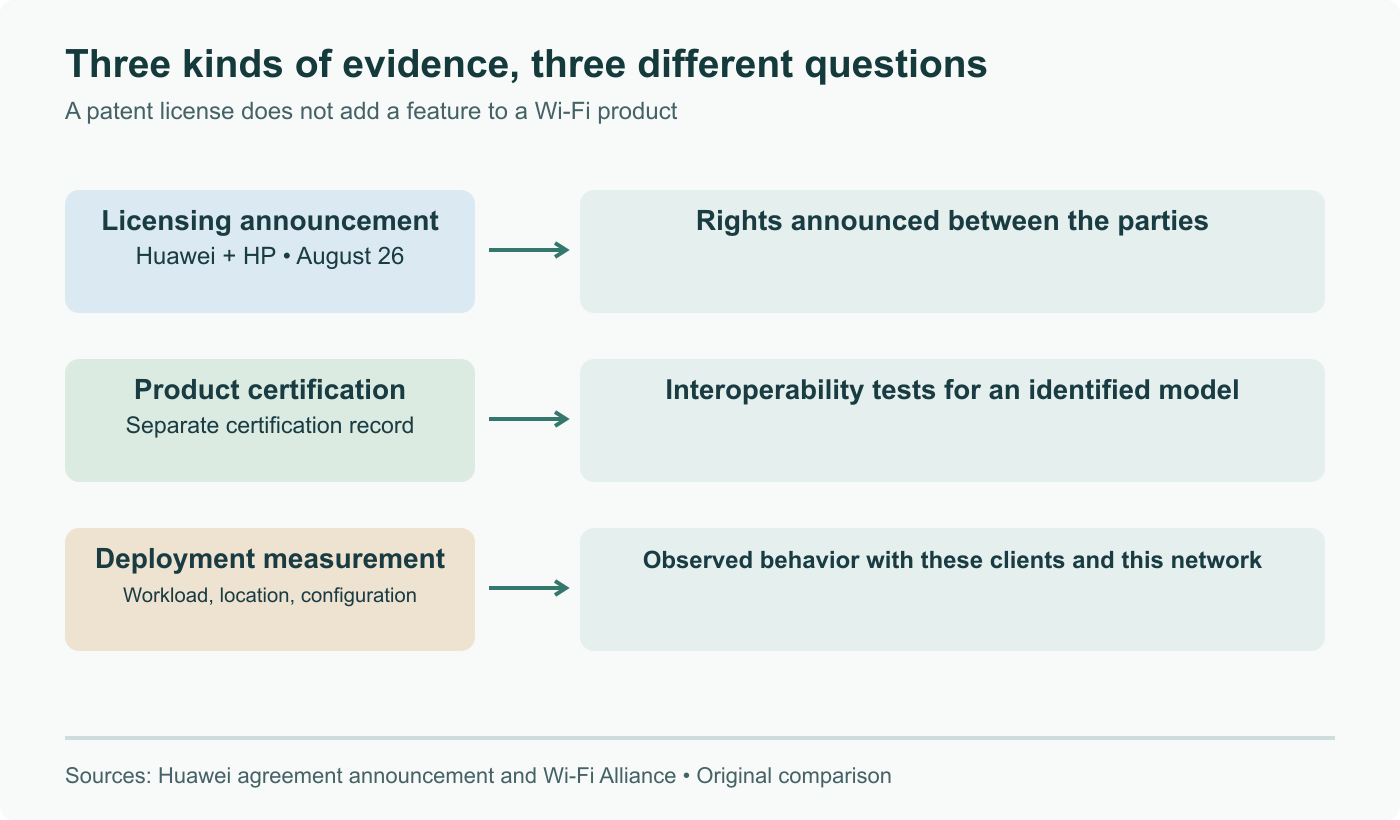
  5. Does any of this reach your network
  6. Sources and further reading

Huawei and HP announced a multiyear global patent cross-licensing agreement on Wednesday August 26, 2026, closing a dispute that began when Huawei sued HP at Europe's Unified Patent Court in August 2025 over a Wi-Fi 6 patent. The deal licenses HP to use a broad range of Huawei Wi-Fi patents, Wi-Fi 7 among them, and gives Huawei reciprocal rights to HP patents. HP pays a balancing fee whose size neither company disclosed. This is not a product announcement and nothing on your network changes because of it, but it is a clear look at the machinery underneath every access point and laptop you buy, and at how much of the cost of a wireless standard is licensing rather than silicon.

The short answer

Huawei and HP signed a multiyear global patent cross-licensing agreement announced on August 26, 2026. It licenses HP to use a broad set of Huawei Wi-Fi patents including Wi-Fi 7, grants Huawei reciprocal rights to HP patents, and involves a balancing fee from HP whose amount was not disclosed. It closes a case Huawei filed at the Unified Patent Court in August 2025 over a Wi-Fi 6 patent.

Aug 26the day the cross-licence was announced
$630MHuawei patent licensing revenue in 2024
1.6bndevices using Huawei Wi-Fi tech by end of 2025
Answer card summarising the Huawei and HP patent agreement: a multiyear global cross-licensing deal announced August 26 2026 covering Wi-Fi 6 and Wi-Fi 7 patents, with HP paying an undisclosed balancing fee and granting Huawei reciprocal rights, ending a Unified Patent Court case filed in August 2025.
The Huawei and HP agreement, the short version. PNG

Nobody specifying access points thinks about patent pools, and that is mostly correct. It is worth thinking about once, though, because the reason Wi-Fi works identically across vendors is the same reason these agreements exist.

What was signed

The agreement is a multiyear global patent cross-licence. HP gets rights to a broad range of Huawei Wi-Fi patents, with Huawei saying the coverage includes Wi-Fi 7. Huawei gets reciprocal rights to HP patents. HP pays a balancing fee, and neither company published the figure.

Alan Fan, Huawei's Chief Intellectual Property Officer, framed it as a testament to the company's independent innovation, which is the expected register for this kind of announcement and not especially informative.

The mechanics are more interesting than the wording. A balancing fee exists because a cross-licence between unequal portfolios needs something to settle the difference. HP paying Huawei tells you which direction the imbalance runs in wireless, without either side having to say so.

How it got here

Checklist card showing the timeline of the Huawei and HP Wi-Fi patent dispute: Huawei files at the Unified Patent Court in August 2025 over a Wi-Fi 6 patent, HP joins the Sisvel Wi-Fi 6 patent pool in November 2025 resolving claims from Huawei and Philips, and a multiyear global cross-licence covering Wi-Fi 6 and Wi-Fi 7 is announced in August 2026 with an undisclosed balancing fee.
Twelve months from filing to cross-licence. PNG

In August 2025, Huawei filed against HP at the Unified Patent Court, claiming HP had used a Wi-Fi 6 patent without a licence.

The venue matters more than the claim. The Unified Patent Court opened in 2023 and rules for most of the European Union at once, so one decision reaches many markets rather than requiring separate national cases. For a patent holder that concentrates leverage enormously. For a defendant it means the downside of losing a single case is now large enough to change the calculation, which is why cases there tend to end in agreements.

In November 2025, HP joined the Sisvel Wi-Fi 6 patent pool, which resolved claims from both Huawei and Philips. A pool is a licensing clearing house: contributors put their standard essential patents in, implementers take one licence covering all of them, and everyone avoids negotiating pairwise. That handled Wi-Fi 6.

This week's agreement goes further than the pool did, extending to Wi-Fi 7 and running bilaterally between the two companies.

Why there is never an engineering answer

The thing worth internalising is why disputes like this end in payments rather than redesigns.

A standard essential patent covers something you cannot avoid while implementing the standard. If the specification says a conforming device behaves a certain way, and that behaviour is patented, every conforming device infringes. There is no design around, because the only alternative is not implementing the standard, and a radio that does not implement Wi-Fi 7 cannot be sold as Wi-Fi 7.

Standards bodies handle this by asking contributors to commit to licensing on fair, reasonable and non discriminatory terms. That commitment prevents a contributor from blocking the standard outright. It does not settle what the price is, which is what the last twenty years of telecommunications litigation have largely been about.

What Huawei gets out of this

Patent licensing brought Huawei roughly $630 million in 2024. Against total company revenue that is a rounding error, and reading the portfolio as a revenue business misses the point.

By the end of 2025 Huawei had signed more than 260 patent licence agreements with information and communications technology manufacturers across multiple regions, 34 of them during 2025. It says its Wi-Fi technology was in use in more than 1.6 billion consumer electronic devices, excluding mobile phones.

The value of that portfolio is mostly as currency. A company with a deep set of standard essential patents in a technology everybody ships can trade access to it, which is exactly what happened here: HP needed Wi-Fi rights, Huawei wanted HP rights plus a fee, and both walked away with something.

Does any of this reach your network

Not in a way you will observe. Licensing costs are already inside the price of every wireless device you own, folded into chipset costs or product margin, and settlements replace an unpredictable litigation risk with a predictable one. There is nothing to change in a procurement plan.

The one genuinely useful takeaway is about supply risk. Unresolved standard essential patent claims in a jurisdiction that grants injunctions are the scenario that pulls products from shelves, and that scenario is what just got closed for HP in Europe. Resolved licensing is the boring state, and boring is what you want underneath your hardware roadmap. If you are choosing wireless equipment on technical merit, our Wi-Fi router comparison is a better use of an afternoon, and on the driver side we looked at nine patches that cut ath11k latency sharply.

Sources and further reading

Frequently asked questions

What is a balancing fee in a cross-licensing agreement?

It is the payment that settles the difference in value between two patent portfolios. In a pure cross-license, each side grants the other rights to its patents and no money changes hands, which works when the portfolios are roughly comparable. When one side brings substantially more relevant patents to the table, the other pays a balancing fee to make up the gap. Here HP pays Huawei, which tells you the direction of the imbalance in Wi-Fi specifically, even though neither company published the amount. The structure is common in telecommunications precisely because almost every large manufacturer holds some patents the others need, so a straight one way licence is rarely the honest description of the relationship.

What is a standard essential patent and why can nobody design around one?

A standard essential patent covers a technique you cannot avoid if you implement the standard as written. If the Wi-Fi 7 specification says a device shall behave a certain way, and that behaviour is patented, then every conforming device infringes by definition. There is no clever engineering path around it, because the alternative is not implementing the standard, and a device that does not implement Wi-Fi 7 cannot be sold as Wi-Fi 7. This is why standards bodies ask contributors to commit to licensing on fair, reasonable and non discriminatory terms. It is also why disputes end in licensing agreements rather than redesigns: there is nothing to redesign.

Does this affect the price or availability of the hardware we buy?

Not visibly, and not in a way you can trace. Licensing costs are already inside the price of every wireless device you have ever bought, bundled into the chipset cost or the finished product margin, and a settlement like this replaces litigation risk with a predictable line item rather than adding a new one. If anything, resolved licensing is the calmer state for a supply chain, because an unresolved standard essential patent claim in a jurisdiction that grants injunctions is the scenario that actually removes products from shelves. Nothing about your procurement changes on the strength of this announcement.

What was the Unified Patent Court case about?

Huawei filed against HP at the Unified Patent Court in August 2025, claiming HP had used a Wi-Fi 6 patent without a licence. The venue is the notable part. The Unified Patent Court opened in 2023 and hears cases covering most of the European Union at once, so a single ruling can reach many markets instead of requiring a country by country campaign. That concentration of leverage has made it a favoured venue for patent holders since it opened, and it changes the arithmetic for defendants: the cost of losing once is much larger than it used to be, which tends to move disputes toward settlement faster.

How large is Huawei licensing as a business?

Meaningful but not transformative at Huawei's scale. Patent licensing brought in roughly $630 million in 2024. By the end of 2025 the company had signed more than 260 patent licence agreements with information and communications technology manufacturers across several regions, 34 of them during 2025 alone, and said its Wi-Fi technology was in use in over 1.6 billion consumer electronic devices excluding mobile phones. The strategic value exceeds the revenue line: a large portfolio of standard essential patents is mainly useful as something to trade, which is exactly what a cross-licence like this one does.