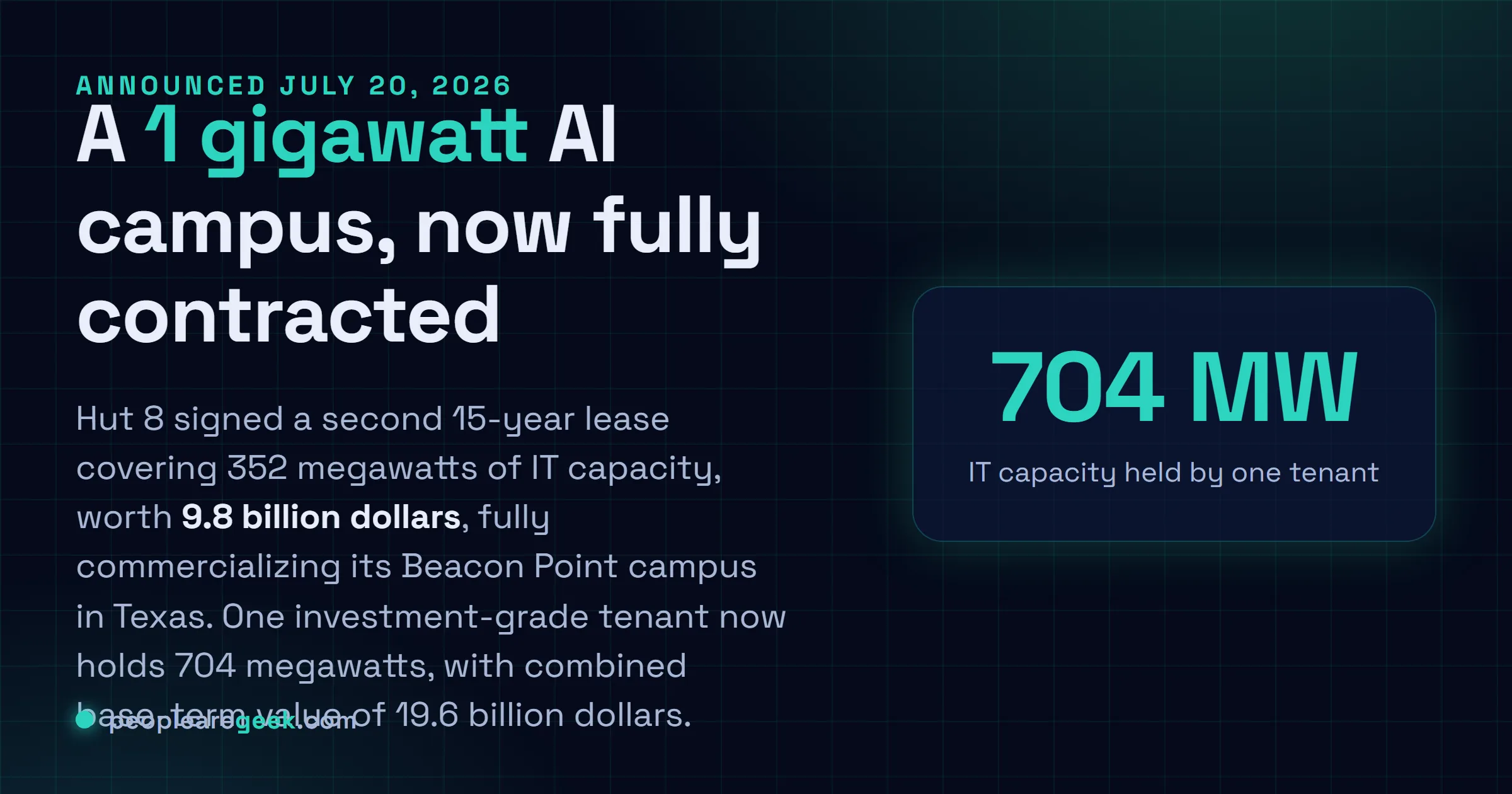
Hut 8 signed a second lease at its Beacon Point campus in Texas on Monday, July 20, 2026, and the deal finishes what the first one started. The new 15-year agreement covers 352 megawatts of IT capacity with a base-term value of 9.8 billion dollars, and it fully commercializes the roughly 1 gigawatt site. The tenant is the same investment-grade customer that took the first phase, which now holds 704 megawatts of contracted IT capacity at a single campus. Total base-term value across both leases reaches 19.6 billion dollars over 15 years, rising as high as 50.2 billion if renewal options are exercised. It is a clean look at the scale a single AI compute site now represents.
The short answer
Hut 8 signed a second 15-year lease at its Beacon Point campus in Texas on July 20, 2026, covering 352 megawatts of IT capacity with a base-term value of 9.8 billion dollars. The deal fully commercializes the roughly 1 gigawatt site. The same investment-grade tenant now holds 704 megawatts of contracted IT capacity, and the two leases together carry a base-term value of 19.6 billion dollars, up to 50.2 billion if renewals are exercised. First Phase 2 delivery is expected in the second quarter of 2028.
Most of the AI story is told in model names, but the part that actually decides who can train what is a lot more physical. It is measured in megawatts, substations, and cooling. On Monday, July 20, 2026, Hut 8 gave us a clean look at that layer: a second lease at its Beacon Point campus in Texas that fully books the site to a single customer. We read it not as a stock headline but as a data point about the scale a modern AI compute campus now represents.
The deal in plain terms
The new agreement runs 15 years and covers 352 megawatts of IT capacity, with a base-term contract value of 9.8 billion dollars. It completes the commercialization of Beacon Point, a campus planned for roughly 1 gigawatt of total power. The tenant is the same high investment-grade company that signed the first phase, and with this lease it doubles its footprint to 704 megawatts of contracted IT capacity at one site.
Stack the two leases together and the numbers get easier to grasp. The combined base-term value is 19.6 billion dollars over 15 years, and if the renewal options are fully exercised, the total can reach 50.2 billion dollars. Those are utility-scale figures attached to what is, functionally, a very large building full of accelerators.
Why the unit is megawatts
If you are used to thinking about servers and racks, the framing here can look odd. Nobody is counting machines. At this scale the binding constraint is power: how many megawatts you can deliver to the chips, and how much heat you can pull back out. That is why operators lease and plan in megawatts of IT capacity rather than square feet or server counts.

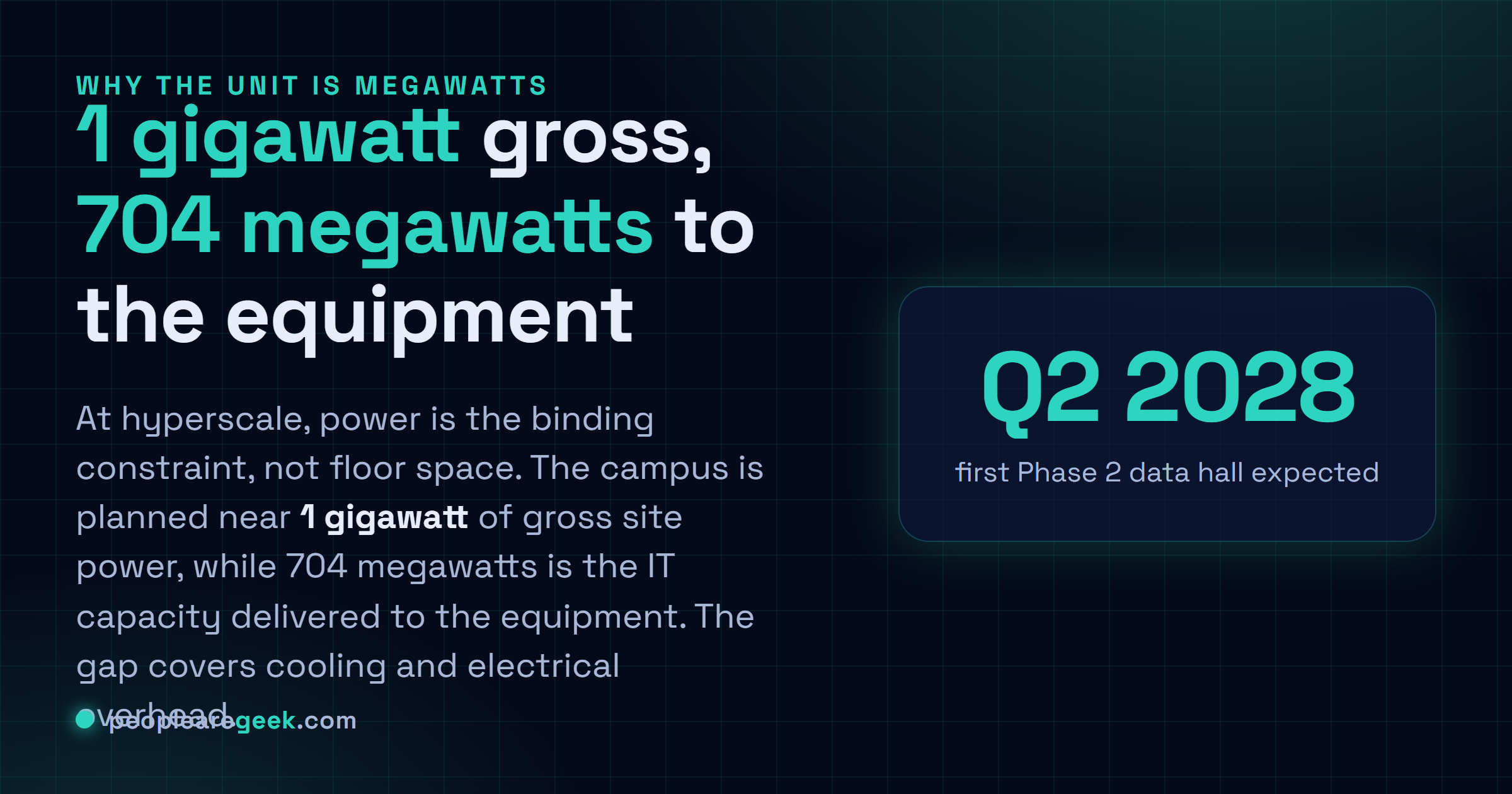
One distinction is worth keeping straight. The 704 megawatts is IT capacity, the power that reaches the equipment. The roughly 1 gigawatt figure is gross site power, which also has to cover cooling, power conversion losses, and the rest of the electrical overhead. The gap between those two numbers is essentially the efficiency of the facility, and it is why a gigawatt campus does not translate into a full gigawatt of usable compute load.
The timeline tells the real story
Hut 8 expects to deliver the first Phase 2 data hall in the second quarter of 2028. For a lease signed in 2026, that lead time might look slow, but it is the honest shape of the work. The long poles are not racking servers. They are securing grid power, building substations, and standing up the cooling and structure to support a load like this. Those steps take years, and they are the reason capacity is scarce even when demand is obvious.
The 15-year term follows from the same logic. Infrastructure this expensive and this slow to build is not something either side wants to leave half-committed. There is also a backstory worth noting: Hut 8 started as a cryptocurrency miner and has been repositioning power assets and operations it developed during that era toward AI customers. That pivot, from mining to AI colocation, is turning out to be a common path for operators who already know how to secure large blocks of cheap power.
For anyone who runs infrastructure, sizes capacity, or plans around cloud regions, deals like this are the leading indicators. When a single campus books 704 megawatts to one tenant, it tells you AI demand is now being planned in gigawatt increments, and that power, not chips alone, is the number to watch.
Sources and further reading
- PR Newswire: Hut 8 commercializes first phase of 1 GW Beacon Point AI data center campus
- The Globe and Mail: Hut 8 fully commercializes Texas campus with a 9.8 billion dollar AI data centre lease
- Data Centre Magazine: Hut 8 commercialises a 9.8 billion dollar Texas AI data centre lease
Frequently asked questions
What did Hut 8 announce?
On Monday, July 20, 2026, Hut 8 said it signed a second lease at its Beacon Point campus in Texas, covering 352 megawatts of IT capacity over a 15-year base term with a contract value of 9.8 billion dollars. The deal fully commercializes the campus, which is planned for roughly 1 gigawatt of total power. Combined with the first phase, the same customer now has 704 megawatts of IT capacity contracted at the site, and the two leases carry a combined base-term value of 19.6 billion dollars.
Who is the tenant?
Hut 8 describes the customer as the same high investment-grade company that executed the Phase 1 lease. It has not been named publicly in the announcement. What matters operationally is that a single tenant has doubled its footprint at the campus to 704 megawatts of IT capacity, which is the kind of commitment that only a very large AI or cloud operator makes, and it signals confidence that the demand behind the build is real and durable.
Why is capacity measured in megawatts instead of servers?
Because at hyperscale, power is the binding constraint, not floor space or rack count. A modern AI hall is limited by how many megawatts it can deliver to the chips and how much heat it can remove, so operators lease and plan in megawatts of IT capacity. Note that IT capacity, the 704 megawatts here, is the power delivered to the equipment, and it is lower than the roughly 1 gigawatt of gross site power, which also covers cooling and electrical overhead.
When does the new capacity come online?
Hut 8 expects to begin delivering the first Phase 2 data hall in the second quarter of 2028. That lead time is normal for capacity at this scale, because the slow parts are securing grid power, building substations, and standing up cooling and structure, not installing servers. The 15-year lease term reflects that reality: both sides are committing for the long haul because the underlying infrastructure takes years to build and is expensive to leave idle.
Why does a data center lease matter to engineers?
Because it is a concrete measurement of where compute capacity is heading and what it costs to stand up. A single campus contracting 704 megawatts of IT load tells you that AI training and inference demand is being planned in gigawatt increments, which shapes power availability, network build-out, and hardware supply for everyone downstream. If you run infrastructure, size capacity, or plan around cloud regions, these announcements are the leading indicators for where the compute, and the constraints, will be.