SysadminNews

IBM Puts Arm Instructions Inside the Mainframe Core

On this page
  1. One core, two instruction sets
  2. What IBM actually published
  3. Why Arm, and why now
  4. What the announcement does not say
  5. What it changes for the people who run these machines
  6. Sources and further reading

IBM announced on Monday, August twenty fourth, 2026, at the Hot Chips conference, a next generation processor for IBM Z and LinuxONE in which each core natively executes both Arm and IBM Z instructions. The design is built on a 2 nanometer node and is described as carrying 11 high performance cores running above 5.7 gigahertz, with AI inference accelerators for in transaction fraud detection and a dedicated on chip data processing unit for I/O. The point worth pausing on is the one IBM makes explicitly: there are no separate Arm cores and IBM cores on this die.

The short answer

At Hot Chips on August 24, 2026, IBM announced the first dual architecture mainframe processor for future IBM Z and LinuxONE systems. Each core natively executes both Arm and IBM Z, or Arm and LinuxONE, instructions concurrently, with no separate Arm cores on the die. The design carries AI inference accelerators for in transaction fraud detection and an on chip data processing unit for I/O. It is the first processor milestone from the IBM and Arm collaboration established in April 2026.

11 coresabove 5.7 GHz on a 2 nanometer node
2 ISAsArm and IBM Z, on the same core
22 millionArm developers IBM is aiming at
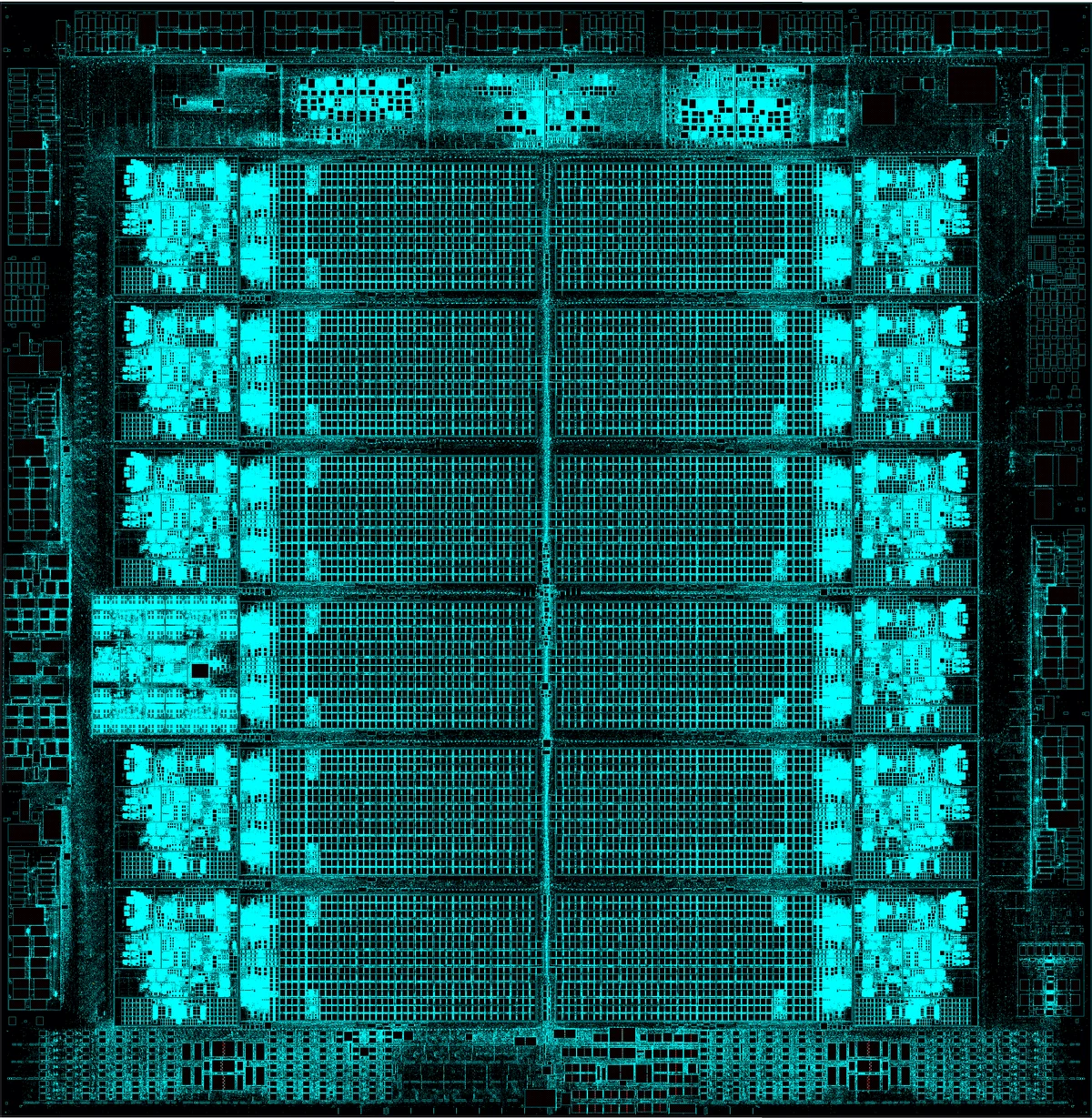
Official IBM chip layout image of the next generation dual architecture processor for IBM Z and LinuxONE, showing the repeated core blocks and cache arrays of a 2 nanometer design with 11 high performance cores.
The chip layout published with the announcement. Source: IBM newsroom. PNG

The mainframe has spent forty years being described as a thing you migrate away from, and the people who actually run one have spent forty years explaining why that is harder than it sounds. What IBM announced at Hot Chips answers a narrower and more honest version of the problem: not that the hardware is wrong, but that a growing share of useful software is never built for it.

One core, two instruction sets

The sentence that matters in the press release is a negative one. The chip is architected to not contain separate Arm and IBM cores.

That rules out the two implementations most people would guess at. It is not a heterogeneous package where an Arm cluster sits beside a Z cluster and a hypervisor routes work to whichever one fits, which is roughly how the industry has handled mixed architecture before. And it is not binary translation, where arm64 code is fed through a layer that turns it into something the native cores understand, paying a tax on every instruction.

Instead each core is capable of both, and IBM says the two can execute concurrently. VentureBeat, which covered the Hot Chips session, reported that a core switches between Arm software mode and traditional Z mode on a nanosecond scale, with the open source KVM hypervisor handling dispatch of virtual machines across both architectures on the shared silicon. Take those mechanism details as press reporting rather than as specification, because IBM did not put them in the release. The architectural claim itself is IBM's own.

If you have ever wondered why a Z box cannot simply run your container, this is that question being addressed at the lowest possible level. The nearest familiar reference point is not another processor at all. It is the way KVM's MMU handling was reworked for Linux 7.3, where the interesting work sits in how a guest gets mapped onto the host rather than in how fast either side runs on its own.

What IBM actually published

The specification list is short, and worth reading literally, because a design disclosure at Hot Chips is not a datasheet.

Built on a 2 nanometer technology node. Eleven high performance cores. Operating at more than 5.7 gigahertz. AI inference accelerators for in transaction fraud detection. A dedicated on chip data processing unit for I/O acceleration. A large cache architecture for demanding enterprise workloads, with no numbers attached. At the platform level, scaling to hundreds of cores and tens of terabytes of memory.

Eleven cores is an odd number in the literal sense, and a deliberate one for this line: IBM has historically shipped Z processors with a core count that leaves room for redundancy and yield, which is part of how these machines reach their availability figures. The clock speed tends to surprise people who have not looked at a mainframe processor recently. Above 5.7 gigahertz is not a boost figure quoted for a marketing slide, it is where this class of chip lives, because single thread transaction latency is the metric the whole platform is optimised around.

Answer card summarising IBM's dual architecture processor announced at Hot Chips on August 24, 2026: a 2 nanometer design with 11 high performance cores above 5.7 GHz, AI inference accelerators for in transaction fraud detection, an on chip data processing unit for I/O acceleration and a large cache, where every core natively executes both Arm and IBM Z instructions rather than the die carrying separate Arm and IBM cores.
Everything IBM put on the record. Cache sizes, product name and ship date were not part of it. PNG

Why Arm, and why now

IBM leads its own announcement with an ecosystem number rather than a performance number: more than 22 million developers worldwide in the Arm software ecosystem, supporting applications from cloud to edge, including the cloud native and AI software that increasingly shapes modern infrastructure.

That framing tells you which problem is being solved. Anyone who has tried to run a modern observability stack, a model serving runtime or a recent AI framework on s390x knows the pattern. The project supports amd64 and arm64, the s390x build either does not exist or lags badly, and you end up maintaining a port that nobody upstream is testing. The gap is not that the mainframe is slow. It is that the mainframe sits outside the two architectures every CI matrix already covers.

Arm's side of the announcement makes the same point from the other direction. Mohamed Awad, Executive Vice President for Cloud AI at Arm, framed it as extending Arm's momentum into mission critical enterprise infrastructure, a segment Arm has not previously been able to reach. This is the first processor milestone from the IBM and Arm collaboration established in April 2026.

What the announcement does not say

Three absences are worth naming, because coverage tends to skip them.

The processor has no public name. There is no announced availability date, and IBM's closing boilerplate explicitly says the statements represent goals and objectives only and are subject to change or withdrawal. And there are no benchmarks, no cache sizes and no indication of what the performance profile looks like when a core is doing Arm work rather than Z work, which is precisely the number a capacity planner will eventually want.

Christian Jacobi, Chief Technology Officer and IBM Fellow in IBM Systems Development, described it as bringing Arm natively to the platform while keeping the qualities that made IBM systems the foundation for how businesses run. That is a statement of intent about a chip that has not become a shipping product.

What it changes for the people who run these machines

For now, nothing operationally. If you administer a Z or LinuxONE estate, this changes no plan you have for this year or next.

What it changes is the shape of the argument when someone proposes moving a workload off the platform because a required piece of software has no s390x build. Today that is a hard constraint and the migration case writes itself. On the roadmap IBM has just published, it becomes a temporary one, and the choice shifts from move the workload to wait for the hardware.

That is a long horizon, and the honest read is that IBM is asking its installed base to hold. Whether that is persuasive depends entirely on whether the chip ships and whether Arm workloads on it run fast enough to be worth putting there. Neither question is answerable from a conference slide. But it is a genuinely unusual answer to an old problem, and unusual answers to old problems are rare enough to be worth watching.

Sources and further reading

Frequently asked questions

What does dual architecture mean on this processor?

It means the instruction set is a property of the running workload rather than a property of the silicon it was scheduled on. IBM states the chip is architected to not contain separate Arm and IBM cores, and that each core can natively execute Arm and IBM Z, or Arm and LinuxONE, instructions concurrently. That rules out the two designs people usually assume. It is not a package with an Arm complex bolted next to a Z complex, and it is not translation or emulation of one instruction set on top of the other. Every core is capable of both, so an Arm binary runs as a first class citizen on the same physical core that a moment earlier was running z/OS work.

When can I actually buy one?

IBM did not say. This is a design disclosure at a chip conference, not a product launch, and the press release closes with the standard notice that statements about future direction and intent are subject to change or withdrawal and represent goals and objectives only. The processor does not even have a public name yet. VentureBeat reported an expected arrival around 2028 as the successor to z17, which is consistent with the roughly three year cadence between IBM Z generations, but that is press analysis rather than an IBM commitment. Treat this as a 2028 conversation and be suspicious of anything more precise.

Does this replace Linux on IBM Z or LinuxONE as they exist today?

No. IBM frames it as running Arm native Linux environments simultaneously with z/OS and Linux on IBM Z, which is an addition rather than a substitution. The existing s390x distributions, the existing z/OS estate and the existing tooling all continue. What changes is that a container image built for arm64, which today simply will not run on a Z box without a rebuild or an emulation layer, becomes something the machine can execute directly. For teams that maintain a parallel build pipeline for s390x, that is the part with real consequences.

Why would IBM want the Arm ecosystem on a mainframe at all?

Because software availability, not raw throughput, is the constraint that actually limits what people deploy on IBM Z. The press release leads with the figure of more than 22 million developers worldwide in the Arm ecosystem and points at cloud native and AI software specifically. Most of the current generation of infrastructure software, observability agents, model serving runtimes and AI frameworks ships arm64 builds as a matter of course and s390x builds rarely or never. Rather than asking that ecosystem to port, IBM proposes to meet it where it already is.

What else is on the die besides the cores?

IBM lists three things alongside the 11 cores. AI inference accelerators aimed at in transaction fraud detection, which is the same on chip inference story IBM has told since the first Telum generation and which exists so a scoring model can run inside the transaction rather than as a separate round trip. A dedicated on chip data processing unit for I/O acceleration. And a large cache architecture for demanding enterprise workloads, although IBM published no cache sizes in this announcement. At the system level, IBM says these platforms scale to hundreds of cores and tens of terabytes of memory.