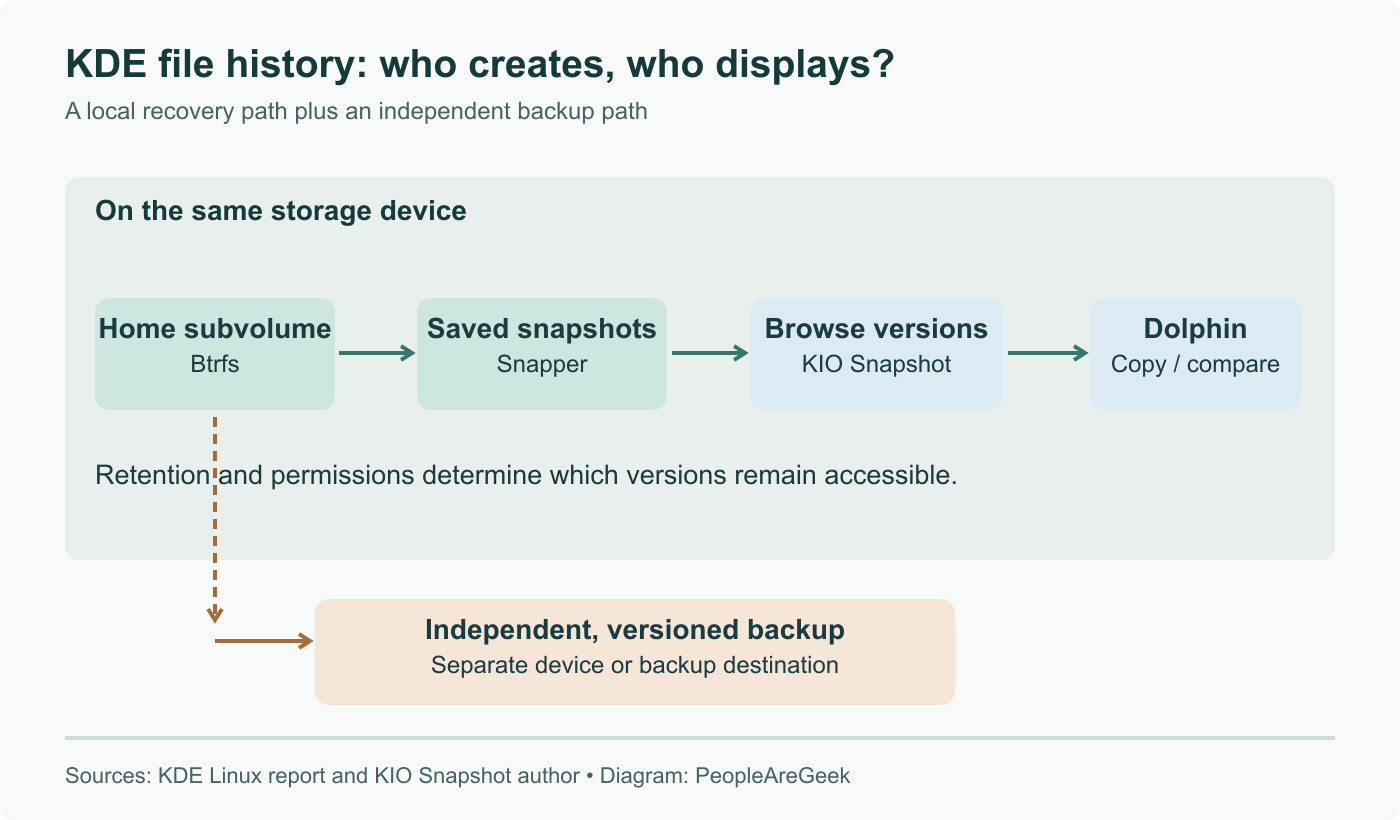
KDE Linux published its August 2026 progress report on August 31, and the headline item is a piece of plumbing that most distributions leave to the user. Home directories are now Btrfs subvolumes, Snapper is configured automatically for every user account, and a new component called kio-snapshot exposes the resulting snapshots through a snapshot protocol that any KDE application can read. The visible result is a right click in Dolphin that shows you the past versions of a file. The invisible result is that a distribution decided file history is not an optional extra, and wired it in at the filesystem layout level.
The short answer
KDE Linux converted user home directories into Btrfs subvolumes and turned on automatic snapshots for all user files through Snapper, configured per account rather than left to the user. A new component, kio-snapshot, exposes those snapshots through a KIO protocol that every KDE Frameworks application understands, with Dolphin integration that shows the past versions of a file from a right click. It creates nothing itself, it only reads existing snapshots, and it works without root by avoiding the Btrfs calls that require it. The August report also brings CJKV input working out of the box and two configuration fixes.
There is a specific kind of loss that backups handle badly. Not the dead drive, which is what backup software is designed around, but the ordinary mistake discovered four hours later: the file you saved over, the directory a script cleaned up too enthusiastically, the document that an application decided to truncate on exit. By the time you notice, the nightly backup has already run and faithfully copied the damage.
Btrfs and ZFS have had the answer to this for years, and almost nobody outside of a handful of distributions turns it on for home directories. KDE Linux, in its August 2026 report published on August 31, did.
The layout change comes first
Hadi Chokr's contribution is the part that has to happen before anything else is possible: migrating the filesystem layout so that every user home is its own Btrfs subvolume, then configuring Snapper automatically for each of them.
That ordering matters. A subvolume is the unit Btrfs can snapshot, so a home directory that is just a folder inside a larger subvolume cannot be versioned independently of everything else on the system. Distributions that snapshot for rollback after a package update typically snapshot the root subvolume, which is a completely different goal and deliberately excludes user data. Making home its own subvolume is what turns per user file history from impossible into a configuration question.
Once each home is a subvolume, Snapper does what it has always done, taking timed snapshots and rotating them out according to a retention policy. The distribution ships that configuration rather than documenting it, which is the entire difference between a feature and a wiki page.
kio-snapshot does not take snapshots
The second half, from Bharadwaj Raju, is the part users touch. kio-snapshot is a KIO worker that provides a snapshot protocol, and the important thing to understand about it is what it deliberately does not do. It does not create snapshots. It only provides access to snapshots that already exist, which is why Snapper is still in the picture.
What it gives you is two virtual views over the same underlying data. One is a whole subvolume at a point in time, browsable as an ordinary directory tree. The other is a single file across the history of the subvolume containing it, which is the one exposed through Dolphin: right click a file, get a folder view listing each distinct past version of it found in the snapshots.
Because it is a KIO worker rather than a Dolphin plugin, every application built on KDE Frameworks can open those URLs. A file dialog can browse into a snapshot. That is a meaningfully larger surface than a file manager feature, and it is the reason to implement it this way instead of as a context menu action.
The rootless part is the good engineering
The Btrfs kernel interface reserves a number of operations for the superuser, which is a reasonable default and an obstacle here. A file history browser that needs root to answer "what did this document look like on Tuesday" is a file history browser nobody uses.
The implementation works around the restricted calls rather than escalating past them. Listing the subvolumes present under a given path, for example, is used in place of querying subvolume identifiers directly, because the first is available to an unprivileged process and the second is not. The underlying machinery is libbtrfsutil from btrfs-progs plus the Solid library from KDE Frameworks for device awareness.
It is a small design decision with a large consequence. Anything that prompts for a password is something people avoid, and a recovery feature people avoid is not a recovery feature. Snapper still needs configuring to permit rootless access to its snapshots, which is exactly the sort of detail a distribution should be handling on your behalf rather than leaving in a manual.
If you are weighing filesystems for a machine you actually use, this is the argument that tends to get skipped. Our Btrfs coverage of the Linux 7.3 direct I/O work and the notes on Chris Mason stepping down as Btrfs maintainer cover where the filesystem itself is heading, while Incus 7.4 near live migration is another case of a project building something substantial on top of cheap snapshot differences.
Two fixes in the report deserve a second read
Buried in the same report are two corrections that are worth noting if you administer anything comparable.
The first: members of the wheel group had access to the Docker socket without needing it. That socket carries host level authority by design, so handing it out as a side effect of administrative group membership grants far more than the situation calls for. It is a common configuration slip and worth checking on your own systems.
The second: kernel modules that had been blacklisted were still ending up inside unified kernel images. A blacklist that the build process does not honour is worse than no blacklist, because it produces confident documentation about a state that does not exist.
What to take from this
KDE Linux is still pre Beta, reported at eighty five percent of the way there, so this is not yet a recommendation to install it. The idea is portable, though, and that is the useful part.
If you run Btrfs on a workstation, the two questions worth asking today are whether your home directory is its own subvolume, and whether anything is snapshotting it on a schedule. On most installations the answers are no and no, because the installer put home inside a subvolume shared with the rest of the system and pointed Snapper at root. Fixing the first is disruptive enough that it usually waits for a reinstall. Fixing the second, once the first is done, takes a Snapper configuration and a timer.
Sources and further reading
- This Month in KDE Linux: August 2026, KDE Blogs, August 31, 2026
- KDE Linux Now Providing Automatic Btrfs Snapshots For All User Files, Phoronix, August 31, 2026
- Btrfs Snapshot Integration in KDE, Bharadwaj Raju, August 19, 2026
- KDE/kio-snapshot on GitHub
Frequently asked questions
Is this a backup?
No, and the developers say so directly. A Btrfs snapshot lives on the same filesystem as the data it references. It protects you from the mistakes you make yourself, an accidental delete, an editor that truncated a file, a script that rewrote a directory it should not have touched. It protects you from none of the events that destroy the filesystem itself: a failing drive, a lost or stolen laptop, a controller that starts writing garbage. Think of it as an undo history for your home directory, sitting alongside a real offsite backup rather than replacing one.
What is kio-snapshot and how does it differ from Snapper?
They do opposite halves of the job. Snapper creates and rotates snapshots on a schedule. kio-snapshot does not create anything, it only reads what already exists and presents it. It is a KIO worker providing a snapshot protocol, which means every application built on KDE Frameworks understands the URLs it serves. It builds two kinds of virtual view: a whole subvolume at a point in time, browsable as a directory tree, and a single file across the history of the subvolume that contains it, which is what the Dolphin right click surfaces.
Does browsing snapshots require root?
That was the interesting engineering problem, and the answer is no. The Btrfs kernel API restricts several operations to the superuser, so the implementation works around them rather than escalating. Listing subvolumes under a given path, for instance, is used instead of querying subvolume identifiers directly, because the former is available to an ordinary user and the latter is not. The work builds on libbtrfsutil from btrfs-progs and the Solid library from KDE Frameworks. Snapper still needs the right configuration to allow rootless access to its snapshots.
Can I get this on a distribution that is not KDE Linux?
Partly, and it is worth doing. kio-snapshot is a normal KDE component, so once your distribution packages it, the Dolphin integration follows on any Btrfs system that already has snapshots. What you would be reproducing by hand is the layout work: making each home directory its own subvolume and configuring Snapper per user. Several distributions already snapshot the root subvolume for rollback after updates, which is a different goal. Snapshotting home is about the user's own mistakes, and it is the case that actually loses people's data.
What else landed in KDE Linux in August 2026?
Chinese, Japanese, Korean and Vietnamese text input now works out of the box, with the required components preinstalled rather than left as an exercise. Two configuration oversights were corrected: members of the wheel group had more access to the Docker socket than the situation required, and blacklisted kernel modules were still being included in unified kernel images. The automated quality assurance system caught several integration problems before release, quick help links were added to the launcher menu, and the project reported itself at eighty five percent of the way to its Beta milestone.