SysadminNews

LACT 0.10 Adds NVIDIA PowerMizer and Blackwell Hotspot

On this page
  1. Two controls NVIDIA owners have been missing
  2. The hotspot sensor was lying
  3. A GTT bar, and a setup that finally sets things up
  4. What we would do
  5. Sources and further reading

LACT is the GUI that fills a gap nobody at AMD, Intel or NVIDIA has filled on Linux: a single control panel for GPU clocks, fan curves, power limits and sensor readings that works across all three vendors. Version 0.10 shipped on the morning of Wednesday, August 12, and it is a release aimed squarely at NVIDIA owners. There are two new overclocking controls, a Blackwell hotspot reading that reports real numbers instead of nonsense, and per memory chip temperatures on GDDR6X and GDDR7 cards. The setup experience got fixed too, which matters more than it sounds.

The short answer

LACT is the cross vendor GPU control panel Linux never got officially, covering NVIDIA, AMD and Intel from one GUI. Version 0.10 leans hard toward NVIDIA: PowerMizer mode forces the highest performance state, a voltage boost slider grants a little extra headroom, the Blackwell hotspot sensor now reports real values through a card specific path instead of nonsense, and GDDR6X and GDDR7 cards expose per memory chip temperatures. AMD users get a GTT usage bar. Everyone gets a setup wizard instead of a command to copy and paste.

0.10.0released on the morning of August 12, 2026
2new NVIDIA overclocking controls: PowerMizer and voltage boost
GDDR6X/7memory types now reporting per chip temperatures
Answer card: LACT 0.10 was released on August 12, 2026, adding NVIDIA PowerMizer performance level forcing and a voltage boost slider, a Blackwell specific hotspot sensor path that replaces bogus readings, per memory chip temperature sensors for GDDR6X and GDDR7 including both sides of clamshell cards, a GTT usage bar on AMD, an interactive service setup wizard and polkit authentication for profile hook commands.
LACT 0.10 at a glance. Source: the LACT 0.10.0 release notes on GitHub, August 12, 2026. PNG

If you run a Radeon or an Arc card on Linux and you want to change a fan curve, there is no official application to open. AMD does not ship one. Intel does not ship one. NVIDIA ships nvidia-settings, which has never had much to say about overclocking.

LACT is what filled that hole, and version 0.10 landed on Wednesday morning with a clear bias toward NVIDIA hardware.

Two controls NVIDIA owners have been missing

PowerMizer mode is the simpler of the pair. It forces the GPU into its highest performance state instead of letting the driver walk up and down through p-states on its own schedule. LACT has offered the equivalent on AMD for a while under the performance level name, so this is parity rather than novelty, but it is the kind of parity that matters if you have been fighting inconsistent clock behaviour. Driver managed ramping is usually right and occasionally costs you consistency, which surfaces as uneven frame pacing or benchmark runs that will not settle.

Voltage boost is the more interesting one, and the release notes are refreshingly careful about it. The slider allows the GPU to boost to slightly higher voltages. It is explicitly not a full voltage offset control, only a small amount of extra headroom that may help some overclock setups. If you have used the voltage slider in MSI Afterburner's main window, that is the analogue.

Both landed from contributor makarov-roman.

The hotspot sensor was lying

This is the fix rather than the feature, and it is the one we would care about most.

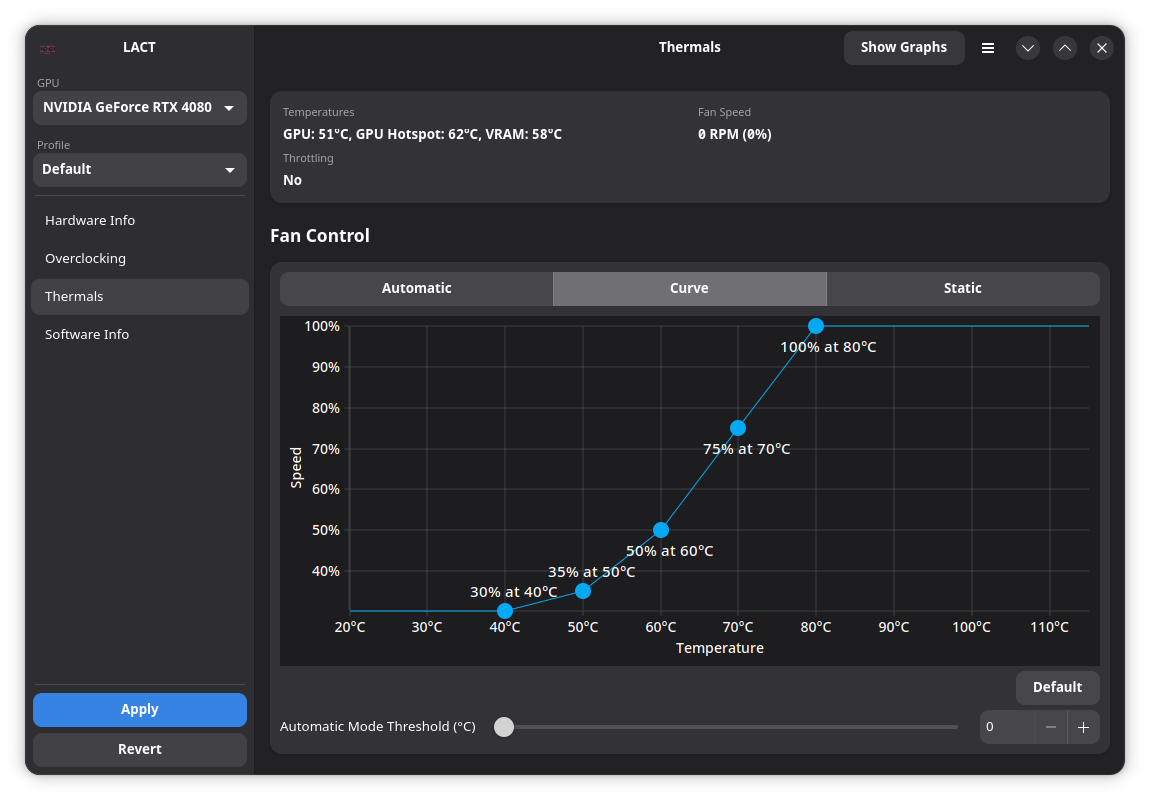
Hotspot temperature, sometimes called junction temperature, is the hottest measured point on the die rather than the averaged edge reading. On current cards it is the number that actually drives thermal throttling behaviour. Before 0.10, LACT read it on Blackwell and reported bogus values, which is worse than reporting nothing: a wrong temperature reads as authoritative, and people tune fan curves against it.

Version 0.10 reads it through a Blackwell specific path and gets real numbers.

Alongside that comes something LACT could not do at all before: per memory chip temperature sensors on cards with GDDR6X and GDDR7 memory. On clamshell designs, where memory chips sit on both sides of the board, it reports the front and back separately. The project credits Paulo Games with finding these sensors and sharing the discovery, which is a reminder of how much of this tooling is built on people poking at undocumented registers and telling someone what they found.

Terminal figure showing the new LACT command line detach and reattach subcommands used to release a GPU from LACT so it can be bound to a virtual machine passthrough driver, and then return it to LACT management afterwards.
The new detach and reattach pair in LACT 0.10. Device names are illustrative. PNG

A GTT bar, and a setup that finally sets things up

AMD users get one addition worth knowing about. LACT 0.10 shows a status bar for GTT usage, which is the system memory a GPU reaches through its aperture rather than dedicated VRAM. On a discrete card that is a spillover region. On an integrated GPU it is most of the picture, because there is no large private pool to fall back on, and hitting the limit is a common cause of a VRAM heavy application becoming slow for no reason you can see. Now you can see it.

The setup change is not a feature and is probably the most valuable thing in the release. LACT needs its system service enabled before much of it works. Previously the application showed you a dialog with a command to copy and run yourself. Version 0.10 replaces that with an interactive wizard that manages the service, and it can enable autostart while it is there.

Security handling improved in the same pass. LACT now ships a polkit policy file, installed by make install, and profile hook commands require admin authentication through polkit rather than simply running. Given that hooks are arbitrary commands attached to profile switches, asking before running them is the right default.

The last addition is for a narrower audience: lact cli detach and lact cli reattach release a GPU from LACT so it can be handed to a virtual machine, then take it back afterwards. Anyone doing GPU passthrough on a multi card workstation will recognise the problem that solves.

What we would do

Upgrade if you are on NVIDIA, and upgrade first if you are on Blackwell. A hotspot sensor that reports bogus values is not a cosmetic bug when it is the reading your fan curve is built around, and this is the release that fixes it.

On AMD the case is softer. The GTT bar is genuinely useful on integrated graphics and largely decorative on a discrete card with plenty of VRAM. The polkit and setup work benefits everyone equally and quietly.

One note for anyone scripting around LACT: profile hook commands now prompt for authentication, so a hook that previously ran unattended will not any more. That is the correct behaviour, but it will look like a regression the first time an automated profile switch stops halfway.

Sources and further reading

Frequently asked questions

What is LACT and why does it exist?

LACT is a third party Linux GPU configuration and monitoring application, and it exists because the official alternatives do not. AMD ships no graphical control panel for Radeon on Linux, and Intel ships none for Arc. NVIDIA has nvidia-settings, but its overclocking story has always been thin. LACT provides one GUI that works across NVIDIA, AMD and Intel hardware, offering clock and voltage curve editing, fan control, power limits and a large amount of sensor reporting. It is built around a system daemon that does the privileged work, with the GUI talking to it, which is why enabling the service is a real step in the setup rather than an optional extra.

What do the two new NVIDIA controls actually do?

PowerMizer mode lets you force the GPU into its highest performance state rather than letting the driver move between p-states on its own. It is the direct equivalent of the performance level setting LACT already offered on AMD, and it is useful when the driver's own clock ramping is costing you consistency, which shows up as inconsistent frame pacing or variable results in a benchmark run. Voltage boost is a slider that allows the GPU to boost to slightly higher voltages. It is worth being precise about what it is not: this is not a full voltage offset control, only a small amount of extra headroom. If you have used the voltage slider in MSI Afterburner's main window on Windows, this is that control.

What was wrong with the Blackwell hotspot sensor before?

It reported bogus values. The hotspot, or junction temperature, is the hottest point measured on the die rather than the averaged edge temperature, and on modern cards it is the reading that actually governs thermal throttling, so a wrong number is worse than no number. Blackwell needed a card specific path to read it correctly, and 0.10 adds one. The same release adds something LACT did not have at all: per memory chip temperature sensors on GPUs with GDDR6X and GDDR7 memory, including separate readings for the front and back of the PCB on clamshell cards where memory sits on both sides. The project credits Paulo Games with finding these sensors and sharing the discovery.

What is the GTT usage bar for?

GTT is the system memory a GPU can address through its aperture, as opposed to dedicated VRAM. On a discrete card it is a spillover area. On an integrated GPU it is much of the story, since there is no large private pool of memory to fall back on. LACT 0.10 adds a status bar showing GTT usage, which gives you a direct way to see whether a VRAM heavy application is hitting the limit on an iGPU. That is the sort of thing you would previously have inferred from a workload getting slow for no visible reason, which is a poor way to diagnose anything.

Is anything different about installing it now?

Yes, and it is an improvement. LACT needs its system service enabled for much of its functionality to work, and previously the application handed you a command to copy and run yourself. That is a fine instruction and a bad first impression. Version 0.10 replaces it with an interactive wizard that manages the service for you, and can enable autostart during setup. The release also ships a polkit policy file, installed automatically by make install, and profile hook commands now require admin authentication through polkit rather than running unprompted. There is also a new lact cli detach and reattach pair, which releases a GPU from LACT so it can be passed through to a virtual machine.