Linux 7.2 is out, released by Linus Torvalds on Sunday, August sixteenth, on schedule and without the extra release candidate week that looked possible a fortnight ago. The headline for anyone running servers is cache aware scheduling, which keeps threads of the same process inside one last level cache domain instead of scattering them across a socket. Underneath that sit changes with a more immediate payoff, faster ext4 and Btrfs paths, MultiPath TCP raised from eight subflows to sixty four, and a new USB4STREAM protocol that turns a Thunderbolt cable into a 40 gigabit transfer link. Here is what actually matters when you plan the upgrade.
The short answer
Linus Torvalds released Linux 7.2 on Sunday, August sixteenth, 2026, on the original schedule despite a heavy final week. Cache aware scheduling keeps a process's threads inside one last level cache domain, ext4 fast commit sheds its lock contention, Btrfs enables large folios by default and parallelises direct I/O, and MultiPath TCP moves from eight subflows to sixty four. USB4STREAM turns a Thunderbolt cable into a character device you can read and write. The 7.3 merge window opened the following day.
We spend most kernel release weeks reading feature lists that will not change a single graph on the monitoring dashboard. This one is different in a specific way: three of its changes alter behaviour you have already measured, on hardware you already own, without you configuring anything.
The scheduler stops fighting the cache
Cache aware scheduling is the change we previewed when it was merged during the 7.2 window, and it is worth restating now that it ships.
Until now the load balancer treated an idle core as an idle core. If two threads of the same process were runnable, it would happily put one on each end of a socket, and every shared cache line they touched had to travel between last level cache domains. On a modern server part with many such domains, the scheduler was manufacturing cache misses that the workload had not asked for.
Linux 7.2 gives the balancer a preference. Threads that belong to one process get placed together inside a single last level cache domain when that is possible. A guard keeps this from turning into a hotspot: once a process is using more than roughly a quarter of a domain's capacity, the kernel goes back to spreading the load.
The gain is real but conditional. Multi threaded services with genuine shared state benefit. Embarrassingly parallel jobs and anything already limited by memory bandwidth will not notice. If you run databases or application servers on EPYC or Xeon, this is the line item to benchmark first.
Storage and filesystems, where the numbers are
The filesystem work in this release is unusually concrete.
Ext4 fast commit no longer suffers the lock contention and deadlocks it hit under heavy concurrent use, which is the kind of fix that shows up as a disappeared tail latency rather than a faster average. Directory lookups now work in four byte chunks, which pays off in directories dense enough that lookup cost was visible. Small random four kilobyte reads on NVMe gained about five percent in io_uring polling mode.
Btrfs enables large folios by default and adds experimental folios up to two megabytes. More importantly, direct I/O no longer runs serially, and the reported gain on that path reaches fifty nine percent, with sequential writes up about fifteen percent thanks to new writeback request limits.
Around them, XFS zoned storage support dropped its experimental label, a new dm-inlinecrypt device mapper target hands encryption to block devices that can perform it inline, NFS raised its default transfer block size to four megabytes on hosts with sixteen gigabytes of memory or more, and the in kernel SMB server gained compressed file support and network compression. Memory reclaim also moved: the MGLRU refinements report up to a thirty percent improvement on MongoDB under YCSB, and fewer surprise out of memory kills.
Networking gets more room
MultiPath TCP now supports up to sixty four subflows per connection, where the previous ceiling was eight. That ceiling was starting to bite on hosts with many paths, and raising it by a factor of eight changes what is practical rather than what is possible.
The longer running effort to reduce dependence on the global rtnl_lock continued, which matters on machines juggling large numbers of network namespaces and interfaces. Neither change asks anything of you. Both simply remove a limit you may have been working around.
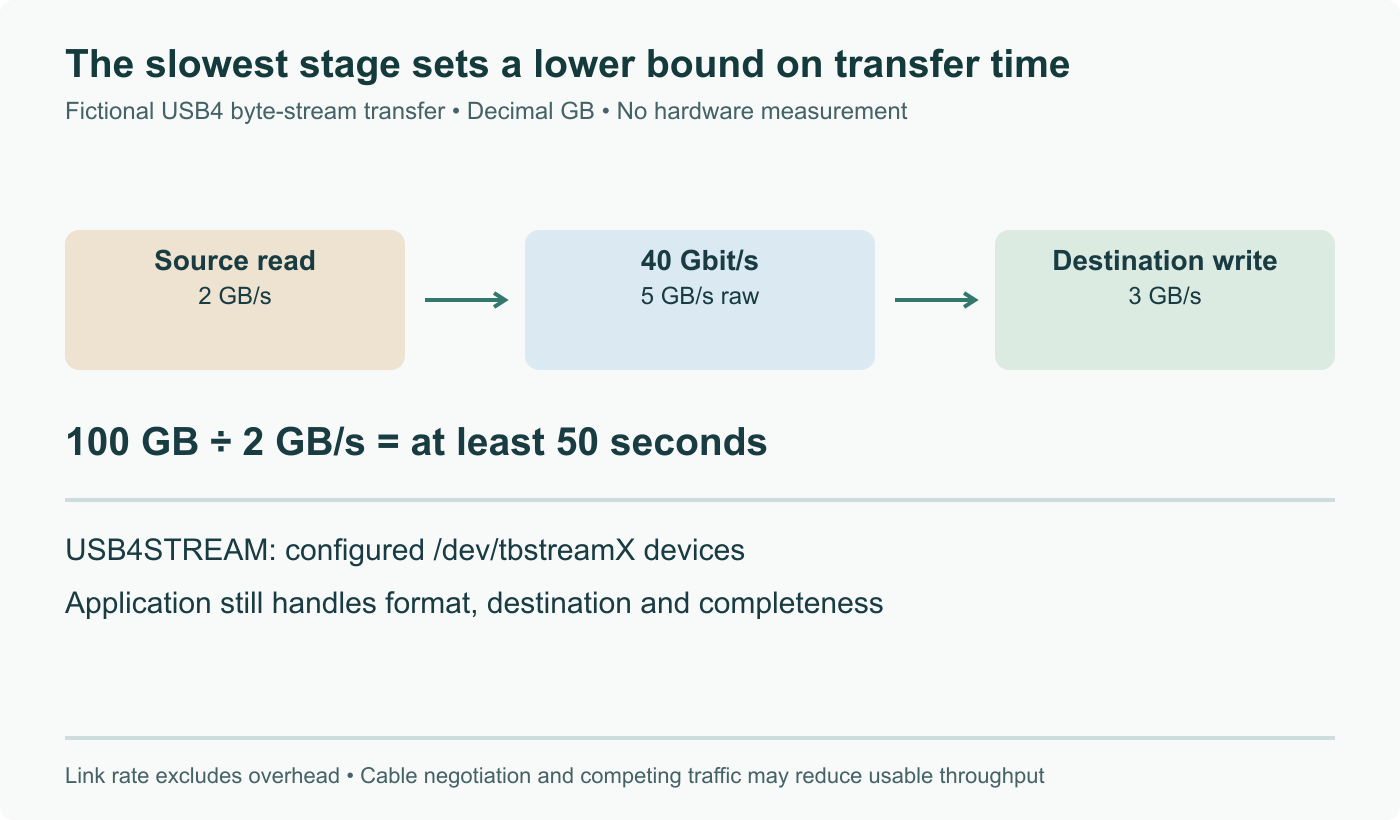
USB4STREAM is the more entertaining addition. Connect two machines with a USB4 or Thunderbolt cable and each gets a /dev/tbstreamX character device. Read and write calls move the data at link speed, forty or eighty gigabits per second, with no IP stack and no share to configure. For moving a large image between two boxes on a bench, that is a genuinely simpler answer than standing up a temporary export.
Housekeeping, and what Torvalds said about the size
The removals read like a museum inventory. Over thirteen thousand lines of i486 era floating point emulation, a forty year old Hercules graphics driver, the AppleTalk protocol, and ISA and PCMCIA ARCnet adapters all left the tree. In the other direction, s390 gained the ability to build Rust kernel code, the zerocopy crate joined the source tree, KVM picked up Intel Mode Based Execution Control and AMD Guest Mode Execution Trap, and Apple M3 machines can now boot, at a stage best described as early.
Torvalds was blunt about the shape of the cycle. The final week was, in his words, "once again, bigger than I would have wished for," and he chose to ship anyway: "If I delayed releases for that reason we'd probably never have a release at all." Several late reverts landed in the DRM scheduling code, which he defended as the right call rather than a tidy one, saying "It may not be pretty, but it's the correct way to deal with 'Oh, that code wasn't ready.'"
The size is not an illusion. The 7.1 to 7.2 cycle added 974,361 lines, roughly 677,929 of them actual code, pushing the kernel past forty three million lines. Torvalds has attributed part of that growth to the volume of small fixes arriving from AI assisted contributors, a pattern we looked at when the 7.2 release candidates started running large. Around twenty nine percent of recent commits carried fix tags.
The 7.3 merge window opened the day after the release with forty pull requests already queued. If you maintain a distribution kernel, that is your next two weeks.
Sources and further reading
- Linux 7.2 Released With Faster I/O, New AMD and Intel Driver Improvements, Phoronix, August 16, 2026
- Linux Kernel 7.2 Released With Btrfs, Scheduler and Networking Improvements, Linuxiac, August 2026
- Linux 7.2 debuts, Linus Torvalds says the new normal means he had to do it now, The Register, August 17, 2026
- Linux 7.2 brings cache aware scheduling, faster ext4, MGLRU reclaim, OMG Ubuntu, August 2026
- Linux 7.2 Features: Cache Aware Scheduling, USB4STREAM, AMD ISP4, AMDGPU HDMI 2.1 FRL, Phoronix
Frequently asked questions
When was Linux 7.2 released and what is the headline change?
Linus Torvalds released Linux 7.2 on Sunday, August sixteenth, 2026, without the eighth release candidate week that a difficult final fortnight had made plausible. The headline change is cache aware scheduling, a load balancing addition that tries to keep the threads of one process inside a single last level cache domain rather than spreading them across every idle core. On chips with many cache domains, which now means most server parts from both AMD and Intel, that removes a class of cache bouncing the scheduler used to cause on its own.
What is cache aware scheduling and will it help my workload?
It teaches the load balancer that two threads of the same process usually want to be near each other. Instead of placing them purely by which core is idle, the scheduler prefers cores sharing a last level cache, so data one thread touched is still resident when the next one reads it. A guard stops the kernel packing everything into one domain: once a process is consuming more than roughly a quarter of the domain's capacity, the balancer spreads out again. The workloads that gain most are multi threaded services with real shared state, databases and application servers among them. Single threaded jobs and workloads that are already memory bandwidth bound will see very little.
What is USB4STREAM and what do I do with it?
USB4STREAM is an Intel developed protocol, merged in 7.2, for moving data between two machines connected by a USB4 or Thunderbolt cable. Each end gets a character device named /dev/tbstreamX that accepts ordinary read and write calls, so a transfer is a plain file operation rather than a network setup. There is no IP stack, no NFS export and no share to configure, and the link runs at USB4 speeds of 40 or 80 gigabits per second depending on the hardware. It coexists with the existing Thunderbolt networking driver, so you can keep using that where you actually want a network interface.
Which filesystem and storage changes are worth the upgrade on their own?
Several. Ext4 fast commit lost the lock contention and deadlocks it hit under heavy concurrent load, and directory lookups now compare in four byte chunks, which speeds up finding a file in a dense directory. Btrfs enables large folios by default, stops serialising direct I/O, and reports write gains of up to fifty nine percent on that path plus about fifteen percent on sequential writes. XFS zoned storage support is no longer marked experimental. NFS raises its default transfer block size to four megabytes on machines with sixteen gigabytes of memory or more, and a new dm-inlinecrypt device mapper target hands encryption to block devices that can do it inline.
What was removed in Linux 7.2?
Mostly hardware nobody has powered on this decade. More than thirteen thousand lines of i486 era floating point emulation went, along with a forty year old Hercules graphics driver, the AppleTalk networking protocol, and the ISA and PCMCIA ARCnet adapters. On the other end of the age range, the s390 architecture can now build Rust kernel code and the zerocopy crate joined the tree. Initial Apple M3 boot support also landed, though it is early enough that it is interesting rather than usable.