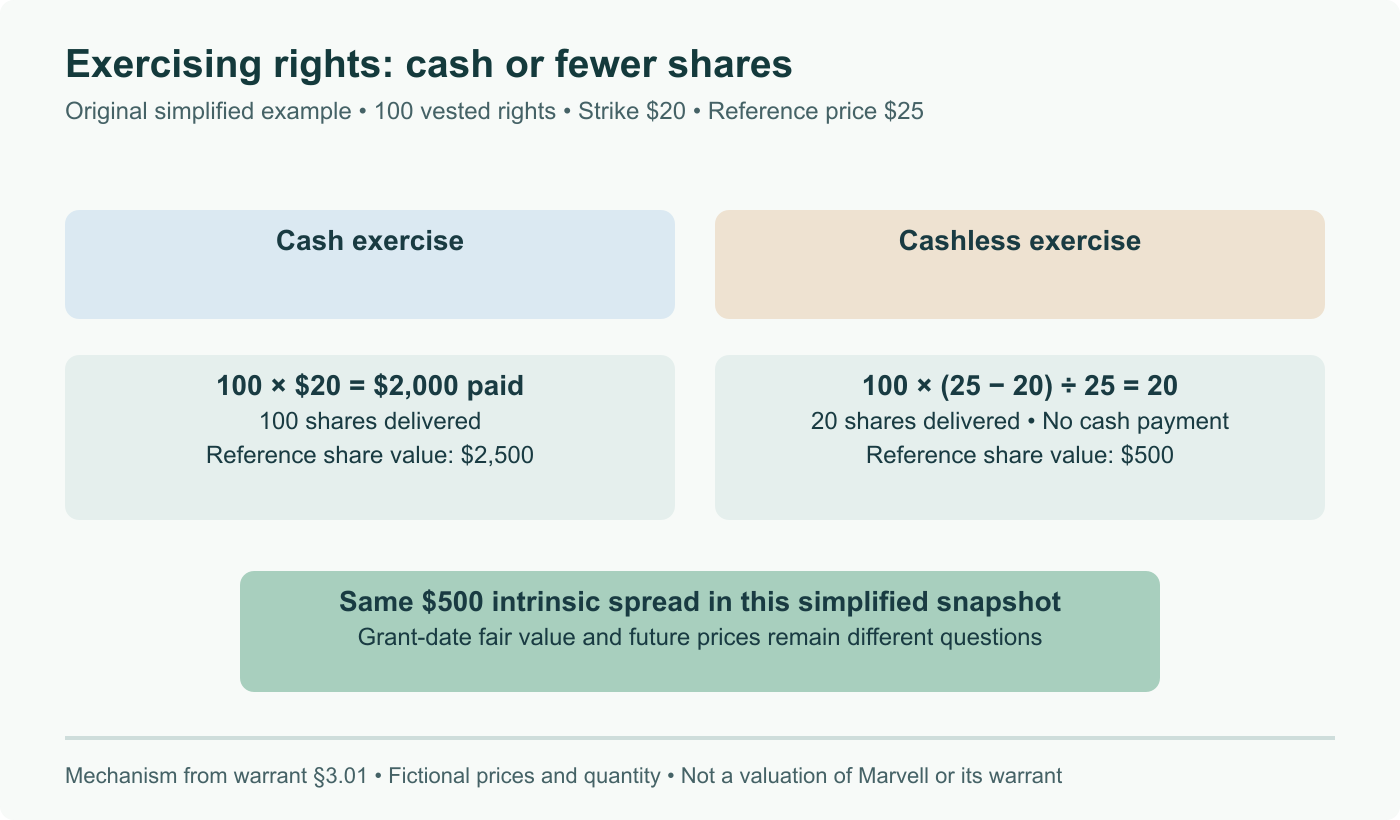
Marvell has given Google the right to buy roughly 7 percent of the company, and the price of that right is chip orders. An SEC Form 8-K filed this week discloses a commercial agreement dated July twenty ninth, 2026, and a warrant issued on August eighteenth for 58,970,907 shares at 206.58 dollars each, worth about 12.2 billion dollars if fully exercised. The interesting part for anyone who builds infrastructure is not the finance. It is the product list: inference accelerators, storage controllers, network interface controllers, memory interface controllers and near memory compute, all attaching to the TPU ecosystem.
The short answer
Marvell filed an SEC Form 8-K disclosing a commercial agreement with Google dated July twenty ninth, 2026, and a warrant issued on August eighteenth for up to 58,970,907 shares at 206.58 dollars each, about 12.2 billion dollars if fully exercised and roughly 7 percent of the company. Vesting follows purchases rather than time. Marvell will build AI inference accelerators, storage controllers, network interface controllers, memory interface controllers and near memory compute attaching to the TPU ecosystem. Marvell rose sharply on August nineteenth, Broadcom fell.
Four of the five product lines in this deal have nothing to do with matrix multiplication. That is the part worth sitting with.
The terms
Marvell disclosed the arrangement in an SEC Form 8-K this week. The commercial agreement with Google LLC, covering Marvell's development of custom semiconductor products, is dated July twenty ninth, 2026. The warrant itself was issued on August eighteenth.
It grants Google the right to purchase up to 58,970,907 shares of Marvell common stock at an exercise price of 206.58 dollars per share. Fully exercised that is roughly 12.2 billion dollars and about 7 percent of the company, which would make Google Marvell's fifth largest shareholder.
Vesting is where the structure gets interesting. Approximately 1.4 million shares vest in the first year. Everything after that vests against cumulative custom product revenue: one tranche for every 500 million dollars Google spends, across 240 tranches, running from Marvell's third quarter of fiscal 2027 through the end of fiscal 2033. Multiply it out and the full vesting schedule implies something in the region of 120 billion dollars of custom chip purchases, which is the figure most coverage attached to the deal.
Markets moved on Wednesday, August nineteenth. Marvell rose sharply, reported in the region of 12 to 14 percent intraday. Broadcom, which has been Google's principal partner for TPU design work, fell around 4 to 5 percent. Morningstar analyst William Kerwin called it a big win for Marvell and framed it as a growing pie at Google opening to new sources, which is a more careful description than the stock moves alone suggest.
What is actually being built
The filing describes custom silicon programs that attach to the TPU ecosystem. Reporting on the deal breaks that into five categories, and the composition matters more than the total.
There are AI inference accelerators. There are storage controllers. There are network interface controllers. There are memory interface controllers. And there is near memory compute.
One of those five is an accelerator. The other four are data movement. Storage controllers get bytes off media, NICs get them across a fabric, memory interface controllers get them into and out of DRAM, and near memory compute is an attempt to stop moving them quite so far in the first place.
That composition is a reasonable summary of where large scale inference actually spends its time. Anyone who has profiled a serving deployment and found the accelerators waiting rather than working will recognise the shape. A hyperscaler committing seven years of custom silicon budget mostly to the plumbing around its accelerators is making the same observation with a much larger number attached.
Second source, not replacement
Nothing in the filing suggests Google is leaving Broadcom, and reading it that way would be a mistake. Broadcom remains the incumbent on TPU design work. What changed is that it is no longer the only option.
The direction was already visible. Before this deal, Macquarie analyst Arthur Lai had projected Broadcom's share of Google custom silicon revenue falling from roughly 95 percent in 2026 to around 65 percent by 2028, attributing part of that to other partners and part to Google's own in house work. The warrant does not create that trend, it confirms it.
Second sourcing is ordinary procurement discipline, and it is the same instinct that makes anyone with an operations background uncomfortable running a single vendor for a critical component. At hyperscaler scale it also buys pricing leverage, which coverage has noted alongside Broadcom's post VMware pricing history. Marvell brings its own technical arguments too, including photonic memory work acquired from Celestial AI.
The broader pattern is worth naming. Chip vendors granting equity tied to customer purchases has become a recurring structure this year, visible in arrangements between accelerator vendors and large AI labs, and we have covered several of them, including Nvidia guaranteeing 105 billion dollars for an OpenAI campus in Ohio. Each individual deal has a defensible logic. The accumulation of them is what has drawn the circularity criticism, and it sits alongside the three trillion dollars of AI commitments Big Tech is carrying off balance sheet.
What it means if you build infrastructure
Very little this quarter, and something worth tracking after that.
You cannot buy a TPU. They are a Google Cloud service, and this deal does not change that. Nor does it change any price you are quoted today. The vesting schedule does not even begin until Marvell's third quarter of fiscal 2027.
The medium term signal is about the merchant market. When a hyperscaler funds seven years of custom NIC, memory interface and storage controller development at a vendor that also sells to everyone else, that work has a way of surfacing in products the rest of the industry can buy. Marvell is not a captive supplier, and the engineering does not stay in one customer's rack forever.
The other signal is strategic and free to act on. The money in this deal went into data movement, not into compute. If your own inference roadmap is built around finding more FLOPS, it is worth checking whether your bottleneck agrees, because the largest buyer in the market just placed a seven year bet that it does not. That pattern has shown up repeatedly this cycle, including in foundry pricing moves driven by AI demand, and it usually rewards the teams who profile before they procure.
Sources and further reading
- Marvell Technology Form 8-K, filed with the SEC, August 2026
- Marvell hands Google a $12.2bn share option in a custom-chip deal, TNW, August 2026
- Marvell gives Google option to buy $12.2 billion stake in custom AI chip deal, Reuters via WTVB, August 19, 2026
- Marvell Technology links Google warrant to future AI chip sales, StockTitan SEC filing summary, August 2026
- Marvell and Google expand custom silicon partnership, Evertiq, August 20, 2026
Frequently asked questions
What are the exact terms of the warrant?
Marvell and Google entered a commercial agreement on July 29, 2026 covering Marvell's development of custom semiconductor products for Google. On August 18, 2026 Marvell issued Google a warrant to purchase up to 58,970,907 shares of common stock at an exercise price of 206.58 dollars per share, which is about 12.2 billion dollars if fully exercised and roughly 7 percent of the company. Vesting is tied to cumulative custom product revenue rather than to time: approximately 1.4 million shares vest in the first year, and the remainder vests one tranche for every 500 million dollars Google spends, across 240 tranches, running from Marvell's third quarter of fiscal 2027 through the end of fiscal 2033. Fully exercised, Google would become Marvell's fifth largest shareholder.
What is Marvell actually going to build?
Custom silicon programs that attach to the TPU ecosystem, which the filing and subsequent reporting break into five categories: AI inference accelerators, storage controllers, network interface controllers, memory interface controllers, and near memory compute. Read that list carefully, because only the first item is an accelerator. The other four are the parts that move data to and from an accelerator, which is where a large share of practical AI infrastructure performance actually lives. This is not a competing TPU. It is the silicon around the TPU.
Does this mean Google is dropping Broadcom?
Nothing in the filing says so, and the sensible reading is that Google is adding a second source rather than switching. Broadcom has been Google's principal partner for TPU design work and remains so. The market read it as dilution rather than replacement: Marvell rose sharply on the announcement, in the region of 12 to 14 percent intraday on August 19, while Broadcom fell around 4 to 5 percent. Analyst commentary before this deal had already projected Broadcom's share of Google custom silicon revenue falling over time, so the direction was visible before the warrant made it concrete.
Why structure a supply deal as an equity warrant?
Because it aligns a supplier's incentives with a customer's roadmap over seven years, and because it has become a pattern. Tying vesting to cumulative purchases means Marvell only dilutes its shareholders in proportion to revenue it has already booked, and Google only accumulates a position if it actually buys. The obvious criticism is that this is circular: a chip vendor granting equity to the customer whose orders determine the equity's value, which is the same shape as recent arrangements between accelerator vendors and large AI labs. It is worth watching precisely because so many of these structures now exist at once, and none of them has yet been tested through a downturn.
Does any of this change what I can buy or deploy?
Not directly and not soon. TPUs are available through Google Cloud rather than as parts you rack, and nothing here changes that. What it does change is the medium term supply picture for the components around accelerators, because a second serious vendor designing network interface controllers, memory interface controllers and storage controllers for a hyperscaler tends to push that work into the merchant market eventually. The other practical signal is directional: the money is going into data movement rather than into raw compute, which matches what most teams find when they profile an inference deployment.