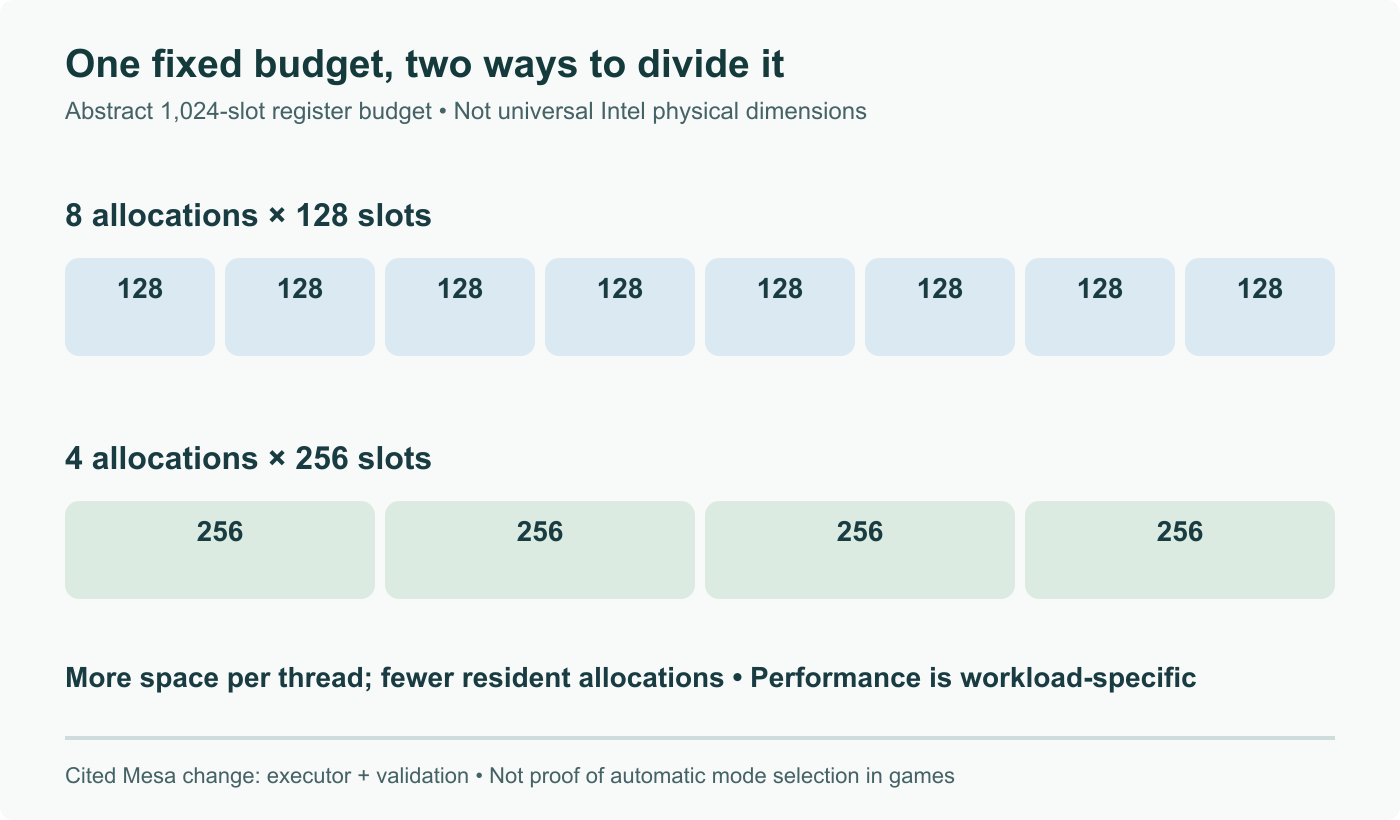
Mesa 26.3 has switched on Large GRF mode for Intel graphics, which doubles the register slice a single hardware thread gets from 128 registers to 256. The commits landed over the weekend of August 8 and cover DG2 Alchemist, so the Arc A series, along with Xe2 Battlemage and the integrated graphics in Lunar Lake. Xe3 reaches the same 256 registers through a different mechanism called Variable Register Thread. The gain is fewer register spills to memory. The cost is real and worth understanding before you expect free performance: an execution unit that gives each thread twice the registers can only keep half as many threads in flight.
The short answer
Mesa 26.3 development git has enabled Large GRF mode for Intel graphics, doubling the general register file slice given to a single hardware thread from 128 registers to 256. It covers DG2 Alchemist, Xe2 Battlemage and the Lunar Lake integrated graphics, with Xe3 reaching the same register count through the newer Variable Register Thread mechanism. The point is to stop complex shaders spilling values to memory. The price is occupancy: the register file is fixed, so twice the registers per thread means half as many threads resident on an execution unit.
Two commits landed in Mesa 26.3 development git over the weekend of August 8, and they change something that shader authors on Intel hardware have wanted for a long time without being able to ask for it. Large GRF mode is now on, which means the compiler can give a single hardware thread 256 general purpose registers instead of the default 128.
That sounds like a straightforward doubling of a resource, and it very nearly is. What makes it interesting is that the resource was never free.
Where the registers come from
An Intel execution unit contains a general register file, a block of fast storage physically attached to the unit. It is a fixed size. Every hardware thread running on that unit takes a slice of it, and the slice size determines how many threads can be resident at once.
In the default configuration a thread gets 128 registers, each 64 bytes wide, and the unit keeps eight threads in flight. Switch to Large GRF and a thread gets 256 registers, which means the same physical file now supports four threads. Nothing was added to the silicon. The allocation simply changed, and the number of concurrent threads fell out of the arithmetic.
On Xe2 the same relationship appears in the thread token budget: a thread receives 16 tokens when the vector engine is running eight threads, and 32 in Large GRF mode when it is running four.
The problem it solves
Register spilling is the reason anyone wants this.
When a shader keeps more values alive at once than it has registers to hold, the compiler moves some of them to memory and loads them back when they are needed. On a CPU this is unpleasant but survivable, since the value usually lands in L1 a handful of cycles away. On a GPU it is considerably worse. The memory hierarchy is further away in relative terms, and the shader is running in thousands of simultaneous instances, so one spill in the source becomes a very large amount of traffic in the machine.
The shaders that hit this are the complicated ones: ray tracing kernels, heavy compute, anything with a lot of live state. Doubling the register budget can take a shader that was spilling and make it fit entirely in registers, which does not make it slightly faster, it removes a whole category of memory traffic.
The trade nobody should skip past
Occupancy is how a GPU hides latency. While one thread waits on a memory load, the unit runs another. Cutting resident threads from eight to four cuts the machine's ability to do that in half.
Whether that matters depends entirely on the shader.
A shader that is arithmetic heavy and rarely stalls on memory does not need eight threads to keep the pipeline full. Losing half of them costs little, and if the same change eliminates spilling, the net is clearly positive. A shader that is memory bound is the mirror image: it was relying on those threads to cover latency, and taking them away hurts more than the saved spills help.
This is why Large GRF is a compiler heuristic and not a switch you flip. The driver decides per shader whether the register pressure justifies paying for it. Intel's own optimisation guidance says the same thing in plainer terms: the benefit is workload specific.
Xe3 does it differently
Newer hardware takes a more flexible route. Rather than choosing between two fixed configurations, Xe3 uses Variable Register Thread, which lets the allocation vary rather than snapping to 128 or 256. The second of the two Mesa commits opens that path up.
It is a better design, because the binary choice is a blunt instrument for a decision this sensitive to workload. The underlying constraint has not moved though. The register file is still a fixed budget, and every register given to one thread is a register another thread does not get.
What we would do
Nothing, which is the honest answer for once.
There is no flag to set and no tuning to do. The work is in Mesa 26.3 development git, so it reaches you when your distribution packages that release, and rolling distributions will see it long before fixed release ones. We covered Mesa 26.2 bringing mesh shaders to the NVK driver recently, and the pattern is the same: the interesting work in Mesa is increasingly in the compiler rather than in feature checkboxes.
The one group this is worth flagging to is anyone benchmarking Intel graphics on Linux across Mesa versions. A compiler heuristic that changes register allocation can move a shader heavy title noticeably without a single thing changing in your configuration, and if you do not know the mode landed, that looks like measurement noise rather than a real result.
Sources and further reading
- Mesa 26.3 Intel driver code enables Large GRF mode for newer GPUs, Phoronix, August 9, 2026
- Mesa turns on Intel Arc Large GRF mode, 256 registers, half the threads, Hardware Busters
- Intel Xe GPU architecture, oneAPI optimization guide
- Registerization and avoiding register spills, Intel oneAPI optimization guide
- Looking ahead at Intel's Xe3 GPU architecture, Chips and Cheese
Frequently asked questions
What is register spilling and why does it cost so much on a GPU?
A shader compiler assigns the values a program keeps alive to hardware registers. When a shader needs more live values at once than there are registers to hold them, the compiler has to put some in memory and load them back later. That is a spill. On a CPU the penalty is usually modest because the spilled value lands in L1 cache a few cycles away. On a GPU it is worse for two reasons: the memory hierarchy is further away in relative terms, and the shader is running in thousands of instances at the same time, so a single spill in the code becomes an enormous amount of traffic in practice. Complex shaders, ray tracing kernels and heavy compute workloads are the ones that hit this wall, which is exactly the population Large GRF is aimed at.
Why does doubling the registers halve the number of threads?
Because the general register file is a fixed amount of physical storage on the execution unit, and threads divide it between them. Each register is 64 bytes wide, and in the default configuration a hardware thread receives a slice of 128 of them. The unit can then keep eight threads resident at once. Ask for 256 registers per thread and the same physical file supports four. Nothing was added to the hardware, the allocation was simply changed. On Xe2 the same arithmetic shows up in the thread token budget: a thread gets 16 tokens when the vector engine runs eight threads, and 32 in Large GRF mode when it runs four.
If occupancy drops by half, when is this actually a win?
When the shader was spilling and did not need many threads to stay busy. Occupancy is how a GPU hides memory latency: while one thread waits on a load, others run. A shader with a lot of arithmetic and few memory stalls does not need eight threads to fill the pipeline, so losing four of them costs little while eliminating spills gains a lot. A shader that is memory bound is the opposite case, and halving the threads available to hide latency will hurt more than the saved spills help. Intel says as much in its own optimisation guide: the benefit is workload specific. That is why this is a compiler heuristic rather than a global switch.
Which Intel hardware does this cover, and what about Xe3?
The commits cover DG2 Alchemist, which is the Arc A series discrete cards, and Xe2 Battlemage, which covers the Arc B series along with the integrated graphics in Lunar Lake. Xe3 gets to the same place by a different route. Rather than a fixed Large GRF mode, Xe3 uses Variable Register Thread, which lets the register allocation vary rather than picking one of two fixed configurations. It is a more flexible design and it means the compiler is making a finer grained decision on newer parts, but the underlying trade is unchanged: the register file is a fixed budget and giving more to each thread means running fewer of them.
Do I need to do anything to get this, and when does Mesa 26.3 ship?
No, and not for a while. The work landed in Mesa 26.3 development git, which means it arrives on your machine whenever your distribution packages that release, and rolling distributions will see it well before fixed release ones. This is a driver internal decision, not a feature you enable: the compiler decides per shader whether the register pressure justifies the mode. That is the correct design given how workload dependent the trade is, and it also means there is nothing to configure and nothing to get wrong. If you are benchmarking Intel graphics on Linux across Mesa versions, it is worth knowing this landed, because a shader heavy title can move without anything in your setup changing.