Meta and BlackRock announced on Tuesday a venture to develop a 1 gigawatt data center campus in El Paso, Texas, at a development cost of about $14 billion. The structure is the story. Funds managed by BlackRock take 80% of the venture, Meta keeps 20%, a $12.5 billion debt package carries most of the build, and Meta leases the entire campus back as sole initial occupant on a four year term with four extensions available out to twenty years. First capacity is expected online in 2028. Underneath the financial engineering sits a number that describes the real constraint: twelve thousand electricians.
The short answer
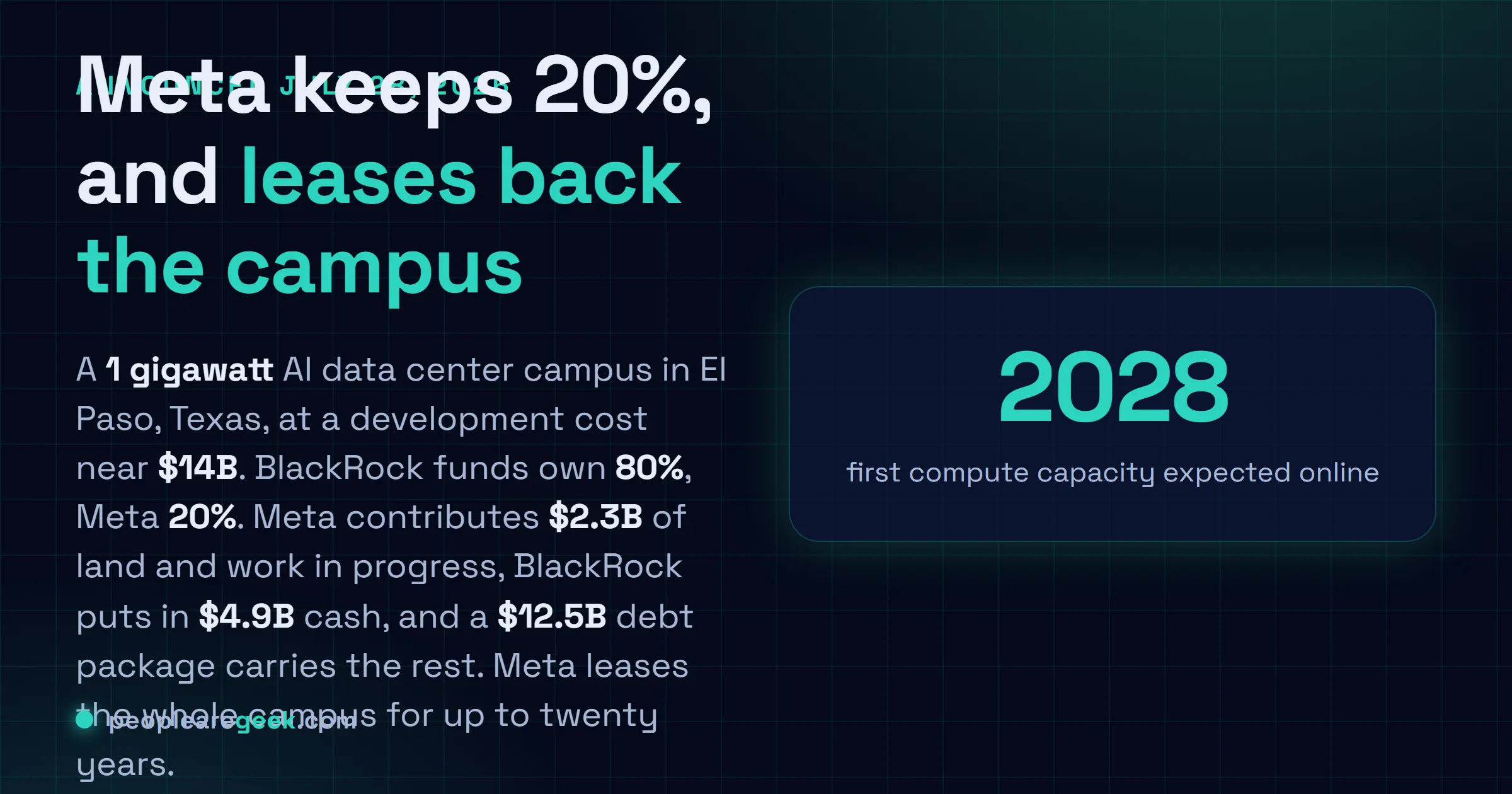
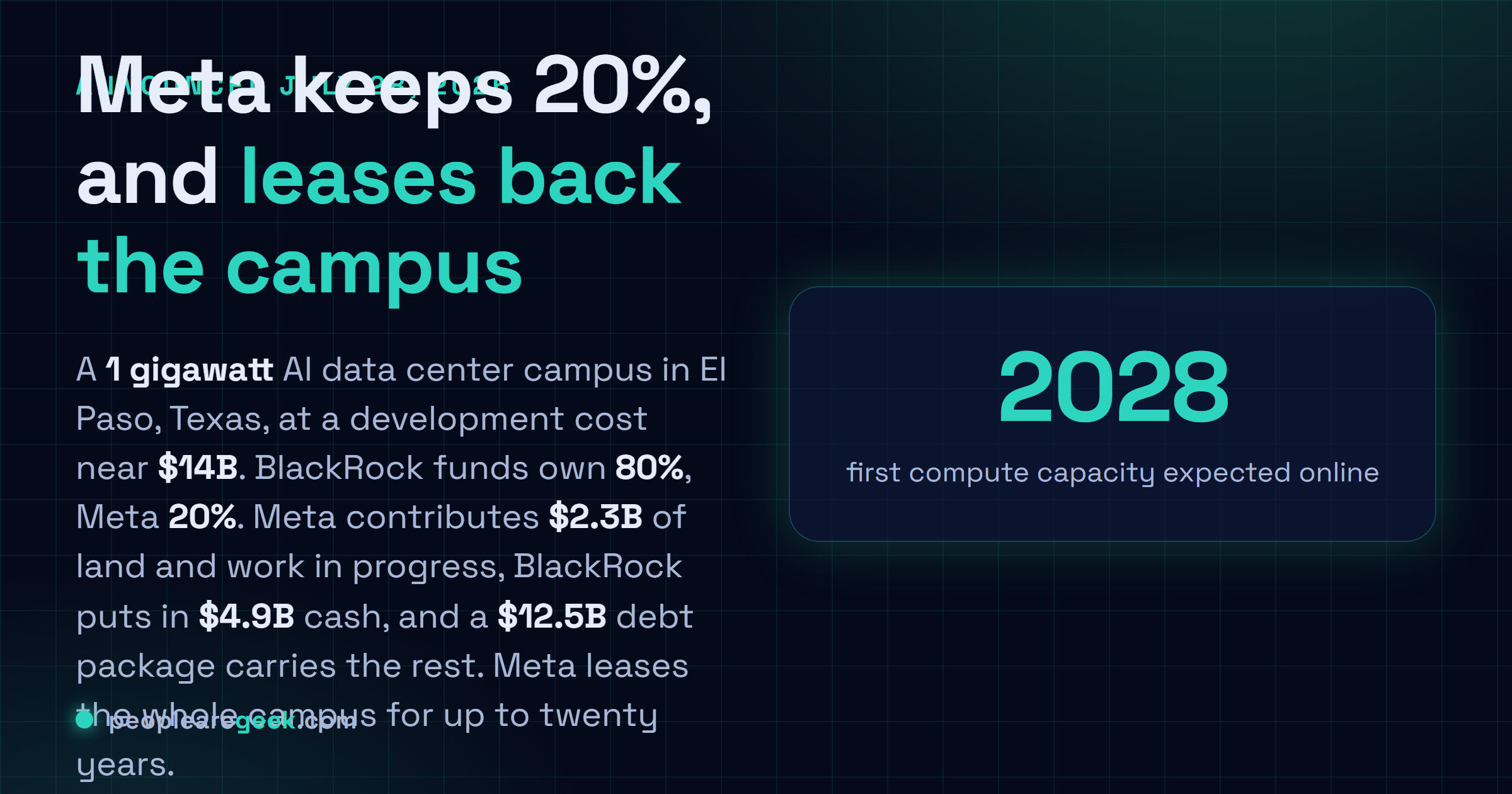
Meta and BlackRock announced on Tuesday July twenty eighth a venture to develop a 1 gigawatt AI data center campus in El Paso, Texas, at a development cost of about $14 billion. Funds managed by BlackRock will own 80% and Meta 20%. Meta contributes land and partially completed construction assets worth about $2.3 billion, BlackRock invests roughly $4.9 billion in cash at closing, and the venture raises a $12.5 billion debt package. Meta takes a one time distribution of about $1 billion and leases the whole campus as sole initial occupant, four years initially with four extensions out to twenty. First capacity is expected in 2028.
Read past the headline number and this announcement is not really about a data center. It is about who holds the asset, and Meta has arranged for that to be somebody else.
The money, in the order it moves
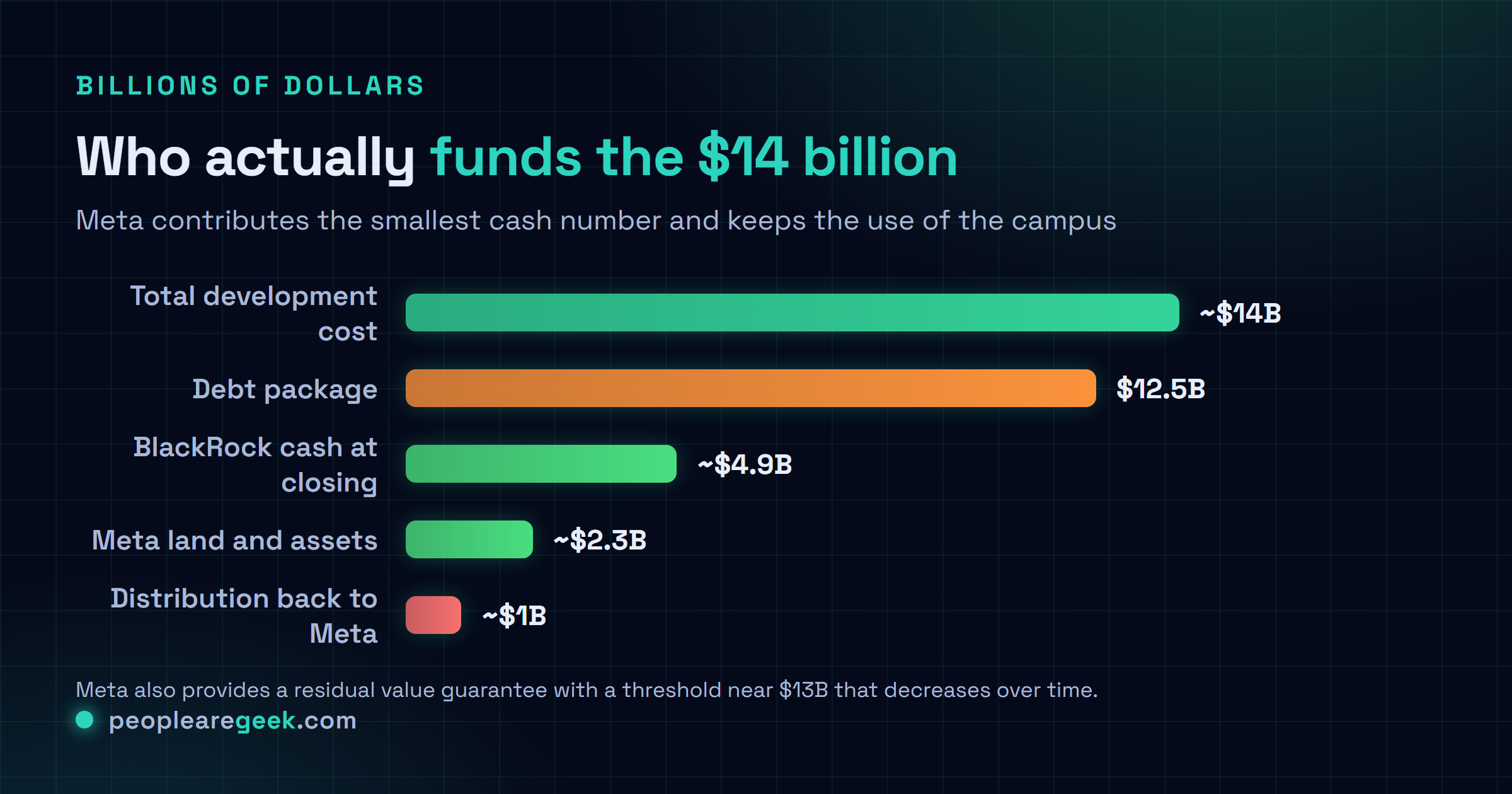
Meta puts in land and partially completed construction work valued at roughly $2.3 billion. BlackRock funds put in about $4.9 billion in cash at closing. The venture raises a $12.5 billion debt package. Total development cost lands near $14 billion.
BlackRock funds end up owning 80% of the venture. Meta owns 20%, takes a one time distribution of about $1 billion, and provides a residual value guarantee with a threshold around $13 billion that decreases over time.
Then Meta leases the entire campus back, as sole initial occupant, on an initial four year term with four further four year options. Twenty years of occupancy if it exercises them all.

What the structure buys each side
Meta gets a gigawatt of capacity, on its own schedule, in a location where it has already been building since October 2025, without carrying the full $14 billion build itself. Ownership and use are separable things, and only one of them shows up as capital expenditure.
BlackRock gets a long dated, contracted infrastructure asset with a single creditworthy tenant on a lease that can run twenty years. That is close to the ideal shape for the kind of capital BlackRock manages, which is why Larry Fink's line about being built to meet that need is doing real work rather than being decorative.
Mark Zuckerberg framed it in terms of speed: the partnership allows Meta to move faster and at greater scale. Both things can be true. The structure is faster and it is also lighter on the balance sheet, and the second is not a side effect.
For anyone watching hyperscaler capital expenditure figures as a proxy for how much AI capacity is being built, this arrangement is a reminder that the figures are getting harder to read. A gigawatt built this way does not appear in the same place as a gigawatt built the old way.
The constraint is not the chips
A gigawatt describes electrical capacity, not servers. It covers compute, cooling, conversion losses and everything else that draws from the meter, and it is the unit the industry uses because power is what actually gates a campus coming online.
Two numbers in this announcement describe the real bottleneck better than the dollar figures do.
The first is the labour split. More than 4,000 construction jobs at peak, with more than 2,300 workers already onsite, against roughly 300 permanent operational roles once the campus runs. A gigawatt campus is a construction project that leaves behind a small operations team.
The second is more interesting. The BlackRock Foundation is putting nearly $30 million into a workforce programme called Future Builders, expected to train more than 12,000 electricians over three years.
When an infrastructure investor of that size starts funding trade schools, it is telling you what it cannot buy. Accelerators have a lead time. Grid interconnection has a queue you can at least join. Qualified electricians to terminate cable, land busway and commission switchgear have neither, and there are not enough of them. Anyone who has tried to schedule an electrical contractor for a modest data hall expansion this year already knows this, at a smaller scale and with less patience.
What to watch
The venture is expected to close in the coming days. First compute capacity is expected online in 2028, which is the date to hold onto: three years from groundbreaking to first watts, for a project with a hyperscaler's balance sheet and an asset manager's capital behind it.
If that date slips, it will be worth knowing whether it slipped on power, on equipment, or on people.
Sources and further reading
- Meta newsroom: new strategic venture with BlackRock to develop a data center in El Paso
- Meta investor relations press release
- CNBC: Meta and BlackRock partner on $14 billion El Paso data center
- Bloomberg: Meta and BlackRock plan to invest in a giant Texas data center
- Meta: breaking ground on the AI optimized data center in El Paso, October 2025
Frequently asked questions
What is the actual structure of this deal?
A joint venture that develops and owns the campus, with funds managed by BlackRock holding 80% and Meta holding 20%. Meta contributes land and partially completed construction assets valued at about $2.3 billion. BlackRock contributes roughly $4.9 billion in cash at closing, and the venture raises a $12.5 billion debt package. Meta receives a one time distribution of about $1 billion and takes a residual value guarantee with a threshold near $13 billion that decreases over time. Meta then leases the entire campus as sole initial occupant, on an initial four year term with four further four year options, giving a potential occupancy of twenty years.
Why would Meta give away 80% of something it wants to use?
Because ownership and use are separable, and only one of them lands on the capital expenditure line. Meta contributes about $2.3 billion of land and work in progress and receives roughly $1 billion back at closing, while BlackRock's cash and a $12.5 billion debt package fund the rest of a $14 billion build. Meta still controls the campus for up to twenty years through the lease, and it is the only tenant. The company gets the capacity on its own schedule without carrying the full build on its balance sheet, and BlackRock gets a long dated contracted asset with a creditworthy single tenant. That is the trade, and it is why this structure keeps appearing across the industry.
What does 1 gigawatt of compute capacity actually mean?
It describes the electrical capacity the campus is built to draw, not a measure of servers or of computation. A gigawatt is roughly the output of a large nuclear reactor, and it is the unit the industry has settled on because power, not silicon, is what limits how fast a campus can be brought online. The figure covers the whole facility: the compute itself plus cooling, conversion losses and everything else on the meter. It is also why the interesting questions about a project like this are about grid interconnection and construction labour rather than about which accelerators go in the racks.
When does any of it run, and how many people work there?
First compute capacity is expected online in 2028, which is three years after Meta broke ground on the El Paso site in October 2025. Construction is expected to support more than 4,000 jobs at peak, with more than 2,300 workers already onsite. Once the campus is fully operational, the permanent operational headcount is expected to be around 300. That ratio between construction and operations is normal for this kind of facility and worth remembering whenever a data center is described as a jobs programme. The durable employment is in building them, not in running them.
What is the electrician number about?
Alongside the venture, the BlackRock Foundation is funding a workforce programme called Future Builders with an investment of nearly $30 million, expected to train more than 12,000 electricians over three years. An infrastructure investor spending real money to manufacture skilled trades is a signal about what is actually scarce. Accelerators can be bought, and grid interconnection can eventually be negotiated. The people who terminate the cable, land the busway and commission the switchgear cannot be ordered on a lead time, and there are not enough of them. That constraint applies to anyone building capacity right now, at any scale.