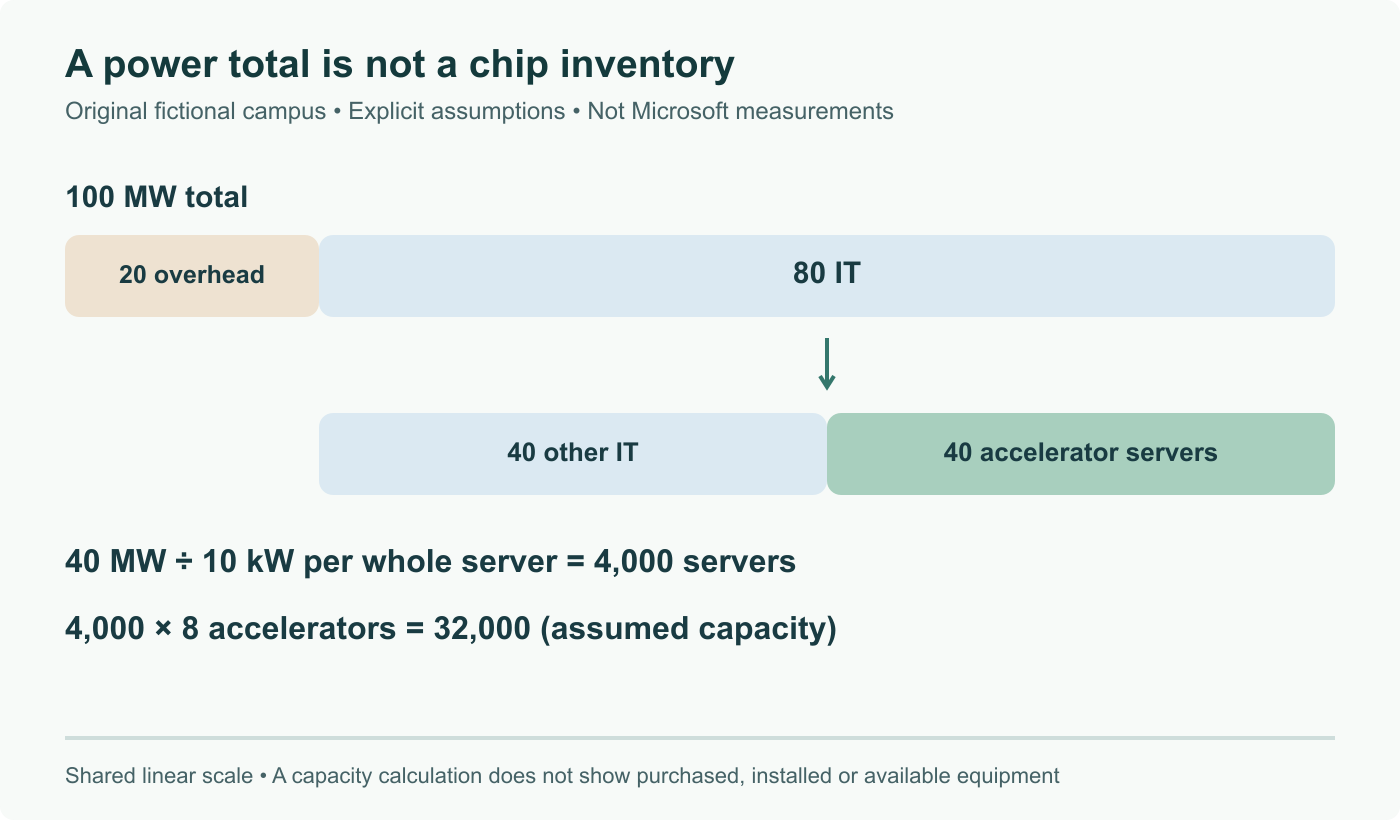
The Guardian published a report on August seventeenth, 2026 saying internal documents put Microsoft at roughly two point two million AI chips installed worldwide, after about two hundred eighty billion dollars of spending since 2022. Microsoft disputes the calculation without saying which figure is wrong, so treat the number as contested rather than settled. What is not contested is the mechanism the story describes, and it is the one every capacity planner already recognises. Chips are not the binding constraint. Warm shells, grid connections and commissioned power are, and Satya Nadella has said so on the record himself.
The short answer
The Guardian reported on August seventeenth, 2026 that internal documents put Microsoft at about two point two million installed AI chips worldwide, after roughly two hundred eighty billion dollars of spending since 2022 and against an internal target of one point eight million by the end of 2024. Fewer than five hundred thousand Blackwell parts are said to be installed. Microsoft calls the calculations inaccurate without naming a figure. The mechanism underneath is not in dispute: power and buildings gate deployment, not chip supply.
Anyone who has waited eleven months for a power upgrade on a single room will read this story differently from the way the finance press is reading it.
What was reported
The Guardian published on Monday, August seventeenth, 2026, citing internal Microsoft documents it had reviewed. The headline claim is that Microsoft has approximately two point two million AI chips installed across its global fleet, after spending roughly two hundred eighty billion dollars since 2022 on land, buildings, computing infrastructure and related expansion, including more than forty one billion dollars in the past quarter alone.
Two supporting details give the number its shape. An internal target reportedly called for one point eight million chips installed by the end of 2024, which means the fleet grew by around four hundred thousand over the following period rather than multiplying. And the newer parts are thinner on the ground than expected: fewer than five hundred thousand Blackwell accelerators installed, against roughly one million anticipated. An Nvidia specialist quoted in the article put it simply, saying the figures were lower than expected.
Microsoft's response was that the calculations are inaccurate and draw the wrong conclusions from incorrect assumptions. The company did not say which figures it considers wrong.
We are going to treat that as a genuine and unresolved objection. Nobody outside the reporting can see the documents, and a company disputing a number without correcting it is not the same as the number being wrong.
The gap is the interesting part, whatever the exact figure is
Set the dispute aside for a moment and look at the ratio. Two hundred eighty billion dollars of capital expenditure against a couple of million accelerators does not divide into anything resembling a chip price. Even at the most generous per unit assumptions, the accelerators are a minority of that spend.
Which is exactly what you would expect, and exactly what makes the story useful. The money went into land, into buildings, into substations, into cooling plant, into fibre. The chips are the part everyone counts because they are the part with a name and a launch date, and they are not the part that takes the time.
This is the same arithmetic we looked at in Nvidia's guarantee for the Ohio campus published the same day, where ten gigawatts of new generation is expected to yield eight gigawatts of usable IT capacity. The industry is spending most of its capital on everything that is not a GPU.
Chips in inventory are not capacity
Satya Nadella has already described this constraint publicly and in blunt terms, saying the biggest issue is not a compute glut but power, and that the company can end up with chips sitting in inventory it cannot plug in for lack of warm shells.
That sentence is worth keeping because it inverts the usual mental model. The intuitive story of the last three years is that accelerators are scarce and everything else is a formality. The operational reality is closer to the opposite. Fabs can respond to demand in quarters. A substation, an interconnect agreement, a commissioned building and a cooling loop respond in years, and they respond to regulators and utilities rather than to purchase orders.
So a fleet that grows more slowly than the capital spend suggests is not a sign that something went wrong. It is the visible shape of a supply chain whose slowest element is civil engineering.
The capacity numbers do not reconcile either
The reporting's second thread is about gigawatts rather than chips, and it is the one worth borrowing for your own vendor conversations.
Microsoft describes roughly five gigawatts of datacenter capacity added over two years. A 2024 internal presentation reportedly indicated five gigawatts already installed at that point, which would put the total near ten gigawatts today. Meanwhile Microsoft's own sustainability reporting, according to the Guardian, points to something closer to one point two gigawatts of AI capacity in 2024. Professor Shaolei Ren, quoted in the piece, argued that sustainability filings are the more credible source, because they are prepared for regulators rather than for a keynote.
The reconciliation is probably not fraud, it is vocabulary. Announced capacity, contracted capacity, built capacity, energised capacity and commissioned IT capacity are five different numbers that can all legitimately be called capacity, and they can differ by a factor of several. Press releases almost never specify which one is meant.
What to actually do with this
Nothing in this report changes an architecture. It should change two habits.
First, when a provider quotes capacity, ask which of those five numbers it is, and ask specifically what is energised and commissioned today in the region you need. The answer is usually available and rarely volunteered.
Second, plan on the assumption that large contiguous accelerator allocations stay scarce and regionally uneven through the next planning cycle, because the constraint is being built out of concrete and copper rather than silicon. That means treating region and instance family as variables you can move, keeping reservation lead times in the roadmap rather than assuming on demand supply, and knowing in advance which workloads you would relocate if the region you want has no power headroom.
That is the same conclusion Microsoft's own capacity commentary pointed at when Azure passed a hundred billion dollars a year and still reported demand above available capacity. Two very different sources, one constraint.
Sources and further reading
- Are Microsoft's AI plans being held back by a shortage of chips?, the Guardian, August 17, 2026
- Are Microsoft's AI plans being held back by a shortage of chips?, AOL UK syndication, August 17, 2026
- Microsoft CEO says the company doesn't have enough electricity to install all the AI GPUs in its inventory, Tom's Hardware
- The Week Ahead in AI: Stripe Acquiring OpenRouter, Microsoft and AI Chips, The AI Insider, August 17, 2026
- Microsoft brings 1GW of data center capacity online in Q2 2026, Data Center Dynamics
Frequently asked questions
What did the Guardian actually report, and how solid is it?
The Guardian published on August seventeenth, 2026, citing internal Microsoft documents it had reviewed. The core claims are that Microsoft has about two point two million AI chips installed globally, that it spent roughly two hundred eighty billion dollars since 2022 on land, buildings and computing infrastructure including more than forty one billion in the past quarter, that an internal target called for one point eight million chips by the end of 2024, and that fewer than five hundred thousand Blackwell parts are installed against expectations closer to one million. Microsoft responded that the calculations are inaccurate and draw the wrong conclusions from incorrect assumptions, without identifying which figures it disputes. That is a real objection with no detail attached, so the honest description is a contested report from documents nobody else can see.
Is 2.2 million AI chips a small number or a large one?
Both, depending on the comparison. In absolute terms it is one of the largest accelerator fleets on earth. Against the spending it is the point of the story, because two hundred eighty billion dollars buys a great deal more silicon than that at any plausible unit price, which means most of the money went into land, shells, power and cooling rather than accelerators. An Nvidia specialist quoted in the piece said the figures were lower than expected. The gap between money spent and chips running is not evidence of waste, it is evidence of what the buildout actually consists of.
Why would chips sit uninstalled at all?
Because an accelerator needs a finished building, commissioned power, cooling capacity and network fabric before it serves a single request, and those take years while a chip order takes months. Satya Nadella has said publicly that the company can end up with chips in inventory it cannot plug in, and that the problem is power rather than a compute glut. A rack without a warm shell to sit in is inventory, not capacity. That sequencing is the single most useful thing in the story for anyone who plans infrastructure at any scale.
What does this mean for teams buying GPU capacity on Azure or anywhere else?
It supports what the pricing already tells you. Availability of large contiguous accelerator allocations stays tight, regional availability stays uneven, and the regions with power headroom are not always the regions near your users or your data residency boundary. The practical response is unchanged and unglamorous: treat region and instance family as a planning variable rather than a constant, ask providers about commissioned capacity rather than announced capacity, and put reservation lead times in your roadmap instead of assuming on demand supply.
How does this square with the capacity figures Microsoft publishes?
That tension is the reporting's second thread. The company describes about five gigawatts of datacenter capacity added over two years, while a 2024 internal presentation reportedly indicated five gigawatts already installed at the time, which would imply roughly ten gigawatts today. The Guardian notes that Microsoft's own sustainability reports point to something closer to one point two gigawatts of AI capacity in 2024. Professor Shaolei Ren, quoted in the piece, argued that sustainability filings carry more credibility than announcements, because they are compiled for a different purpose and a different audience. Announced capacity, contracted capacity, built capacity and commissioned capacity are four different numbers, and press releases rarely say which one they mean.