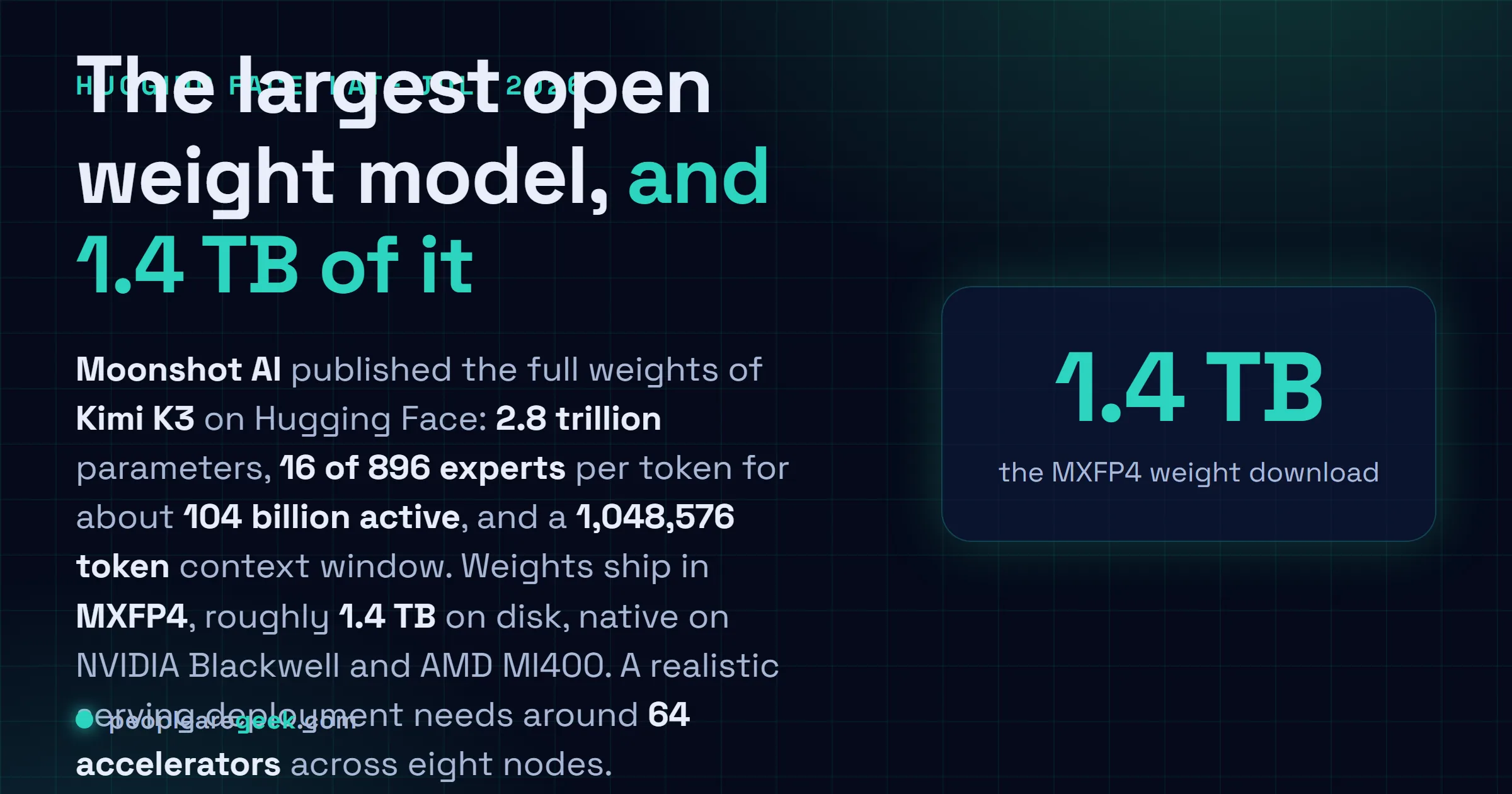
Moonshot AI has published the full weights of Kimi K3 on Hugging Face, making a 2.8 trillion parameter mixture of experts model the largest open weight release to date. The download is roughly 1.4 terabytes in MXFP4, and a serving deployment needs something in the order of sixty four accelerators across eight nodes, so this is not a laptop story. What makes it worth your afternoon anyway is what shipped alongside the weights: the attention kernels, the MoE communication library, and the harness Moonshot uses to run agent environments at scale. The license is the part that needs reading twice.
The short answer
Moonshot AI has published the complete weights of Kimi K3 on Hugging Face, a 2.8 trillion parameter sparse mixture of experts model that activates 16 of its 896 experts per token for roughly 104 billion active parameters. Context window is 1,048,576 tokens. The weights ship in MXFP4, about 1.4 terabytes on disk, natively supported by NVIDIA Blackwell and AMD MI400 class accelerators. Alongside the checkpoint Moonshot opened its attention kernels, its MoE communication library, and its agent environment infrastructure. The license is MIT like with a separate agreement required above roughly 20 million dollars of model as a service revenue.
The model was unveiled on July sixteenth and the API went live shortly after. What arrived in the last day or so is the thing that actually changes anyone's options: the checkpoint itself, downloadable, with a technical report next to it.
What is in the box
Kimi K3 is a sparse mixture of experts model with 2.8 trillion parameters stored and around 104 billion participating per token. The router selects 16 experts out of 896. If you have only ever worked with dense models, the practical consequence is that your memory budget is set by the big number and your compute budget by the small one.
Attention is split across 93 layers, 69 of them using Kimi Delta Attention and 24 using gated multi head latent attention. Kimi Delta Attention is Moonshot's hybrid linear attention scheme, and the claim attached to it is up to 6.3 times faster decoding at a full one million token context compared to the previous approach. Context length is 1,048,576 tokens, and vision comes from MoonViT-V2, a 401 million parameter encoder that gives the model native image and video understanding rather than a bolted on captioning step.
The weights are MXFP4 with MXFP8 activations, and this is not a post training compression pass. Moonshot trained with quantisation awareness, which is why the four bit checkpoint is the reference artefact rather than a lossy convenience build. MXFP4 runs natively on NVIDIA Blackwell and on AMD MI400 class accelerators.
The hardware arithmetic

Here is where enthusiasm meets a spreadsheet. The MXFP4 download is roughly 1.4 terabytes. Expanded to 16 bit it is about 5.6 terabytes, which is why nobody is going to do that.
Holding 1.4 terabytes of parameters takes eighteen 80 gigabyte accelerators at absolute minimum, and that is before a single token of key value cache exists. A deployment that serves concurrent requests at meaningful context lengths needs headroom, and the figure that keeps appearing in deployment write ups is around sixty four accelerators across eight nodes. vLLM and SGLang both support the model, so the software side is not the obstacle.
That arithmetic sorts the audience cleanly. If you already operate a GPU cluster, the open weights mean you can run a frontier class model with no data leaving your network and no per token bill, which for regulated workloads is the entire argument. If you do not, the weights are interesting reading and you will use the API or a hosted endpoint like everyone else. Together AI and Modal both had hosting available on day zero.
How it scores
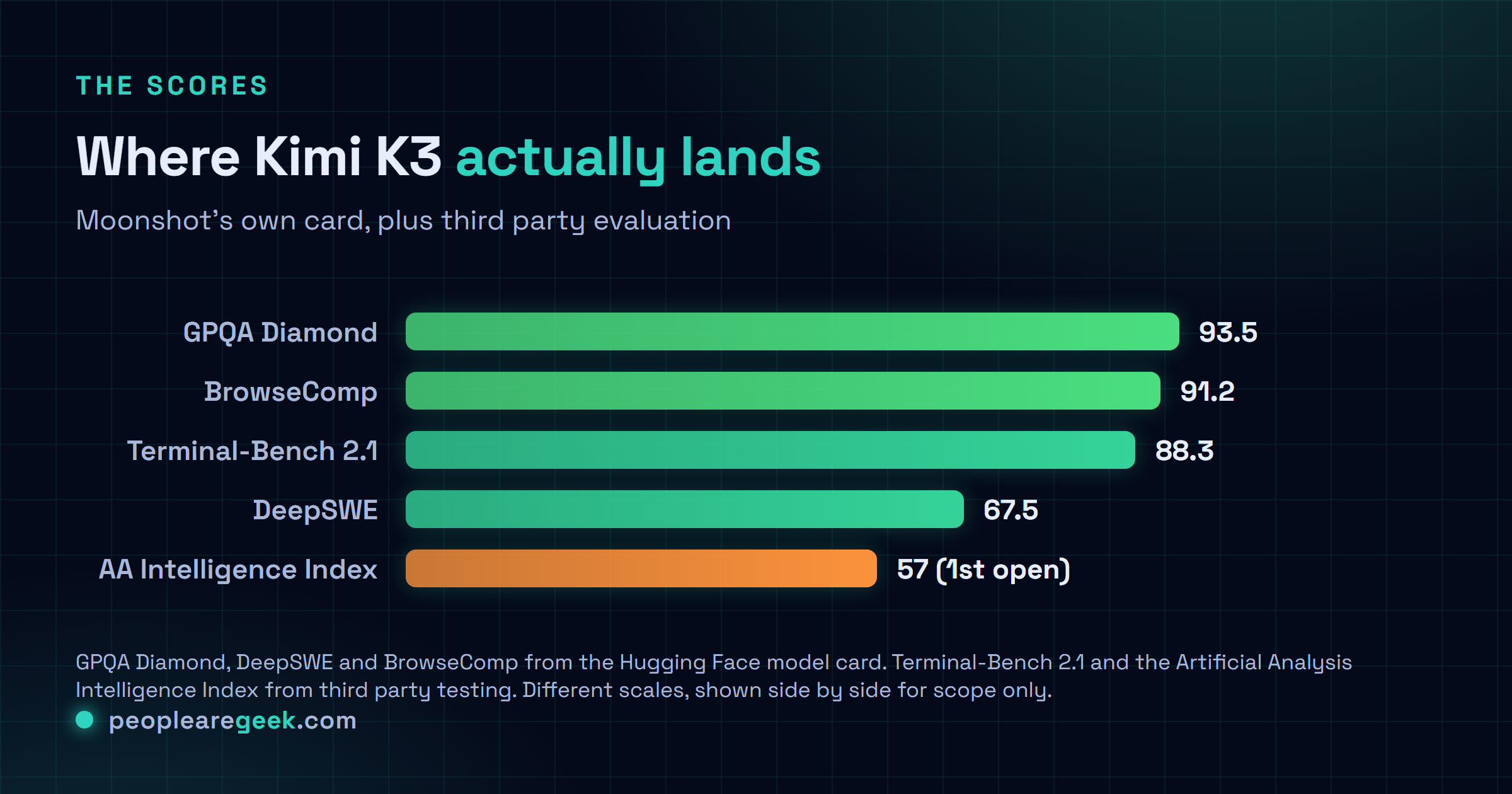
Moonshot's own card reports 93.5 on GPQA Diamond for reasoning, 67.5 on DeepSWE for coding, and 91.2 on BrowseComp for agentic browsing. Third party numbers broadly agree with the shape of that: 88.3 on Terminal-Bench 2.1, first place among open weight models on the Artificial Analysis Intelligence Index at 57, and the top spot on Arena WebDev for front end code, ahead of several closed frontier models.
The framing Moonshot chose for the architecture work is the more interesting claim. Rather than leading with the parameter count, the company describes roughly 2.5 times the intelligence per unit of compute compared to Kimi K2. Independent testing has been more measured, with Fireworks AI describing specialisation rather than across the board dominance when the model is compared with frontier systems. Both readings can be true, and the sensible response is the same either way: run your own evaluation set.
Reading the license properly
The weights are not under plain MIT, whatever the shorthand in some coverage suggests. Moonshot ships them under a document it calls the Kimi K3 License. The substance is MIT like, free for commercial use with attribution, plus a threshold clause: a model as a service business above roughly 20 million dollars in annual revenue, or serving a very large monthly user base, needs a separate agreement with Moonshot. Artificial Analysis classified it as commercial use restricted on that basis.
For most readers of this site that clause is theoretical. If you are deploying the model inside a company to serve your own products, your own staff, or your own customers as part of a wider product, nothing in it constrains you. If your plan is to sell inference on Kimi K3 as the product, that is precisely the case the clause exists to cover, and the text belongs in front of a lawyer before it goes into a pricing page.
What to take from it
The three infrastructure releases are the most portable part of this announcement, and they got the least attention. Attention kernels for a hybrid linear scheme, a communication library for MoE routing, and a harness for running agent environments at scale are all problems that teams serving large sparse models solve badly and privately. Having a reference implementation from a lab that runs one at this size is useful whether or not you ever load the checkpoint.
For the model itself, treat it as a serious option to benchmark rather than a migration to schedule. Point a hosted endpoint at your own evaluation set this week. The interesting question is not whether Kimi K3 is good, since the benchmark field has answered that, but whether it is good at the specific thing you need at a price and latency you can live with.
Sources and further reading
- The Kimi K3 model card on Hugging Face
- The Kimi K3 technical report repository on GitHub
- VentureBeat: Kimi K3's full weights are here, but they are open with a caveat
- The New Stack: Moonshot opens Kimi K3 weights, but few can run it
- Interconnects: Kimi K3, the open weights escalation
Frequently asked questions
What can I actually run at home?
Nothing, in the honest sense of the question. The weights occupy about 1.4 terabytes in the MXFP4 format Moonshot trained them in, and roughly 5.6 terabytes if you expand them to 16 bit. Even the compressed figure needs eighteen 80 gigabyte accelerators just to hold the parameters before a single request arrives, and a deployment that serves real traffic with room for the key value cache at long context lands nearer sixty four accelerators spread over eight nodes. The open weights matter for a different reason than local inference: they let an organisation that already owns a cluster run this model on its own hardware, inside its own network, with no request leaving the building.
Is the license really open?
It is permissive for most people and conditional for a few. Moonshot ships the weights under what it calls the Kimi K3 License, close to MIT in spirit, with an attribution requirement and a clause that kicks in at scale: a model as a service business above roughly 20 million dollars in revenue, or with a very large monthly user base, has to enter a separate agreement with Moonshot. Artificial Analysis labelled it commercial use restricted for exactly that reason. If you are a company running the model for your own products or internal work, the conditions almost certainly never apply to you. If you plan to resell inference on it as your business, read the text before you build a price list on top of it.
How does 2.8 trillion parameters square with 104 billion active?
Those are two different counts and both are real. The model holds 896 experts, and the router picks 16 of them per token, so the parameters that participate in any single forward pass total around 104 billion out of the 2.8 trillion stored. Memory cost tracks the large number because every expert has to be resident and reachable. Compute cost per token tracks the small one. That gap is the whole point of a sparse mixture of experts design, and it is why a model this large can be served at a price per token that competes with much smaller dense models.
What did Moonshot release besides the weights?
Three things that are arguably more reusable than the checkpoint. The attention kernels Moonshot wrote for Kimi Delta Attention, its hybrid linear attention scheme, which the company credits with up to 6.3 times faster decoding at one million tokens of context. A communication library for mixture of experts routing, which is the part of MoE serving that usually turns into custom in house plumbing. And infrastructure for running agent environments at scale, meaning the harness used for training and evaluating tool using behaviour. A team building on any large MoE model can take those pieces without touching Kimi K3 itself.
Should this change what model I use in production?
Probably not this week, and the reason is operational rather than about quality. Third party evaluations put Kimi K3 at or near the top of the open weight field, first on the Artificial Analysis Intelligence Index among open models and leading Arena WebDev, with strong coding numbers. The published API price of 3 dollars per million input tokens and 15 dollars per million output is competitive. What has not happened yet is the boring part: weeks of production traffic, latency data under load, and the retry and refusal behaviour that only shows up at volume. Run it against your own evaluation set on a hosted endpoint first. Together AI and Modal both had hosting up on release day, so the trial costs you an afternoon rather than a procurement cycle.