NVIDIA is in talks to guarantee roughly two hundred fifty billion dollars of debt so that OpenAI can lease a ten gigawatt data center campus in Piketon, Ohio. That is the report, attributed to the Wall Street Journal and picked up widely on Monday, July twenty seventh. It is worth separating from the headline number, because NVIDIA is not writing a cheque here. It is putting its balance sheet behind somebody else's lease and construction debt, which is a different instrument with very different consequences. The campus sits on a decommissioned Cold War uranium enrichment site, runs mostly on new natural gas generation, and at full build out would roughly double the capacity of the largest data center hub on earth.
The short answer
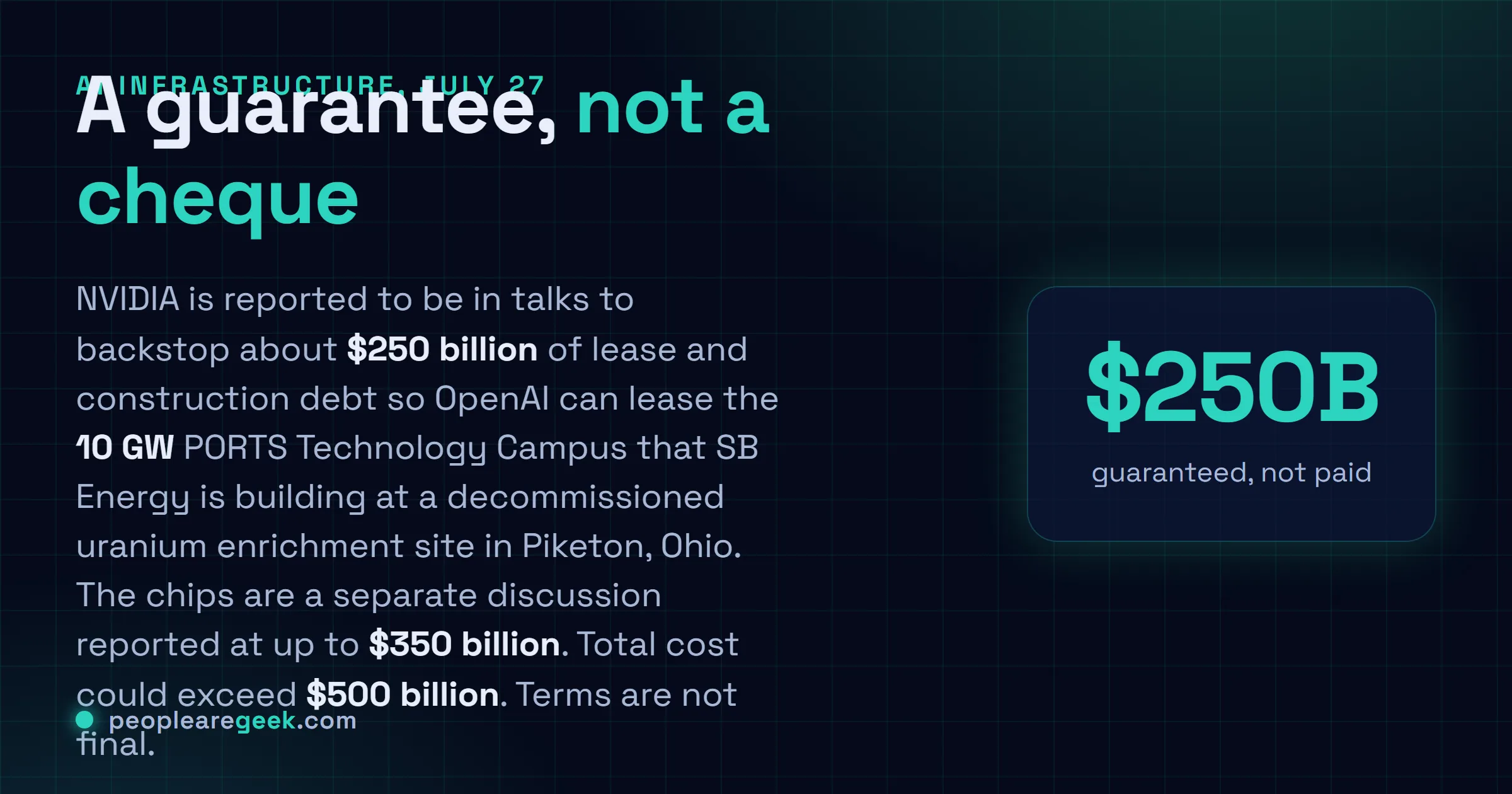
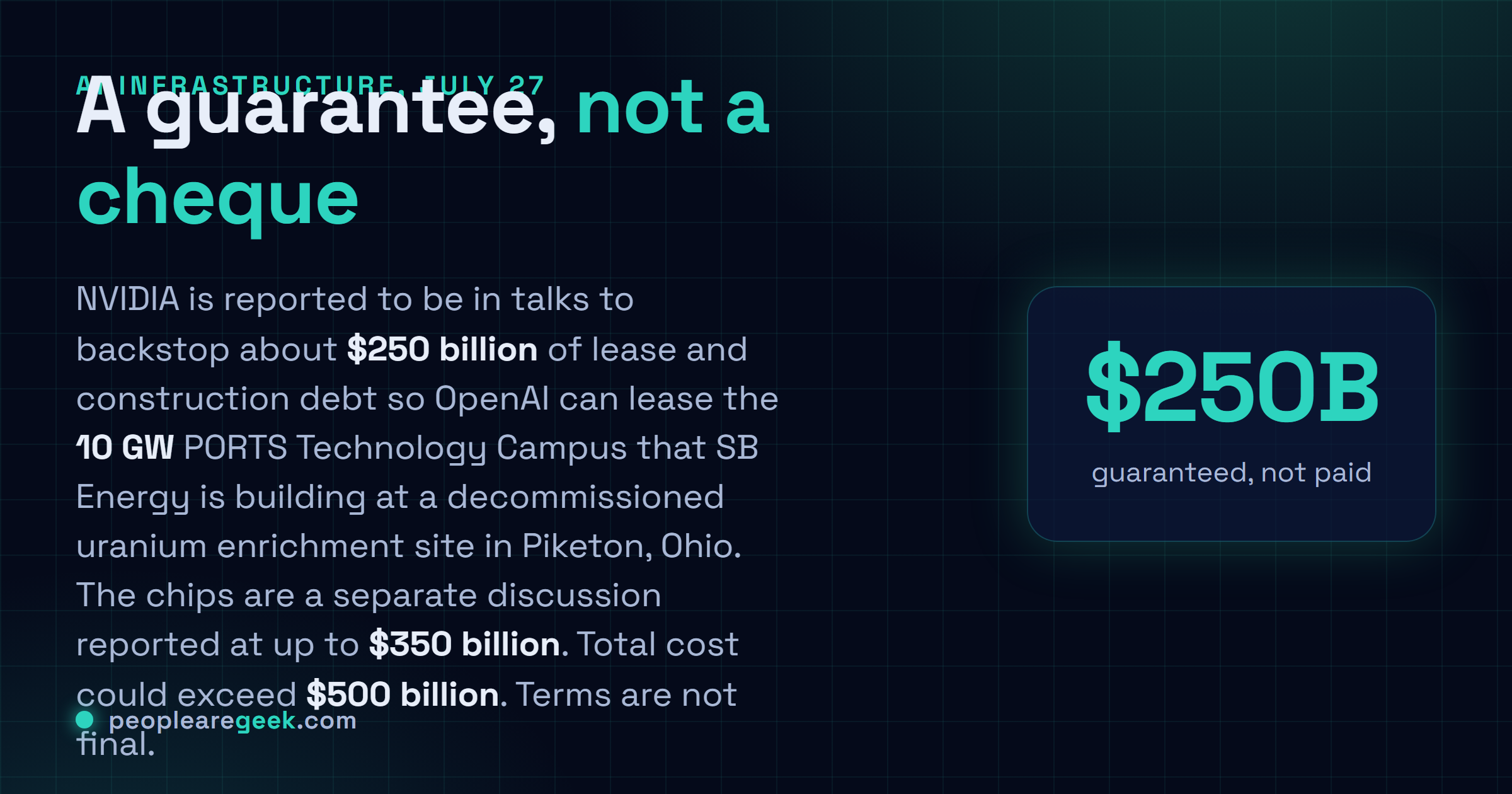
NVIDIA is reported to be in talks to backstop about $250 billion of debt so OpenAI can lease the PORTS Technology Campus, a ten gigawatt site SB Energy is developing at a decommissioned uranium enrichment plant in Piketon, Ohio. The guarantee covers the lease and construction debt, not the chips, which are the subject of a separate discussion reported at up to $350 billion. The structure exists because OpenAI has no investment grade rating. First phase is roughly 800 MW by early 2028. Terms are not final.
Most infrastructure news gives you a thing you can eventually rack, boot and monitor. This one gives you a financing structure, and the financing structure is the news. It is the part that decides whether ten gigawatts of concrete and gas turbines in southern Ohio ever exists.
What a backstop actually is
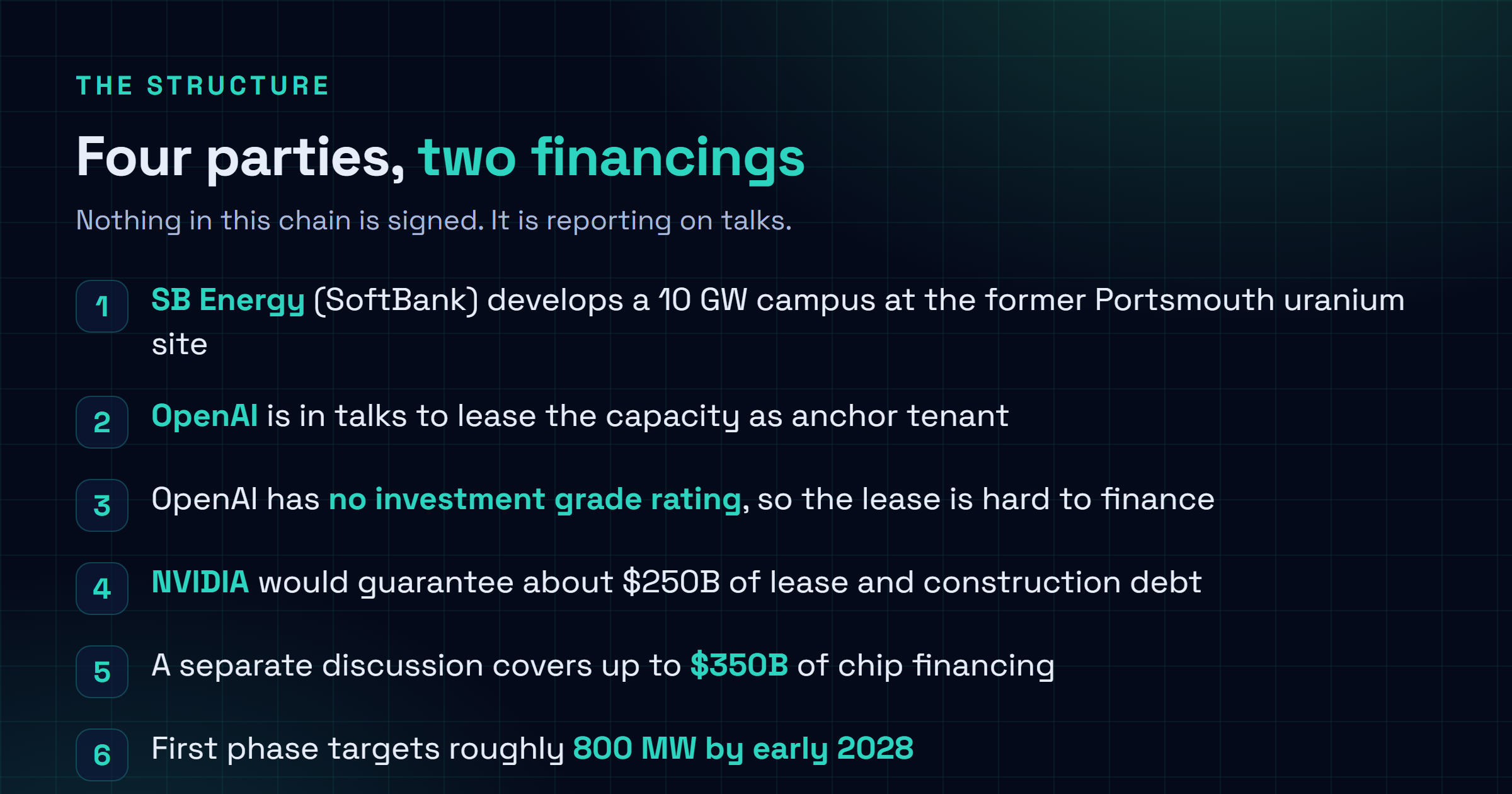
The word doing the work is guarantee. NVIDIA is not reported to be investing $250 billion, lending $250 billion or spending $250 billion. It is reported to be considering a promise to lenders: if OpenAI defaults on the lease payments or the construction debt behind this campus, NVIDIA makes those lenders whole.
At signing, nothing moves except risk. The lenders get a counterparty they are comfortable with, the developer gets to borrow at a rate that makes the project pencil out, and NVIDIA carries a contingent liability that only becomes real money if things go wrong. In the good case NVIDIA pays nothing at all and the guarantee quietly expires alongside the debt.
That is why the structure exists, and it points straight at the problem it solves. OpenAI is a private company, it is not profitable, and it does not have an investment grade credit rating. A twenty year lease signed by a counterparty like that is not paper you can build a cheap debt stack on. Swap in NVIDIA's credit and suddenly you can. The guarantee is a translation layer between the tenant everyone wants and the balance sheet lenders will accept.
It is worth being precise about coverage, because the numbers in circulation get added together carelessly. The $250 billion is the lease and construction debt: buildings, substations, the campus itself. The GPUs are not in it. NVIDIA is separately reported to be discussing financing for OpenAI's chip purchases at this site, potentially as much as $350 billion. Two deals, two risk profiles, and only one of them was the headline.
Three thousand seven hundred acres of Cold War
The site has a history that is hard to invent. The PORTS Technology Campus is planned across roughly 3,700 acres of federal land at the former Portsmouth Gaseous Diffusion Plant, about fifty miles south of Columbus. Built in the nineteen fifties, it enriched uranium for the Atomic Energy Commission, the weapons program and Navy submarines, and it stopped enriching in 2001.
SoftBank announced the campus in March 2026, with groundbreaking the same month. The scale is the part that resists intuition. Northern Virginia, which is the largest concentration of data centers anywhere on the planet, held something like five gigawatts of total capacity in 2025. This single site is planned for ten. Pike County has a population of roughly twenty eight thousand people.
Power is the reason a decommissioned industrial megasite is attractive rather than a greenfield. The campus is paired with ten gigawatts of new generation, of which at least 9.2 gigawatts is natural gas, reported as a $33.3 billion build, plus a $4.2 billion transmission investment with AEP Ohio. Federal land, existing heavy industrial interconnection, and a state willing to permit the gas.

The circularity argument, fairly stated
The criticism arrived within hours and it is not stupid. Jim Chanos characterised the arrangement as NVIDIA effectively financing its own chip sales. Michael Burry made the same observation more briefly. The shape of the objection is that NVIDIA guarantees the debt that lets OpenAI commit to a campus, and the campus is then filled with NVIDIA silicon purchased partly through NVIDIA arranged financing. Revenue that returns to the vendor who underwrote it is revenue with a footnote.
The defence is that vendor financing is genuinely ordinary. Telecom equipment makers did it for years, aircraft manufacturers do it continuously, and the practice is neither hidden nor exotic. A supplier with a strong balance sheet lends its creditworthiness to a customer who needs capacity now, because the supplier wants the order.
Both things are true, and the disagreement is really about magnitude and concentration. Vendor financing at ordinary scale spreads across many customers, so no single default matters much. Here the exposure concentrates in one customer, on one site, in one technology cycle, at a number that is a meaningful fraction of very large balance sheets. That is a different risk shape even if the mechanism is familiar, and it is fair to say so without claiming anything improper is happening.
What this means if you buy compute
In the short term, nothing. There is no capacity here before 2028, so your quotas, your queue times and your per token pricing over the next eighteen months are entirely unaffected by whether this deal closes.
The signal is about which constraint the industry is spending its balance sheet on. The money in this story is going to land, gas turbines, transmission lines and buildings. It is not going to fabs. Read that as a statement about where the ceiling is expected to be: the people writing the largest cheques in the industry believe the binding limit on AI compute later this decade is electricity and the permitting to deliver it, not the ability to manufacture accelerators.
If that read is right, the practical consequence for anyone budgeting inference over a multi year horizon is that the cost curve gets tied to power markets more tightly than to silicon generations. Regions with cheap firm power and a permitting culture become the places capacity actually shows up, which is a planning input if you have data residency requirements or latency budgets that assume compute will be available near your users.
One last caution worth keeping in front of the excitement. This is reporting on talks, not an announcement. Terms are not finalised, and the deal could fall apart. The gap between a ten gigawatt announcement and ten gigawatts of energised capacity has swallowed a lot of projects that also had impressive numbers attached.
Sources and further reading
- Tom's Hardware: NVIDIA weighs a $250 billion guarantee so OpenAI can lease SoftBank's 10 gigawatt Ohio campus
- DIGITIMES: NVIDIA weighs a US$250B backstop for OpenAI's Ohio data center
- Data Center Dynamics: OpenAI in talks to lease a 10 GW data center from SB Energy in Ohio
- Benzinga: Jim Chanos says NVIDIA is effectively financing its own AI chip sales
- SB Energy: the PORTS Technology Campus
Frequently asked questions
Is NVIDIA actually paying $250 billion?
No, and the distinction is the whole story. A backstop is a guarantee, not a payment. NVIDIA would be promising lenders that if OpenAI cannot meet its obligations on the lease and the construction debt, NVIDIA covers them. No money moves at signing. What moves is credit risk, from the lenders onto NVIDIA's balance sheet, which is why the arrangement is being discussed at all. If everything goes to plan, NVIDIA pays nothing and the guarantee simply expires with the debt.
Why does the project need a guarantee in the first place?
Because OpenAI cannot borrow at the rates this project needs. It is a private company that is not profitable and does not carry an investment grade credit rating, so a twenty year lease signed by OpenAI is not the kind of paper that lets a developer raise tens of billions cheaply. SB Energy, the SoftBank power subsidiary building the site, needs that debt on favourable terms to make the economics work. Substituting NVIDIA's credit for OpenAI's is what makes the lease financeable.
Does the backstop cover the GPUs?
No. The reported $250 billion covers the data center lease and the construction debt, meaning the buildings, the power infrastructure and the campus itself. The chips are a separate conversation. NVIDIA is reported to be discussing a distinct arrangement to finance OpenAI's chip purchases for the site, which could reach as much as $350 billion. Those are two different deals with two different risk profiles, and conflating them inflates the number considerably.
Why are people calling this circular?
Because the money largely returns to its source. NVIDIA guarantees the financing that lets OpenAI commit to a campus, and the campus is filled with NVIDIA chips bought partly with NVIDIA arranged financing. Jim Chanos described it as NVIDIA effectively financing its own chip sales, and Michael Burry made a similar point. The counterargument is that vendor financing is old and ordinary in capital intensive industries, from telecom equipment to aircraft. The open question is scale, not novelty.
When would any of this actually run workloads?
Not soon. The first phase targets roughly 800 megawatts by early 2028, at an initial cost reported between $30 billion and $40 billion. The full ten gigawatts is a build out measured in years beyond that, and it depends on a gas generation program and a transmission upgrade that have their own schedules. Terms on the NVIDIA guarantee are not final and the deal could still fall apart, so treat the 2028 date as the earliest plausible point rather than a commitment.
Should this change how I plan compute capacity?
Not your near term planning, no. Nothing here adds a single GPU hour before 2028, so quotes, quotas and queues over the next eighteen months are unaffected. What it does tell you is where the industry expects the constraint to sit. The bottleneck being financed is power and land, not silicon, which is a reasonable signal that electricity availability rather than chip supply is what will price your inference in the early 2030s.