Nvidia announced on August 11, 2026 that it has signed memorandums of understanding with six of the largest capital allocators in the world to mobilise more than 500 billion dollars for AI infrastructure. Apollo, BlackRock, Blackstone, Brookfield, Goldman Sachs and KKR will build dedicated pools of capital that Nvidia customers can draw on to fund datacenters and the hardware inside them. The mechanism underneath is what makes this worth your attention rather than a finance headline: the debt is collateralised by compute itself. Jensen Huang's argument is that a GPU has become a revenue generating asset, financeable the way a toll road or a power plant is.
The short answer
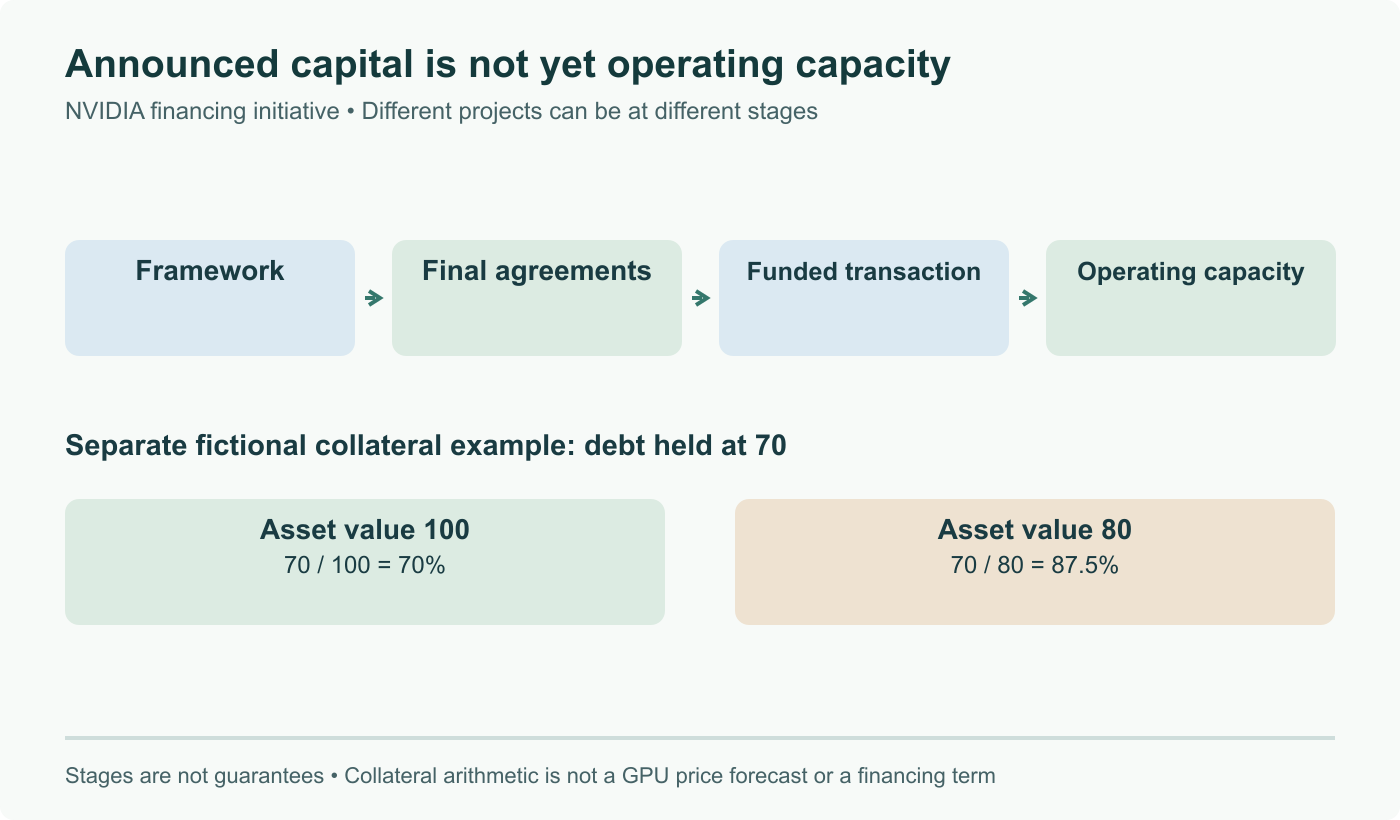
Nvidia announced on August 11, 2026 that it has signed memorandums of understanding with Apollo, BlackRock, Blackstone, Brookfield, Goldman Sachs and KKR to mobilise more than 500 billion dollars for AI datacenter buildout. Capital would flow through special purpose entities issuing bonds and private offerings, collateralised by compute, with Goldman Sachs as lead bookrunner on public debt and first deals expected within months.
There is a sentence in this story that deserves to be read twice. Jensen Huang told CNBC that his chips are an "investable asset", and the entire 500 billion dollar arrangement announced on August 11, 2026 rests on other people agreeing with him.
The Financial Times first reported the plan on August 10. Nvidia confirmed it the following day: memorandums of understanding with Apollo Global Management, BlackRock, Blackstone, Brookfield Asset Management, Goldman Sachs and KKR, to create what the parties describe as dedicated pools of capital at significant scale and attractive rates for Nvidia customers.
Huang's own framing was that he is "bringing the world's leading long-term capital providers together to independently underwrite AI infrastructure". He also says he approached only those six firms, and none of them said no.
The structure, and why it is the story
Strip away the size and the mechanism is this: debt, secured by compute.
Capital flows through special purpose entities that issue private offerings and bonds, with individual vehicles potentially raising tens of billions each. Goldman Sachs takes the lead bookrunner role for public debt. Lease arrangements then put the resulting compute in front of Nvidia's clients. Nvidia itself may provide financing support of up to 25 percent of a given opportunity, which caps its own exposure while keeping it in the deal.
The comparison Nvidia keeps reaching for is toll roads and power plants. That is not decoration. Those are the assets these six firms have spent decades underwriting, and inviting the comparison is an argument that a rack of GPUs belongs in the same category: long lived, cash generating, financeable.
What it changes for people who run infrastructure
Today, building serious GPU capacity means paying for it. Balance sheet, venture money, or a hyperscaler's capital budget. That is a hard ceiling for everyone who is not already enormous, and it is a large part of why capacity has concentrated in so few hands.
Debt against the hardware moves that ceiling. An operator with contracted demand can borrow against the compute instead of funding it up front, which is precisely how capital intensive industries have always scaled. If these vehicles close as described, more capacity comes online and more of it sits outside the handful of names that dominate today.
That is the optimistic reading, and it is a reasonable one. The pressure it responds to is real and documented: Microsoft has said Azure demand exceeds its capacity, and Cloudflare expects machine traffic to reach a thousand times human levels. Nobody is inventing the demand side here.
The question nobody has answered
Collateral only works if the collateral holds its value for the life of the loan.
An aircraft secures an aircraft loan because a twenty year old airframe is still an airframe. A power plant secures a power plant loan for similar reasons. A GPU is a harder case. It produces real revenue today, which is the strong half of Huang's argument. It also depreciates against a product cadence that has been running roughly annually, and hardware two generations behind the current part commands a very different price.
So the unresolved question in every one of these vehicles is what a financed GPU is worth in year four. Not whether it still works, but what it earns when it is competing against parts that did not exist when the debt was written.
That is not a reason to dismiss the structure. Plenty of asset classes are financed against uncertain residual values, and lenders price that uncertainty. It is a reason to read the eventual terms rather than the headline, because the terms are where the answer will be.
The constraint moves, it does not vanish
The useful way to think about this, if you plan capacity for a living, is that it removes one bottleneck and leaves the others untouched.
Capital has been a genuine constraint on datacenter growth. If 500 billion dollars of third party money arrives to relieve it, the binding limits become the physical ones: grid connections, power generation, water and cooling, land, and the multi year queues in front of all of them. Those do not respond to a memorandum of understanding.
Nvidia has been building this position from several directions at once, from a 250 billion dollar backstop for OpenAI's Ohio buildout to national scale projects like Japan's Frontia AI factory. What is new here is that the money is other people's, and the risk is being distributed to institutions that price this kind of thing for a living.
Whether that is prudent underwriting or a very large bet on demand holding is the thing to watch, and the first real evidence will arrive when the first vehicle prices its debt.
Sources and further reading
- Nvidia lines up 500 billion dollars in financing as CEO Jensen Huang tells CNBC his chips are an investable asset, CNBC, August 10, 2026
- Nvidia taps Wall Street for 500 billion dollar funding commitment, Fortune, August 11, 2026
- Nvidia, Wall Street partner on 500 billion dollar AI financing, Axios, August 10, 2026
- Nvidia and Wall Street team up on a 500 billion dollar bet on AI infrastructure, CNN Business, August 11, 2026
- Nvidia partners with Wall Street firms on 500 billion dollar AI financing, Quartz, August 11, 2026
Frequently asked questions
What is actually being announced here, in concrete terms?
Memorandums of understanding, not signed deals. Nvidia and six firms have agreed to create dedicated pools of capital that Nvidia's customers can borrow from, at what the parties describe as attractive rates and significant scale. The capital would flow through special purpose entities issuing private offerings and bonds, with Goldman Sachs positioned as lead bookrunner for the public debt side, and lease arrangements providing compute to Nvidia's clients. Individual vehicles could issue tens of billions each. Nvidia may contribute up to 25 percent of a given opportunity itself. Deals are expected within months. Until those close, the 500 billion figure is a target rather than a balance.
Why does financing structure matter to someone who runs infrastructure?
Because it determines how much capacity exists and how it is priced. Today a large GPU deployment is mostly funded from a company's own balance sheet or venture money, which caps how fast anyone who is not a hyperscaler can build. Debt collateralised by the hardware changes the shape of that: an operator with contracted demand can borrow against the compute rather than pay for it up front. If it works, more capacity comes online and more of it sits with operators who are not the five names that dominate today. If demand softens before the debt is repaid, the same structure concentrates the pain.
What does it mean to use compute as collateral?
It means the lender's security is the GPUs and the revenue they generate, in the way an aircraft secures an aircraft loan. That works when the asset holds value and produces predictable cash flow over the life of the debt. GPUs are an unusual case for both tests. They generate real revenue today, which is Jensen Huang's argument. They also depreciate against a product cadence that has been running roughly annually, and a generation that is two steps behind commands a very different price. The unresolved question is what a financed GPU is worth in year four, and that question sits inside every one of these vehicles.
Who are the six firms and why those six?
Apollo Global Management, BlackRock, Blackstone, Brookfield Asset Management, Goldman Sachs and KKR. Huang has said he approached only those six and none declined. What they have in common is experience underwriting long lived physical infrastructure: pipelines, power generation, toll roads, data centre real estate. That is the comparison Nvidia is deliberately inviting. These are the institutions that finance things expected to produce cash for decades, and bringing them to GPUs is an argument about the asset class as much as it is a funding round.
How does this compare with the other commitments Nvidia has made recently?
It is a different instrument doing a different job. Nvidia has previously backstopped specific projects directly, and has taken equity positions in customers and partners. This arrangement instead brings third party money in and keeps Nvidia's own exposure capped at up to 25 percent of an opportunity. Practically, that lets Nvidia support far more buildout than its own balance sheet could carry, while the underwriting risk sits with institutions whose business is exactly that. It also means the constraint on datacenter growth shifts away from capital and back toward the physical limits: power, land, cooling and grid connections.