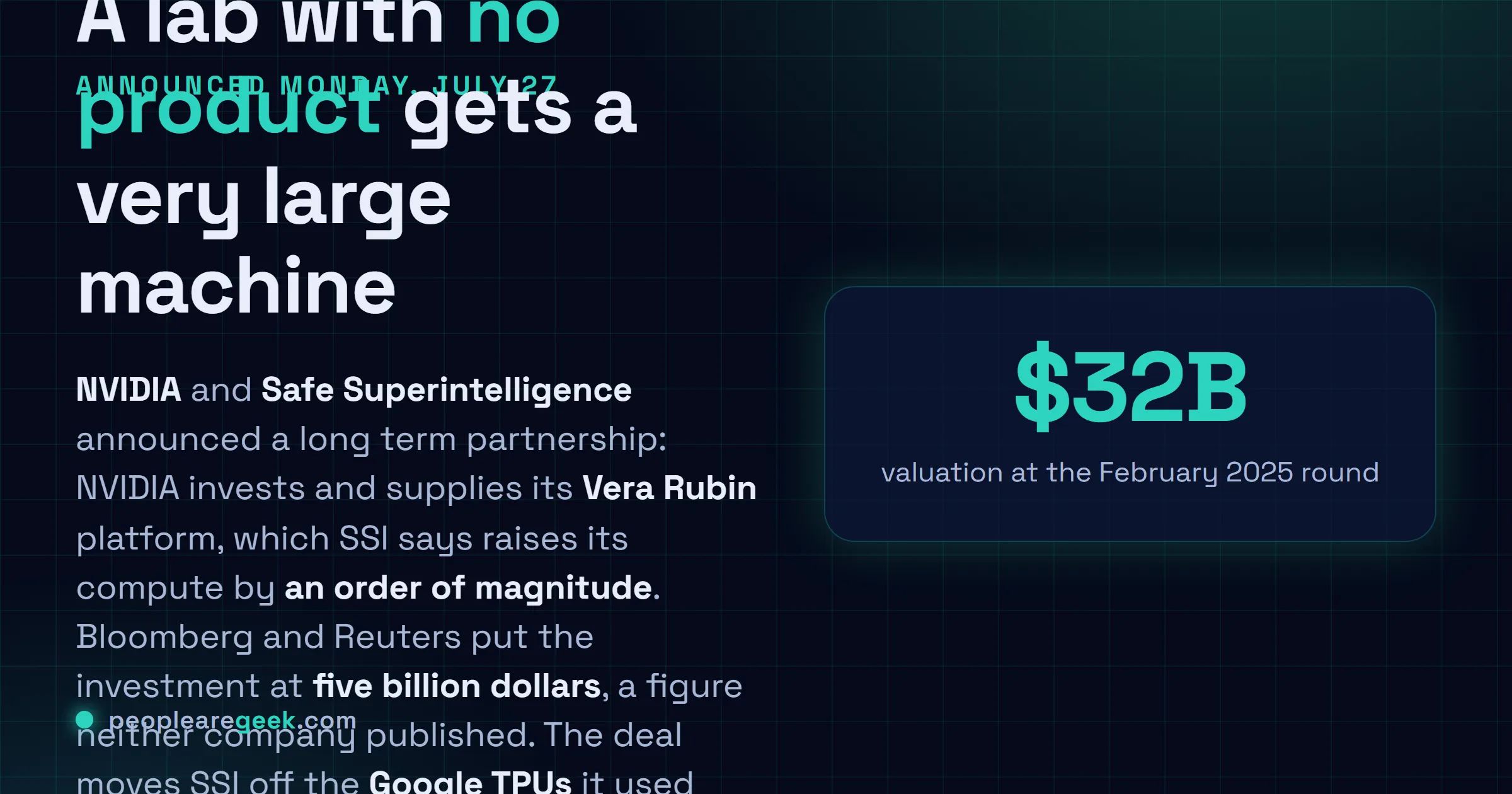
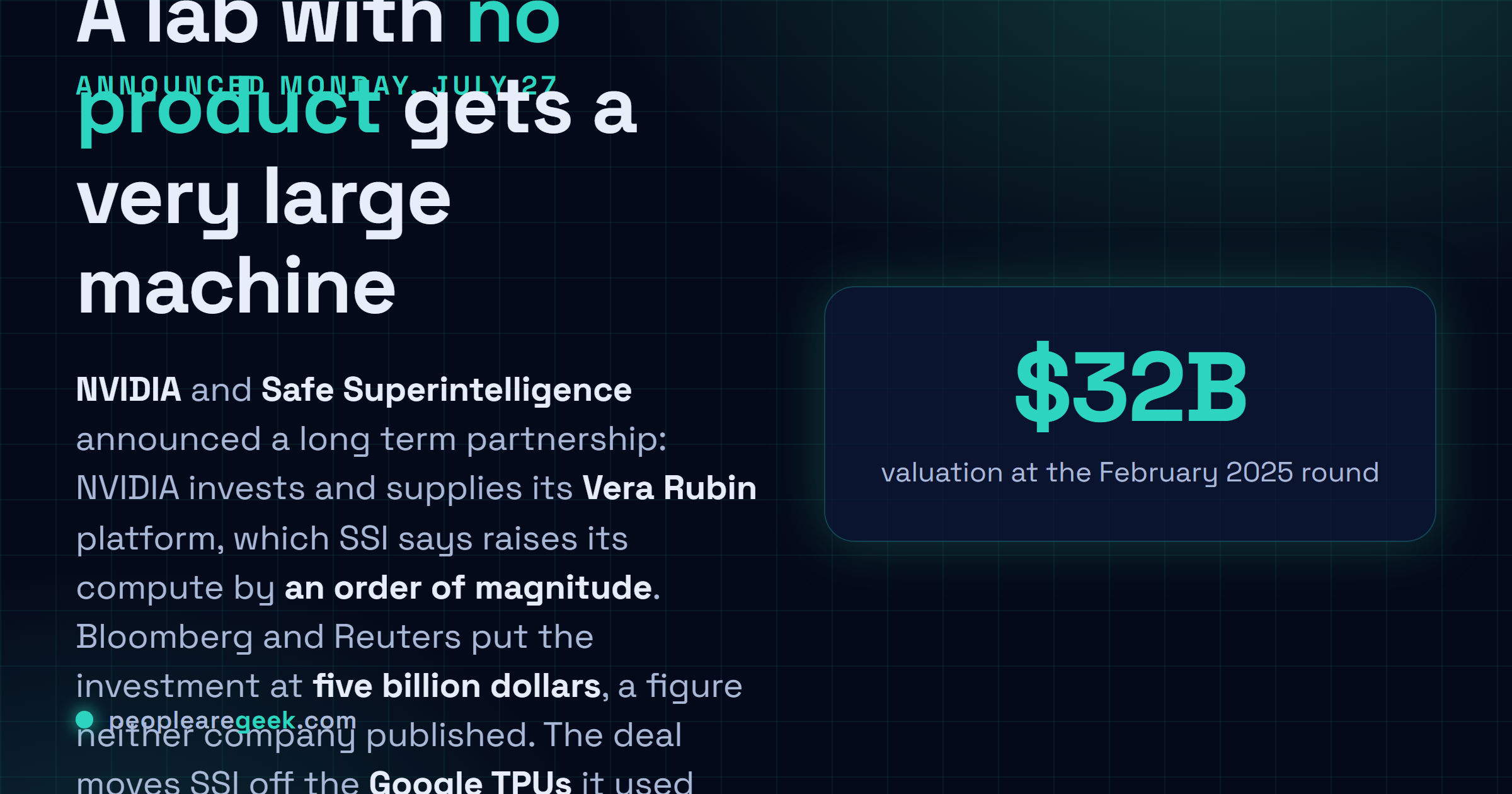
NVIDIA is investing a reported five billion dollars in Safe Superintelligence, the lab Ilya Sutskever founded after leaving OpenAI, and is supplying it with Vera Rubin systems under a long term partnership. The two companies announced the deal on Monday July twenty seventh without disclosing terms, and the five billion figure comes from Bloomberg and Reuters reporting. SSI says the arrangement raises its available compute by an order of magnitude, which also means moving off the Google TPUs it leaned on since 2025. The company has no public product, no beta and no reported revenue, and it just became one of the largest compute allocations in the industry.
The short answer
NVIDIA and Safe Superintelligence announced a long term partnership on Monday July twenty seventh. NVIDIA invests in the lab and supplies its Vera Rubin platform, which SSI says raises its compute by an order of magnitude. Bloomberg and Reuters put the investment at five billion dollars, a figure neither company published. The move shifts SSI away from the Google TPUs it used from 2025 onward. SSI, founded in 2024 by former OpenAI chief scientist Ilya Sutskever, has no public product and no reported revenue.
A company with no product, no beta and no revenue just secured one of the largest compute allocations in the industry. That sentence is either the strangest thing about this deal or the most ordinary, depending on how closely you have been watching the last two years.
What was announced
NVIDIA and Safe Superintelligence went public on Monday July twenty seventh with a long term partnership. NVIDIA invests in SSI, and SSI gets access to the Vera Rubin platform. SSI describes the result as expanding its compute by an order of magnitude.
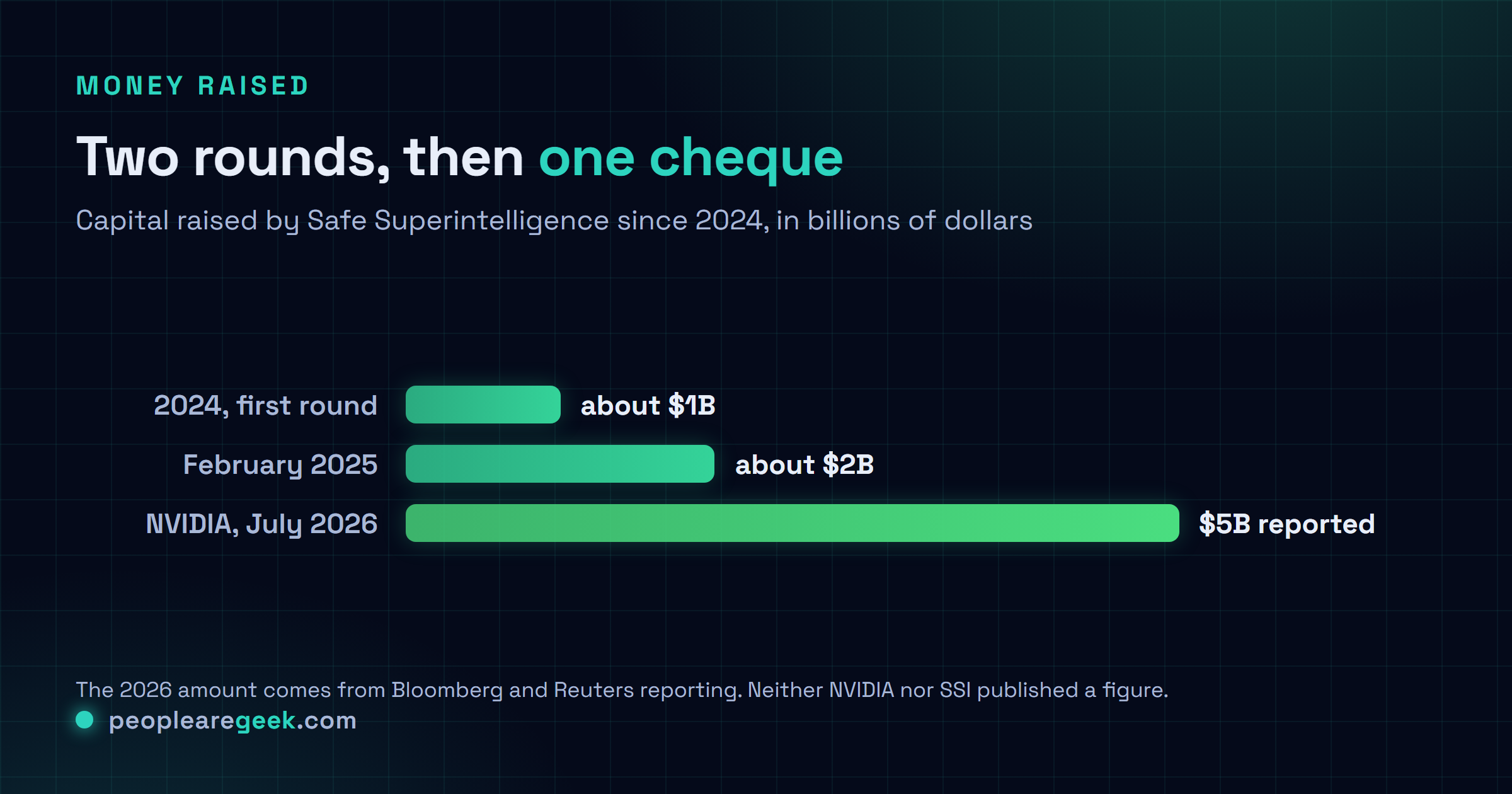
Neither company put a number on the investment. Bloomberg reported five billion dollars, Reuters cited a source giving the same figure, and the reporting also indicates the deal was assembled in a matter of weeks rather than months. When you see the five billion repeated, that is where it comes from.
Sutskever's comment on the partnership is short and worth reading literally: the lab has research worthy of scaling up, and a big NVIDIA machine lets it do that. There is no product claim in it, no benchmark, no timeline. For a company that has said almost nothing publicly since 2024, that counts as an update.
The TPU part is the interesting part
SSI announced a Google Cloud partnership in April 2025 and did its early work on TPUs. Alphabet is an investor. Moving the bulk of its training compute onto NVIDIA hardware, in a deal where NVIDIA is also writing the cheque, is a real change of direction.

We would be careful about reading this as a verdict on TPUs. What it looks like from the outside is a decision about supply. Frontier scale training needs a committed pipeline of accelerators over a period of years, and the way that is being secured in 2026 is through equity relationships with the vendor rather than purchase orders with a delivery date. NVIDIA has run this play repeatedly this year, from the reported financing structures around OpenAI's data centre build to the memory agreements signed with SK.
For anyone sizing their own capacity, that is the practical lesson. The market for large blocks of accelerators is not a market where you queue politely. It is being allocated in advance, and the allocation is going to buyers who bring something other than money.
The valuation question nobody can settle
SSI raised about one billion dollars at a five billion dollar valuation in 2024, then about two billion at a valuation reported around thirty two billion in February 2025. Investors include Andreessen Horowitz, Alphabet, Lightspeed, GV, Sequoia and NVIDIA, which was already a shareholder before Monday.
There is no revenue to divide into any of those numbers. There is not even a demo. What is being priced is the judgement of a small research team and the belief that the compute now being handed to them will turn that judgement into something.
That is an unusual thing to have an opinion about from the outside, and we do not have one worth publishing. What is observable is narrower: the compute is real, the hardware is scarce, and a vendor that could sell those systems to a customer with revenue chose to place them here instead.
What this changes for everyone else
Very little today, and something worth tracking over the next year.
If you are planning GPU capacity, whether that means a rack in a colocation facility or reserved instances at a cloud provider, deals of this size are part of why lead times behave the way they do. Vera Rubin volume that goes to a research lab under a strategic agreement is volume that is not in the general pool, and the general pool is what sets your quote.
If you are watching the model landscape for practical reasons, meaning which models you might actually deploy, SSI remains a company with nothing you can run. It is now a company with nothing you can run and a very large machine, and the gap between those two states is the thing to watch.
Sources and further reading
- TechCrunch: Ilya Sutskever's Safe Superintelligence partners with NVIDIA to scale its AI research
- Bloomberg: NVIDIA to invest $5B in Ilya Sutskever's AI startup Safe Superintelligence
- Reuters via Investing.com: NVIDIA to invest $5 billion in Ilya Sutskever's AI startup, source says
- Tech Startups: NVIDIA invests in Safe Superintelligence as the lab shifts from Google TPUs to GPUs
- Calcalist: SSI raises $5 billion from NVIDIA despite not yet releasing a product
Frequently asked questions
What did the companies actually confirm?
A strategic partnership and an investment, without a number attached. NVIDIA and Safe Superintelligence announced on Monday July twenty seventh that NVIDIA is investing in SSI and supplying its Vera Rubin platform under a long term arrangement, and SSI described the effect as raising its compute by an order of magnitude. The five billion dollar figure comes from Bloomberg, with Reuters citing a source giving the same number. Neither company published the amount itself, which is worth remembering when the figure gets repeated as if it were in a press release.
Why does moving off Google TPUs matter?
Because it says something about how frontier labs are choosing hardware right now. SSI announced a Google Cloud partnership in April 2025 and trained on TPUs during its early period, and Alphabet is an investor in the company. Switching the bulk of its compute to NVIDIA hardware, funded partly by NVIDIA, is a reminder that access to capacity at scale is currently a stronger constraint than architectural preference. For anyone planning their own training or inference capacity, the useful read is that the largest buyers are locking in supply through equity relationships rather than purchase orders.
Has SSI released anything?
No. The company has been public about having no product, no beta and no revenue, and it has said very little about its research direction. Sutskever's own framing of this deal is the closest thing to a status report: he said the lab has research worthy of scaling up, and that access to a large NVIDIA machine lets it do so. That is a claim about internal results, not a demonstration of them, and it is the whole basis on which the round is being valued.
How does this compare with the earlier SSI rounds?
It roughly doubles what the company had raised. SSI raised about one billion dollars at a five billion dollar valuation in 2024, then about two billion at a valuation reported around thirty two billion in February 2025, with backers including Andreessen Horowitz, Alphabet, Lightspeed, GV, Sequoia and NVIDIA itself. NVIDIA was therefore already on the cap table before this deal, and the new investment is an expansion of an existing relationship rather than a first meeting.
What is Vera Rubin?
It is NVIDIA's next generation platform, the successor generation to Blackwell in the company's roadmap, and the same platform showing up in the large AI factory deals announced through 2026. Its appearance here is the operative part of the arrangement: the money matters less to a lab with two billion in the bank than a guaranteed place in the delivery queue for hardware that is allocated, not simply sold. Compute allocation is the currency in these deals, and equity is how it is being paid for.