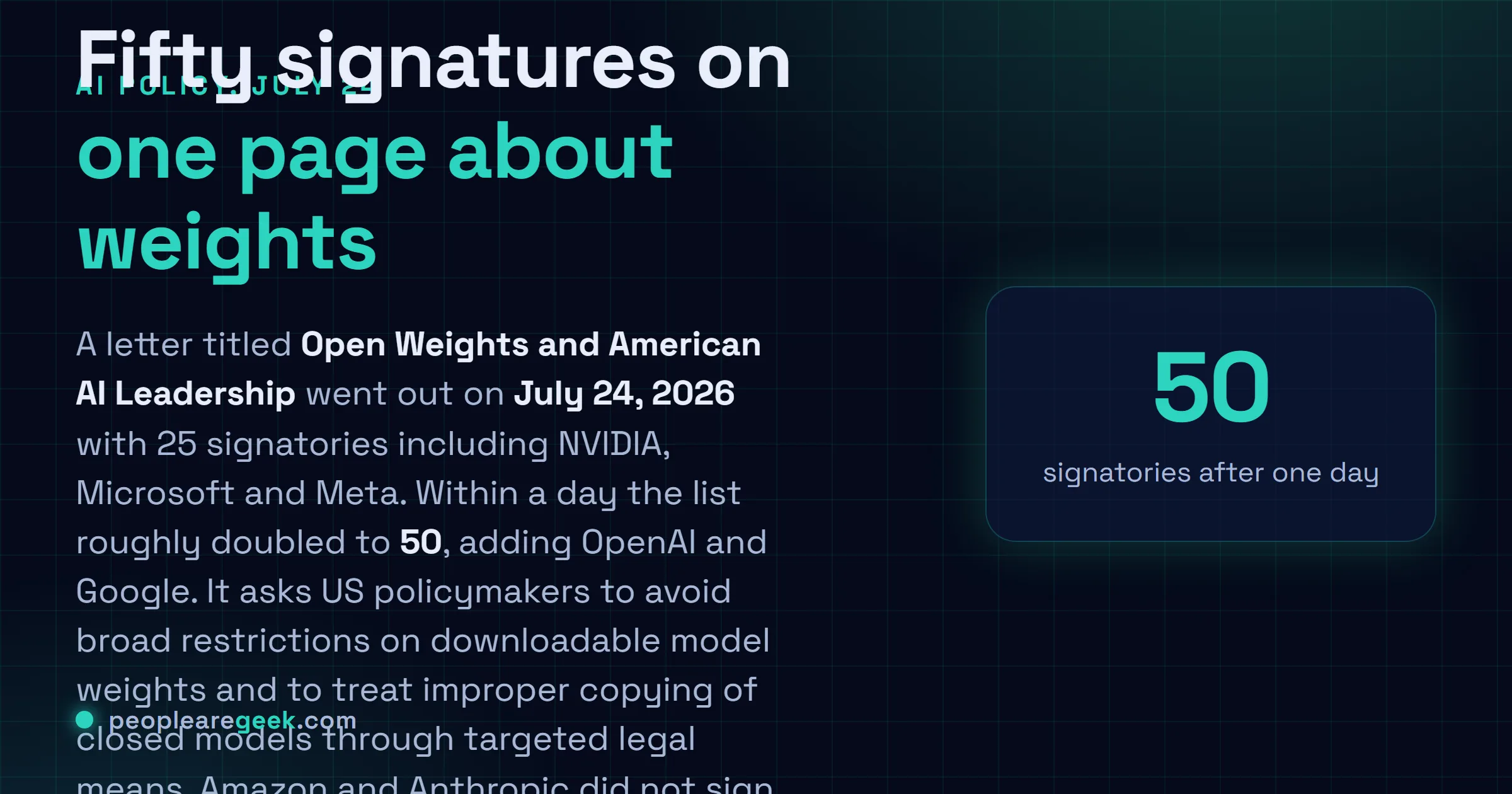
A one page policy letter went out on Friday, July twenty fourth, under the title Open Weights and American AI Leadership. Twenty five companies signed it. By Saturday the list had doubled to roughly fifty, and the late additions included OpenAI and Google, two labs whose commercial interests point the other way. The argument is narrow and worth reading if you deploy models yourself: restrictions written to slow down foreign labs would also land on the downloadable weights that startups, universities and ordinary engineering teams build on. We read the letter, checked who signed and who stayed out, and looked at what a restriction would actually change for people running models on their own hardware.
The short answer
A policy letter titled Open Weights and American AI Leadership was published on Friday, July twenty fourth, by twenty five US technology companies including NVIDIA, Microsoft and Meta. It asks policymakers to avoid broad restrictions on downloadable model weights and to address concerns about improper copying of closed models through targeted legal means instead. NVIDIA chief executive Jensen Huang used his first ever post on X to circulate it. The list roughly doubled within a day, adding OpenAI and Google. Amazon and Anthropic did not sign.
Most policy letters from large technology companies are safe to ignore. This one is worth twenty minutes, partly because of who signed it and partly because the thing it is defending is something a lot of us use without thinking of it as a political object at all.
What the letter asks for
The text runs about a page. It argues that downloadable model weights belong in the same category as strategic infrastructure, and that the measure of American standing in AI is not which single frontier model tops a leaderboard but whether the technology spreads into every sector. The line the signatories chose to lead with puts it plainly: "Our AI leadership will be judged not by one frontier AI model, but by whether the United States builds a strong, open ecosystem that diffuses into every sector."
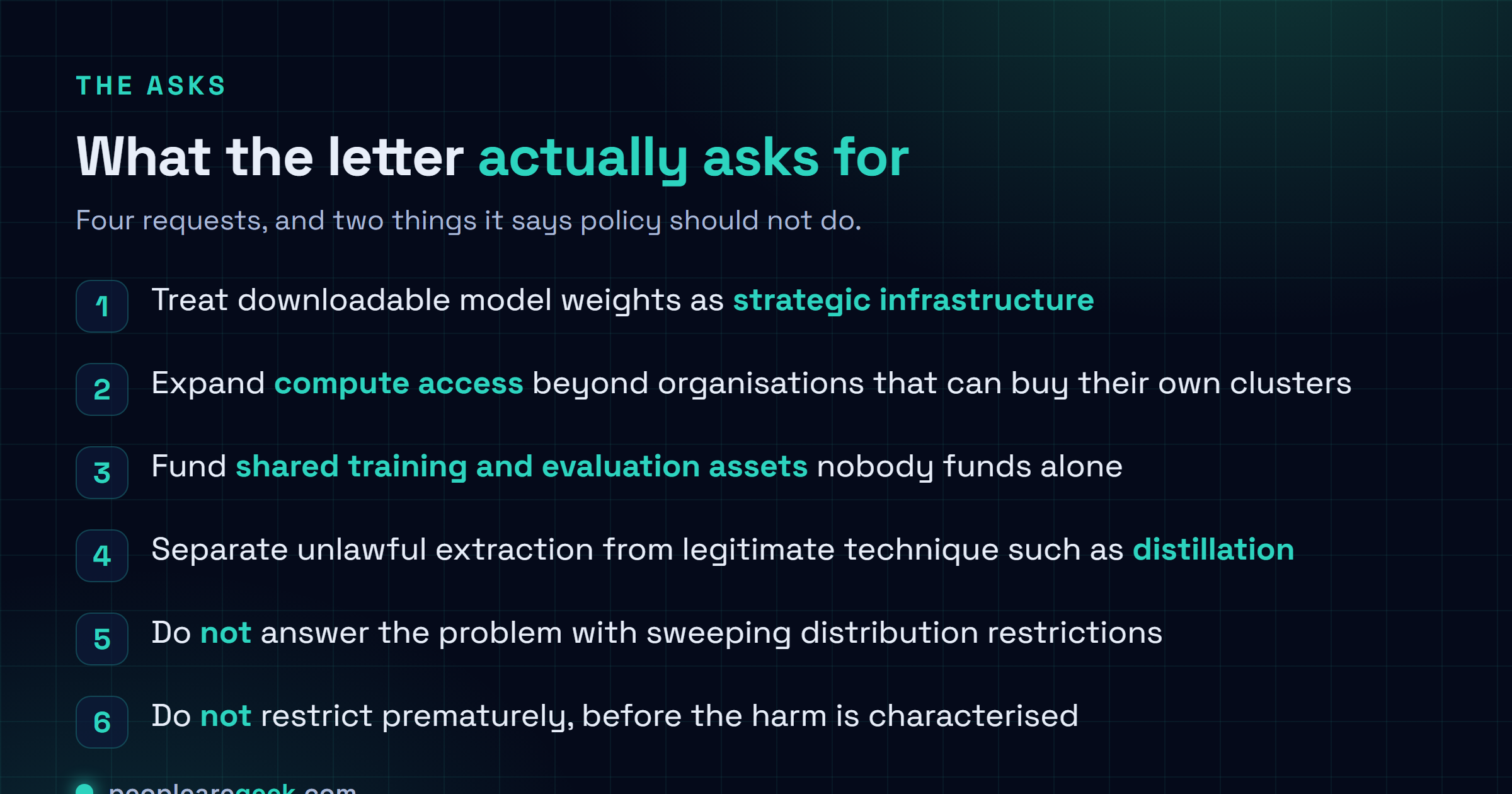
From there it makes three concrete asks. Expand access to compute for the people who cannot buy their own clusters. Invest in shared training assets, meaning datasets and evaluation resources that no single organisation has an incentive to fund alone. And, the point the coverage focused on, draw a line between unlawful extraction of value from a closed model and ordinary technique. Distillation, training a smaller model on the outputs of a larger one, is named directly. The letter accepts that misuse raises real concerns and argues those concerns belong in targeted legal and commercial frameworks rather than in sweeping restrictions on a method that sits underneath a large share of the small models now in production.
The comparison it reaches for is open source software in the nineteen eighties, when the idea that publishing code would hand away an advantage was taken seriously by serious people and turned out to be wrong in a way that took twenty years to become obvious.
Who signed, and the absences that got noticed
The first version carried twenty five names. NVIDIA, Microsoft, Meta, IBM and Dell Technologies from the large vendors. Hugging Face, Mistral, Mozilla and The Linux Foundation from the open ecosystem. Andreessen Horowitz and Y Combinator from the investor side. Perplexity, Replit, ServiceNow and Palantir among the application companies.
Jensen Huang circulated it using his first ever post on X, which is the sort of detail that reads as trivial and is not. A chief executive who has spent a decade declining to use the platform choosing this as the reason to start is a statement about how NVIDIA reads the stakes.
By Saturday the list had roughly doubled. AMD, Cisco, Cloudflare, Cohere, GitHub, Block, Box, DoorDash, Nebius, Ollama, Prime Intellect and Fireworks AI appear on the expanded version, along with OpenAI and Google. Those last two are the interesting ones. Both sell access to closed models and both would, on a simple reading of their interests, do well out of restrictions on downloadable competitors. Signing anyway suggests they care more about the precedent than about the near term advantage: a government that can decide which weights may be published can decide that twice.
Amazon and Anthropic stayed off the list. Neither has explained why, and we are not going to guess at motives that neither company has stated.

Why this matters if you deploy models yourself
The abstraction to resist here is treating this as a story about big companies arguing over market share. The concrete thing under discussion is whether an engineer can keep doing what has become entirely normal: pull a set of weights, serve them on hardware inside your own network, and never send a request to anyone else's API.
That pattern is what makes a model usable in the places where an API call is not an option. Regulated data that cannot leave a jurisdiction. An air gapped environment. A latency budget that does not survive a round trip. A cost structure where per token pricing does not work at your volume. In each case the answer for the last two years has been the same, which is to find a competent open weight model and run it yourself.
A restriction written to slow down a foreign lab does not distinguish between that use and any other. If the rule attaches to weights above a capability threshold, the models that clear the threshold today are exactly the ones worth self hosting. If it attaches to distillation as a technique, it reaches almost every efficient small model shipped since 2024, because that is how they were built.
We covered what a model level export control looks like in practice when Anthropic suspended Fable 5 and Mythos 5 worldwide in June. The relevant lesson from that week was not the policy argument. It was that the API calls stopped, for everyone, with no notice, because the company had no way to filter access at the granularity the directive assumed. Rules written about models land on the people running them.
What happens next
Nothing, mechanically. No rule changed on Friday, no download stopped working, and a letter with fifty signatures is still a letter. What it does is establish a position that will be quoted back at any future proposal, and give reporters a list of companies to ask for comment.
The thing to watch is definitional. If a proposal appears, the question that determines whether it touches your work is how it scopes itself: a threshold in parameters or compute, a named list of models, or a technique. The first two are survivable and mostly affect frontier labs. The third one reaches into ordinary engineering, and it is the one the letter spent its strongest paragraph on. That paragraph is the reason fifty companies with otherwise incompatible interests found something to agree on.
Sources and further reading
- Open Weights and American AI Leadership, the letter as hosted by NVIDIA
- The same text and the full signatory list on Microsoft's site
- CNBC: NVIDIA, Microsoft and Meta warn against premature restrictions on open weight models
- Fox Business: NVIDIA and Microsoft urge the US to avoid broad restrictions on open AI models
- Forbes: the open weights letter doubled to fifty signatories
- Fortune: Huang's first post on X and the argument he made with it
Frequently asked questions
What are open weight models, exactly?
They are models whose trained parameters are published for download, so anyone can run them on hardware they control, inspect how they behave, and fine tune them on their own data. That is a different thing from open source in the software sense, because the training code and the training data are usually not published alongside the weights. What you get is the artefact, not the recipe. For most engineering teams the artefact is the part that matters, since it is what lets you serve a model inside your own network without sending anything to a vendor API.
Who signed the letter and who did not?
The first version carried twenty five names, among them NVIDIA, Microsoft, Meta, IBM, Dell Technologies, Hugging Face, Mistral, Mozilla, The Linux Foundation, Perplexity, Replit, ServiceNow, Andreessen Horowitz and Y Combinator. Within a day the list roughly doubled and picked up OpenAI, Google, AMD, Cisco, Cloudflare, Cohere, GitHub, Block, Nebius and Ollama, among others. Amazon and Anthropic are the two large absences that reporters kept pointing at, since both have obvious commercial reasons to be cautious about the position the letter takes.
What restriction is the letter actually responding to?
It follows a period in which Washington has been visibly willing to use export control authority on models rather than only on chips. Anthropic had to suspend Claude Fable 5 and Mythos 5 for its entire customer base in June after a US directive, and in the week before the letter, senior administration figures accused a Chinese lab of improper use of restricted hardware and floated sanctions over distillation. The letter does not defend any of that conduct. It argues that the response should be targeted rather than a broad rule that also catches legitimate model release.
Does this change anything for me today?
No. It is a lobbying document, not a regulation, and nothing about how you download or serve a model changed on July twenty fourth. Its usefulness is as a signal about where the policy conversation sits and which companies are prepared to be seen on that side of it. If your architecture depends on being able to pull weights and serve them yourself, this is the debate that decides whether that stays routine or becomes something you need a licence for.
Why would OpenAI and Google sign something like this?
Both sell access to closed frontier models, so on a narrow reading they would benefit if downloadable competitors became harder to distribute. The reading that fits their behaviour better is that neither wants a precedent where a government decides which model weights may be published, since the same authority that restricts a rival can later restrict them. OpenAI also ships open weight models of its own, which makes the position less contradictory than the headlines suggested.
What should I watch next?
Whether any of this turns into a written rule, and how the rule defines its scope. The practical detail to look for is not the headline but the definition: a rule aimed at frontier scale weights above some threshold lands very differently from one aimed at distillation as a technique, because the second one touches almost every small model shipped in the last two years.