DevNews

OpenAI Buys Back 7 Billion Dollars of Employee Shares

On this page
  1. What a self funded tender actually means
  2. The flat mark is the part to read carefully
  3. The IPO question does not resolve
  4. Why a developer should care at all
  5. Sources and further reading

OpenAI has completed a tender offer letting current and former employees sell roughly 7 billion dollars of stock, at a valuation of 852 billion dollars. Two details make it more interesting than the headline number. The valuation is flat, unchanged from the round that closed in March 2026, and OpenAI funded the buyback out of its own balance sheet rather than bringing in outside buyers. That keeps the cap table closed right before a possible listing, and it says something about the cash position. The company filed confidentially with the SEC in June. Reported on August 10, 2026 by Bloomberg, CNBC and others.

The short answer

OpenAI completed a tender offer of roughly 7 billion dollars in employee stock at an 852 billion dollar valuation, the same mark as its March 2026 round. Unusually, the company bought the shares back itself rather than selling them to outside investors, so the cap table gains no new holders ahead of a possible listing. OpenAI filed confidentially with the SEC in June 2026. The news was reported on August 10, 2026.

$7Bof employee shares repurchased in the tender
$852Bvaluation, unchanged from the March 2026 round
0new outside holders added to the cap table
Answer card: OpenAI completed a tender offer of roughly 7 billion dollars in employee shares at an 852 billion dollar valuation, unchanged from the March 2026 round, funding the buyback from its own balance sheet rather than selling to outside investors, following a confidential SEC filing for a possible IPO in June 2026.
The August 10, 2026 tender offer in one card. Sources: Bloomberg, CNBC and TechCrunch. PNG

The number that got quoted everywhere on Monday was 7 billion dollars. It is the least informative part of the story.

Two other facts do the actual work. The tender priced at 852 billion dollars, exactly the valuation of the round that closed in March 2026, and OpenAI repurchased the shares itself instead of finding outside buyers for them. Both were reported on August 10, 2026 by Bloomberg, with CNBC and TechCrunch carrying the same figures.

What a self funded tender actually means

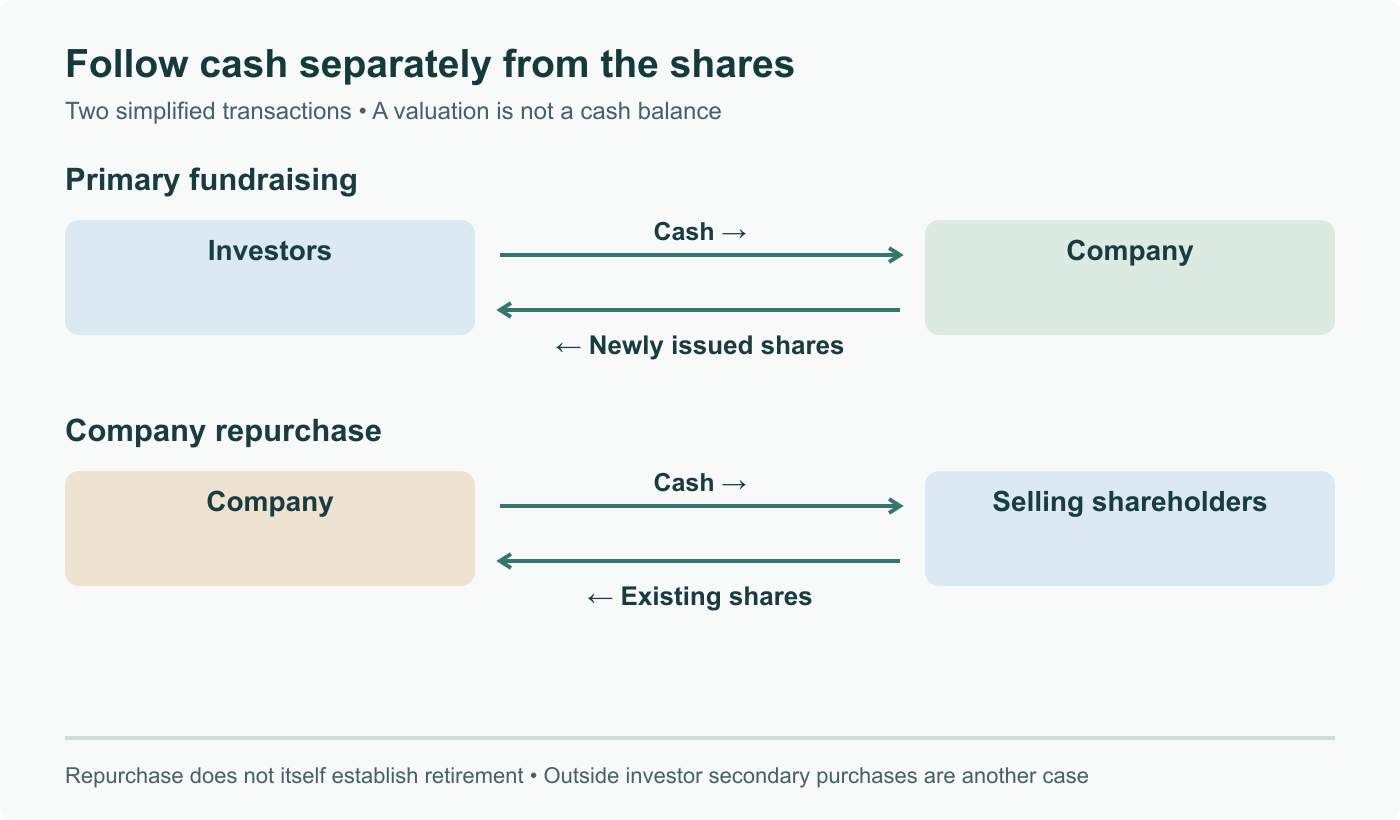
In the usual arrangement, a tender offer is a matching exercise. Employees want to sell, an investor wants in, the company brokers the trade and sets the price. The shares change hands, the cap table grows by one name, and the price becomes the new mark that everyone quotes until the next round.

That is not what happened here. OpenAI bought the shares back with its own money, which means they were retired rather than transferred. No new holder appears. Nobody gets board access, information rights or a position they can later sell to somebody else. Going into a possible public listing, the ownership structure is exactly the same as it was the week before.

The other implication is simpler and less discussed. Spending 7 billion dollars of your own cash on your own stock requires having 7 billion dollars of your own cash, roughly five months after closing a primary round. Whatever else the tender signals, it is a statement about the balance sheet.

Comparison chart of OpenAI valuation marks: 157 billion dollars in October 2024, 300 billion in March 2025, 500 billion in the October 2025 employee tender, 852 billion after the March 2026 round, and 852 billion again in the August 2026 tender.
Reported valuation marks since October 2024. The August 2026 tender holds the March mark rather than setting a new one. PNG

The flat mark is the part to read carefully

A tender is normally priced from the most recent primary round rather than negotiated from scratch, so a flat number is the ordinary outcome when that round is only months old. Reading a flat mark as a down round would be wrong.

Reading it as nothing would also be wrong. The sequence of reported marks runs 157 billion dollars in October 2024, 300 billion in March 2025, 500 billion in an employee tender in October 2025, and 852 billion after the March 2026 round closed. That is a market that has repriced upward at roughly every opportunity for two years. August 2026 is the first opportunity in a while that produced no movement at all.

The IPO question does not resolve

OpenAI filed confidentially with the SEC in June 2026, with Goldman Sachs, Morgan Stanley and JPMorgan reported as working on the offering. That is real preparation and not a gesture.

But the entire function of a tender offer is to give employees liquidity without a public market. Running one relieves exactly the pressure that pushes a private company to list. So the same event supports both readings, and the analysts quoted in Monday's coverage duly split between them.

Our reading is narrower and we think safer: OpenAI has bought itself the ability to choose its own timing. That is worth something regardless of which way it chooses. Anthropic has been reported in early investor meetings of its own, so the question of who lists first is now a live one rather than a hypothetical.

Why a developer should care at all

Cap table mechanics are not usually our beat, and if you ship software on top of these APIs you can reasonably file this under news you do not need.

The part that eventually reaches you is margin. A company moving toward public markets has to show a path to profitability on a schedule set by other people, and that pressure lands first on the cheapest parts of the product: free tiers, rate limits, deprecation windows for older models, and the price per token on the models you already depend on. None of that changes this week. Over eighteen months it plausibly does.

The defensive posture has not changed either, and it is worth restating because it is cheap. Keep the prompt, tool definition and retry layer behind an interface you control, so that changing provider is a config change. Measure your cost per completed task rather than per token, because that is the number a pricing change actually moves. And do not let a single vendor's roadmap become an implicit dependency of your product roadmap.

The infrastructure side of this is moving on similar timelines. NVIDIA's reported 250 billion dollar backstop on an Ohio buildout is the same story seen from the hardware end.

Sources and further reading

Frequently asked questions

What is a tender offer and why do private companies run them?

A tender offer is an organised, company sanctioned window in which employees can sell some of their vested shares at a fixed price. Private companies run them because stock compensation is only compensation if it can eventually become money, and a company that stays private for ten years has a retention problem: engineers who joined early are wealthy on paper and cannot pay a mortgage with it. A tender is the pressure valve. It is also a control mechanism, since the alternative is employees selling into secondary markets at prices the company does not set and to buyers it did not choose.

Why does it matter that OpenAI funded the buyback itself?

Because it changes who ends up owning the company. In the usual structure, an outside investor puts new money in and buys the employee shares, which adds a holder to the cap table and sets a new price. Here the company used its own cash, so the shares are repurchased rather than transferred, no new holder appears, and nothing about the ownership structure changes going into a possible listing. It also requires the cash to exist, which is the part worth noting. A company spending 7 billion dollars on its own stock is making a statement about its balance sheet whether or not it intends to.

Does a flat valuation mean growth has stopped?

Not on its own. A tender is typically priced off the last primary round rather than repriced from scratch, so a flat number is the normal outcome when the round is recent, and the March 2026 round was recent. What a flat mark does tell you is that nobody involved pushed for a markup, and in a market where AI valuations have moved every few months that absence is information. It is weaker information than a down round and stronger than nothing.

Does this make an IPO more or less likely in the near term?

It cuts both ways, which is why the reporting disagrees. The confidential filing in June is real preparation. But a tender exists to give employees liquidity without a public market, so running one is also how a company buys itself time. The honest read is that OpenAI has removed the internal pressure that would otherwise force a listing on someone else's schedule. That is compatible with listing next year and equally compatible with not listing next year.

Should any of this change how I build on the OpenAI API?

Not today, and we would be wary of anyone telling you otherwise. What it should change is your assumptions about the next few years. A company preparing for public markets eventually has to show margin, and the pressure that creates lands on free tiers, rate limits and per token pricing long before it lands on the models themselves. The defensive move is the same one that was already correct: keep your prompt and tool layer behind an interface you own, so that swapping a provider is a configuration change rather than a rewrite.