OpenAI has acquired NextSlide, a startup that turned prompts, notes, documents or research into polished editable presentations. The deal closed earlier in 2026 and surfaced publicly on August 8 through the company's own site and a LinkedIn post from founder Ahmed Beshry, months after the fact. Terms were not disclosed, and the team has moved onto ChatGPT. Beshry previously co founded Caper AI, the smart cart company Instacart bought in 2021, so this is his second exit. Small acquisitions rarely deserve an article. This one is a clean illustration of which problem is actually hard in document generation.
The short answer
OpenAI has acquired NextSlide, a startup whose product turned prompts, notes, documents or research into polished editable presentations. The transaction closed earlier in 2026 and became public on August 8 through the NextSlide website and a LinkedIn post from founder Ahmed Beshry. Financial terms were not disclosed and no OpenAI comment appears in the reporting. The team has moved onto ChatGPT, with Beshry saying they will continue the same mission of helping people create, communicate and turn ideas into work. Beshry co founded Caper AI, acquired by Instacart in 2021. No product, feature or timeline has been announced.
An undisclosed acquisition of a small startup, announced months after it closed, is normally not worth your attention. This one is, for a reason that has little to do with OpenAI: it puts a price on a problem that most engineers underestimate, which is producing a document someone can actually edit.
What was bought, and what is known
NextSlide's product took unstructured input, described by its founder as prompts, notes, documents or research, and produced a polished editable presentation. Ahmed Beshry founded it and announced the outcome on his LinkedIn and on the company site, saying the team would continue pursuing the same mission of building products that help people create, communicate and turn ideas into work.
The deal closed earlier in 2026. It became public on August 8. Terms were not disclosed, which is consistent with how OpenAI has handled its smaller purchases, and no comment from OpenAI appears in the reporting. The team now works on ChatGPT.
Beshry's track record is the other detail worth noting. He co founded Caper AI, the smart cart and cashierless checkout company, which Instacart acquired in 2021. This is his second exit, and second time exiting into a much larger consumer product.
What has not been announced, and it is worth being blunt about this, is any product, feature or timeline. Anything you read predicting a slides capability in ChatGPT is inference drawn from an acquisition, not something anyone stated.
The part that is actually hard
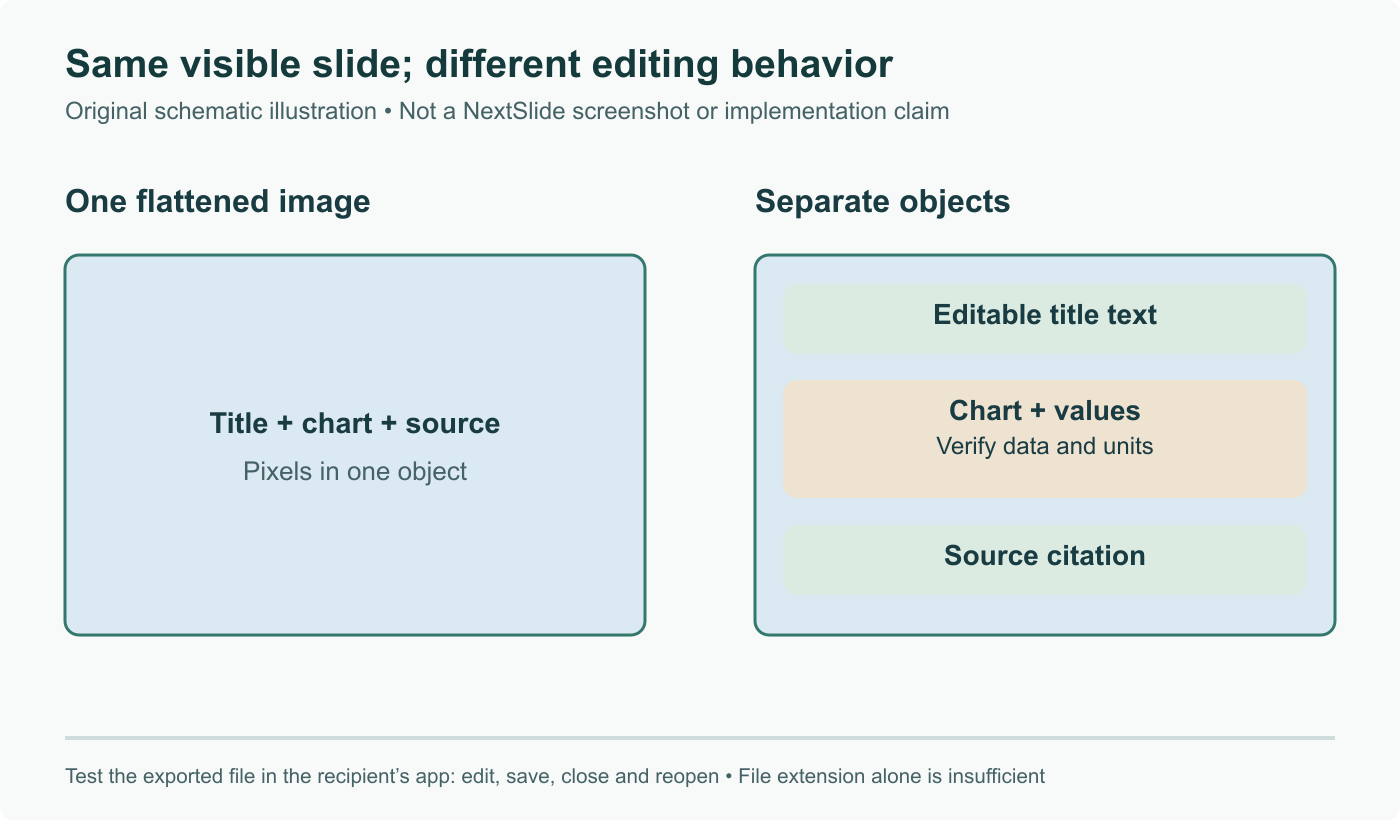
Generating something that looks like a slide has been straightforward for a while. A model can emit an image, or a block of HTML, that renders convincingly in a screenshot.
Generating a deck someone can open in their usual tool, drag a box, retype a bullet, restyle the master and send to a colleague is a different problem entirely. A presentation file is a structured document with a strict internal grammar. Layouts inherit from masters. Placeholders own their geometry. Theme colours and fonts are referenced rather than inlined. Parts relate to other parts, and the application validates those relationships when it opens the file.
A generator has to satisfy all of that while accepting input of arbitrary length and shape. What happens when the title runs to three lines. What happens when the image is portrait and the layout expects landscape. What happens when a bullet list has nineteen items. Those are constraint satisfaction questions, not text generation questions, and they are answered by a year of unglamorous iteration rather than by a better model.
On top of the format sits a taste layer that no automated check can evaluate: deciding what belongs on a slide at all, and what should be cut. Users judge that instantly and cannot articulate the criteria. The combination of a rigid format, unbounded input and a subjective quality bar is why this space has consumed a lot of effort for modest results.
Why buy the team
That combination also explains the acquisition logic. The scarce asset is not code and it is not research. It is a group of people who have already made several hundred small decisions about which layouts survive real content, and who no longer need to rediscover them.
This is the familiar shape of a talent led acquisition: a small team with a working product is absorbed for its accumulated judgement, the price stays undisclosed because the price is not the point, and the product's future is decided separately and usually later. Reading a roadmap into it is a mistake, in either direction.
The practical note for anyone building on small tools
Nothing here calls for alarm, but it is a reasonable prompt to check a few habits.
The risk in this class of deal is quiet rather than dramatic. A tool you rely on rarely gets shut down with a bang, it simply stops receiving attention, because the people who maintained it are now doing something else and nobody has announced anything.
The countermeasures are cheap and boring. Prefer tools that emit a standard file format, because an artefact that exists as a real file is portable in a way that an artefact living only inside a web application is not. Keep exports of anything you could not regenerate from scratch. Where you have the choice, prefer an API contract to a product surface, since APIs get deprecated with notice periods while features simply disappear.
That advice has nothing to do with OpenAI or with this particular purchase. It is just the version of dependency hygiene that acquisitions periodically remind everyone to apply.
Sources and further reading
- OpenAI acquires presentation startup NextSlide, TechCrunch, August 8, 2026
- OpenAI acquires presentation startup NextSlide, Yahoo Finance
- OpenAI Acquires NextSlide, the AI Presentation Startup, Unite.AI
- OpenAI acquires NextSlide as ChatGPT expands into presentations, RuntimeWire
Frequently asked questions
What did NextSlide actually build?
A tool that took unstructured input, described by its founder as prompts, notes, documents or research, and produced a polished and editable presentation from it. The word doing the work in that sentence is editable. Generating something that looks like a slide is a solved problem and has been for a while, since a model can emit an image or a block of markup that renders convincingly. Producing a deck that a person can then open in their normal tool, move a box, retype a bullet, restyle a master and hand to a colleague, is a different and much less glamorous engineering problem. It means emitting real presentation file structure, with layouts, placeholders, theme references and text frames that behave the way the application expects. That gap between looks right and can be edited is where most document generation efforts quietly fail.
What are the confirmed facts, and what is inference?
Confirmed: OpenAI acquired NextSlide, the deal closed earlier in 2026, it became public on August 8 through NextSlide's own website and a LinkedIn post by founder Ahmed Beshry, financial terms were not disclosed, and the team is now working on ChatGPT. Beshry stated the team would continue pursuing the same mission of building AI products that help people create, communicate and turn ideas into work. Also confirmed is his background: he co founded Caper AI, the cashierless checkout and smart cart company that Instacart acquired in 2021. Not confirmed, and worth being explicit about: no announced product, no timeline, no statement that any NextSlide feature will appear in ChatGPT in a recognisable form, and no comment from OpenAI in the reporting. Anything you read about a forthcoming slides feature is inference from the acquisition, not an announcement.
Why acquire rather than build a slide generator in house?
Because the scarce input is people who have already made the unglamorous decisions. A team that has shipped a presentation generator has spent a year discovering which layouts survive arbitrary content lengths, how to place an image without wrecking the text frame beside it, what happens when a title runs to three lines, and which theme constructs the target application silently rejects. None of that is research, all of it is knowledge, and it is faster to hire the people who hold it than to rediscover it. The pattern is old and well understood: small teams with a working product get absorbed for the team and the accumulated judgement rather than the codebase, terms stay undisclosed because the number is not the point, and the product's fate is decided separately and usually later.
What does this mean if I build on top of small AI tools?
Treat it as a routine reminder rather than a crisis. The specific risk in this class of acquisition is that a tool you depend on stops receiving attention long before anyone announces anything, because the people who maintained it are now working on something else. The practical countermeasures are unremarkable and cheap. Prefer tools that emit a standard file format you could open with something else tomorrow, since a deck that exists as a real presentation file is portable in a way that a deck existing only inside a web application is not. Keep an export of anything you cannot regenerate. Prefer an API contract to a product surface when you have the choice, because APIs are deprecated with notice periods while features are removed. None of this is specific to OpenAI or to this deal.
Is generating presentations a real engineering problem or a novelty?
It is a real one, and it is underrated precisely because the output looks trivial. A presentation file is a structured document with a strict internal grammar: slide layouts inherited from masters, placeholders that own their geometry, theme colours and fonts referenced rather than inlined, and relationships between parts that the application validates on open. A generator has to satisfy all of that while accepting input of arbitrary length and shape, which is a constraint satisfaction problem more than a text generation one. Then there is the taste layer, deciding what belongs on a slide at all, which cannot be evaluated by any automated check and is the part users judge instantly. The combination of a rigid format, unbounded input and a subjective quality bar is why this space has absorbed a lot of effort for modest results, and why a team that got it working is worth acquiring.