On July 22, 2026, OpenAI launched Presence, a platform for running AI agents in production rather than another model to prompt. Building a demo agent is easy now; the hard part is everything around it: the policies it must follow, the actions it may take, the tests that prove it behaves before it touches a customer, and the monitoring that catches it when it drifts. Presence bundles that operational layer: voice and chat agents for support and internal requests, standard operating procedures and guardrails, approved actions, pre deployment simulations, evaluation tools, and a Codex powered loop that suggests fixes from real escalations. It ships in limited general availability for enterprises only, through OpenAI account teams and Forward Deployed Engineers, not self service. For developers who have shipped an agent and then spent months on the governance around it, the question is whether a platform can carry that weight.
The short answer
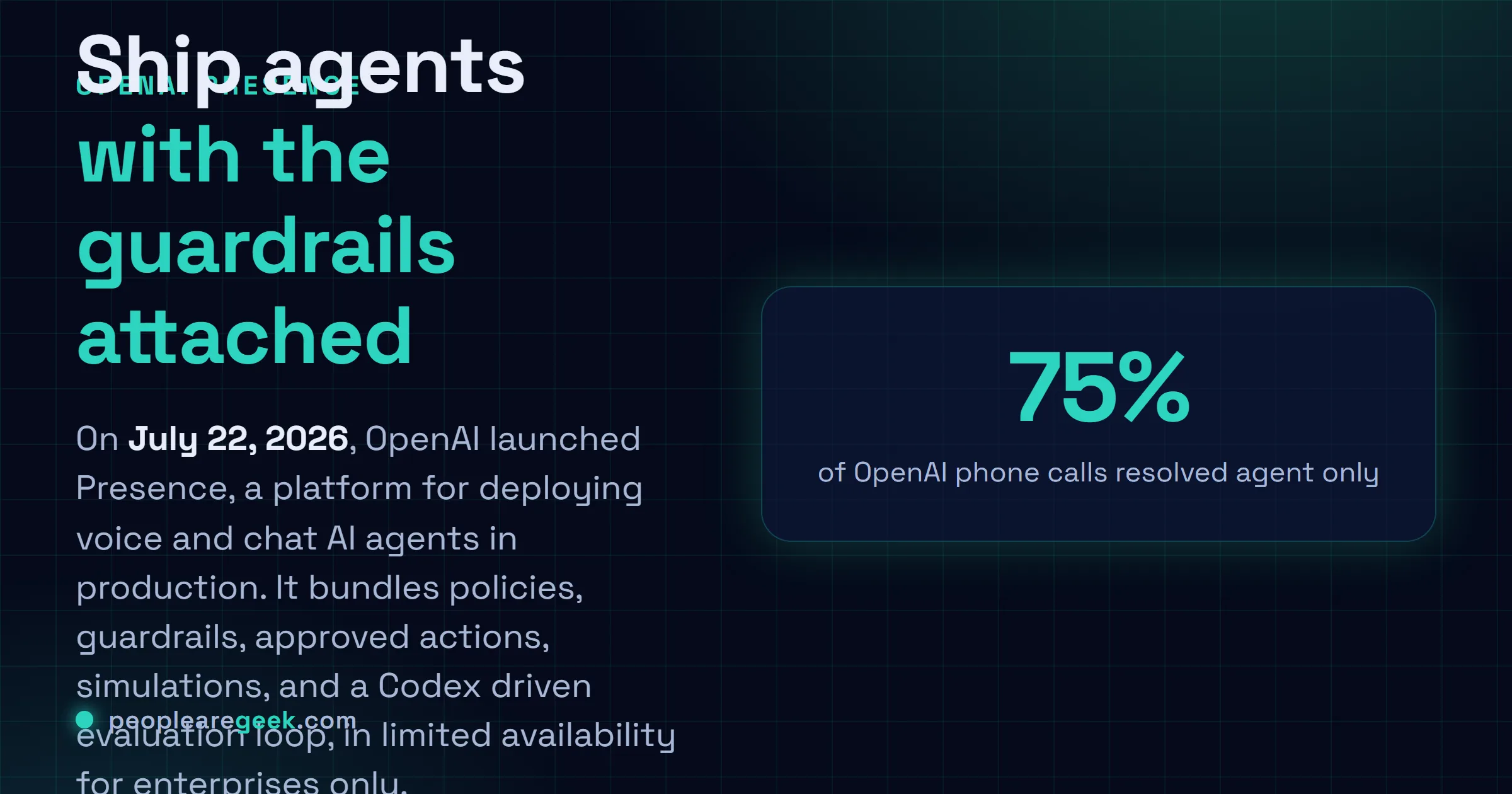
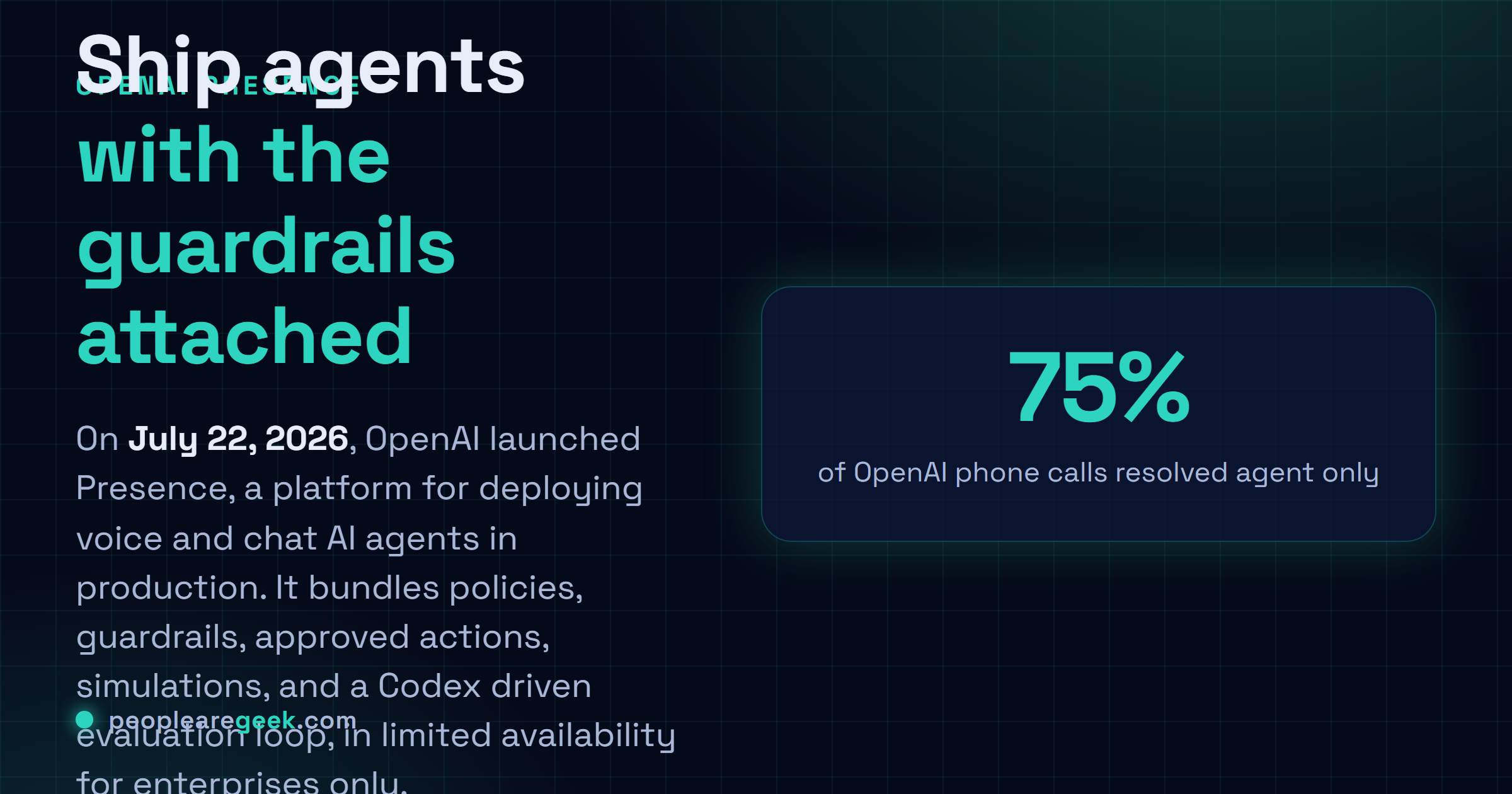
On July 22, 2026, OpenAI launched Presence, a platform for deploying AI agents in production rather than another model to prompt. It supports voice and chat agents for customer service and internal requests, wrapped in an operational layer: policies and standard operating procedures, guardrails, approved actions, pre deployment simulations, evaluation tools, and a Codex powered loop that suggests fixes from real escalations. It ships enterprise only, through OpenAI account teams, not self service. OpenAI says it already runs its own phone support and resolves 75 percent of calls without a human.
There is a familiar gap between a working agent demo and an agent you would let answer a real customer at two in the morning. The demo takes an afternoon. The gap takes months, and it is filled with unglamorous work: writing down what the agent may and may not do, testing it against the weird inputs real people send, wiring up approvals for anything risky, and building the monitoring that tells you when it has quietly started giving bad answers. OpenAI's Presence, announced July 22, is a direct move on that gap.
What Presence is, and what it is not
OpenAI is careful to describe Presence as a deployment platform rather than a standalone model. That framing matters. The models to build agents already exist; Presence is the layer that runs them in production. It supports voice and chat agents aimed at customer service and internal requests, the two places where organizations most want to put an agent and most fear the consequences of getting it wrong.
What you get is the operational scaffolding around the agent: policies and standard operating procedures, guardrails, a set of approved actions the agent is allowed to take, simulations to test behavior, evaluation tools, and a Codex powered process that reviews interactions and suggests improvements. If you have built anything real with agents, that list reads like the backlog you accumulate after the demo works, the tickets that stand between a prototype and something you would actually turn on.
The lifecycle it is trying to own

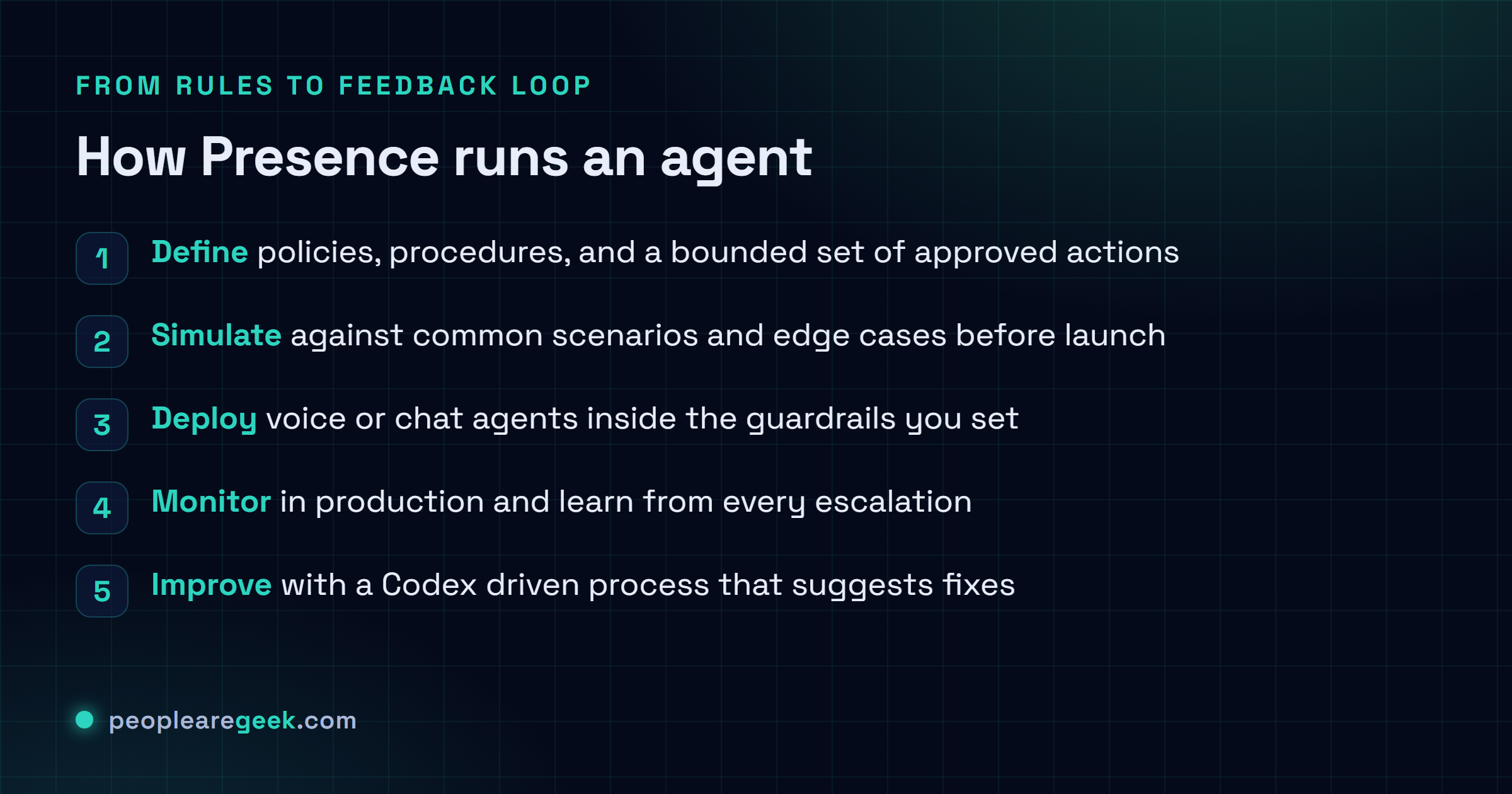
The shape of Presence follows the lifecycle of putting an agent to work:
- Define the rules. You give the agent policies, standard operating procedures, and a bounded set of approved actions. This is the part that turns a general model into something with a job description and limits.
- Test before it ships. Presence runs pre deployment testing against common scenarios and edge cases. Simulating the awkward inputs before a customer sends them is the difference between finding a failure in a test harness and finding it in a transcript.
- Deploy with guardrails. The agent goes live inside the constraints you set, on voice or chat, rather than as an unbounded chatbot.
- Watch it, then improve it. In production, Presence monitors the agent and learns from escalations, the moments where it handed off to a human. A Codex driven process then suggests behavioral fixes based on what actually went wrong, which is a more honest feedback signal than a synthetic benchmark.
OpenAI offers itself as the reference customer: it says Presence handles its own English language phone support and resolves 75 percent of inbound calls without human intervention. That is a real number worth noting, with the usual caveat that a company running its own product on a workload it controls is the easiest possible case.
Who it is for, and the catch
Presence is not something you sign up for on a Friday afternoon. It launched in limited general availability for enterprise customers only, and OpenAI is explicit that it is not a self service product. Companies deploy it through their OpenAI account team and Forward Deployed Engineers, the model where the vendor's engineers sit close to the customer during rollout. OpenAI names BBVA, SoftBank, and IAG among those exploring it, and points it at customer support, sales, and higher risk internal workflows.
That delivery model tells you something about the honest state of production agents. If deploying an agent safely were a solved, self service problem, you would not need Forward Deployed Engineers in the room. The fact that OpenAI is selling Presence as a high touch, enterprise engagement is a fair admission that the operational layer is still hard enough to need humans alongside it. For developers, that is the useful signal: the industry has stopped pretending the model is the whole product and started building, and charging for, the scaffolding that makes an agent safe to turn on. Whether Presence is the right shape for that scaffolding is something only production deployments outside OpenAI will answer.
Sources and further reading
- Help Net Security: OpenAI Presence connects AI agents to enterprise data with built-in guardrails
- VentureBeat: OpenAI unveils Presence, a new platform for realtime voice agents and chatbots
- Metaverse Post: OpenAI Debuts Presence, an Enterprise Platform for Mission-Critical AI Agents
Frequently asked questions
What is OpenAI Presence?
Presence is a deployment platform OpenAI launched on July 22, 2026, for running AI agents in production. OpenAI describes it as a deployment platform rather than a standalone model. It supports voice and chat agents for customer service and internal requests, and it wraps them in an operational layer: policies and standard operating procedures, guardrails, approved actions, simulations, evaluation tools, and a Codex powered improvement process.
How is it different from just calling a model API?
Calling a model gives you a response. Presence is about everything a business needs around that response before an agent is allowed to act on its own. It runs pre deployment testing against common scenarios and edge cases, enforces which actions an agent may take, monitors agents in production, and uses a Codex driven process to suggest behavioral improvements from real escalations. The pitch is that the model was never the hard part; the operational scaffolding is.
Is Presence available to everyone?
No. Presence launched in limited general availability for enterprise customers only. OpenAI says it is not a self service product, so companies work through their OpenAI account team and Forward Deployed Engineers to deploy it. It targets customer support, sales, and higher risk internal workflows. BBVA, SoftBank, and IAG are named among the companies exploring it.
Does OpenAI use Presence itself?
Yes. OpenAI says Presence currently handles its own English language phone support and resolves 75 percent of inbound calls without human intervention. That is a useful reference point, though a vendor running its own product on a controlled workload is not the same as a third party deploying it into a messy production environment, so independent results will be the ones worth watching.