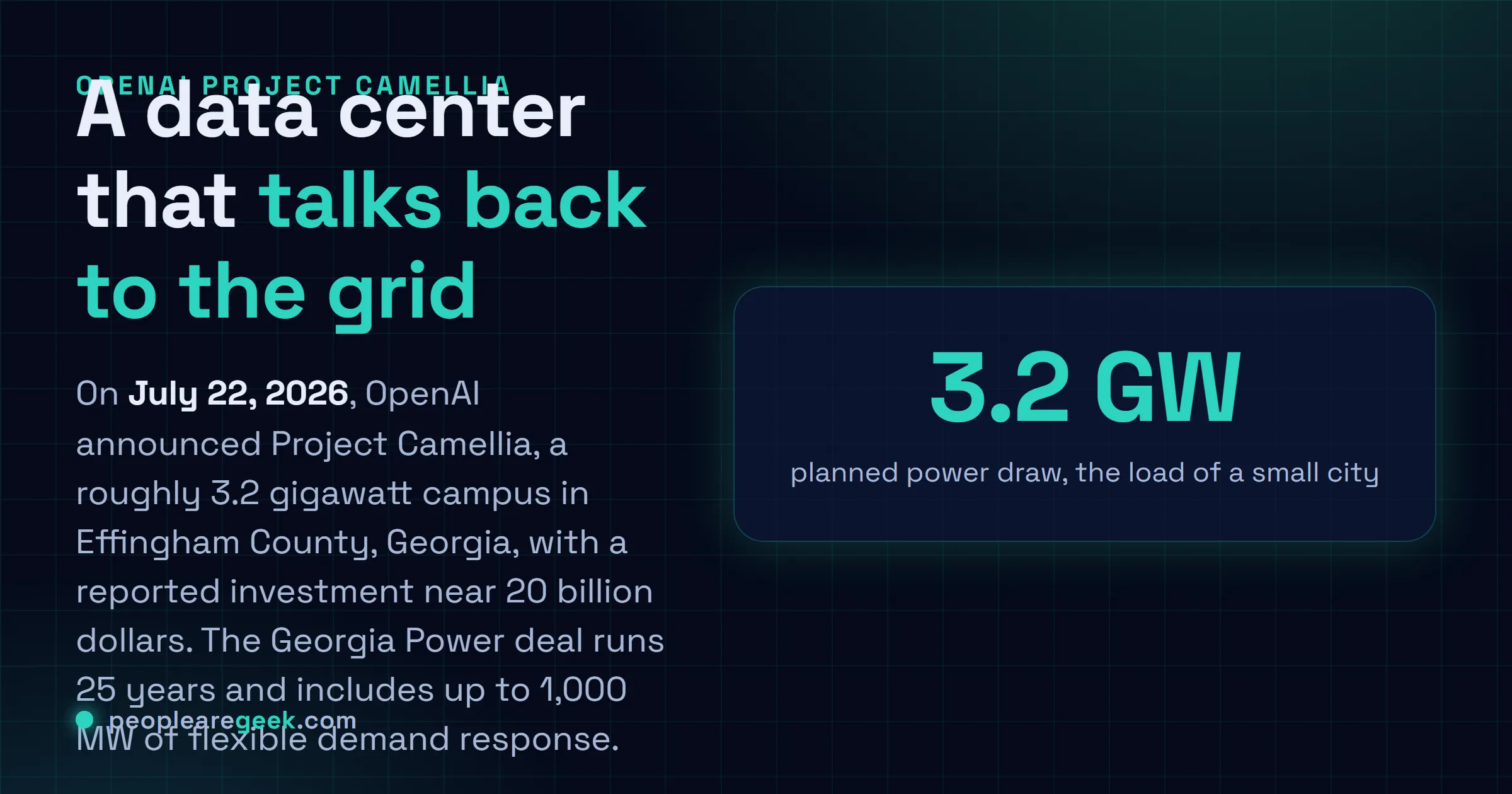
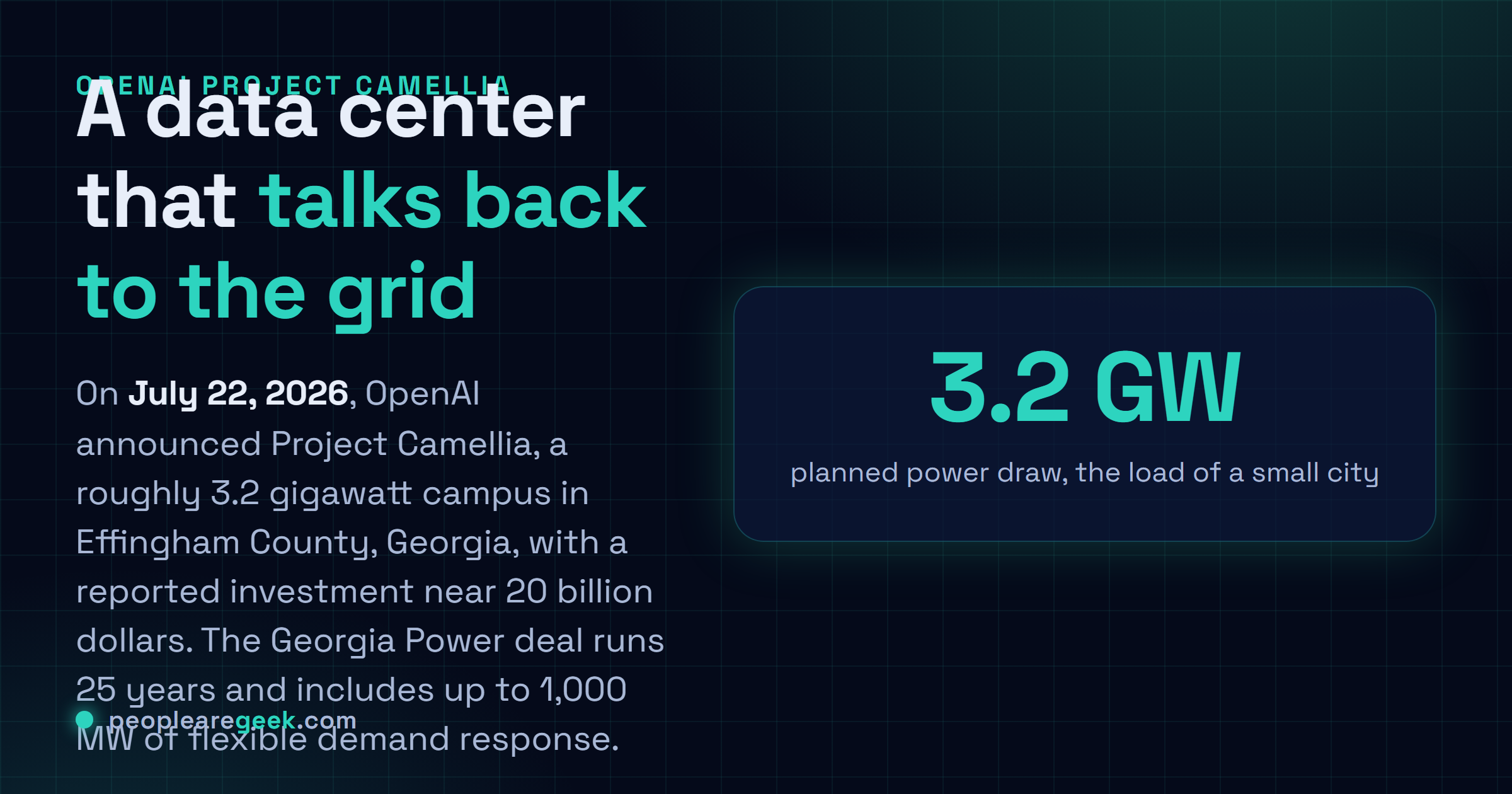
On July 22, 2026, OpenAI put a name and a location on one of its next large data centers: Project Camellia, a roughly 3.2 gigawatt campus at the Savannah Gateway Industrial Hub in Effingham County, Georgia, with a reported capital investment of around 20 billion dollars. Numbers that big can blur together, so it is worth translating them. A gigawatt is the output of a large power plant, and 3.2 of them is the load of a small city dedicated to a single data center. The detail that should catch an infrastructure person's eye is not the money but the electricity deal: a 25 year agreement with Georgia Power that includes up to 1,000 megawatts of flexible demand response, meaning the campus has agreed to dial its own consumption up or down to help the grid stay balanced. That is a quiet but important shift in how these buildings relate to the power system, and it is the part worth understanding whether or not you ever set foot in Georgia.
The short answer
On July 22, 2026, OpenAI announced Project Camellia, a roughly 3.2 gigawatt data center at the Savannah Gateway Industrial Hub in Effingham County, Georgia, with a reported capital investment near 20 billion dollars and about 400 long term jobs. The part worth studying is the power deal: a 25 year agreement with Georgia Power that includes up to 1,000 megawatts of flexible demand response, so the campus can dial its own load up or down to help balance the grid. It is a sign of how large consumers are starting to behave as grid resources, not just loads.
Every so often a data center announcement is worth reading not for the company behind it but for what it says about the constraint everyone in infrastructure now runs into: power. OpenAI's Project Camellia, announced July 22 for a site in Effingham County, Georgia, is one of those. Strip away the branding and it is a story about a single building negotiating with a regional grid as a peer, and that is a shift worth understanding.
What was announced
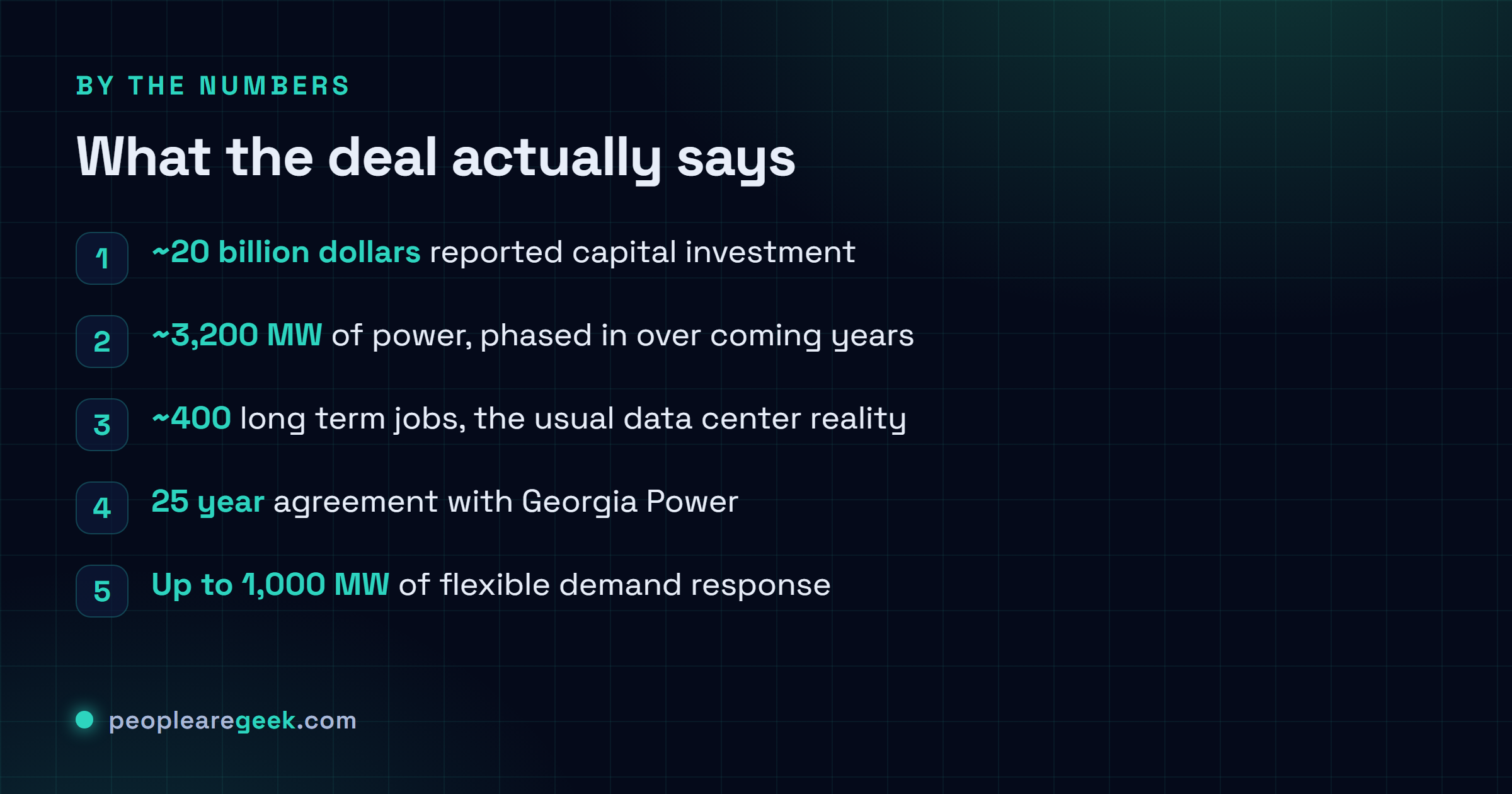
OpenAI named Project Camellia as a large AI data center campus at the Savannah Gateway Industrial Hub, a logistics site of roughly 2,600 acres in Effingham County, near Savannah. Local reporting puts the capital investment at around 20 billion dollars, the power requirement at about 3,200 megawatts, and long term employment at roughly 400 jobs. The utility partner is Georgia Power, under a 25 year agreement, with electricity phased in over the coming years rather than switched on all at once.
The jobs number is the one that always surprises people. A campus that costs tens of billions supports a few hundred permanent staff, because a data center is not a factory floor. The value it produces is compute, not headcount, and the local economic case rests on tax revenue and construction rather than long term employment. It is worth being clear eyed about that, because the gap between the investment figure and the jobs figure is where a lot of community debate lives.
Why 3.2 gigawatts is the real headline

To feel the scale, translate the unit. One gigawatt is roughly the output of a single large power plant and enough electricity for hundreds of thousands of homes. A 3.2 gigawatt campus draws power on the order of a small city, concentrated on one industrial parcel. That is why a project like this is not a matter of signing a utility contract and plugging in. At this size, the building's demand is large enough to shape how the regional grid is planned, where new generation and transmission get built, and what everyone else on that grid pays.
This is the constraint that now governs where AI infrastructure can go. Land and construction are rarely the limiting factor; multi gigawatt power, delivered on a workable timeline, is. Announcements increasingly lead with the utility partner and the delivery schedule for exactly this reason, and Camellia's phased power delivery is a tell that the electricity, not the concrete, sets the pace.
The demand response clause worth watching
The most interesting line in the deal is the reported inclusion of up to 1,000 megawatts of flexible demand response. Demand response means a consumer agrees to reduce or shift its consumption when the grid is stressed, in exchange for better terms or simply to make the interconnection feasible. Historically it was the domain of factories and aggregated commercial loads. Seeing a gigawatt of it attached to a single data center is notable.
The reason it matters is a genuine change in posture. A conventional large load is a problem the grid has to plan around: it is always there, and the system has to be built to serve its peak. A load that can shed or shift up to a gigawatt on request becomes something closer to a resource. During a heat wave or a generation shortfall, a campus that can throttle its own draw helps keep the wider system stable instead of adding to the strain. For AI workloads, some of which are batch jobs that can bend around time of day, this is a natural fit, and it hints at a future where very large data centers are active participants in grid balancing rather than passive consumers.
The trade offs on the ground
None of this erases the local costs, and it is worth naming them plainly. Residents near the site have raised concerns about power costs, strain on infrastructure, and water use, the same trade offs that follow campuses of this size wherever they land. On the other side, local officials tie the project to tax revenue meant to fund an initiative called Project Zero, aimed at eliminating the county homestead property tax, alongside planned partnerships with the local school district. County Manager Tim Callanan framed the revenue as the thing that could make that tax goal real as soon as next year.
For an infrastructure audience, the lesson generalizes past this one campus. The era where a data center could be a quiet tenant that just drew power is ending. At gigawatt scale, these buildings are negotiated infrastructure: they reshape a regional grid, they take on obligations like demand response, and they carry real local costs alongside their tax revenue. Project Camellia is one more data point in a trend every operator planning capacity should be tracking, because power, not silicon, is increasingly the thing that decides what gets built and where.
Sources and further reading
- WTOC: OpenAI announces plans for a new data center in Effingham County
- AI News Today, July 23, 2026: OpenAI Project Camellia and Presence
Frequently asked questions
What is Project Camellia?
Project Camellia is a large AI data center campus OpenAI announced on July 22, 2026, at the Savannah Gateway Industrial Hub in Effingham County, Georgia. Local reporting describes a capital investment of around 20 billion dollars, a power requirement of about 3,200 megawatts, roughly 400 long term jobs, and a 25 year power agreement with Georgia Power. Electricity is expected to be delivered in phases over the coming years.
How much power is 3.2 gigawatts, really?
A gigawatt is roughly the output of a single large power plant, enough for hundreds of thousands of homes. A 3.2 gigawatt data center campus draws power on the scale of a small city, all of it aimed at one industrial site. That is why these projects are now negotiated directly with the utility and the grid operator: at this size, a single building's demand is large enough to affect how the regional power system is planned and run.
What is the demand response part of the deal?
The Georgia Power agreement reportedly includes up to 1,000 megawatts of flexible demand response. That means the campus can reduce or shift up to a gigawatt of its own consumption when the grid is under strain, rather than drawing a flat load no matter what. For an infrastructure audience this is the interesting mechanism: instead of only adding demand, a very large consumer becomes a resource the grid operator can lean on during peak periods.
What does it mean for the local community?
Local officials tie the project to tax revenue that funds an initiative called Project Zero, which aims to eliminate the county homestead property tax, with talk of a large average reduction for homeowners. There are also planned educational partnerships with the local school district. At the same time, residents have raised concerns about power costs, strain on infrastructure, and water use, which are the recurring trade offs wherever a campus of this size lands.