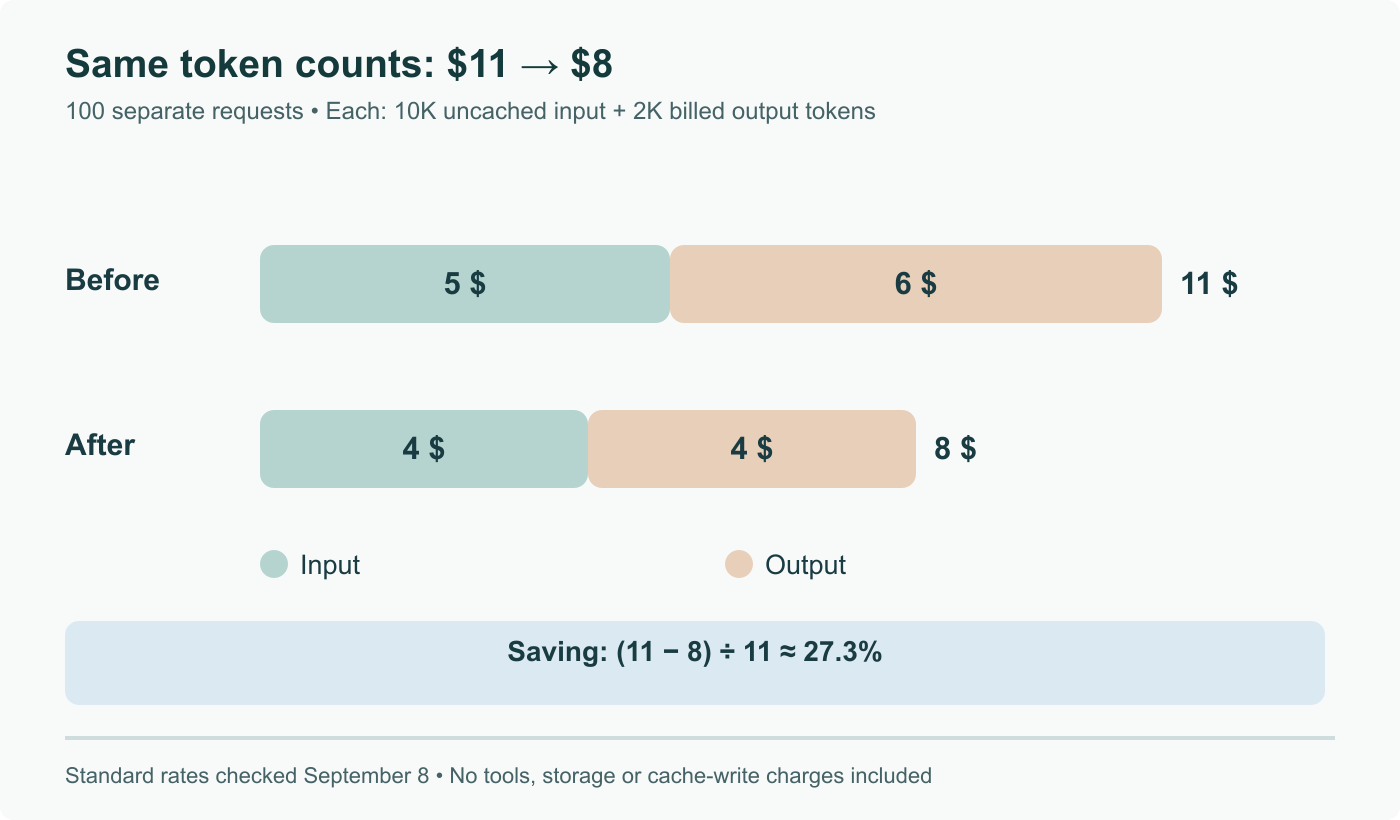
OpenAI cut the API price of GPT-5.6 Sol, its frontier model, on Friday, August twenty first, 2026. Input falls from $5 to $4 per million tokens, cached input from 50 cents to 40 cents, and output from $30 to $20. The output side is the real move: that is a third off, not a fifth. The new rates are promotional and run for three months, to November twenty first, 2026. They cover the API and eligible credit plans for ChatGPT Work and Codex, while Pro, Plus and Business subscriptions stay exactly where they were. This is the second repricing of the 5.6 family in under a month.
The short answer
OpenAI repriced GPT-5.6 Sol on August 21, 2026. Input drops from $5 to $4 per million tokens, cached input from 50 cents to 40 cents, and output from $30 to $20. The rate is promotional and runs three months, to November 21. It covers the API plus eligible ChatGPT Work and Codex credit plans, and leaves Pro, Plus and Business subscriptions untouched. Your actual saving lands somewhere between 20 and 33 percent depending on how output heavy your workload is.
The interesting number in this announcement is not the one in the headline. OpenAI says over 20 percent, which is true of the input side. The output side fell by a third, and for most people running a frontier model in production, output is where the money goes.
What changed and what did not
Three numbers moved, all per million tokens. Input goes from $5.00 to $4.00. Cached input goes from $0.50 to $0.40. Output goes from $30.00 to $20.00. The cached input rate keeps its ten to one relationship with fresh input, so prompt caching remains worth exactly as much as it was yesterday, which is to say a great deal on any workload with a stable system prompt.
The scope is narrower than the excitement around it suggests. This is the API price, plus eligible credit plans for ChatGPT Work and for Codex. Pro, Plus and Business subscriptions were explicitly left alone. If your organisation buys seats rather than tokens, this announcement changes nothing for you.
The duration is the part worth writing down. OpenAI framed it as three months, effective August 21, which puts the end at November 21, 2026. That is a promotional rate with a stated expiry, not a new list price.
Do the arithmetic on your own traffic
The saving on your invoice is not 20 percent and it is not 33 percent. It is a weighted blend, and the weight is your input to output ratio.
Take a retrieval heavy service that ships ten times more input than output. Old cost for eleven million tokens: ten million input at $5 plus one million output at $30, so $80. New cost: $40 plus $20, so $60. That is 25 percent off.
Now take a generation workload closer to one to one. Old cost for two million tokens: $5 plus $30, so $35. New cost: $4 plus $20, so $24. That is 31 percent off.
The pattern holds generally. The more of your spend sits on the output meter, the closer you get to the full third. Agent loops that read enormous contexts and emit short tool calls sit at the bottom of the band. Anything that writes long answers, long code or long summaries sits near the top.
The competitive frame
At $4 and $20, Sol now sits under Claude Opus 5 on both meters, since that model lists at $5 and $25. Claude Fable 5 is a different proposition again at $10 and $50. This is the second repricing of the GPT-5.6 family in under a month: on July 30 OpenAI cut Luna by 80 percent and Terra by 20 percent while leaving Sol untouched. Sol has now joined them.
Read that sequence as what it is. The bottom of the range got cheap first, which pushed volume workloads down a tier. Now the top of the range has moved, which makes staying on the flagship less of a budget decision. If you routed traffic away from Sol on cost grounds in July, the routing evaluation you ran then was priced on a $30 output meter that no longer exists.
Separately, GitHub is running its own promotion, halving the price of Sol inside GitHub Copilot until September 3, 2026. That is Copilot billing rather than the API, it does not stack, and it closes far sooner. If your evaluation happens inside Copilot, that is a much shorter window.
What we would actually do this week
Pull last month's token counts by model out of the usage dashboard and recompute the bill at $4 and $20. That gives you the real number rather than the headline one, and it takes about ten minutes.
Then, if you moved workloads off Sol earlier this summer for cost reasons, re-run that comparison. The tier boundaries have moved twice since July and the answer you cached in your head is probably stale.
Finally, put November 21 in the calendar with a note about what your unit costs look like if the rate reverts. Building a customer facing price on a promotional input is fine, as long as somebody has done the arithmetic for the day it ends.
Sources and further reading
- 20% price reduction for GPT 5.6 Sol: API, Codex credits and ChatGPT Work, OpenAI Developer Community, August 21, 2026
- OpenAI cuts developer pricing for frontier GPT-5.6 Sol model by more than 20%, The Star, August 22, 2026
- OpenAI Slashes GPT-5.6 Sol Developer Pricing by Over 20%, BigGo Finance, August 2026
- OpenAI's announcement post on X, August 21, 2026
Frequently asked questions
What are the new numbers, exactly?
Per million tokens: input goes from $5.00 to $4.00, cached input from $0.50 to $0.40, and output from $30.00 to $20.00. Input and cached input both fall 20 percent, output falls 33 percent. OpenAI announced the change on August 21, 2026, effective immediately, and describes it as running for the next three months, which puts the end date at November 21, 2026. The headline figure of over 20 percent is the conservative reading, since the actual saving on your bill depends entirely on how much of your spend sits on the output side.
How much will our bill actually drop?
Between 20 and 33 percent, and where you land is decided by your input to output ratio. Work it out from your own usage rather than from the headline. A retrieval heavy workload sending ten times more input than output saves about 25 percent, because most of the spend is on the side that only fell a fifth. A reasoning or generation workload at roughly one to one saves about 31 percent. An agent loop that reads a large context and emits a short tool call sits near the bottom of the range. If you have a month of token counts in your usage dashboard, multiply input tokens by 4 and output tokens by 20, both per million, and compare against what you paid.
Does this apply to our ChatGPT subscription?
No. OpenAI was specific that Pro, Plus and Business subscription usage is unchanged. The reduction covers the API and is rolling out across eligible credit plans for ChatGPT Work and for Codex. In other words this is a developer and platform price, aimed at the people who buy tokens by the million, not at seat based plans. If your team pays per seat, nothing on your invoice moves.
What happens on November 21?
OpenAI has committed to the rate for three months and has not said what follows. Treat the old prices as the ones that could return, because a promotional rate is a promise with a stated end date, not a permanent list price. In practice the frontier has repriced downward repeatedly through 2026, so a snap back to $5 and $30 would be unusual. Still, if you are building a business case or a per customer margin model on top of these numbers, put the reversion date in it and check what your unit economics look like at the old rate.
How does this sit against Claude and the rest of the field?
At $4 and $20, Sol now undercuts Claude Opus 5, which lists at $5 per million input and $25 output, on both sides of the meter. Claude Fable 5 sits well above both at $10 and $50, which reflects a different position in the range rather than a like for like comparison. Price is not the only axis here, and for coding and agent work the benchmark and harness differences matter more than a few dollars per million. But the gap that used to justify tier shopping on cost alone has narrowed at the top of the market.
Is there anything else running alongside this?
Yes. GitHub announced a separate and deeper promotion on its own account, halving the price of GPT-5.6 Sol inside GitHub Copilot until September 3, 2026. That one is a Copilot billing promotion rather than an OpenAI API change, so it does not stack with the API rates and it ends much sooner. If you evaluate models inside Copilot rather than through the API, that is the window worth using for a side by side.