QEMU 11.1 is out as of August 11, 2026, carrying more than 3200 commits from 285 authors, and the release notes describe a version without one headline feature. Read that as a compliment rather than a shrug. What landed instead is a long list of things that quietly remove friction: UFS 4.1 storage emulation that lets you exercise Write Booster and defragmentation paths, big endian RISC-V, nested virtualization on Apple silicon through the hvf accelerator, and a real time clock you can push out of the hypervisor. If you run QEMU as infrastructure rather than as a curiosity, several of these change what you can reproduce on a single machine.
The short answer
QEMU 11.1 was released on August 11, 2026. There is no single headline feature, which is why the release is easy to underrate: it adds Universal Flash Storage emulation from the UFS 4.1 specification, big endian RISC-V and a batch of new RISC-V extensions, nested virtualization on the Apple hvf accelerator, MPIPL crash memory preservation on PowerNV, and vhost-host-user offload for the virtio-rtc clock device.
Every so often a release arrives that its own maintainers decline to sell. QEMU 11.1, out on August 11, 2026, is one of those. Phoronix summarised it as arriving with "no one feature standing out particularly", and the project's own announcement reads as a list rather than a pitch.
That framing undersells it. Over 3200 commits from 285 authors went into this version, and a good share of them are the kind of change that turns a class of problem from "you need the hardware" into "you need a config file".
The storage work is the part to notice
QEMU 11.1 extends its Universal Flash Storage emulation with two features drawn from the UFS 4.1 specification: Write Booster and Host Initiated Defragmentation.
Write Booster is a device level caching mode. UFS devices use it to absorb bursts of writes into faster storage before settling them, and its behaviour under pressure is exactly the sort of thing that produces confusing performance reports and hard to reproduce latency spikes. Host Initiated Defragmentation is what the name says: the host asks the device to reorganise itself rather than waiting for the device to decide.
Both matter because UFS is the storage in phones, tablets and an increasing number of embedded and automotive boards. Testing against its real behaviour used to require the physical device. Now the caching and defragmentation paths can be exercised inside a virtual machine, which means inside CI.
RISC-V gets its awkward corner covered
The RISC-V additions in 11.1 are wide, and one of them is deliberately unglamorous: big endian support.
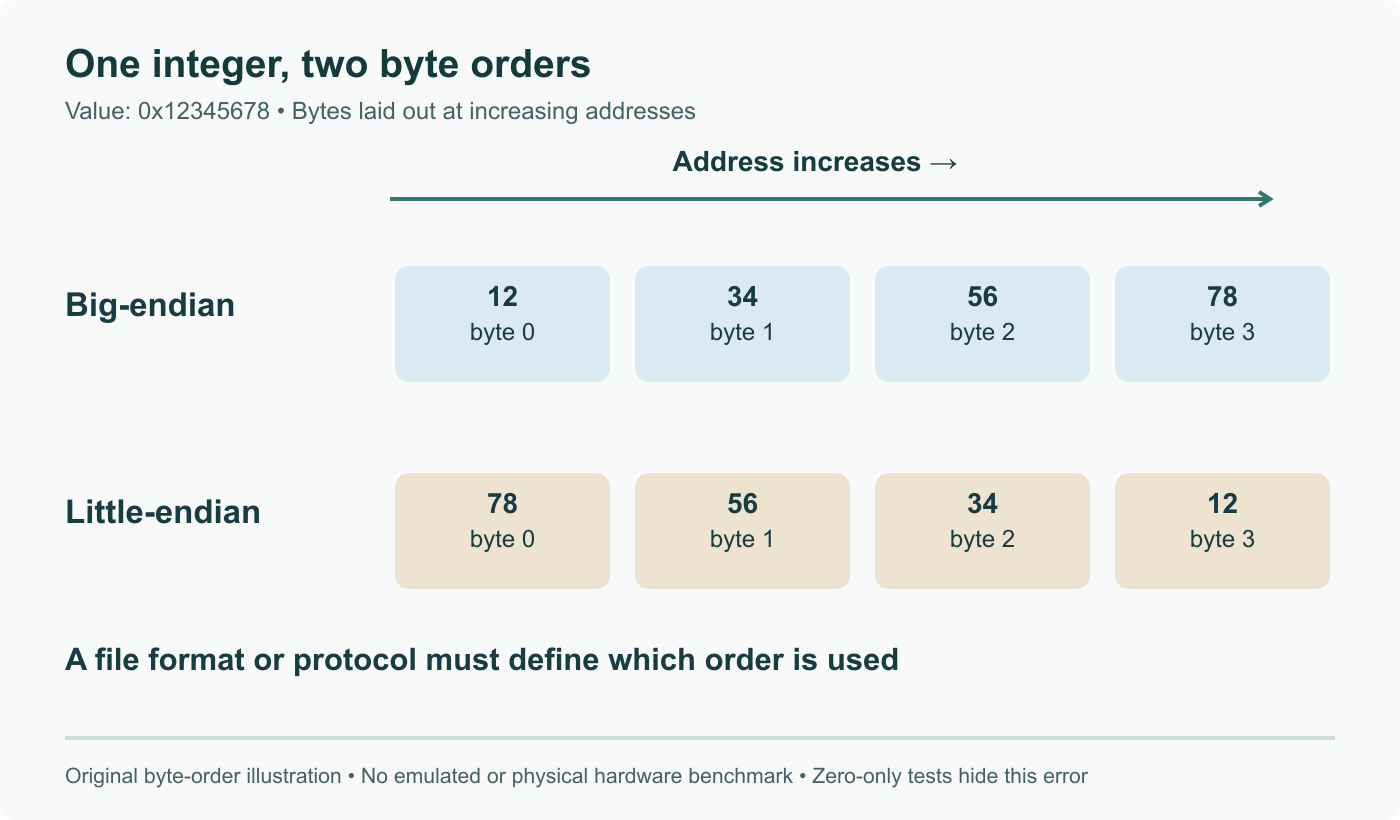
Almost nothing ships as big endian RISC-V. That is precisely the point. The specification permits it, kernels and toolchains carry code paths for it, and those code paths get almost no real world exercise. Emulation is the only sane way to test them, and endianness bugs are the archetypal defect that sits quietly in portable code until the one untested platform finds it.
Alongside that, 11.1 adds the Zbr and xbr0p93 extensions, Zvfbfa, fractional LMUL on the vector SHA instructions, KVM support for Zicbop and BFloat16, a new K230 board, and Tenstorrent mvendorid handling. The pattern matches what we saw when PoCL made RISC-V a conformant OpenCL 3.0 target: the architecture is past the point where support means booting, and into the phase where it means completeness.
Nested virtualization arrives on Apple silicon
The hvf accelerator is how QEMU reaches Apple's Hypervisor framework, and it is what gives you hardware accelerated Arm guests on an Apple silicon Mac. QEMU 11.1 adds nested virtualization there, together with vGIC support for the virtual interrupt controller.
The practical consequence: a guest running under hvf can now run a hypervisor of its own. Testing hypervisor code, or Kubernetes configurations that assume nested virtualization is available, no longer requires hunting down an Arm server. It requires a laptop you may already own. Kernel side Apple silicon support has been moving quickly in parallel, with M3 Pro, Max and Ultra device trees landing in Linux 7.3.
The Arm side also picked up a new imx8mp-evk machine type and the ability to specify cache topology on the virt board, which is the detail you want when you are trying to make a guest's reported topology match something real.
Everything else worth a line
vhost-host-user for virtio-rtc. Real time clock handling can now be offloaded out of the hypervisor process into a dedicated user space helper, following the same split QEMU already uses for network and block devices. On a densely packed host, that is one less thing the main process has to stay responsive for.
MPIPL on PowerNV. Memory contents survive an unexpected reset, so a crash leaves something behind to examine. Anyone who has lost a state to a reboot understands why this is on the list.
Nest MMU emulation on PowerPC, and ASTFLE facility 2 for KVM on s390x, both of them nested virtualization plumbing on their respective platforms.
HPPA moved to SeaBIOS-hppa v25, with TLB insert fixes aimed at running HP-UX 9. A change with a very small audience and a very high value to that audience.
GUI and console work: improved virtual console handling, the ability to specify character encodings, and GTK and VNC improvements. Unremarkable individually, and collectively the difference between a usable console and a frustrating one.
Should you move
If you are on a distribution package, this will arrive when it arrives and there is no urgency. If you build QEMU yourself and any of UFS emulation, big endian RISC-V, or hvf nested virtualization is on your list, 11.1 is the version that has it, and none of these are backportable in any pleasant way.
For the Windows guest side of the equation, the QEMU ecosystem has been moving too: Triton brings DirectX 11 to QEMU as a real Windows driver, which addresses a gap that predates most of what is in this release.
Sources and further reading
- QEMU version 11.1.0 released, QEMU project, August 11, 2026
- QEMU 11.1 Released With Numerous Improvements, Phoronix, August 11, 2026
- QEMU 11.1 changelog, QEMU Wiki
- QEMU downloads
Frequently asked questions
Which change here is most likely to matter on a machine I actually run?
For most people it is the storage work. QEMU 11.1 adds UFS emulation for Write Booster, the device level caching mode in the UFS 4.1 specification, and for Host Initiated Defragmentation. Universal Flash Storage is what sits inside phones, tablets and a growing number of embedded boards, and until now the honest way to test software against its quirks was to own the hardware. Being able to emulate the caching and defragmentation behaviour means a driver bug or a filesystem assumption can be reproduced in a virtual machine, in a script, on a build agent. That is the difference between a bug you can bisect and a bug you can only observe.
What does big endian RISC-V give me, given that essentially nothing ships that way?
Coverage, mainly. The RISC-V specification allows big endian operation and almost every real system runs little endian, which means big endian code paths in kernels, toolchains and libraries get very little exercise. Emulation is the only practical way to test them. This matters if you maintain portable code, because endianness bugs are the classic category that stays invisible for years and then surfaces on the one platform nobody tested. QEMU 11.1 also adds the Zbr and xbr0p93 extensions, Zvfbfa, fractional LMUL on the vector SHA instructions, KVM support for Zicbop and BFloat16, the K230 board and Tenstorrent mvendorid handling.
What is the hvf nested virtualization change, and does it help on Apple silicon?
Yes, and it is one of the more practical additions. The hvf accelerator is the path QEMU uses to reach Apple's Hypervisor framework on macOS, which is how you get hardware accelerated Arm guests on an Apple silicon machine. QEMU 11.1 adds nested virtualization support there, along with vGIC, the virtual generic interrupt controller. In plain terms, a guest running under hvf can now itself run a hypervisor. If you test Kubernetes nodes that use nested virtualization, or hypervisor code itself, that previously meant finding an Arm server. Also new on the Arm side are a new imx8mp-evk machine type and cache topology specification on the virt board.
What is vhost-host-user for virtio-rtc, in practice?
It moves real time clock handling out of the hypervisor process and into a separate user space helper. virtio-rtc is the paravirtualised clock device a guest talks to, and handling it inside QEMU means the main process is on the hook for that work. Offloading it follows the same pattern QEMU already uses for networking and block devices with vhost-user: a smaller, more focused process handles one device, and the hypervisor is not the thing that has to stay responsive for it. On a host packing many guests, that separation is a scheduling and isolation win rather than a feature you will notice in a benchmark.
Anything for people running QEMU on architectures other than x86 and Arm?
Two things worth naming. On PowerPC, QEMU 11.1 adds MPIPL support for PowerNV, which preserves memory contents across an unexpected reset so a crash can be examined afterwards rather than evaporating, plus emulation of the nest MMU. On s390x, KVM gained support for the ASTFLE facility 2, which is nested virtualization plumbing on the mainframe side. HPPA also moved to SeaBIOS-hppa v25 with TLB insert fixes that specifically target running HP-UX 9, which is the kind of change that only matters to a handful of people and matters enormously to them.