Alibaba released Qwen3.8-Max on August 3, and the number that matters most is not the 2.4 trillion parameters. It is the promise of open weights the following week, which would make this the first model in the Max tier to ship publicly instead of staying behind an API. The model is a sparse mixture of experts with a one million token context window, priced at two dollars per million input tokens. On benchmarks it trades places with the frontier rather than beating it: ahead on PaperBench at 93.0, clearly behind on agentic coding, where SWE-bench Pro puts it at 67.7 against 80.0 for Claude Fable 5. A 27B companion arrives alongside it.
The short answer
Alibaba launched Qwen3.8-Max on August 3 through Alibaba Cloud Model Studio and the DashScope API. It is a sparse mixture of experts with 2.4 trillion total parameters, a one million token context window and multimodal input covering text, images and video. Alibaba says open weights for both Qwen3.8-Max and a smaller Qwen3.8-27B follow the week after launch, which would be the first public release of a Max tier Qwen model. Benchmarks are split: 93.0 on PaperBench and 92.6 on GPQA Diamond put it at the frontier, while 67.7 on SWE-bench Pro against 80.0 for Claude Fable 5 leaves a clear gap on agentic coding.
Every few weeks a Chinese lab publishes a benchmark table and the same argument starts again about whether the gap to the frontier has closed. The Qwen3.8-Max table is more interesting than most, not because it wins, but because of where it wins and where it does not.
What actually shipped
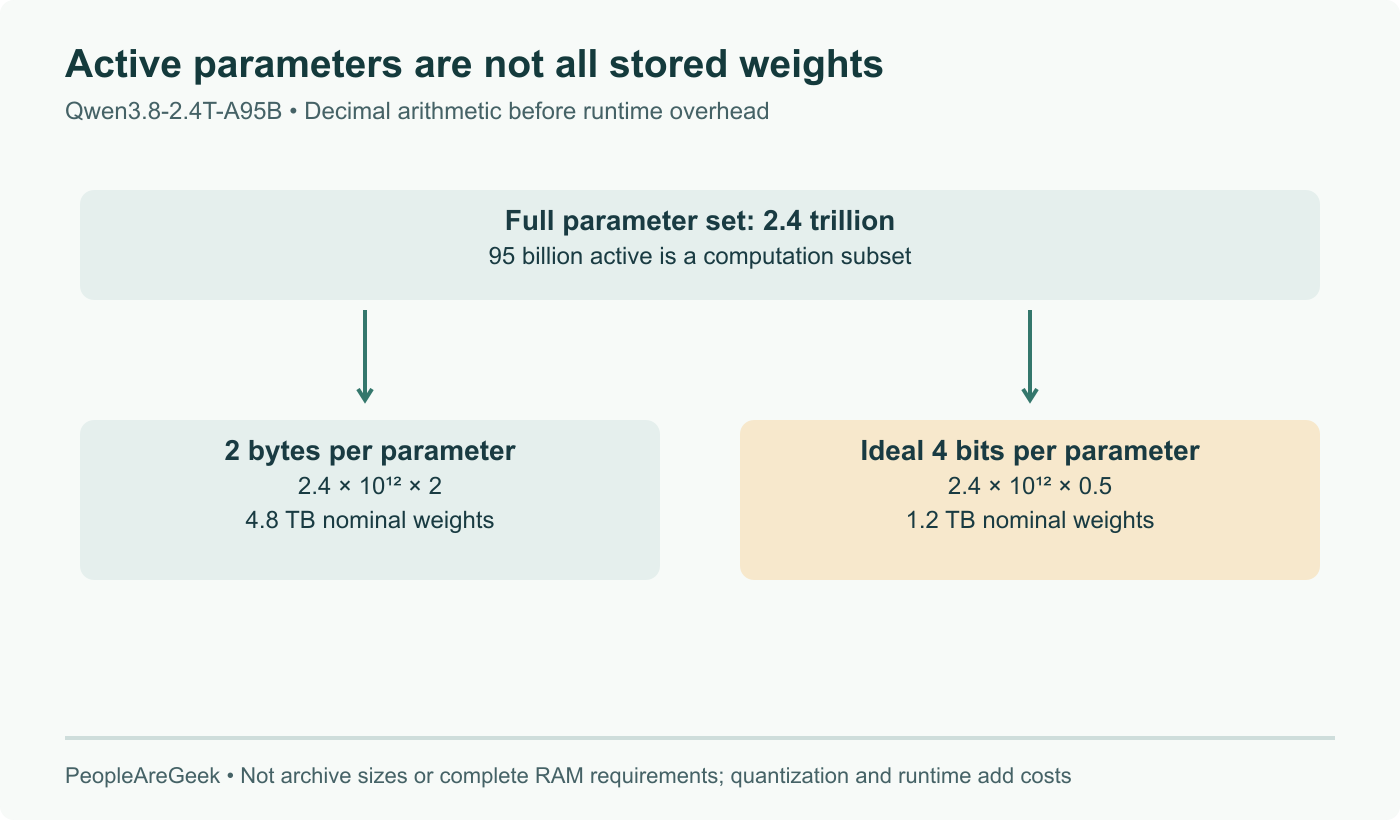
Qwen3.8-Max went live on August 3 through Alibaba Cloud Model Studio, with an API that is described as compatible with both DashScope and OpenAI conventions. It is a sparse mixture of experts totalling 2.4 trillion parameters, roughly seven times the Qwen3.5 model Alibaba released in February. SiliconANGLE reports around 95 billion parameters activate per query, a figure Alibaba has not published directly, so treat it as reported rather than confirmed.
The context window is one million tokens, with a maximum input of 991,000 tokens that drops to 983,000 once thinking is enabled, and a maximum output of 131,000 tokens. There is a separate reasoning budget of up to 262,000 tokens. Input can be text, images or video. Output is text only.
Pricing is two dollars per million input tokens and six dollars per million output tokens. Cache reads are the number worth noting: twenty five cents per million for an implicit cache read, seventeen cents for an explicit one, against two dollars and fifty cents to create an explicit cache entry. Published rate limits are two million tokens per minute and fifteen thousand requests per minute.
The benchmarks split cleanly in two
Read the table in two halves and it tells a coherent story rather than a promotional one.
On reasoning and knowledge work the model is competitive with anything currently shipping. PaperBench, which measures whether a model can reproduce the results of a research paper from the paper alone, gives it 93.0 against 90.5 for GPT-5.6 Sol, 88.8 for Claude Fable 5 and 80.3 for Claude Opus 4.8. GPQA Diamond comes in at 92.6. On Frontend Code Arena, which scores interface development, it reaches 1,668 points, which is 37 points behind the strongest configuration of Claude Opus 5.
Then look at agentic software engineering. SWE-bench Pro puts Qwen3.8-Max at 67.7 where Claude Fable 5 sits at 80.0. FrontierSWE gives 73.5 against 88.8. Terminal-Bench 2.1 is the closest of the three at 86.6, just behind GPT-5.6 Sol's 88.8 and slightly ahead of Claude Opus 4.8 at 84.6. OSWorld-Verified, which measures computer use, lands at 86.1.
The pattern is consistent enough to be believable. Single shot reasoning, research reproduction and knowledge questions are strong. Long horizon tasks where a model has to keep a plan alive across dozens of tool calls and recover from its own mistakes are a tier down. Alibaba does cite a sixteen day autonomous coding project and a chip design optimisation running past five hundred steps as demonstrations, but those are demonstrations rather than scored comparisons, and the scored comparisons are the ones that disagree.
Open weights is the part that changes something
The hosted API is a competitive product and will be judged as one. The weights are a different kind of event.
Every previous Qwen-Max has stayed behind the API while the smaller Qwen models went out under open licences. Alibaba says that changes the week after launch, for both the 2.4 trillion parameter Max and a Qwen3.8-27B built for on premise deployment. If that holds, a Max tier model becomes something you can put on your own hardware, subject to whatever the licence says.
For most readers the 27B is the practical one. Two point four trillion parameters, even sparsely activated, means holding every expert in memory, and Alibaba points at multi node datacenter infrastructure for it. That is a cluster, not a workstation. The 27B is described as the model to run on your own GPUs, and Alibaba has said far less about how it scores, which is unfortunate because for anyone with a self hosting requirement it is the number that matters.
We would also separate two things that get conflated in coverage of releases like this one. Open weights means you receive the parameters and a licence. It does not mean open source, and it does not give you the training data, the training code or the right to do whatever you want with the output. Until the files and the licence text are actually published, this remains a commitment rather than a release.
What we would do with this
If you are running production inference and cost is the constraint, the caching prices are worth a serious look. A workload that reuses a large fixed prefix across many requests, which the one million token window actively encourages, pays seventeen to twenty five cents per million on the cached portion instead of two dollars. That is a structural saving rather than a marginal one, and it rewards designing the prompt layout around the cache boundary.
If you are choosing a model for a coding agent, the published numbers do not support switching. A twelve point gap on SWE-bench Pro and fifteen on FrontierSWE is the difference between an agent that finishes a task and one you have to rescue.
And if you have a self hosting requirement, whether that is data residency, air gapped deployment or simply not wanting a dependency on someone else's API, mark the week and go and read the licence when it lands. That is where this release either matters to you or does not.
Sources and further reading
- Alibaba debuts Qwen3.8-Max model with 2.4T parameters, SiliconANGLE, August 3, 2026
- Alibaba Qwen releases Qwen3.8-Max, a 2.4 trillion parameter MoE model, MarkTechPost, August 3, 2026
- Alibaba shares rally after unveiling Qwen3.8-Max AI model, CNBC, August 3, 2026
- Alibaba unveils Qwen3.8-Max, its most capable flagship model to date, Alizila
- Alibaba's AI model Qwen3.8-Max made widely accessible ahead of open-weights release, South China Morning Post
Frequently asked questions
Is Qwen3.8-Max actually open source?
Not yet, and the word to watch is weights rather than source. On launch day the model was available only through Alibaba Cloud Model Studio and the DashScope API. Alibaba said weights for both Qwen3.8-Max and the smaller Qwen3.8-27B would be published the following week. If that lands, it is the first time a Max tier Qwen model has been released publicly rather than held behind the API, which is the part of this story with real consequences for anyone who needs to run a model on their own hardware. Open weights are also not the same thing as open source: you get the parameters and a licence, not the training data or the training code, and the licence terms decide what you may actually do with the result. Until the files are on Hugging Face and the licence text is readable, treat it as an announcement.
Could I realistically self host it?
The 2.4 trillion parameter model, no, not on anything you own. Alibaba itself points at multi node datacenter infrastructure for that one, and a sparse mixture of experts still has to hold every expert in memory even though it only activates a fraction per token. The 27B companion is the one aimed at your rack. That size fits on a single machine with enough GPU memory, runs under the usual local stacks, and is explicitly described as the on premise option. If your interest in this launch is practical rather than competitive, the 27B is the model to watch, and its benchmark numbers, which Alibaba has not detailed, matter far more to you than anything the Max scored.
How does it compare to the frontier on real work?
It depends entirely on which benchmark you pick, which is itself the useful finding. On PaperBench, which tests whether a model can reproduce the results of a research paper, it scores 93.0 against 90.5 for GPT-5.6 Sol and 88.8 for Claude Fable 5. On GPQA Diamond it reaches 92.6. Then you look at agentic software work and the picture reverses: SWE-bench Pro puts it at 67.7 where Fable 5 sits at 80.0, and FrontierSWE at 73.5 against 88.8. Terminal-Bench 2.1 lands in between at 86.6, close behind GPT-5.6 Sol at 88.8 and slightly ahead of Claude Opus 4.8 at 84.6. Read together, this is a model that is genuinely frontier class at reasoning and knowledge tasks and a tier down on long horizon coding agents.
What does it cost against the alternatives?
Two dollars per million input tokens and six dollars per million output tokens, which is the aggressive end of the market for a model claiming these scores. Caching is where the pricing gets interesting: an implicit cache read is twenty five cents per million tokens, and an explicit cache read is seventeen cents, roughly eight to twelve times cheaper than fresh input. If your workload repeats a large system prompt or a fixed document set across many calls, and with a one million token window that is a plausible design, the cache pricing does more for your bill than the headline rate. Published rate limits are two million tokens per minute and fifteen thousand requests per minute.
What is the context window in practice?
One million tokens nominally, with the details worth reading. Maximum input is 991,000 tokens, dropping to 983,000 with thinking enabled, and maximum output is 131,000 tokens per response. The reasoning budget goes up to 262,000 tokens, which is a separate allowance from the visible output. Alibaba frames the window as more than 200 pages of text or around 100 hours of footage per request, since the model takes text, images and video as input while producing text only. Reports attribute the long context handling to a hybrid attention design that scales linearly rather than quadratically with prompt length, though Alibaba has not confirmed the mechanism.