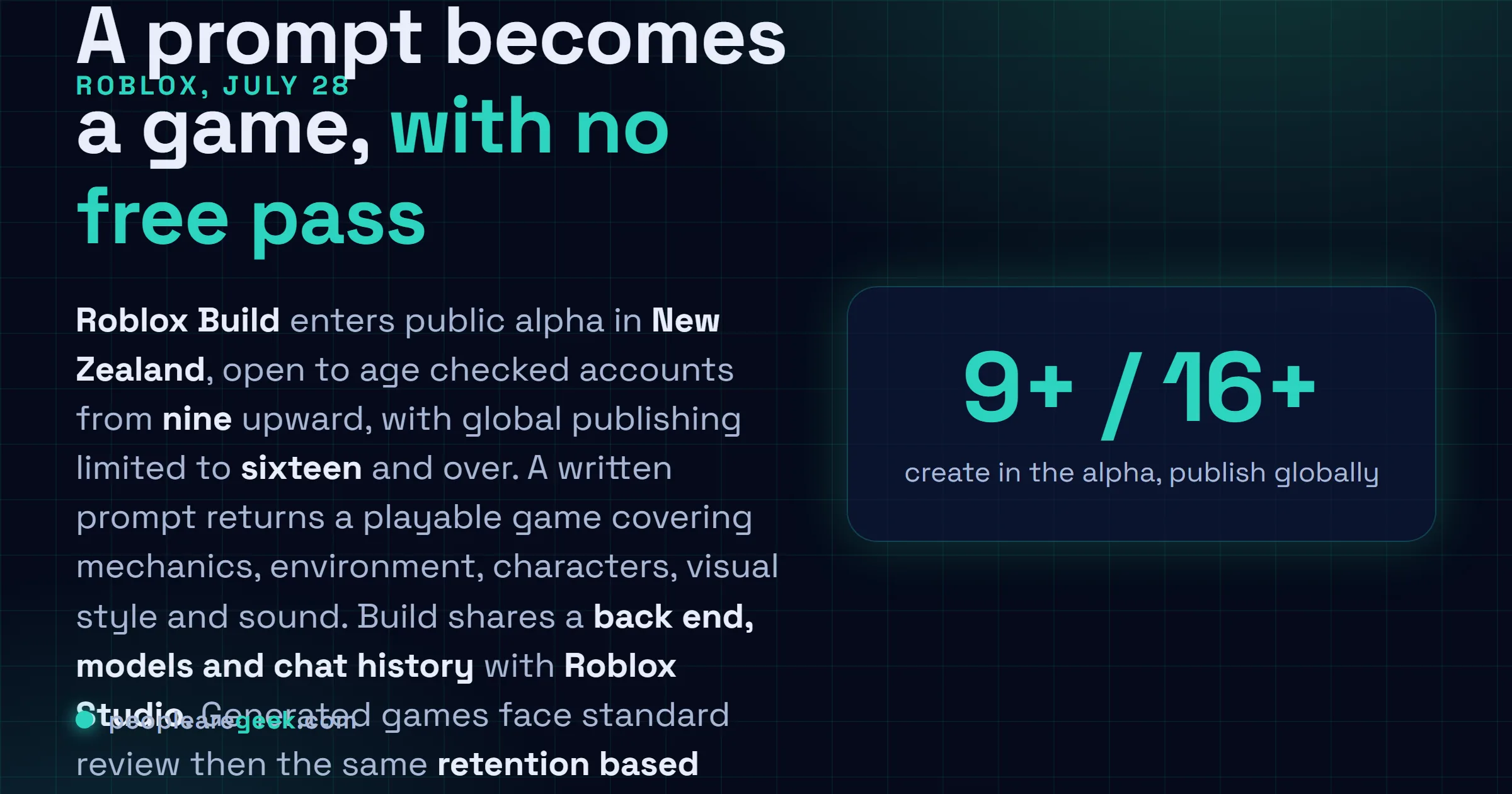
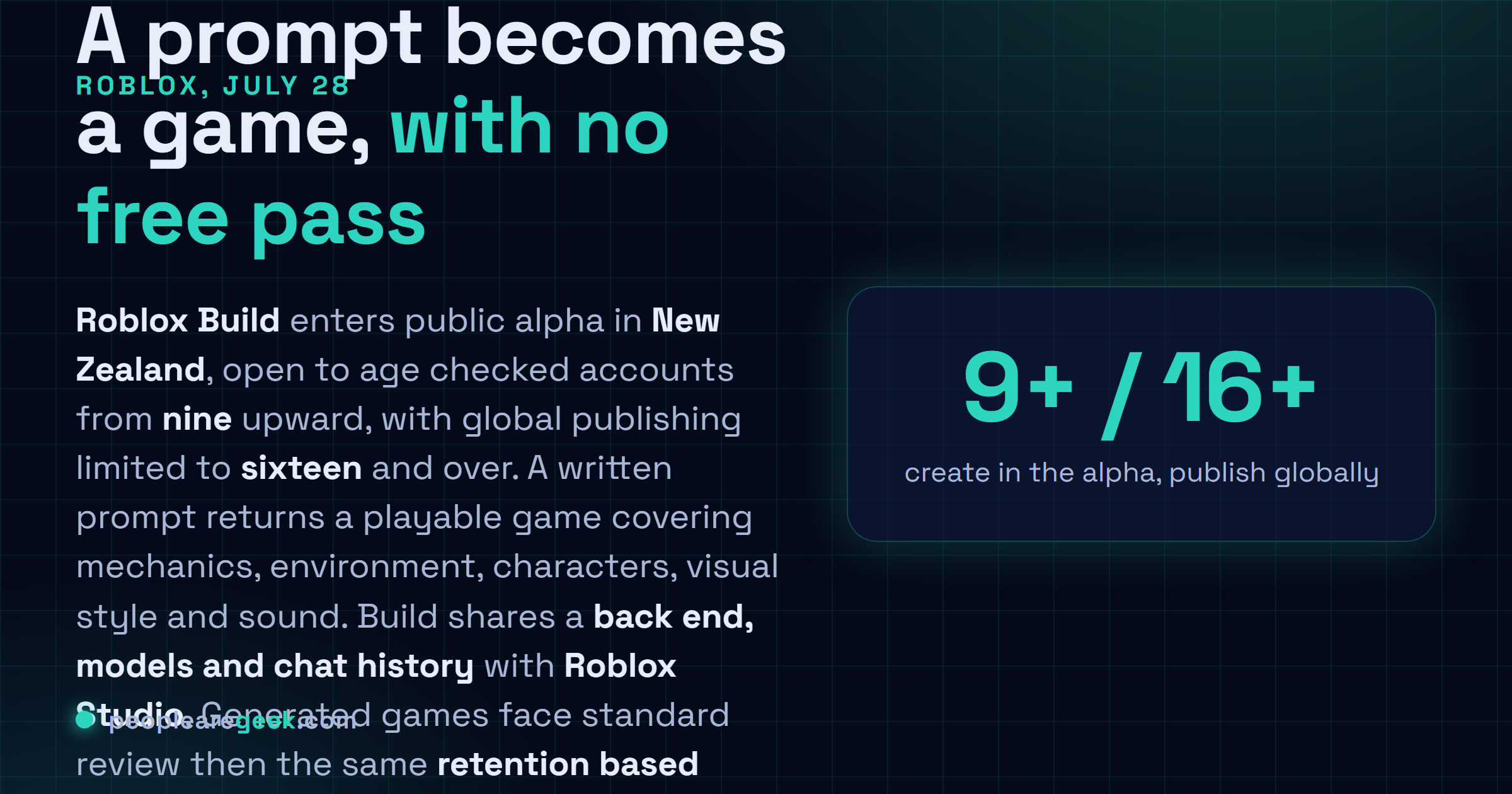
Roblox begins the public alpha of Build today, July twenty eighth, limited to New Zealand and to age checked accounts from nine years old upward. Build is a tab inside the mobile app that turns a written prompt into a playable game, complete with mechanics, environment, characters, visual style and sound. Publishing to a global audience is restricted to accounts sixteen and over. The detail worth the attention of anyone building generative tooling is not the generation itself. It is that Roblox refuses to give the output a distribution advantage: an AI made game is ranked by player retention exactly like everything else.
The short answer
Roblox opens the public alpha of Build on July twenty eighth, restricted to New Zealand and to age checked accounts from nine years old upward, with global publishing limited to accounts sixteen and over. Build is a mobile tab that turns a written prompt into a playable game covering mechanics, environment, characters, visual style and sound, generated by a mix of open source and proprietary Roblox models trained on the platform's own 3D data. It shares a back end, models and chat history with Roblox Studio, so projects move between phone and desktop. Generated games get no ranking advantage: standard safety review, then the same retention based discovery as everything else.
Most generative tooling announcements are about the generation. This one is more interesting for what Roblox decided not to do with the output once it exists.
What the alpha covers
Build was announced on July sixteenth as a creation tab inside the Roblox mobile app, shipped alongside a set of agentic tools for Roblox Studio aimed at experienced creators. The public alpha starting today is the first time anyone outside the company gets to use it.
The scope is deliberately small. One country, New Zealand. Age checked accounts from nine years old upward can create. Publishing to a global audience needs an account sixteen or over. Roblox says the test widens to more regions over the coming months and has not attached dates to that, which for a staged rollout of a system this open ended is the correct amount of commitment.
The loop is four steps: prompt, refine, playtest, share. A creator describes a game in ordinary language, Build produces a playable starting point covering gameplay mechanics, environment, characters, visual style and sound, and refinement happens through further conversation. Roblox credits a mix of open source and proprietary models trained on its own 3D and gameplay data, which is the advantage a platform holds over a general purpose model here: the training data and the runtime are the same world.
The bit engineers should look at

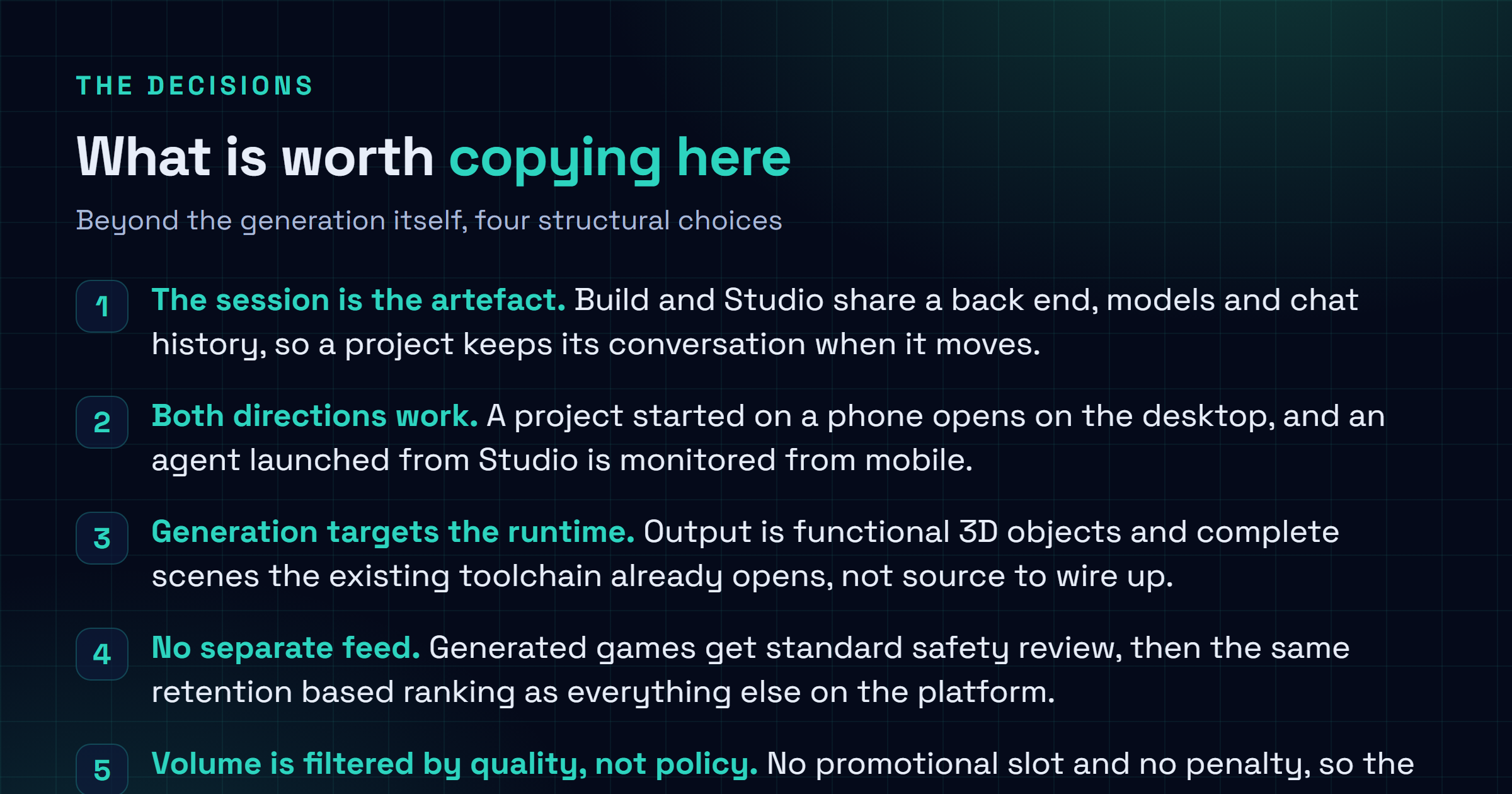
Build and Roblox Studio share a back end, the same models, and the same chat history. That sentence is easy to skim past and it is the most transferable idea in the announcement.
The usual way to add an AI surface to an existing tool is to bolt on a second application that exports files the first one can open. What you get is two products with a bridge between them, and the bridge loses context every time something crosses it. Roblox instead made the session the durable object. A project started on a phone opens in Studio with its conversation history attached, so the desktop tool knows what was asked for and why, not just what the last export contained. The reverse works as well: an agent launched from Studio can be monitored from the mobile app while it runs.
If you are designing anything where a lightweight assistant and a heavyweight editor both operate on the same work, that is the pattern. Persist the conversation, not the artefact.
No distribution advantage
Here is the decision that makes this worth watching from outside the Roblox ecosystem entirely.
A game made in Build goes through the same safety review as any other submission, and then it enters the same discovery system, ranked on player retention against every other title on the platform. There is no separate surface for AI made games, no promotional slot, and no penalty either. Roblox's own framing of the consequence is direct: a game that nobody plays is a game that nobody can find.
Every platform now accepting generative submissions faces the same question, and most have answered it with policy: labels, quotas, separate feeds, review queues that grow faster than they drain. Roblox is answering it with ranking. If lowering the cost of making a game floods the platform, the flood sinks on its own merits, because the mechanism that decides what surfaces never changed and never had to be renegotiated.
Whether that holds is a genuinely open question, and it is the reason the alpha is worth following even if you have never opened Roblox Studio. A retention ranked feed is a harsher filter than a review queue, but it is also slower, and volume arriving faster than players can sample it is exactly the failure mode this design is betting against.
What is not here yet
Three things were announced and have not shipped: playtesting agents, analytics agents, and experiment agents aimed at engagement tuning. Those are aimed at the professional end of the creator base rather than at someone describing a game to a phone, and they are the part of the roadmap that will tell you whether Roblox sees Build as an on ramp or as the product.
Pricing is also unfinished. There is a free base version for all creators and optional paid tiers, with no numbers attached. Serving 3D scene generation is expensive, so where the free tier stops will be the most informative figure in this whole announcement once it exists.
For now the sensible read is that today is a small test with one large idea in it. The generation is the demo. The ranking decision is the thing to argue about.
Sources and further reading
- Roblox newsroom: Build without limits on Roblox
- Roblox investor relations: Roblox introduces Build, a new way to create on the platform
- TechCrunch: Roblox launches an AI powered game creation feature in its mobile app
- The Next Web: Roblox launches Build, a mobile tab that turns text prompts into playable games
- Businesswire: Roblox introduces Build, a new way to create on the platform
Frequently asked questions
What exactly launched today?
A public alpha, in one country. Build itself was announced on July sixteenth as a mobile first creation tab inside the Roblox app, alongside a set of agentic tools for Roblox Studio. What starts on July twenty eighth is the first public test, limited to New Zealand and to age checked accounts from nine upward. Creation is open to everyone in that test group. Publishing to a global audience is limited to accounts sixteen and over. Roblox says more regions follow over the coming months without committing to dates, which is the usual and sensible shape for a staged rollout of something this open ended.
How is this different from asking a chat model to write game code?
The output target is different, and that is most of the difference. A general model asked for a game gives you source you then have to place into a project, run, and debug against an engine it cannot see. Build generates inside the platform that runs the result, so what comes back is a project with functional 3D objects and complete scenes that the existing Roblox toolchain can already open. Roblox describes a mix of open source and proprietary models trained on its own 3D and gameplay data. The loop is prompt, refine, playtest, share, and the playtest step happens in the same app rather than somewhere else.
What happens to a project started on a phone?
It moves, and this is the part of the design most worth copying. Build and Roblox Studio share a back end, the same models, and the same chat history, so a project begun on a phone opens in the desktop tool with its conversation intact rather than as an orphaned export. The reverse direction works too: an agent launched from Studio can be monitored from the mobile app. Treating the interactive session as the durable artefact, rather than the file it produced, is a structural choice, and it is the reason the two surfaces feel like one tool instead of an app and a companion app.
Do AI generated games get promoted differently?
No, and Roblox has been direct about it. A game made in Build goes through the same safety review as anything else and then enters the same retention based discovery system, competing against every other title on the platform. The company's own framing is blunt: a game nobody plays is a game nobody can find. That matters beyond Roblox, because it is a live test of the question every platform taking generative submissions has to answer. Ranking generated work on identical terms means the flood is throttled by whether it is any good, not by a separate policy that has to be argued about.
What does it cost?
There is a free base version available to all creators, with optional paid tiers for heavier use. Roblox has not published a price sheet for the paid options, which is normal for something at alpha stage. Worth noting for anyone modelling the economics: generation of 3D scenes and gameplay is not cheap to serve, so where the free tier ends will end up being the most informative number in the whole announcement once it exists. Announced but not yet shipped are playtesting agents, analytics agents, and experiment agents aimed at engagement tuning, which read as the professional end of the same product.