Most of the AI money this year chased chatbots, so it is worth pausing on a deal that bet on tables instead. SAP has completed its acquisition of Prior Labs, the Freiburg based research company that pioneered tabular foundation models and built the TabPFN series published in Nature. SAP first announced the agreement in early May and, with regulatory approvals secured, closed it around July 17, 2026. The commitment is more than one billion euros over four years to stand up a European frontier AI research lab, and Prior Labs stays an independent legal entity with its brand, its open source work, and its Freiburg headquarters intact. For anyone whose real data lives in rows and columns rather than free text, this is a more interesting story than another model launch, so here is what tabular foundation models are and why a company like SAP paid this much for one.
The short answer
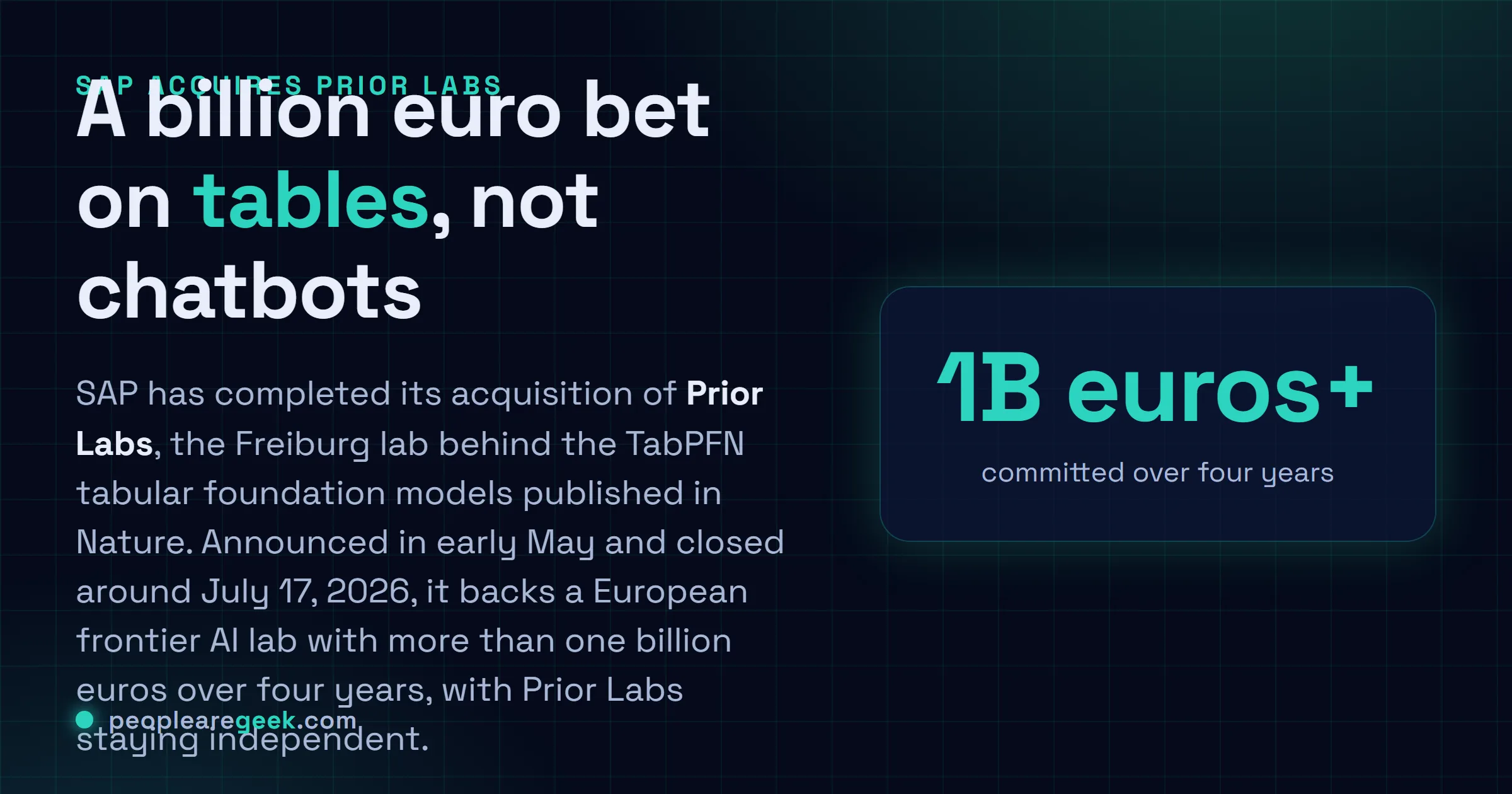
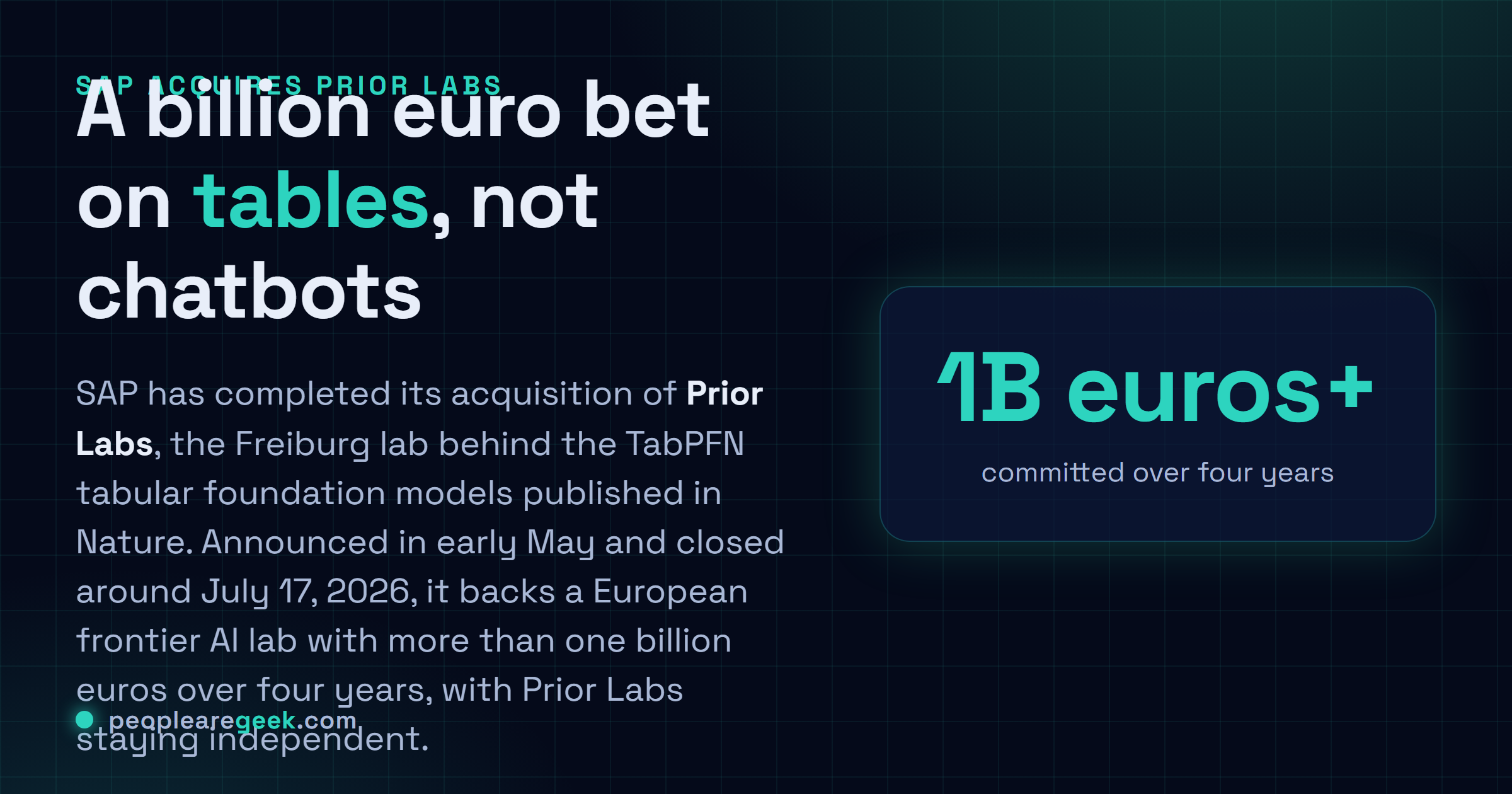
SAP has completed its acquisition of Prior Labs, the Freiburg based company behind the TabPFN tabular foundation models published in Nature. Announced in early May and closed around July 17, 2026 once regulatory approvals landed, the deal backs a European frontier AI research lab with more than one billion euros over four years. Prior Labs stays an independent legal entity, keeping its brand, headquarters, and open source work. The bet is on tables, the shape most enterprise data actually takes, rather than on another chatbot.
The loud story of 2026 was general purpose models getting bigger. The quieter story, and arguably the one closer to where most companies actually keep their data, is tabular AI. SAP just put more than a billion euros behind that quieter story by completing its purchase of Prior Labs, and we think it is worth understanding why a deal about spreadsheets deserves your attention more than the headline suggests.
What SAP bought
SAP announced in early May 2026 that it had agreed to acquire Prior Labs, a German research company founded roughly eighteen months earlier. The agreement was subject to regulatory approval, and once that cleared, SAP closed the deal around July 17, 2026. The framing is a commitment of more than one billion euros over four years to build a European frontier AI research lab, so this is an investment in ongoing research, not just a one time asset grab.
Crucially, Prior Labs is set to keep operating as an independent legal entity. It retains its brand, its Freiburg headquarters, offices in Berlin and New York, its customer relationships, its scientific advisory board, and its open source commitments. Founders Frank Hutter, Noah Hollmann, and Sauraj Gambhir built the lab around a specific technical idea, and the deal structure suggests SAP wants that team to keep working rather than be absorbed and diluted.
Tabular foundation models, explained
Here is the technical core, because the deal makes little sense without it. Most machine learning on tables, the rows and columns of spreadsheets and databases, works by fitting a fresh model to each dataset, very often with gradient boosted trees. It works, but it means per task training every time.
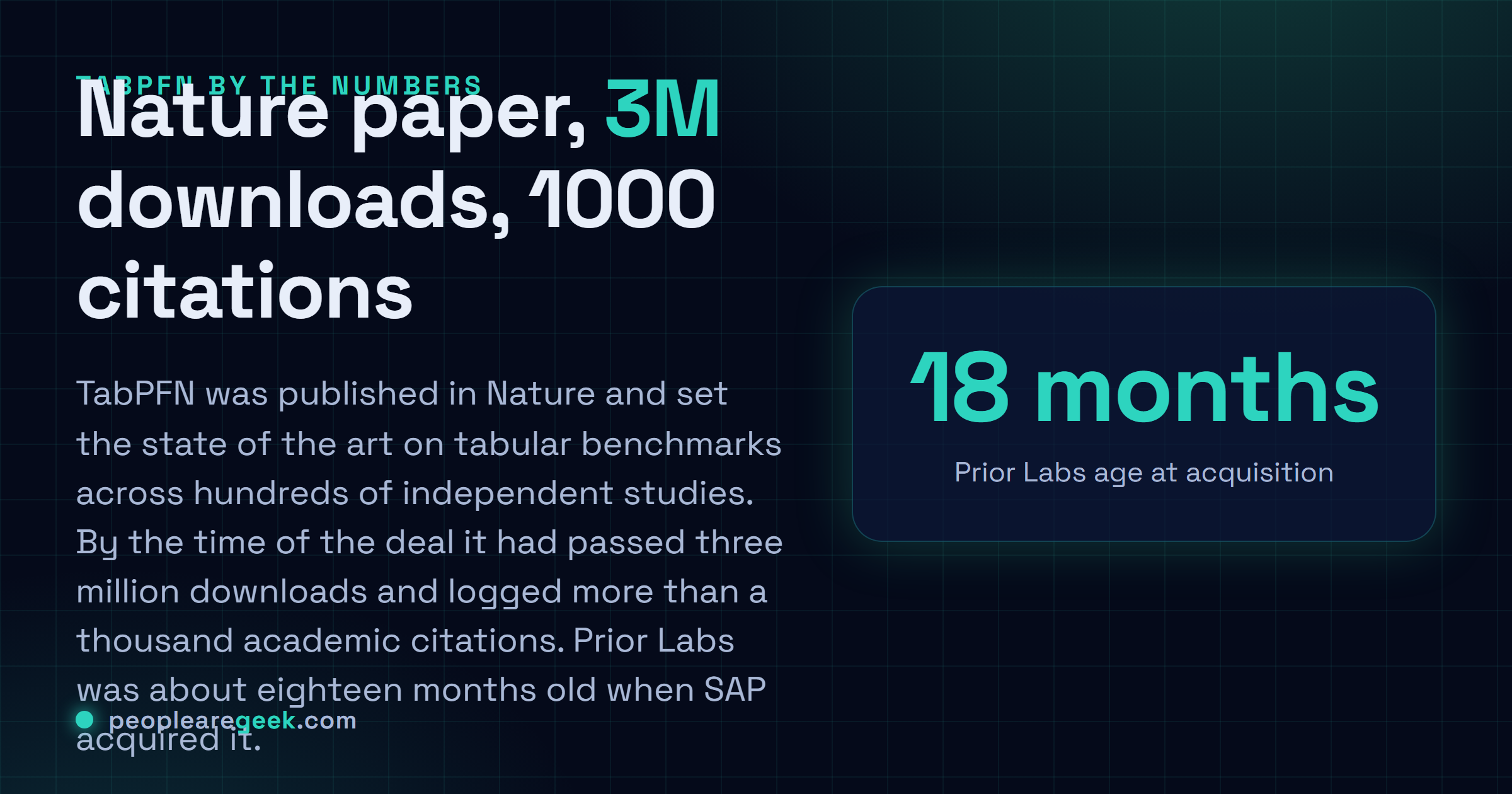
A tabular foundation model flips that. Prior Labs' TabPFN is pretrained to recognize general patterns in tabular data, then handles a new table through in context learning, producing predictions from a modest dataset with little or no task specific training. The results were published in Nature and set the state of the art on tabular benchmarks across hundreds of independent academic studies. By the time of the deal, TabPFN had passed three million downloads and logged more than a thousand academic citations, which is real traction for a research artifact rather than a product.

Why tables are the right target
The reason this matters is boring and important: most enterprise data is tabular. Financial records, inventory, customer tables, sensor logs, the operational core of a business tends to live in structured rows, not in prose. A model that predicts well on that shape of data, with little setup, addresses a problem that is everywhere and rarely glamorous.
SAP sits directly on top of that kind of data for a very large customer base, so buying the leading tabular foundation model team is a natural fit rather than a reach. It is also a deliberate positioning choice. Rather than trying to out chatbot the largest labs, SAP is betting that European enterprise AI can lead through a specialty where it already has the data and the customers.
What it means for practitioners
If you build models on tabular data, TabPFN is worth evaluating on your own datasets, especially where you have modest sample sizes and want a strong baseline without a long tuning cycle. The stated continuation of open source commitments is the part to watch, because the community value depends on the models staying accessible after the acquisition rather than retreating behind an enterprise product.
More broadly, this is a signal about where enterprise AI is heading. Not every problem is a language problem, and the tools that win inside companies may be the ones tuned to structured data rather than to conversation. A billion euro bet on tables is a reminder to keep the unglamorous parts of your stack in view.
Sources and further reading
- SAP newsroom: SAP to acquire Prior Labs to establish a frontier AI lab in Europe
- Tech.eu: SAP acquires Prior Labs 18 months after launch in a deal worth over one billion euros
- The Next Web: SAP acquires Prior Labs to build a European frontier AI research lab
- Prior Labs: TabPFN tabular foundation models
Frequently asked questions
What is a tabular foundation model?
It is a model pretrained to make predictions on tabular data, the rows and columns you find in spreadsheets and databases, without training a fresh model for each task. Traditional tabular machine learning fits a new model to each dataset, often with gradient boosted trees. A tabular foundation model like TabPFN instead learns general patterns during pretraining and then handles a new table through in context learning, so you can get a prediction from a modest dataset with little or no per task training. That is the shift SAP is buying into.
What is TabPFN and why does it matter?
TabPFN is the tabular foundation model series from Prior Labs. Its results were published in Nature and it set the state of the art on tabular benchmarks across hundreds of independent academic studies. By the time of the deal it had passed three million downloads and logged more than a thousand academic citations. It matters because a large share of enterprise data is tabular, so a model that predicts well on tables with little setup addresses a very common and very valuable problem.
How much did SAP commit, and when did the deal close?
SAP announced the agreement in early May 2026 and committed more than one billion euros over four years to build a European frontier AI research lab around Prior Labs. The deal was subject to regulatory approval, which was later secured, and SAP closed the acquisition around July 17, 2026. The one billion euro figure is the multi year investment framing rather than a single upfront price tag.
Does Prior Labs stay independent after the acquisition?
Yes, in structure. SAP has said Prior Labs will continue to operate as an independent legal entity, keeping its brand, its Freiburg headquarters, offices in Berlin and New York, its customer relationships, its scientific advisory board, and its open source commitments. That last point matters to practitioners, because the value of TabPFN to the community depends on it staying accessible rather than disappearing behind an enterprise wall.
Why is this framed as a European AI story?
SAP is Europe's largest software company, and it has positioned the deal as building a globally leading frontier AI research lab in Europe rather than importing one. Prior Labs was founded roughly eighteen months before the acquisition, so this is a large European enterprise buying a young European research team and funding it to keep working. The framing is deliberate: a bet that European enterprise AI can be led from a specialty like tabular data rather than by chasing general chatbots.