Stripe is in talks to acquire OpenRouter for a price close to $10 billion, according to reports published on Thursday, July twenty third. Nothing is signed yet. OpenRouter is the routing layer a lot of teams quietly depend on, a single API that fans requests out to hundreds of proprietary and open weight models and lets you switch between them without rewriting your client. The number is the part that stops you. OpenRouter raised at a $1.3 billion valuation in May, so the reported price is roughly eight times that mark in about two months. If you route production traffic through it, the headline figure is not your problem. What changes underneath is.
The short answer
On Thursday, July twenty third, The Wall Street Journal and The Information reported that Stripe is in talks to buy OpenRouter, the API that routes developer requests across hundreds of proprietary and open weight models, for close to $10 billion. OpenRouter raised at a $1.3 billion valuation in May, so the reported figure is roughly eight times that mark in about two months. Nothing is signed, and the talks could still fall apart. OpenRouter has also held early sale conversations with Databricks. If you route production traffic through a model broker, the useful response is not to guess at the outcome, it is to confirm you could leave in a day.
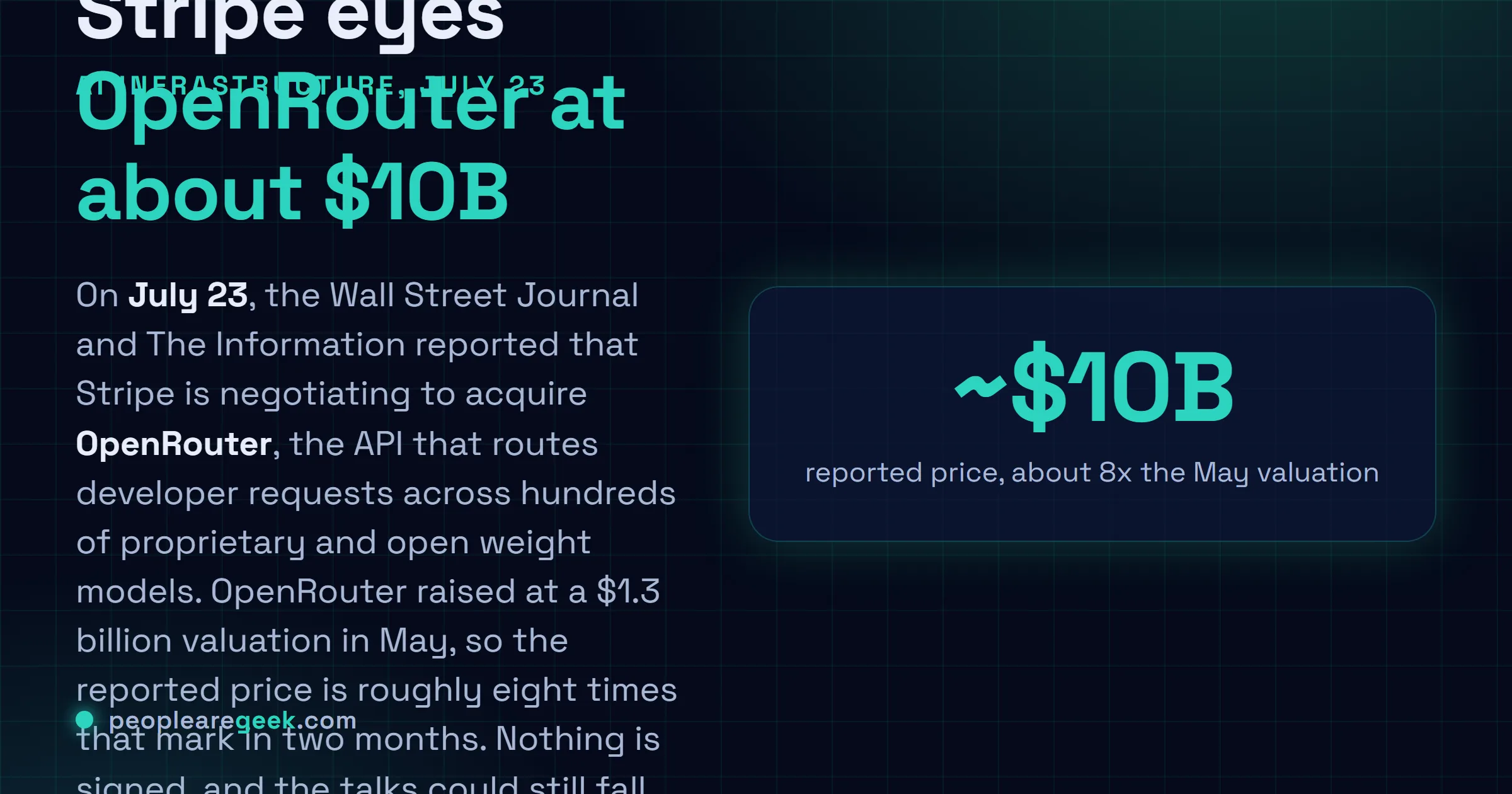
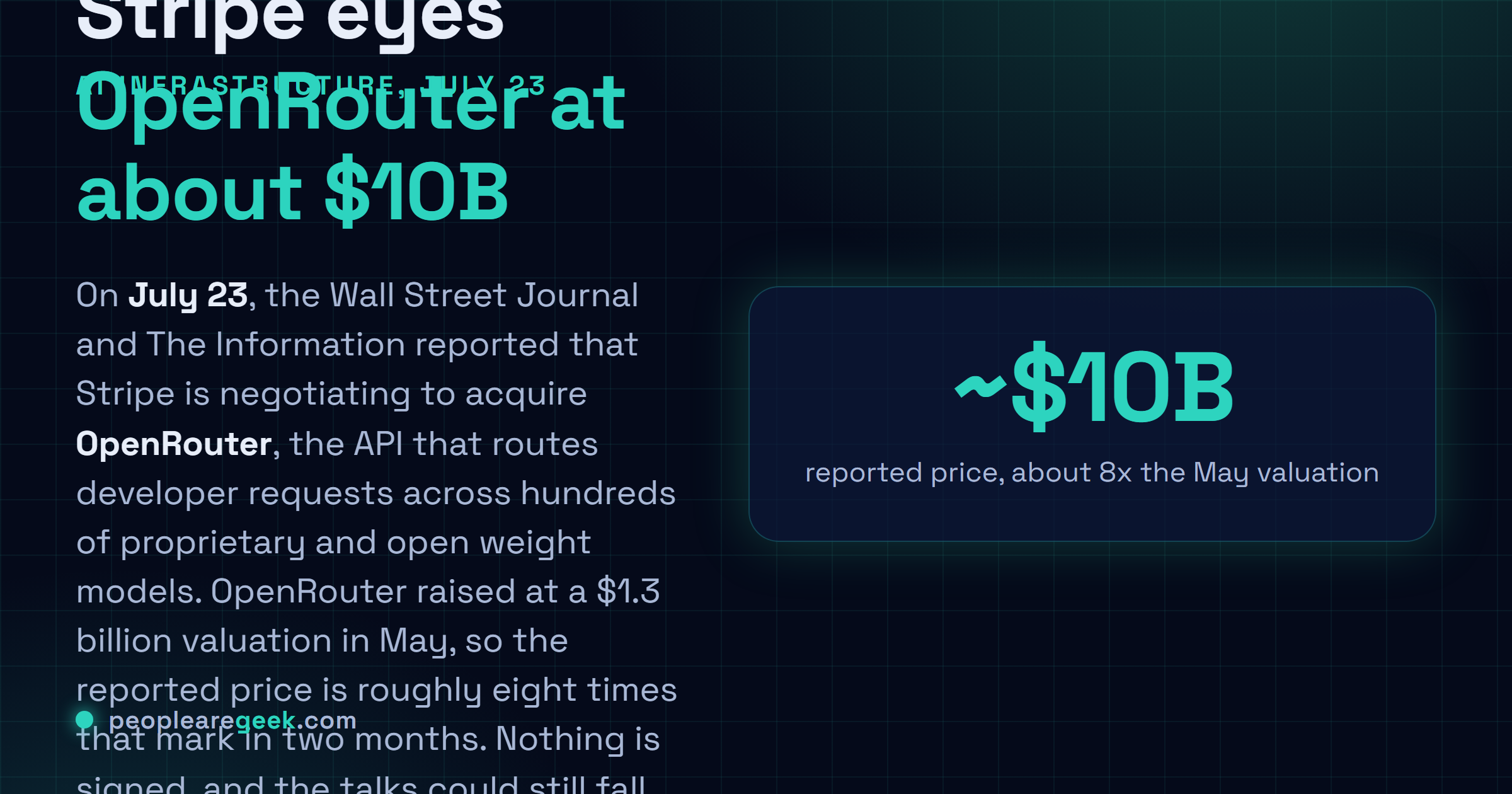
Most of the AI infrastructure money this year has gone into things you can point at, chips, racks, gigawatts of power. This one is a piece of glue. On Thursday, July twenty third, reports said Stripe is negotiating to buy OpenRouter for close to $10 billion, and OpenRouter does not manufacture anything. It forwards your request to the model you asked for. That a company doing that is now discussed at eleven figures says something about where the value in the stack has moved.
What OpenRouter actually does
If you have not used it, the product is easy to describe. You point your client at one endpoint, name a model, and OpenRouter sends the request to whichever provider serves it. Hundreds of models are reachable this way, proprietary and open weight, from many vendors, through a single API shape and a single invoice.
Three things follow from that, and they are the reason adoption spread the way it did. Comparing two models stops being an integration project and becomes a config change. Switching a model in production stops being a deploy and becomes a string edit. And the accounting stops being a monthly reconciliation across a dozen vendor consoles. For teams whose inference bill grew faster than anyone forecast, those three are worth paying a margin for.
Why the number is eight times May
OpenRouter set a $1.3 billion valuation in a funding round in May. The reported price now is close to $10 billion. Roughly eight times, in roughly two months, which is not a normal repricing of a normal business.
The explanation people close to the deal offer is about position rather than revenue. A router sits at the exact point where model choice is made, request by request, for a large number of companies at once. Whoever owns that point can steer traffic toward the cheapest model or the one best fitted to a task, and can see the shape of a market that is otherwise fragmented across vendors who each only see their own share. Stripe already has an operational relationship here, because OpenRouter runs its customer transactions on Stripe. Metering, rating, and billing usage by the token looks a lot like the problem Stripe already solved for payments.

What would actually change for you
Start with what would not. A router acquisition does not break your calls on announcement day, and there is no signed agreement here to break anything at all. The reporting is explicit that terms are unconfirmed and that talks could collapse.
What tends to change after an acquisition is slower and less dramatic. Pricing gets revisited. Rate limits and free tiers get revisited. Terms of service get rewritten to match a larger company's legal posture. Roadmap priorities shift toward whatever the new owner needs, which may or may not be the thing you were waiting for. And there is a fair question, not an accusation, about a neutrality product acquiring an owner with commercial interests of its own. OpenRouter's pitch is that it does not care which model wins. Buyers usually do.
The check worth running this week
You can treat all of this as news and move on, or you can use it as a prompt to answer one question honestly: if your router changed its pricing or its terms next month, how long would it take you to move off it?
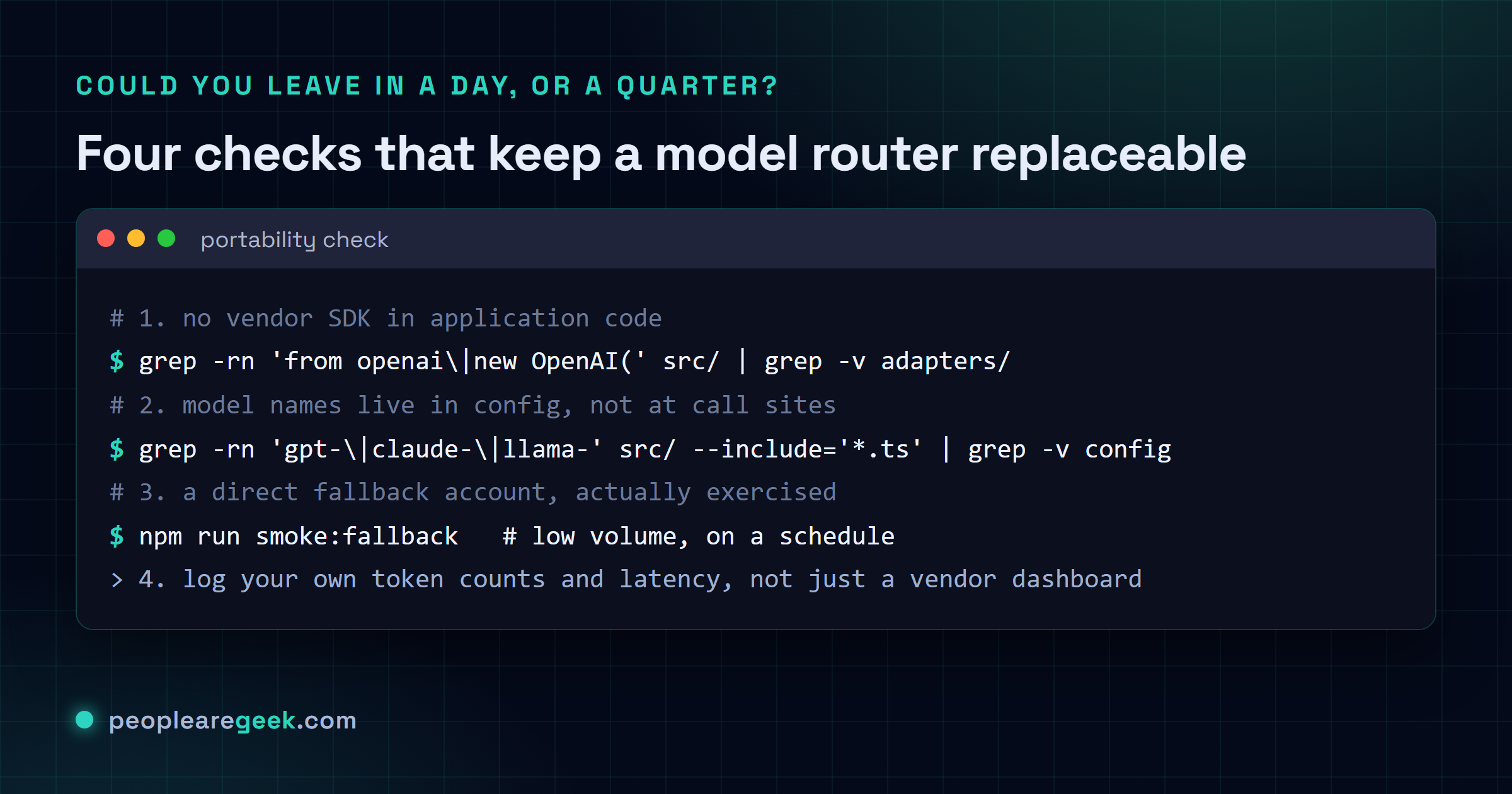
If the answer is a day, you already did the work. If the answer is a quarter, four things close most of that gap. Put the provider behind a thin interface you own, so no vendor SDK is called from application code. Keep model names and endpoints in configuration rather than at call sites. Keep one direct provider account alive and actually exercised at low volume, so the fallback path is tested rather than hypothetical. And log your own token counts and latency, so when you compare offers you are comparing your numbers, not a dashboard someone else controls.
None of that is a bet against Stripe or OpenRouter. It is the ordinary discipline of depending on a middle layer, and the reason to do it now is simply that a rumour is a cheaper reminder than a pricing email.
Sources and further reading
- Reuters via Yahoo Finance: Stripe in talks to acquire OpenRouter in potential $10 billion deal, WSJ reports
- PYMNTS: Stripe eyes $10 billion deal for AI model marketplace OpenRouter
- Benzinga: Stripe eyes OpenRouter in potential $10 billion AI infrastructure deal
- DigiTimes: Stripe reportedly eyes OpenRouter in potential US$10B AI infrastructure deal
Frequently asked questions
What exactly was reported about Stripe and OpenRouter?
On Thursday, July twenty third, The Wall Street Journal and The Information reported that Stripe is discussing an acquisition of OpenRouter at a price close to $10 billion. The reporting is consistent on the headline number and equally consistent on the caveats. No agreement has been signed, terms are unconfirmed, an announcement could come within roughly a month, and the talks could still collapse. OpenRouter has also held early conversations with Databricks about a sale, and other large technology companies were reported to have evaluated bids. Treat it as a credible report of live negotiations rather than a completed deal.
What does OpenRouter do?
OpenRouter is a routing layer for large language models. You send a request to one endpoint using a familiar API shape, and OpenRouter forwards it to whichever model you named, across hundreds of proprietary and open weight options from many different providers. That gives you three practical things. You compare models without maintaining a separate integration for each vendor, you switch a model by changing a string rather than shipping new client code, and you get one bill instead of a dozen. For teams trying to control inference spend or avoid depending on a single provider, that is the whole appeal.
Why would a payments company want a model router?
Stripe and OpenRouter already work together, because OpenRouter uses Stripe to handle its own customer transactions. The strategic logic goes further than that. Stripe sits in the billing path for an enormous number of software businesses, and those businesses are now spending real money on inference. A router lets Stripe see and shape where that spend goes, steering corporate customers toward the cheapest model or the one best suited to a task. Metering and billing per token is closer to a payments problem than it looks, which is the connection the reported price is built on.
What is the risk for teams that route production traffic through OpenRouter?
The realistic near term risk is not an outage, it is drift. Acquisitions tend to change pricing, rate limits, terms of service, and roadmap priorities on a timeline you do not control. A router whose value proposition is neutrality also invites a fair question about whether it stays neutral once an owner has commercial interests of its own. None of that is a prediction, and no deal is signed. It is simply the reason to check now whether you could move off the router in a day rather than a quarter.
How do I keep my inference stack portable?
Keep the provider behind a thin interface of your own rather than calling any vendor SDK from application code. Store model names and endpoints in configuration, never hardcoded in call sites. Keep at least one direct provider account working and exercised, even at low volume, so a fallback path is tested rather than theoretical. Log token counts and latency yourself instead of relying only on a vendor dashboard, so you can compare offers on your own numbers. That work is worth doing regardless of what happens to this deal, because it is the same work that lets you chase a better price next quarter.