Triton is a new DirectX 11 driver for Windows guests running under QEMU, written by the UTM author osy, and Phoronix picked it up on August 8. What makes it interesting is not that Direct3D 11 works in a virtual machine, because that has been possible for a while. It is where the translation happens. Triton implements the Windows Device Driver Interface, the layer Microsoft's own graphics stack talks to, rather than replacing Direct3D DLLs next to each application. That single decision changes what installs cleanly, what a guest sees as its GPU, and how the whole thing behaves. We read the code layout and the author's notes.
The short answer
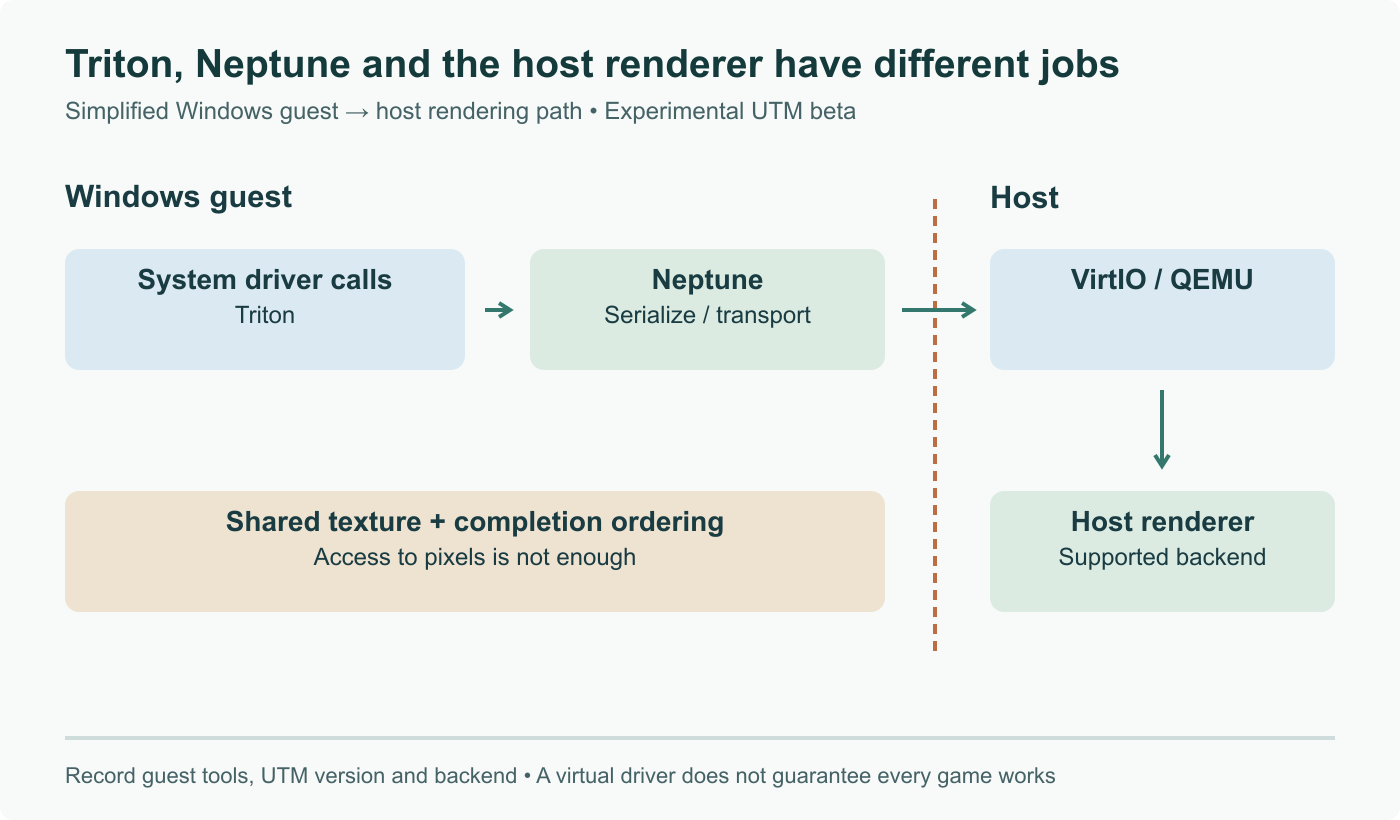
Triton is a DirectX 11 driver for Windows guests under QEMU, written by osy, the developer behind UTM. Instead of substituting Direct3D DLLs inside each application, it implements the Windows Device Driver Interface, so the guest keeps Microsoft's own Direct3D and DXGI runtimes and simply gains a GPU that answers them. Commands travel over VirtIO via the Neptune protocol to virglrenderer on the host, which lands on DXVK and Vulkan on Linux or DXMT and Metal on macOS. Claude Opus 5 and Claude Fable 5 assisted development. It is experimental and needs custom builds.
Anyone who has tried to give a Windows virtual machine real graphics acceleration knows the usual bargain. You drop a translation layer into the guest, point it at the host GPU, and accept that some fraction of your software will refuse to start because the DLL next to it is not the one Microsoft shipped. It works often enough to be worth doing and fails often enough to be irritating. Triton takes a different route into the same problem.
The seam moved down a layer
The Direct3D stack on Windows has more than one place you can intercept. The obvious one is the API: applications call into d3d11.dll and dxgi.dll, so you write your own versions of those and translate the calls to something the host understands, usually Vulkan. That approach is well proven and it is how most graphics translation on Linux works today.
Triton intercepts below that, at the Device Driver Interface. The DDI is the contract Windows itself uses to talk to a display driver, and implementing it means the guest keeps Microsoft's real Direct3D and DXGI runtimes. Applications carry on calling the same operating system components they would call on physical hardware, and what changed is only that the GPU underneath them is virtual. Structurally, Triton is what a vendor ships: a user mode display driver paired with a kernel mode driver for the virtual GPU.
That has a practical consequence worth stating on its own. Nothing lands in the application's folder. Game protection and integrity systems pay close attention to which modules a process loads, and a substituted d3d11.dll is precisely the pattern they exist to flag, which is why API level translation runs into refusals that have nothing to do with rendering correctness. A driver installed at the system level does not trip that wire, because from the process view the module list is entirely ordinary.
What happens after the command leaves Windows
The transport is Neptune, the protocol that carries Direct3D work out of the guest over VirtIO. QEMU receives it and hands it to virglrenderer, the host side library that has been doing this job for Linux guests for years, and virglrenderer talks to whatever graphics backend the host actually has.
The tail of the chain is where the host differences live. On Linux it runs through DXVK and Vulkan. On macOS it goes through DXMT, which maps Direct3D 11 onto Apple Metal, and Apple's own D3DMetal is available as an experimental shorter path. The guest side does not care. That is the design property that makes this worth paying attention to: the Windows driver is written once and the host substitutes whichever translation it can support, rather than every guest needing to know what it is running on.
Two smaller decisions follow from the same instinct. Triton keeps the original DirectX shader code intact further down the pipeline instead of converting it early, which leaves more information available to whatever does the final compilation. And on Apple Silicon it leans on unified memory to avoid copying textures that both sides can already reach.
Where the AI assistance fits
The credit line is unusual enough to note: the author says Claude Opus 5 and Claude Fable 5 helped build the driver. Windows display drivers are a genuinely awkward target for a solo developer. The DDI is documented sparsely, the working reference implementations are proprietary, and the cost of a wrong assumption is a bug check on a machine that then needs rebooting rather than an exception you can read.
It is not a reason to treat the output differently, and the project does not ask you to. The code sits in public at github.com/osy/kvm-guest-drivers-windows, a driver either satisfies the runtime or crashes in ways nobody can miss, and the honest assessment of maturity comes from the author rather than from a reviewer: crashes, visual bugs and compatibility problems are still part of the experience, and this is not ready for a work computer you depend on every day.
What it means for people who run Windows VMs
Not much this week, and quite a lot over the next year if it holds together. Today it means building components yourself, on both sides, with no packaged path. What works when it works covers the Windows desktop, compositing effects, video output and applications built on Direct3D 11, with the early demonstrations showing Windows 11 for ARM running DirectX 11 games and benchmarks under QEMU. No performance figures have been published, so nobody should be quoting speedups yet.
The reason to track it is architectural rather than immediate. A guest side driver that implements the real interface, with the host free to translate however it can, is the shape that eventually turns into something a distribution can ship. Per application translation layers never quite get there, because the maintenance surface is every application rather than one driver. If Triton stabilises, the interesting question stops being whether Direct3D works in a virtual machine and becomes how close it gets to the hardware sitting in the same box.
Sources and further reading
- AI Helped Create A DirectX 11 Driver For QEMU VMs, Phoronix, August 8, 2026
- Introducing Triton: DirectX 11 driver for QEMU, UTM Blog
- osy/kvm-guest-drivers-windows on GitHub
- Introducing Neptune: Direct3D virtualization for QEMU, UTM Blog
- UTM Triton brings DirectX 11 graphics to QEMU on Apple, GenerationAmiga
- Triton: DirectX 11 driver for QEMU, Hacker News discussion
Frequently asked questions
What does implementing the DDI instead of the DirectX API actually buy you?
It moves the seam one layer down, and almost everything else follows from that. When you translate at the API level, you supply your own d3d11.dll and dxgi.dll and the application links against your code instead of Microsoft's. That is how the common approach works, and it functions well, but it means shipping binaries that sit next to the executable and it means your implementation has to be a faithful stand in for every corner of an API surface that Microsoft has been extending since 2009. The Device Driver Interface is the contract underneath: Windows keeps its own Direct3D and DXGI runtimes, and the driver only has to answer the calls the runtime makes. Applications are none the wiser because from their point of view they are talking to Windows, exactly as they would on hardware. Triton is built as a user mode display driver plus a kernel mode driver for the virtual GPU, which is the same shape a real vendor driver takes.
How do the commands actually get out of the guest and onto the host GPU?
Through the Neptune protocol over VirtIO. The user mode driver inside Windows packages the Direct3D work and hands it to the kernel mode component, which pushes it across the VirtIO transport to QEMU. QEMU passes the stream to virglrenderer, the same host side library that has served Linux guests for years, and virglrenderer drives whatever the host graphics backend happens to be. On a Linux host the tail of that chain runs through DXVK and Vulkan. On macOS it goes through DXMT, which maps Direct3D 11 onto Apple Metal, with Apple's own D3DMetal available as an experimental shorter route. The interesting property is that the guest side is host agnostic: the same Windows driver works regardless of which translation layer the host has, because the translation moved out of the virtual machine.
Why does keeping DLLs out of the application folder matter so much?
Because a lot of software objects to unexpected binaries appearing next to its executable. Game protection and integrity systems inspect the modules a process loads, and a replacement d3d11.dll is exactly the kind of thing they are built to notice, which means the API level approach runs into refusals that have nothing to do with graphics correctness. Triton sidesteps the whole category by not being in the application's address space in that way. It is installed as a system driver, the process loads Microsoft's own runtime, and the module list looks the way Windows expects it to look. There is a second, quieter benefit for anyone maintaining virtual machines: you install once, at the system level, instead of maintaining per application copies that go stale independently of each other.
What role did the AI models play, and does that change how I should read the code?
The author credits Claude Opus 5 and Claude Fable 5 with assisting the development of the driver, which is worth noting because Windows display drivers are a domain where the documentation is thin, the reference implementations are proprietary, and the feedback loop for a mistake is a bug check rather than a stack trace. That is a genuinely hard place to make progress alone. It does not change how you should evaluate the result. The code is public at the kvm-guest-drivers-windows repository, it either passes the runtime's conformance expectations or it does not, and a graphics driver announces its own defects fairly loudly. Read it the way you would read any early stage driver from a single author: promising, worth testing, not yet something to put under a workload you care about.
Is it usable today, and what do I need to try it?
It is experimental and the author says so plainly, describing crashes, visual bugs and compatibility problems as still part of the experience and warning that this is not ready for a work computer you depend on every day. Trying it means custom builds rather than a package: the guest drivers live at github.com/osy/kvm-guest-drivers-windows, and you need a QEMU and virglrenderer stack on the host new enough to speak the protocol, which in practice today means building components yourself. What works when it works is the whole Windows desktop, window compositing effects, video output and applications that depend on Direct3D 11, with early demonstrations showing Windows 11 for ARM running DirectX 11 games and benchmarks under QEMU. No throughput figures have been published, so treat performance as an open question rather than a claim.