Canonical has confirmed a virtualization hardware enablement stack for Ubuntu 26.04 LTS, which means an LTS host can now follow newer QEMU, libvirt, EDK2 and SeaBIOS without jumping to an interim release. The packages carry an hwe suffix, they refresh every six months for the first two years of the release, and nothing changes unless you ask for it. The interesting part is not the version bump. It is that Canonical is treating the hypervisor, the management layer and the guest firmware as one unit you move together, with a helper tool that stops you from moving only part of it.
The short answer
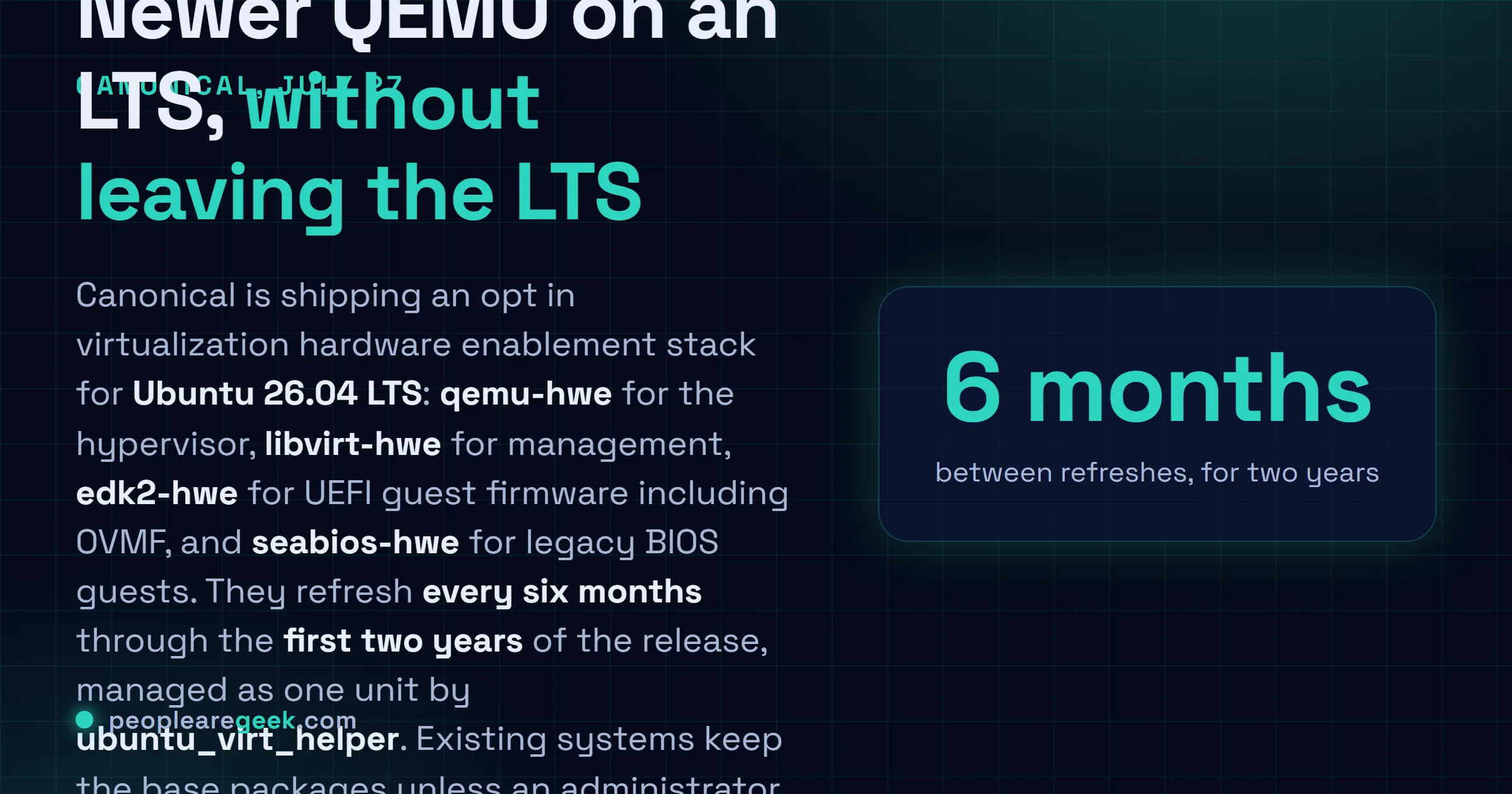
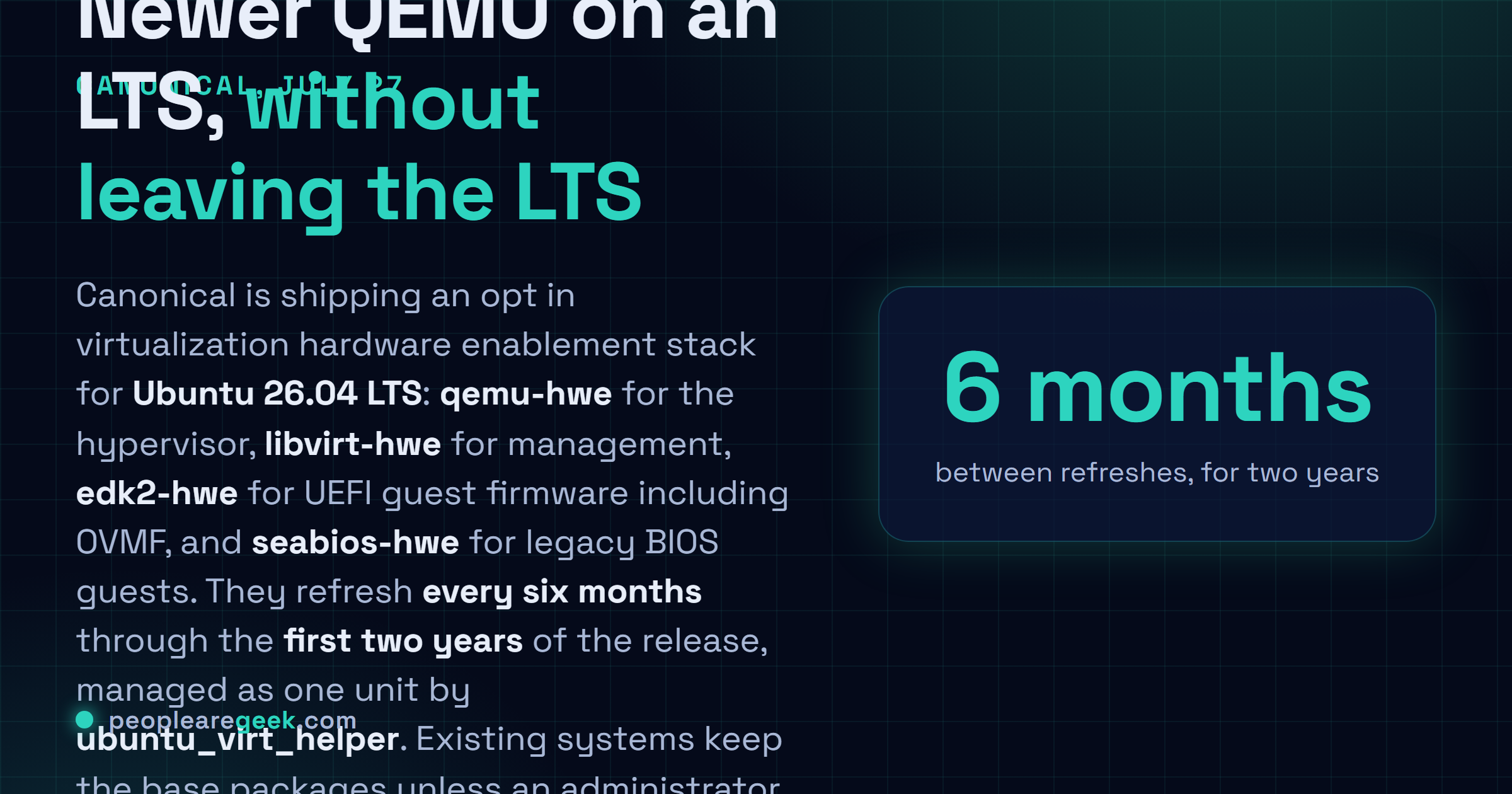
Canonical is shipping a virtualization hardware enablement stack for Ubuntu 26.04 LTS, made of qemu-hwe for the hypervisor, libvirt-hwe for management, edk2-hwe for UEFI guest firmware including OVMF, and seabios-hwe for legacy BIOS guests. The packages refresh every six months through the first two years of the release, and a helper tool named ubuntu_virt_helper manages them as a single set so partial upgrades are not possible. It is opt in: base systems keep the base packages. Canonical points at confidential VMs on AMD SEV-SNP or Intel TDX, regulated workloads and sovereign cloud as the motivating cases.
Anyone who has run virtual machines on an LTS release for a few years knows the shape of this problem. You buy new hardware, the hardware has a feature you want, and the QEMU in your distribution predates that feature by eighteen months.
The gap this closes
The HWE kernel has existed for years and solves the obvious half of the problem. New silicon needs a new kernel, LTS releases ship old kernels, so Canonical backports newer ones and an LTS install can recognise machines that did not exist when the release was cut.
Virtualization has the same lag and the kernel alone does not fix it. Exposing a processor capability to a guest is a chain: the host kernel has to support it, QEMU has to model it and expose it as a CPU feature or a device, libvirt has to be able to describe it in domain XML, and for anything that touches boot the guest firmware has to negotiate it. Break any link and the feature is not there, no matter how new your kernel is.
That chain is why the announcement covers four packages rather than one. qemu-hwe carries the hypervisor and system emulation, libvirt-hwe the management layer, edk2-hwe the UEFI firmware including OVMF, and seabios-hwe legacy BIOS firmware for older guests.
Moving them as a set

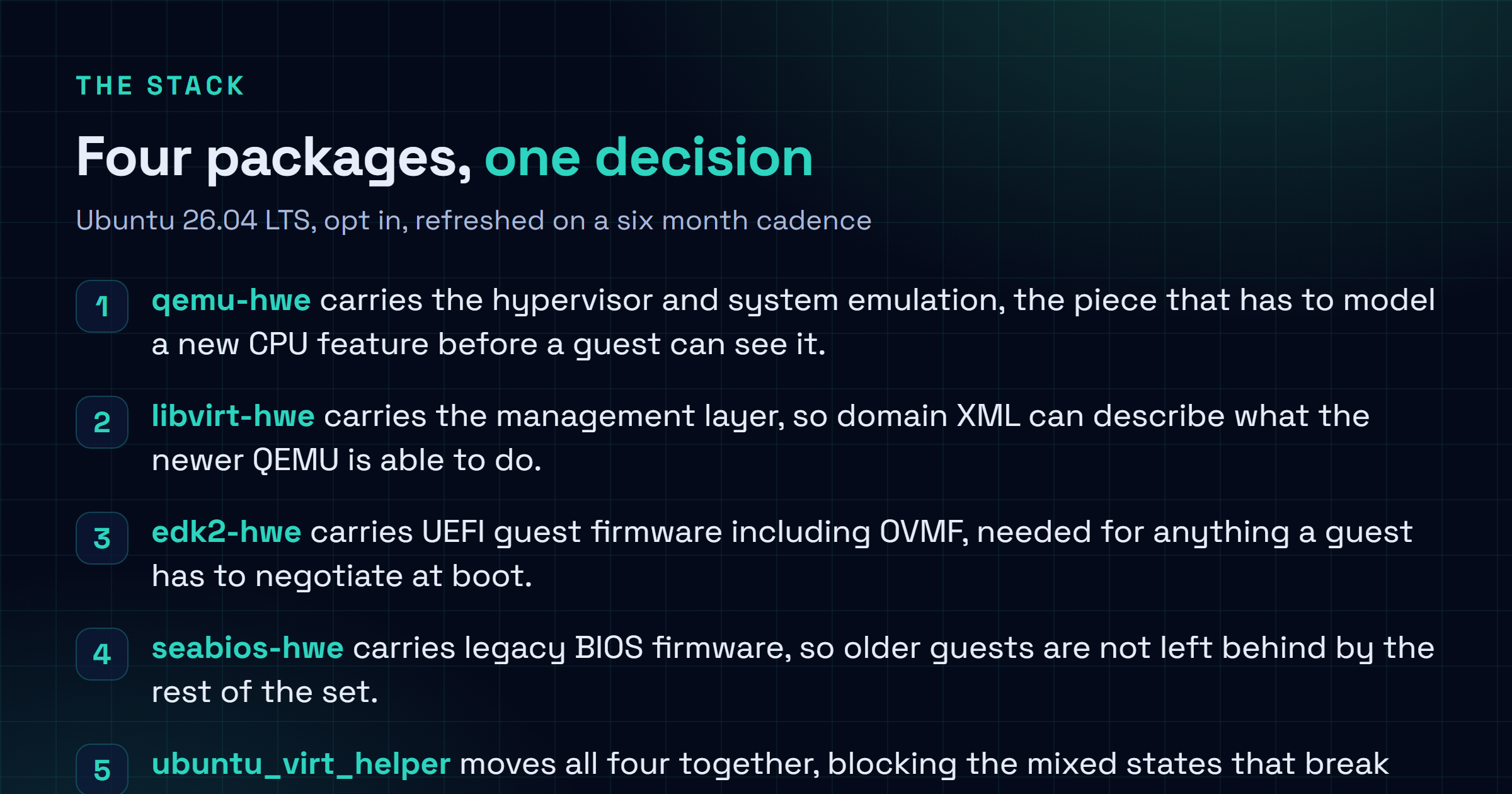
The design decision worth noting is the helper tool. ubuntu_virt_helper exists to manage the stack as a complete unit, and its job is to prevent the mixed states that administrators reach for when they only want one newer thing.
Anyone who has tried to pull a single newer QEMU onto an otherwise untouched host knows why this matters. New QEMU against old libvirt gives you a management layer that cannot describe what the hypervisor can now do. New QEMU against old OVMF gives you guests that boot until the day one of them needs a firmware behaviour that is not there. Machine type definitions resolve differently between versions, which is the class of bug where live migration works in one direction and not the other, and nothing in the logs says why for the first hour.
Bundling the four and moving them together does not eliminate that surface, but it does mean the combination on your host is a combination Canonical tested rather than one you invented at two in the morning.
The cadence and the window
The hwe packages refresh every six months, following the newer upstream versions available in Ubuntu, and that runs for the first two years of the 26.04 lifecycle.
Two years of six month steps is roughly four version jumps, which puts a 26.04 host in a substantially different place at the end of that window than the base packages would. After the window closes the stack stops advancing, which is exactly how the HWE kernel model has always behaved. The trade is stated plainly rather than hidden: you accept more change in exchange for keeping pace with hardware, on a schedule you can read in advance.
Opt in is doing real work here too. An existing 26.04 system keeps the base virtualization packages unless somebody deliberately installs the hwe variants. There is no automatic switch and no default that changes underneath a running fleet, which for a host class where a surprise reboot means a lot of guests moving is the only defensible choice.
Who should care
Canonical's own list of target cases is narrow and honest: confidential VMs using AMD SEV-SNP or Intel TDX, regulated workloads that need stronger isolation between tenants, confidential inference for AI workloads, private and sovereign cloud platforms, and infrastructure that has to run for years without falling behind the hardware underneath it.
What those have in common is a dependency on recent processor capabilities. If your hypervisors run on hardware that the base 26.04 QEMU already supports fully, and your guests are ordinary Linux and Windows workloads, the base stack stays the right answer and will for the life of the release. Adding four packages on a six month treadmill to gain nothing is not an upgrade.
If you are standing up a platform on current generation silicon and you need a capability that arrived upstream after the 26.04 freeze, this is the mechanism that used to not exist. The previous options were to run an interim release on production hypervisors, which nobody wants, or to build QEMU yourself and own that forever, which is worse. A supported middle path is genuinely new.
Sources and further reading
- Canonical: the Ubuntu virtualization HWE stack
- Ubuntu Server documentation: virtualization hardware enablement stack
- Phoronix: Ubuntu to provide a virtualization HWE stack for Ubuntu 26.04 LTS
- 9to5Linux: Canonical introduces the virtualization HWE stack for Ubuntu 26.04 LTS
- Linuxiac: Ubuntu 26.04 LTS gets an optional virtualization HWE stack
Frequently asked questions
Do I have to do anything if I run Ubuntu VMs today?
No. The stack is opt in by design, and Canonical is explicit about that: an existing system keeps using the base virtualization packages unless an administrator deliberately installs the hwe variants. There is no automatic migration, no flag day, and no change to the packages you already have on a 26.04 host. If your hypervisors are working and the hardware they sit on is fully supported by the QEMU version in the base release, the correct action is to read this, note it, and carry on.
How is this different from the HWE kernel?
It is the same idea applied one layer up. The HWE kernel exists because hardware ships faster than LTS releases do, so Canonical backports a newer kernel to let an LTS install recognise newer machines. Virtualization has the same lag for a different reason: support for a new CPU feature in a guest needs the kernel, but also QEMU to expose it, libvirt to describe it, and often the guest firmware to negotiate it. Getting a newer kernel alone does not get you there. The virtualization HWE stack covers the userspace and firmware half of that chain.
What does ubuntu_virt_helper actually prevent?
The failure mode where you upgrade one component and leave the rest behind. QEMU, libvirt and the guest firmware are three pieces that have to agree with each other, and a host running new QEMU with old OVMF, or new libvirt against old QEMU, produces the sort of problem that eats a Thursday: a guest that boots but does not see a feature, a machine type that resolves differently than the XML expected, a migration that fails in one direction only. The helper treats the four packages as a set, so the combinations you end up with are combinations Canonical actually tested.
What is the update cadence and what happens after two years?
The hwe packages refresh every six months, tracking the newer upstream versions available in Ubuntu, and that cadence runs for the first two years of the 26.04 LTS lifecycle. After that window the stack stops moving forward, which mirrors how the HWE kernel model has always worked. Two years of six month steps means roughly four version jumps, which is a very different position from where an LTS host normally sits at the end of its life. Plan the same way you plan HWE kernel adoption: take the newer stack where you need the hardware support, stay on the base packages where you do not.
Who is this actually built for?
Canonical names the cases directly, and they cluster around hardware isolation features. Confidential VMs using AMD SEV-SNP or Intel TDX, regulated workloads that need stronger separation between tenants, confidential inference for AI work, and private or sovereign cloud platforms. What those share is a dependency on very recent processor capabilities, which is exactly the situation where an LTS host with an eighteen month old QEMU cannot expose what the silicon underneath it can do. If none of those describe your fleet, the base stack remains the right default and probably will for the life of the release.