A three month old company with no product just raised more than 90 million dollars, and the reason is the founding team rather than the pitch. Veeda AI announced its seed round on Wednesday, August nineteenth, 2026, co-led by Khosla Ventures and Radical Ventures. Chief executive Sanja Fidler built Nvidia's Toronto research unit into what became its Spatial Intelligence Lab, and she brought two colleagues from it. The company is building world models, which are simulators learned from data rather than written by hand, on the argument that robots cannot learn fast enough in the physical world. Here is what that means technically and why the round is unusual.
The short answer
Veeda AI announced a seed round of more than 90 million US dollars on Wednesday, August nineteenth, 2026, co-led by Khosla Ventures and Radical Ventures. The company, legally Veeda Innovation Inc., was incorporated in early June 2026 and is based in Toronto. Sanja Fidler is chief executive, Zan Gojcic chief technology officer and Huan Ling chief scientist, all from Nvidia's Spatial Intelligence Lab. The product is multimodal world models: learned simulators for training embodied agents. No valuation was disclosed.
Seed rounds this size normally follow a product. This one follows a research lab, which is a different kind of bet and worth understanding on its own terms.
What was announced
Veeda AI announced its seed round on Wednesday, August nineteenth, 2026. It is more than 90 million US dollars, co-led by Khosla Ventures and Radical Ventures, and it is described as one of the largest seed financings ever raised by a Canadian startup.
The company is legally Veeda Innovation Inc. and is based in Toronto. Corporate records reported by The Logic show it was incorporated in early June 2026, which makes the round roughly three months old at the company level. Those same records show that in late July it issued 60.6 million seed shares priced at one US dollar each, and appointed two new directors: Tomi Poutanen of Radical Ventures and Sven Strohband of Khosla Ventures. Since the announced total exceeds 90 million dollars, that filing appears to cover part of the round rather than all of it. No valuation has been published.
The founding team is the substance of the story. Sanja Fidler is chief executive. She joined Nvidia in 2018 to establish its Toronto research unit, which grew into the company's Spatial Intelligence Lab, and she served as vice president of AI research before leaving. Zan Gojcic, a former Nvidia research director based in Zurich, is chief technology officer. Huan Ling, also from that lab, is chief scientist. Fidler and Ling worked on Nvidia's early world models for physical AI developers. Fidler announced the launch on LinkedIn.
What a world model actually is
The term gets used loosely, so it is worth being precise, because the difference between a world model and the two things it resembles is where the engineering lives.
A conventional simulator is written by people. Someone encodes rigid body dynamics, picks a friction coefficient, decides how a contact resolves. It is exact inside the situations its authors anticipated and it simply has nothing to say outside them. Anyone who has watched a physics engine produce something absurd when two objects intersect in an unplanned way has met that boundary.
A video generation model predicts pixels. It can produce something that looks right without any internal notion of state, which is why it can generate a plausible clip of an action it cannot be queried about.
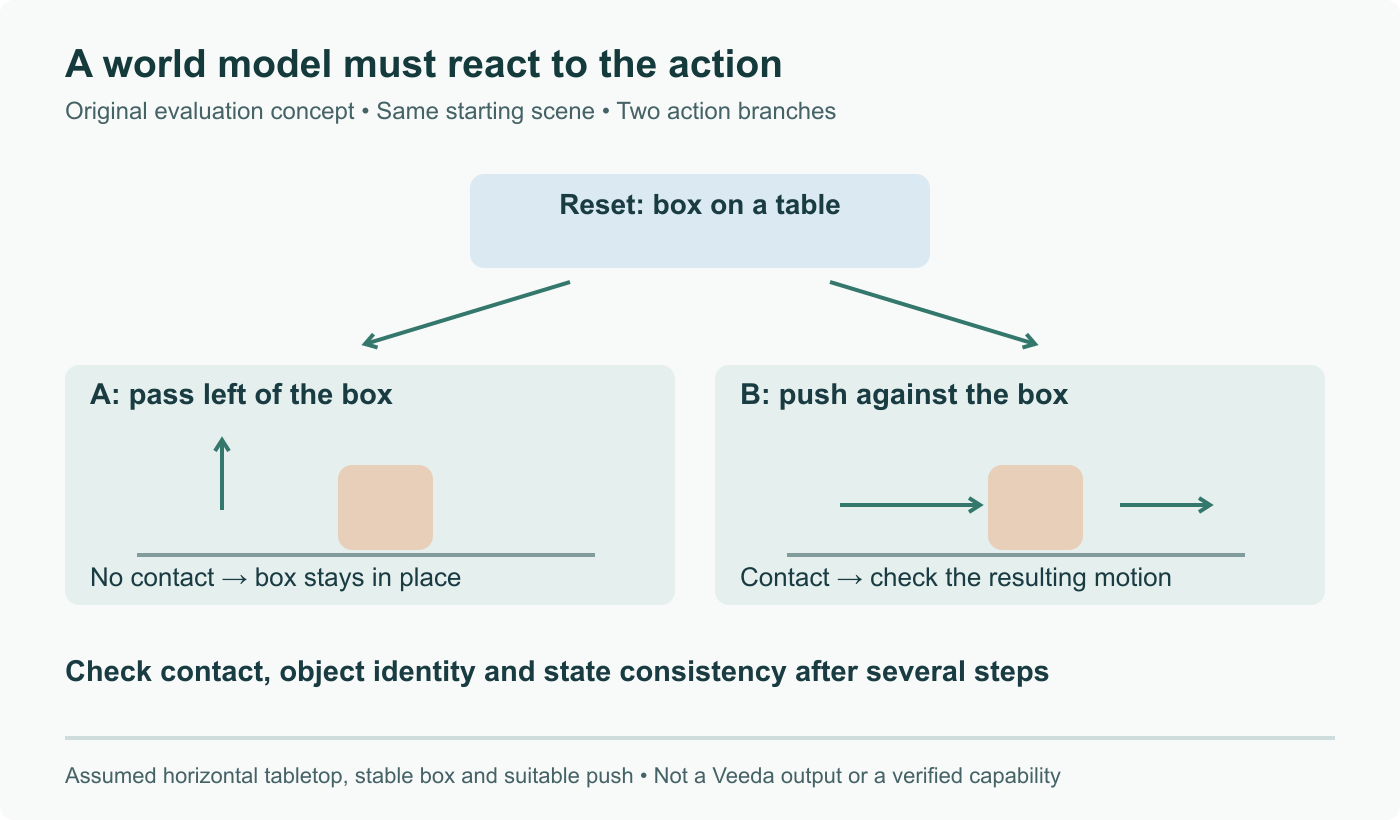
A world model sits between the two. It is trained on physical, spatial and movement data to predict what follows from a state and an action, which means it can be stepped, branched and reset like a simulator while generalising like a learned model. Veeda describes multimodal models producing infinitely scalable simulated environments where embodied agents learn through repeated interaction. The trade is explicit: you gain coverage of situations nobody enumerated, and you give up the guarantee that the answer is correct.
Why the money went here
The thesis behind the round is that robotics is data constrained rather than architecture constrained.
Real world trial and error has four problems at once. It is slow, because a physical arm moves at physical speed. It is expensive, because failures break hardware. It is hard to parallelise, because you need one robot per stream of experience. And some failures are simply not acceptable to repeat. Fidler's framing is that to scale interactive learning, robots will need to learn in a simulated reality.
Simulation removes all four constraints together. The cost is the reality gap: a policy trained in a simulator that differs from the world will fail in the world, in ways that correlate with exactly how the simulator was wrong. Narrowing that gap by learning the simulator from data rather than authoring it is the specific bet here, and it is a plausible one from a team that built the previous generation of this tooling inside Nvidia.
It also sits inside a visible pattern. Capital has been moving toward embodied AI for months, and this is not the first large round in the space this cycle, following moves like Walden Robotics raising 300 million dollars for general purpose robots. On the model side, the same problem shows up from the other direction in work such as Gemini Robotics 2 and its whole body control. One camp is building the bodies and the policies, the other is building the place to train them.
What to take from it
Nothing to install and nothing to change in your stack. A three month old company has no API, no published model and no benchmark, and it would be strange if it did.
What is worth carrying forward is a read on where the field thinks its bottleneck is. Ninety million dollars went into generating training experience rather than into a better learning algorithm, which is a specific claim about which half of the problem is harder right now. If you work near robotics, autonomy or simulation tooling, that tells you where the hiring and the open source releases are likely to concentrate over the next two years.
The honest caveat is the same one that applies to every large seed round. The team is exceptional and the thesis is coherent, and neither of those is a product. The measurable question, whether a learned world model narrows the reality gap enough to beat a well tuned conventional simulator on a real task, has not been answered publicly by anyone yet. That is the number to wait for.
Sources and further reading
- Sanja Fidler's world model startup Veeda AI raises $90M in seed funding, SiliconANGLE, August 19, 2026
- Star researcher Sanja Fidler raises over US$90M for world model startup, The Logic, August 2026
- Former Nvidia lab leader Sanja Fidler launches Veeda AI to tackle world models, BetaKit, August 2026
- Veeda AI Raises $90M+ Seed Backed by Khosla and Radical to Build World Models for Physical AI, Unite.AI, August 2026
Frequently asked questions
What is a world model, in practical terms?
A world model is a learned simulator. Instead of a physics engine where a person writes down the rules and tunes the constants, a world model is trained on physical, spatial and movement data until it can predict what happens next given a state and an action. The distinction that matters for a developer is generality: a hand built simulator is exact within the situations its author anticipated and silent outside them, while a learned one degrades gracefully into situations nobody enumerated but carries no guarantee of being right. Veeda describes its goal as multimodal models producing infinitely scalable simulated environments in which embodied agents learn through repeated interaction.
Why not just train robots in the real world?
Because real world trial and error is slow, expensive, hard to parallelise and sometimes destructive. A robot arm that learns by failing breaks things, and it can only fail once at a time. Simulation removes all four constraints at once: thousands of instances run concurrently, failures cost nothing, and the environment can be reset instantly. Fidler put the argument plainly, saying that to scale interactive learning, robots will need to learn in a simulated reality. The catch is the reality gap, meaning the difference between the simulator and the world, which is exactly the problem a learned world model is meant to narrow.
Who is behind the company?
Sanja Fidler is chief executive. She joined Nvidia in 2018 to establish its Toronto research unit, which became the company's Spatial Intelligence Lab, and she was vice president of AI research there before leaving. Zan Gojcic, a former Nvidia research director based in Zurich, is chief technology officer. Huan Ling, also from the Spatial Intelligence Lab, is chief scientist. Fidler and Ling worked on Nvidia's early world models for physical AI developers, so the team is not entering the field, it is continuing in it under its own name. Fidler announced the launch on LinkedIn.
What do the filings say about the round?
Corporate records reported by The Logic show Veeda Innovation Inc. was incorporated in early June 2026. In late July it issued 60.6 million seed shares priced at one US dollar each and appointed two new directors, Tomi Poutanen of Radical Ventures and Sven Strohband of Khosla Ventures. The publicly announced round is more than 90 million US dollars, so that filing appears to capture part of it rather than the whole. No valuation has been disclosed. It is described as one of the largest seed financings ever raised by a Canadian startup.
Should this change anything I am building today?
Not today. There is no product, no API and no published model, and a company three months old will not have one soon. What is worth taking from it is the direction of capital. Investors put ninety million dollars into the proposition that the binding constraint on robotics is training data rather than model architecture, and that the way to get that data is to generate it. If you work anywhere near robotics, autonomy or simulation, that is a useful signal about where tooling and talent will concentrate over the next two years, well before any of it is something you can install.