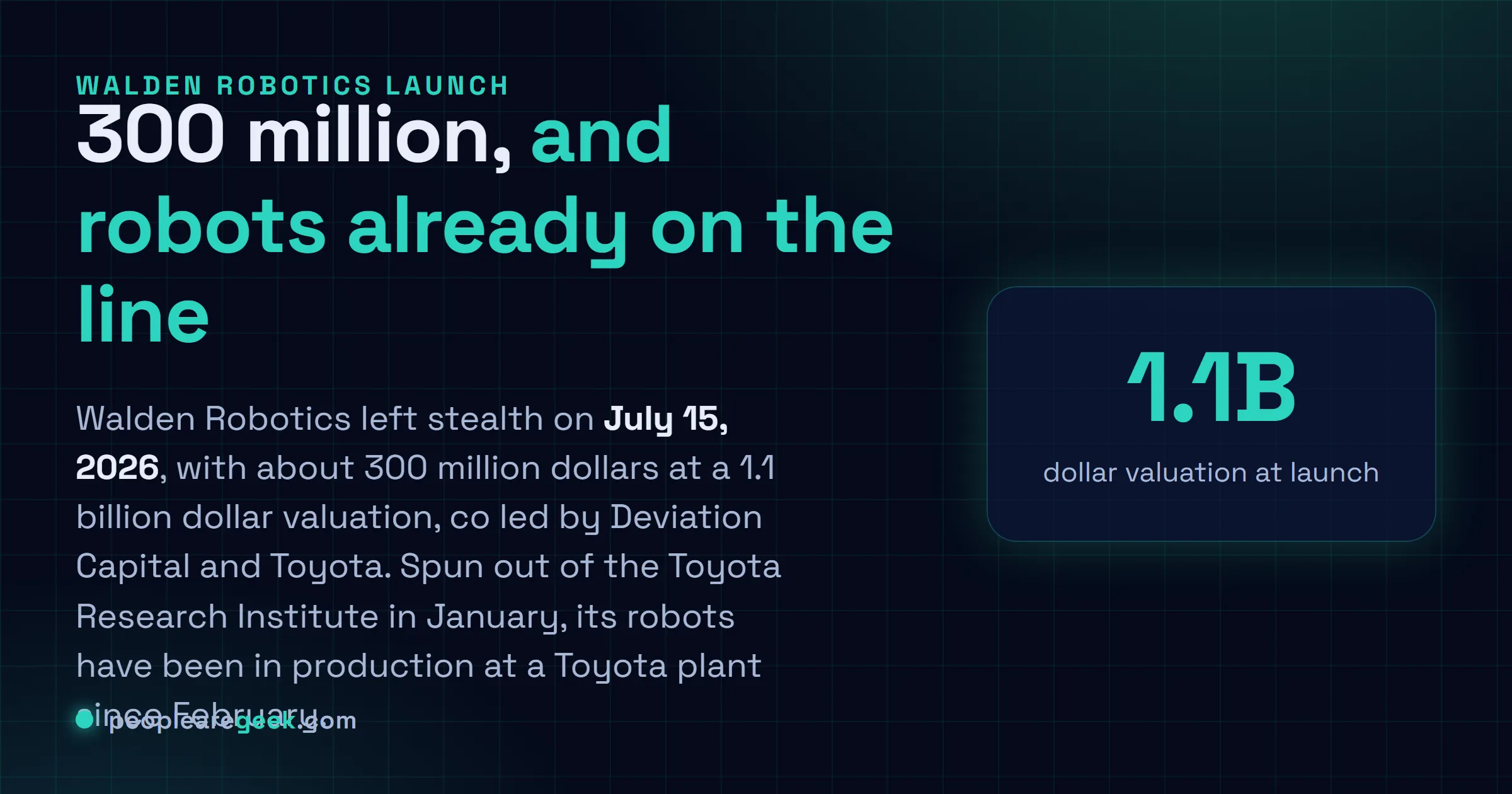
Walden Robotics came out of stealth on July 15, 2026, with about 300 million dollars in seed funding at a 1.1 billion dollar valuation, a rare unicorn label for a company only a few months old. The round was co led by Deviation Capital and Toyota, with NVIDIA, Boeing, Samsung Ventures, and CoreWeave Ventures also taking part. What sets the launch apart is not the money, it is the deployment: Walden spun out of the Toyota Research Institute in January, and by February its general purpose robots were already doing real work in production at a Toyota plant in North America. The pitch is not a demo reel of a humanoid folding laundry. It is a full stack physical AI company saying its robots are useful on a real line today, and that they keep learning while they work.
The short answer
Walden Robotics launched from stealth on July 15, 2026, with about 300 million dollars at a 1.1 billion dollar valuation, co led by Deviation Capital and Toyota, with NVIDIA, Boeing, Samsung Ventures, and CoreWeave Ventures joining. The company spun out of the Toyota Research Institute in January, and its general purpose robots have been doing real work in production at a Toyota plant since February. The bet is physical AI that is useful today and keeps learning while it runs, not a humanoid demo saved for later.
Most robotics launches lead with a video. A humanoid pours a coffee, folds a shirt, walks across a stage, and you are left guessing how much of it was scripted. Walden Robotics chose a different opening line. It came out of stealth with the claim that its robots are already doing paid work on a Toyota production line, and that they have been since February. For an industry that runs on impressive clips and distant timelines, leading with a deployment is the more interesting move.
What Walden raised
Walden launched publicly on July 15, 2026, with roughly 300 million dollars in seed funding at a valuation near 1.1 billion dollars. Deviation Capital and Toyota co led the round, with Toyota backing the company through both its strategic investment group and its early stage venture arm. NVIDIA, Boeing, AE Ventures, Samsung Ventures, and CoreWeave Ventures also joined. That is a heavy roster of industrial and compute backers for a first round, and it tells you who expects to use these machines and who expects to supply the chips they run on.
A seed round at a unicorn valuation is unusual, and it usually means one of two things: hype, or traction that arrived faster than the funding structure. Walden is leaning hard on the second reading. The founding team comes out of the Toyota Research Institute, MIT, Stanford, and Amazon, and the company was only incorporated this year.
From a Toyota lab to the factory floor
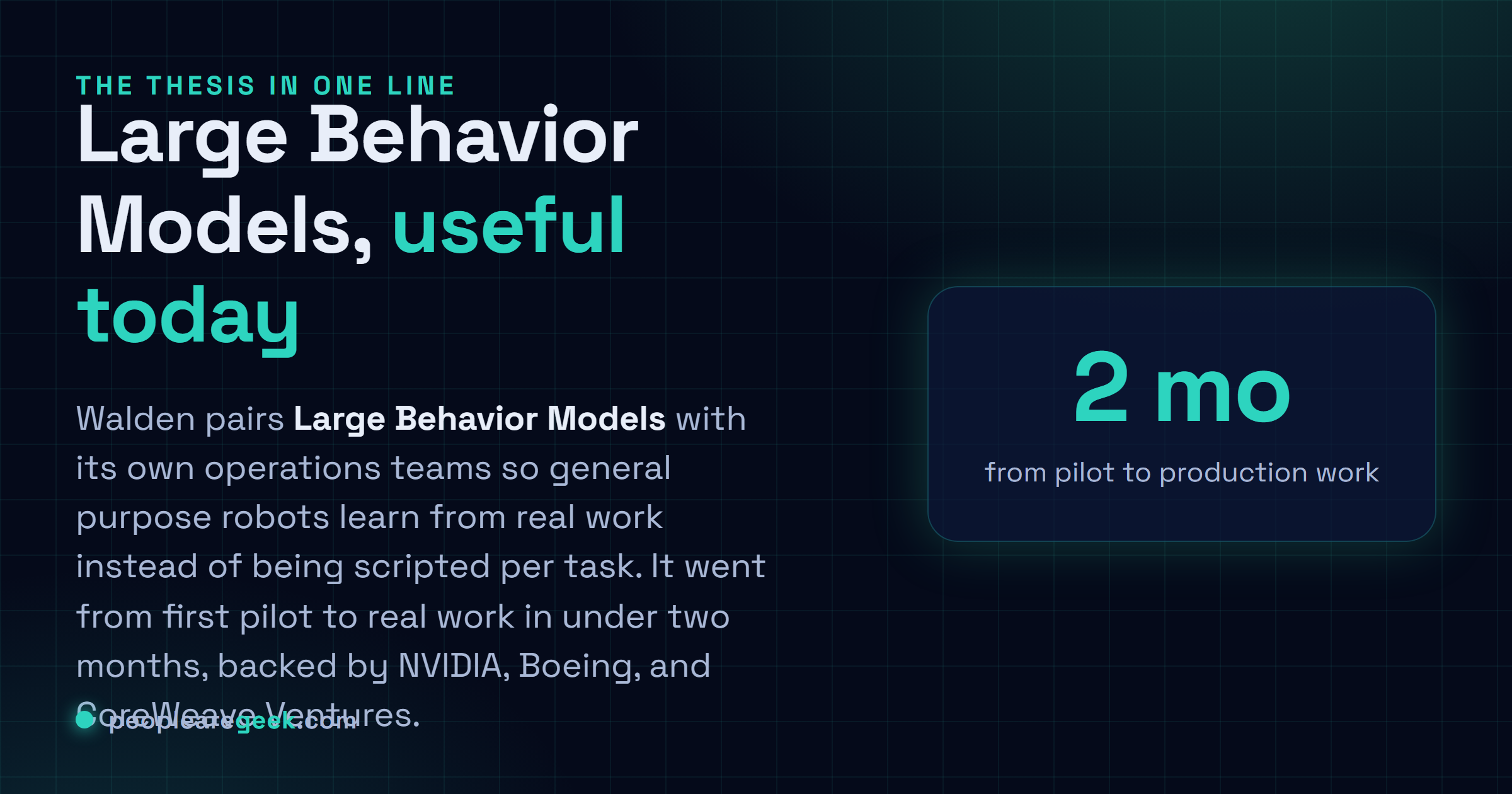
The detail that matters most is the timeline. Walden spun out of the Toyota Research Institute in January 2026. By February, it says, its robots were already doing useful work in production at a Toyota plant in North America. Under two months from a first pilot to real work on a real line is the number the company keeps repeating, and it is doing so on purpose.
That framing is a direct shot at how physical AI usually gets sold. The common pattern is a striking humanoid demo followed by years of "coming soon." Walden is arguing the opposite: start with robots that are genuinely useful on ordinary industrial work now, get them earning inside a partner that also happens to be a lead investor, and let the capability grow from there. Having Toyota as both customer and backer removes the usual chicken and egg problem of needing a deployment to prove the tech and needing proven tech to get a deployment.

Large Behavior Models and the useful today bet
Walden calls its core technology a Large Behavior Model. The idea borrows the shape of a large language model and points it at the physical world. Instead of predicting the next token in a sentence, the model learns general manipulation and movement skills from a large body of real world examples, so one system can handle variation and pick up new tasks without being rebuilt for each one.
This is the crux of the difference between classic industrial robotics and physical AI. A traditional factory robot is precise and fast but brittle. It repeats one carefully scripted motion, and it fails the moment a part is rotated a few degrees or a bin is not where it expects. A behavior model is meant to generalize, to treat a new task as a variation on skills it already has rather than a fresh programming project. Walden also pairs the models with its own operations teams, so a robot can be dropped into an existing workflow and improve as it runs rather than needing a full reprogramming cycle for every change.
If that generalization holds up outside a controlled pilot, the economics of automation shift. The work that classic robotics could never justify is the messy, low volume, high variation work, because the engineering cost of scripting it exceeded the savings. A robot that learns the task instead of being programmed for it is what makes that long tail worth automating at all.
What this means for engineers
You do not need to care about robot funding to find the pattern here useful, because it is the same pattern reshaping software.
- Foundation model thinking is spreading past text. The Large Behavior Model framing is the language model recipe applied to motion: learn general skills from many examples, then adapt to specific tasks with far less bespoke engineering. If you build systems, expect the "large pretrained model plus light adaptation" shape to keep showing up in domains that used to be all hand written rules.
- Deployment is the real benchmark. Walden is selling a running deployment, not a leaderboard score. That is a good instinct to borrow. A model that works on a real workflow with real edge cases tells you more than a demo that works once under perfect conditions. Design your evaluation around production behavior, not staged success.
- Continuous learning in production is the hard part. The promise is robots that improve while they work. That raises the same questions any team faces when a model keeps learning after launch: how you monitor for regressions, how you roll back a bad update, and how you keep a system that changes over time both safe and predictable. Those are engineering problems, not marketing ones.
Walden raising 300 million dollars does not prove that general purpose robots are ready for every factory. Plenty of well funded robotics companies have promised more than they shipped. But a company that leads with a live deployment inside its own lead investor, rather than a highlight reel, is at least being measured against the right thing. The claim to watch is not the valuation. It is whether those robots are still useful, and still learning, a year from now.
Sources and further reading
- Walden Robotics: Walden Robotics launches with 300 million dollars to put general purpose robots to work today
- Bloomberg: Toyota backed robotics startup Walden launches with 1.1 billion valuation
- The Robot Report: Walden Robotics launches at 1.1 billion valuation for general purpose robots
- Tech Startups: Walden Robotics emerges from stealth with 300 million at 1.1 billion valuation
Frequently asked questions
How much did Walden Robotics raise and who backed it?
Walden launched out of stealth on July 15, 2026, with roughly 300 million dollars in seed funding at a 1.1 billion dollar valuation. The round was co led by Deviation Capital and Toyota, through the automaker's strategic investment and early stage venture arms, with participation from NVIDIA, Boeing, AE Ventures, Samsung Ventures, and CoreWeave Ventures.
What does Walden Robotics actually build?
Walden describes itself as a full stack physical AI company. It builds general purpose robots that learn from real world operation rather than robots hard coded for a single task. The company pairs what it calls Large Behavior Models with its own operations teams so the machines can be dropped into an existing workflow and improve as they run, instead of being reprogrammed for every new job.
Are the robots already in real use?
Yes. Walden spun out of the Toyota Research Institute in January 2026, and it says that since February its robots have been doing useful work in production at a Toyota plant in North America. The company frames the under two month gap from first pilot to real work as the point of the whole approach: capable robots earning their keep now, not in some distant demo.
Why does the Large Behavior Model approach matter?
Traditional industrial robots are precise but brittle. They repeat one scripted motion and break when the world shifts. A behavior model learns general skills from many examples, so a single system can handle variation and pick up new tasks without a full reprogramming cycle. If that holds at scale, the economics of automating messy, low volume work change, which is exactly the work classic robotics could never justify.