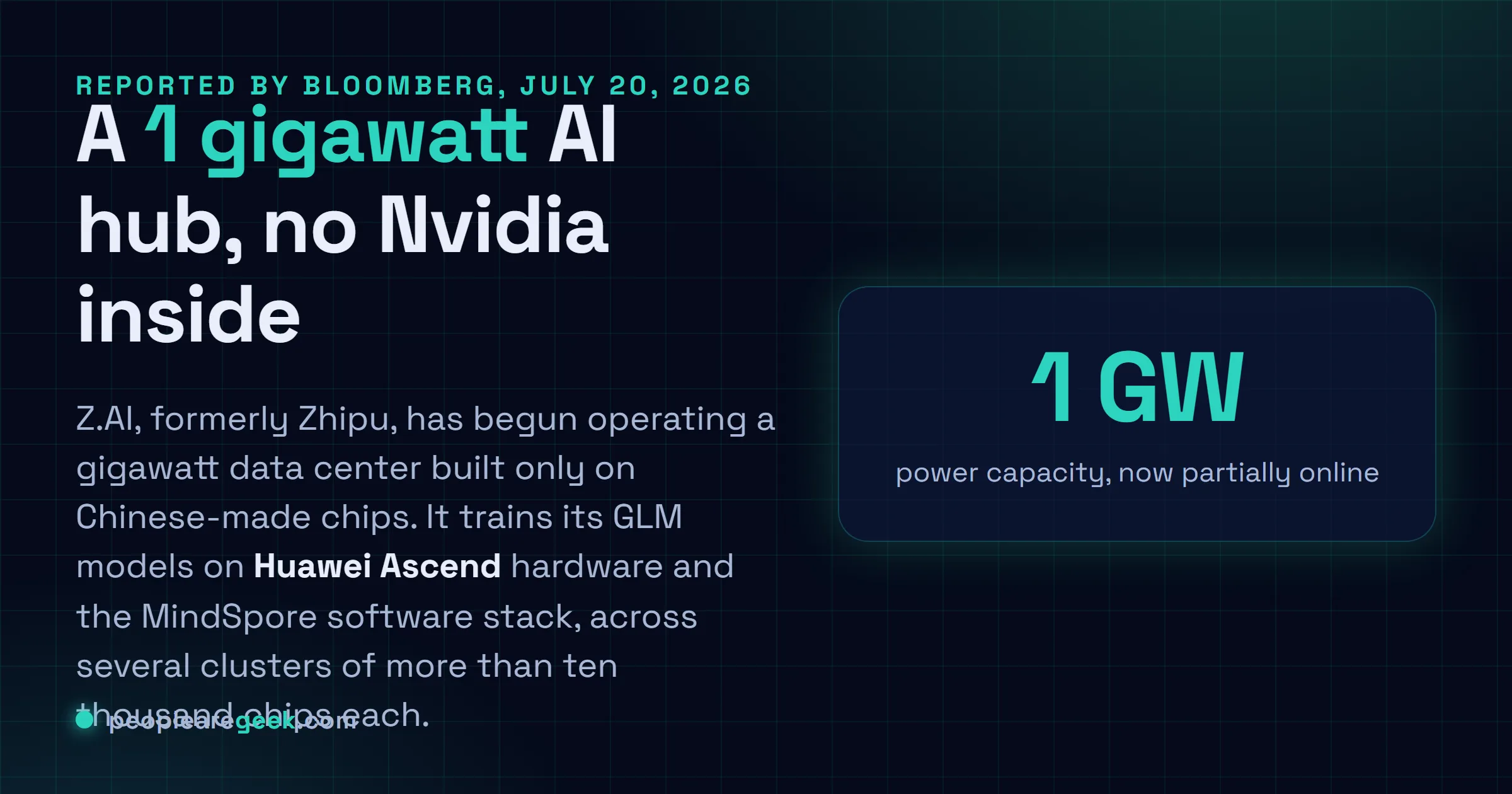
Z.AI, the lab formerly known as Zhipu, has begun operating a 1 gigawatt data center built entirely on Chinese-made chips, Bloomberg reported on July 20, 2026. There is no Nvidia inside. The site trains the company's GLM models on Huawei Ascend accelerators using Huawei's MindSpore software, a fully domestic hardware and software stack that Z.AI describes as a first for a major open model. At full tilt the hub draws roughly the power of 750,000 homes, spread across several clusters of more than ten thousand chips each. It is a concrete look at what large-scale AI infrastructure becomes when a lab designs it around domestic silicon rather than the industry default.
The short answer
Z.AI, formerly Zhipu, has begun operating a 1 gigawatt data center built entirely on Chinese-made chips, Bloomberg reported on July 20, 2026. The site trains the company's GLM models on Huawei Ascend accelerators using Huawei's MindSpore software, a fully domestic hardware and software stack. It spans several clusters of more than ten thousand chips each and draws roughly the power of 750,000 homes at peak. A gigawatt of this silicon still produces less usable compute than a gigawatt of the leading systems, which is the whole engineering story.
Behind every frontier model is a building full of power and silicon, and it is rare to get a clear look at one built on a completely different foundation. On July 20, 2026, Bloomberg reported that Z.AI, the Chinese lab formerly known as Zhipu, has switched on a data center with about a gigawatt of capacity that runs only Chinese-made chips. We find it worth reading not as a geopolitics headline but as an infrastructure case study: what large-scale AI compute looks like when you cannot use the industry default and have to build the whole stack yourself.
What Z.AI built
The facility is a roughly 1 gigawatt hub, now partially operating, dedicated to training Z.AI's GLM family of models. A gigawatt is an enormous amount of electricity, close to the peak draw of 750,000 homes, and Z.AI has organized that capacity into several computing clusters, each holding more than ten thousand accelerators.
The defining detail is what is not in the building. There are no Nvidia parts anywhere in the design. The compute is entirely domestic, which is unusual at this scale. Most large AI training sites, in China and elsewhere, have leaned on the same handful of imported accelerators. Z.AI's context is specific: the US Commerce Department added Zhipu to its export blacklist in January 2025, which cut the company off from buying the most advanced imported parts through normal channels. The gigawatt build is the industrial-scale answer to that constraint.
An entirely domestic stack
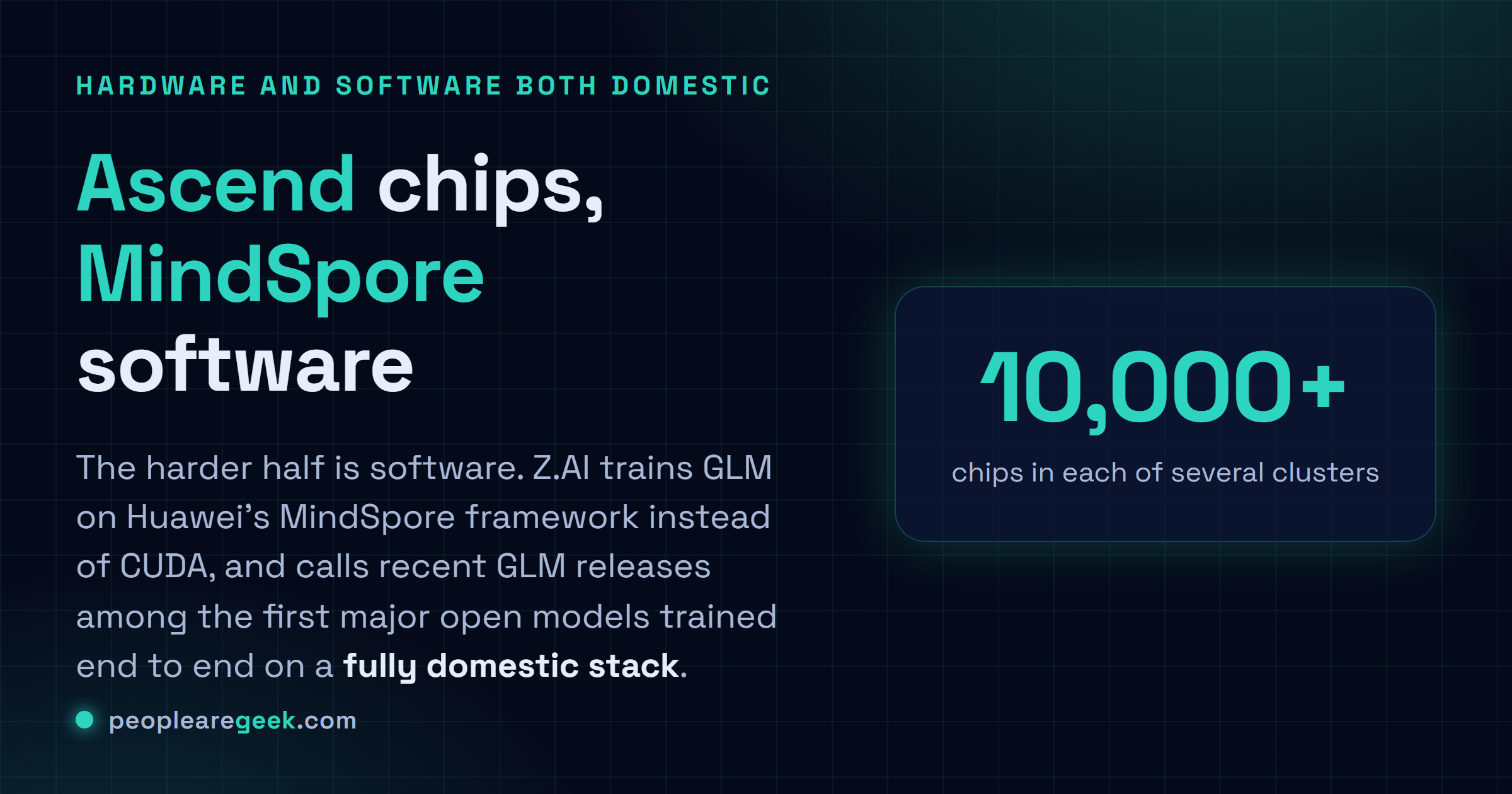
Hardware is only half of an AI platform. The other half is the software that lets engineers actually program the chips, and this is where Z.AI's project is most interesting. The center runs on Huawei Ascend accelerators, and Z.AI trains its GLM models using Huawei's MindSpore framework rather than the CUDA ecosystem that most of the field is built on.
That matters because a training stack lives or dies on its software maturity. Compilers, kernels, libraries, and debugging tools take years to harden, and switching frameworks is rarely a simple recompile. Z.AI has described recent GLM releases as among the first major open models trained end to end on a fully domestic stack, silicon and software both. Whatever you think of the geopolitics, that is a real engineering milestone: it means the tooling around Ascend and MindSpore is now mature enough to carry a frontier-scale training run, not just a demo.

The efficiency gap, and why it matters
The honest part of this story is the tradeoff. By the accounts around the project, a gigawatt of Chinese accelerators delivers less usable training compute than a gigawatt drawn by the leading imported systems. To reach the same effective throughput, the lab has to burn more power and wire together more chips.
For anyone who thinks about infrastructure, that is the whole ballgame, and it is a familiar shape. The constraint is useful work per watt, and when a platform is behind on that number, you compensate with scale: more accelerators, more electricity, more interconnect to keep them coordinated. That raises three practical costs.
- Power. A less efficient platform needs more megawatts for the same result, which is exactly why the story is measured in gigawatts and homes rather than in racks.
- Interconnect. More chips per job means a heavier networking burden to keep them in sync, and the fabric becomes a bigger share of the engineering effort.
- Operational overhead. More hardware to reach a target is more to power, cool, monitor, and keep running, all of which land on the teams who operate the site.
The gap is not static, though. Efficiency per watt is precisely the metric that improves generation over generation, and a working gigawatt-scale deployment is how a platform earns the real-world feedback to close it. The takeaway for the rest of us is straightforward: the market for large-scale AI compute is genuinely diversifying, a second independent stack now runs at frontier scale, and the distance between it and the leader is measured in efficiency, not in whether the work can be done at all.
Sources and further reading
- Bloomberg: Z.AI completes giant data center with Chinese chips to train AI
- The Next Web: Z.AI built a giant AI data centre on Chinese-made chips
- Unite.AI: Z.ai builds gigawatt data center on Chinese chips alone
Frequently asked questions
What did Z.AI actually switch on?
According to Bloomberg, Z.AI, the Chinese lab formerly called Zhipu, has begun partially operating a data center with about 1 gigawatt of power capacity, built to train its GLM family of models. What makes it notable is the hardware: the facility runs only Chinese-made chips, with no Nvidia parts. Z.AI has assembled several computing clusters, each holding more than ten thousand accelerators, and a gigawatt of draw is roughly the peak power of 750,000 homes.
What chips and software is it running?
The center is built on Huawei Ascend accelerators, and Z.AI trains its GLM models using Huawei's MindSpore software framework rather than the widely used CUDA ecosystem. The company has described recent GLM models as among the first major open models trained on an entirely domestic stack, meaning both the silicon and the software toolchain are Chinese. For engineers, that software layer is the harder half of the story, because portability and tooling maturity, not just raw chips, decide how productive a platform is.
Is Chinese silicon as efficient as the alternative?
Not yet, by the accounts around this project. A gigawatt of Chinese accelerators yields less usable training compute than a gigawatt drawn by the leading Nvidia systems, so the lab has to burn more power and wire together more chips to reach the same effective throughput. That efficiency gap, measured as useful work per watt, is the central engineering constraint here. It does not stop the work, but it raises the power bill and the interconnect complexity needed to hit a given result.
Why does this matter if I am not in China?
Because it is evidence about how AI infrastructure diversifies. For years the assumption was one dominant accelerator and one software stack. A gigawatt-scale build on entirely different silicon and a different framework shows a second, independent path taking shape, even if it is less efficient today. If you follow compute supply, model portability, or the economics of training, this is a data point about where alternative stacks stand, and how much power and hardware it takes to close the gap.