Qwen 3.7 Max vs GPT-5.5 is the comparison every team building on LLMs is running right now, because the two flagships landed weeks apart in 2026 and they pull in different directions. GPT-5.5, out in April, is OpenAI's polished all-rounder, strongest on terminal and agent tasks and the hardest reasoning. Qwen 3.7 Max, out in May, is Alibaba's challenger that wins the one coding benchmark that mirrors real pull requests, and does it at a quarter of the output price. We have read the launch numbers and run both, so here is the honest split: where each one wins, what they cost, and how to choose without the hype. Benchmarks move fast, so we cite the launch figures and link the sources.
The short answer
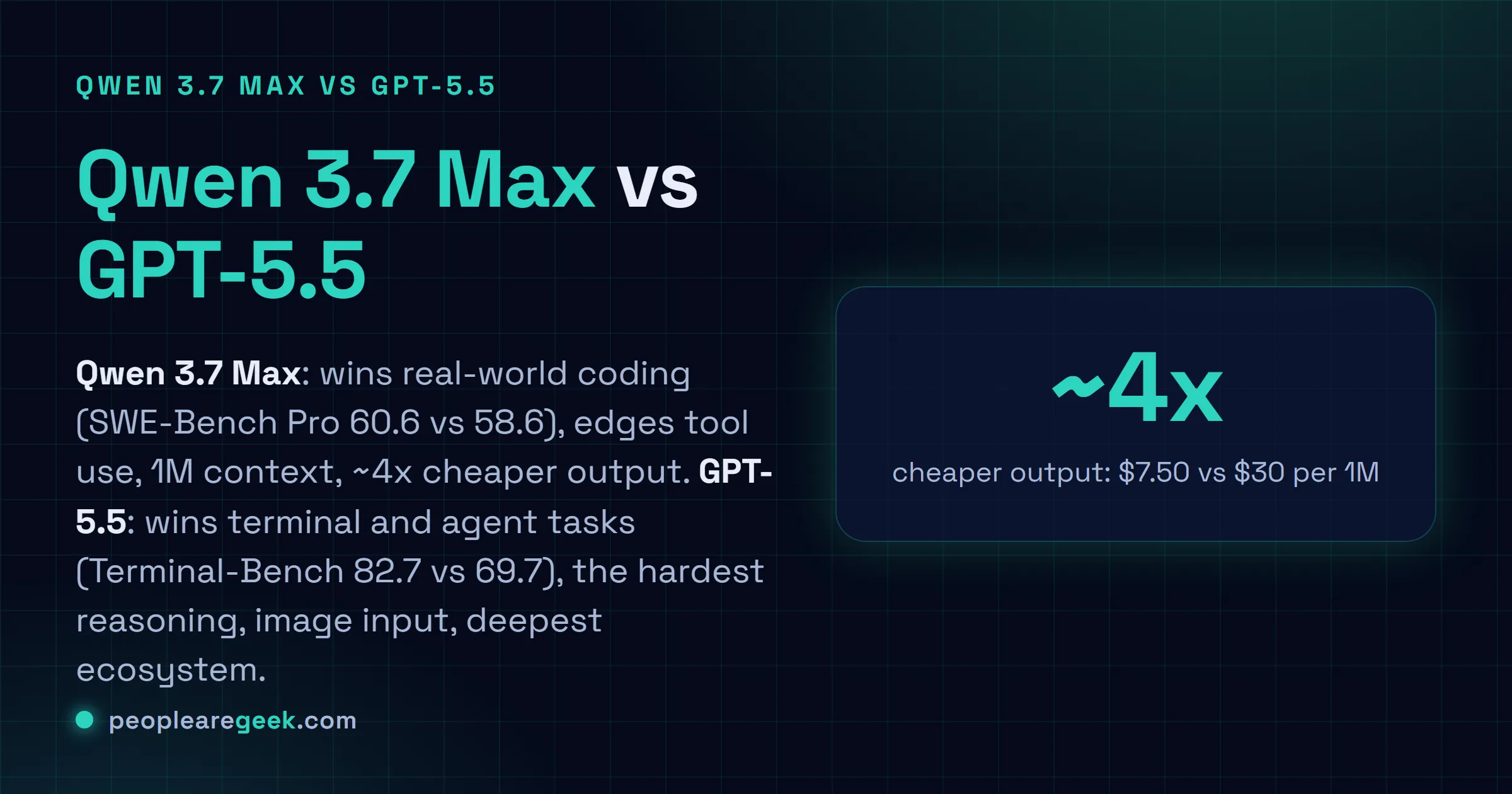
Two 2026 flagships pulling different ways. Qwen 3.7 Max wins the coding benchmark that mirrors real pull requests (SWE-Bench Pro 60.6 vs 58.6), edges tool use, holds a 1M context, and costs about four times less per output token. GPT-5.5 wins terminal and agent tasks (Terminal-Bench 82.7 vs 69.7), the hardest abstract reasoning, takes images, and sits in the deepest ecosystem. Pick by the job, and many teams run both.
For about a year, the top of the model table was an OpenAI and Anthropic conversation, with everyone else a step behind. Qwen 3.7 Max changed the tone of that conversation. Alibaba's flagship landed in May 2026, weeks after GPT-5.5, and it did not just keep pace on price, it beat OpenAI's best on the coding benchmark teams actually argue about. So the question stopped being academic. If you are choosing a model to build on in 2026, these two are the realistic shortlist at the top, and they genuinely solve the job differently. Here is the comparison with the launch numbers in front of us, and our honest read of who should pick which.
The quick verdict
Skimming? Here it is, by what you are building.
| You are... | The pick | Why |
|---|---|---|
| Generating a lot of code on a budget | Qwen 3.7 Max | Wins SWE-Bench Pro, and about 4x cheaper output |
| Building terminal or computer-use agents | GPT-5.5 | Clear Terminal-Bench lead, stronger in long agent loops |
| Doing the hardest reasoning or research | GPT-5.5 Pro | Top abstract-reasoning scores, deliberative variant |
| Processing images alongside text | GPT-5.5 | Native text and image input |
| Running high-volume pipelines | Qwen 3.7 Max | The price gap compounds fast at scale |
That last column is the whole article in miniature: it is rarely "which model is smartest" and almost always "which model wins my specific job at a price I can live with."
Benchmarks, head to head
The numbers below are the launch figures, on the benchmarks where both models reported, so it is a fair side by side. Read SWE-Bench Pro and Terminal-Bench together, because they tell the real story: these two split the coding world between them.
| Benchmark | What it measures | Qwen 3.7 Max | GPT-5.5 |
|---|---|---|---|
| SWE-Bench Pro | Real repository changes (closest to real work) | 60.6 | 58.6 |
| Terminal-Bench 2.0 | Driving a terminal, agent tasks | 69.7 | 82.7 |
| LiveCodeBench | Competitive-style coding | 91.6 | ~91 |
| MCP-Atlas | Tool use over MCP | 76.4 | 75.3 |
The pattern is clear once you see it. On writing and fixing code the way a developer actually does, in a real repo, Qwen 3.7 Max is in front. On making the model operate a machine, a terminal, a chain of tools across a long task, GPT-5.5 pulls ahead by a wide 13 points. They are not really competing for the same crown.
Where Qwen 3.7 Max wins
Two things, and they matter a lot together: real-world coding and price. On SWE-Bench Pro, the benchmark built from actual repository issues and the one most teams trust as a proxy for production coding, Qwen 3.7 Max takes it, 60.6 to 58.6. It also nudges ahead on tool use (MCP-Atlas) and competitive coding. Alibaba paired that with a serious agentic story, demonstrating a 35-hour autonomous run that made over a thousand tool calls without a human stepping in, and a 1,000,000-token context so a whole codebase fits in the window.
Then the price. At launch Qwen 3.7 Max is around 2.50 dollars per million input tokens and 7.50 per million output, against GPT-5.5 at 5 and 30. On output, the number that dominates a real bill, that is roughly four times cheaper. For anyone generating code at volume, that gap is not a rounding error, it is the difference between a feature being affordable and not. The one honest catch: despite Qwen's open-weight reputation, the Max tier is closed and proprietary. You use it through an API, not on your own hardware.
Where GPT-5.5 wins
GPT-5.5 is the better all-rounder, and it is strongest exactly where agents are heading. On Terminal-Bench 2.0 it scores 82.7 to Qwen's 69.7, a 13-point lead that shows up as real reliability when the model has to drive a shell, recover from errors, and keep a long task on track. It leads the hardest abstract-reasoning tests too, and it takes images as well as text, which Qwen's Max tier is not built around. It also posts top marks on professional knowledge work and computer-use benchmarks.
Around the raw model sits the thing benchmarks do not score: the ecosystem. OpenAI's tooling, integrations, SDKs and sheer ubiquity mean GPT-5.5 is the path of least resistance for most teams, and the variants cover the range, a fast Instant model for everyday calls, a Thinking model for harder problems, and GPT-5.5 Pro for long-horizon research and codebase-wide refactors. You pay for all of it, but for terminal-driven agents, the toughest reasoning, or vision, it earns the premium.
Price and access
The split that decides a lot of projects, in one place. Prices are the launch rate cards and move often, so treat them as the shape of the gap, not gospel.
| Qwen 3.7 Max | GPT-5.5 | |
|---|---|---|
| Input, per 1M tokens | ~$2.50 | ~$5 |
| Output, per 1M tokens | ~$7.50 | ~$30 |
| Context window | 1,000,000 | ~1,000,000 |
| Max output tokens | 65,536 | ~128,000 |
| Weights | Closed, proprietary | Closed, proprietary |
| Image input | Text-focused | Text and images |
Access is easy for both, and that is the quiet headline. Qwen 3.7 Max is on Alibaba Cloud Model Studio, OpenRouter and Together AI, and crucially it speaks the OpenAI chat format, as does GPT-5.5 through OpenAI directly. So swapping one for the other in your code is close to a one-line change.

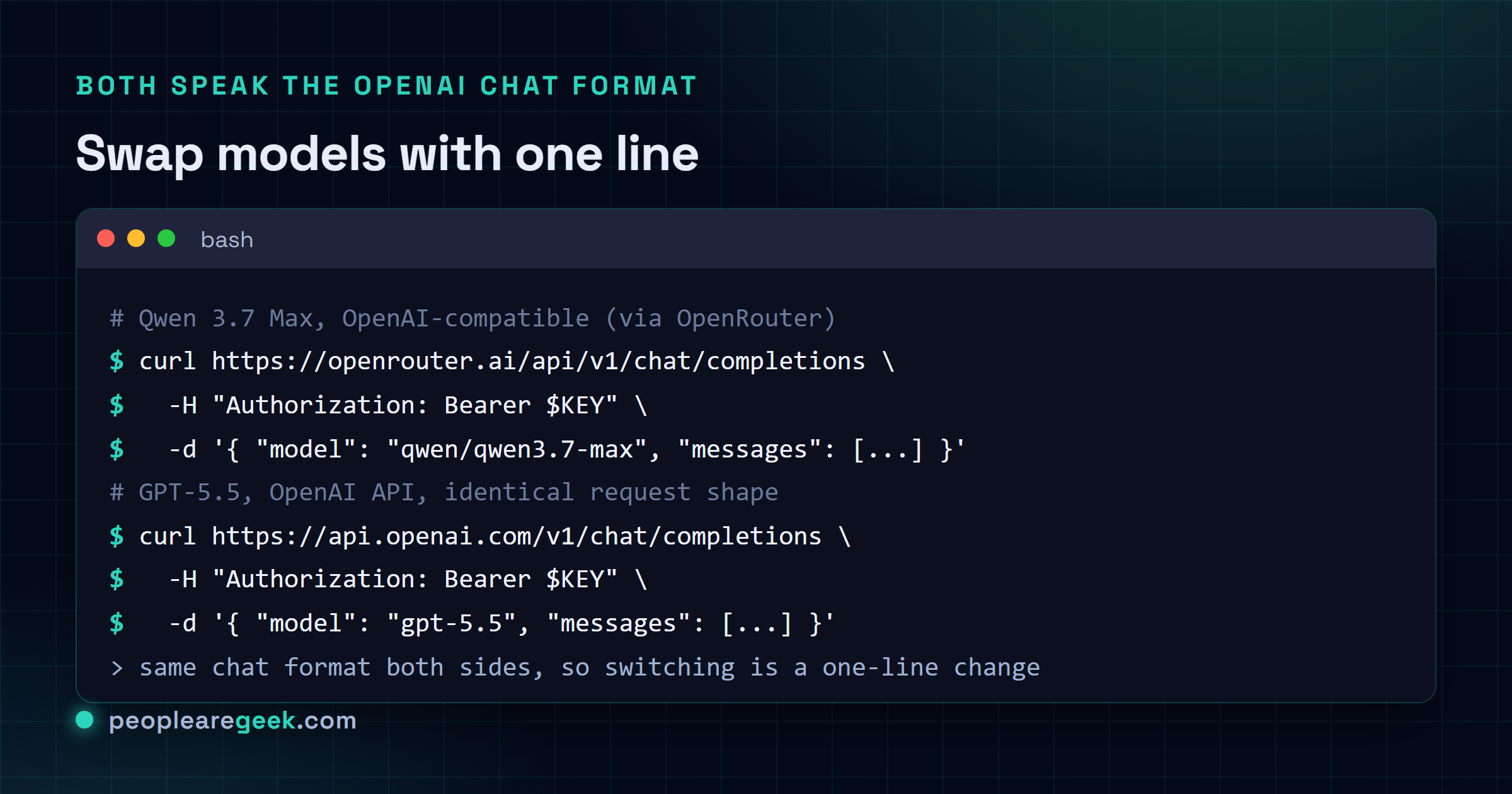
That shared format is what makes the smart play practical: do not pick on faith, route by the job. Send bulk code generation to the cheaper model that wins SWE-Bench Pro, send the terminal-heavy agent runs and the hardest reasoning to GPT-5.5, and let your own results decide the line between them.
So which should you choose?
Two clean cases, again. If your workload is code, especially at volume, and cost matters, Qwen 3.7 Max is the value pick: it wins the coding benchmark that counts, holds a million-token context, and costs about four times less per output token. If you are building terminal or computer-use agents, doing the hardest reasoning, working with images, or you simply want the deepest, most frictionless ecosystem, GPT-5.5 earns its higher price, with GPT-5.5 Pro waiting for the truly long-horizon jobs.
For most teams the real answer is not one model, it is both, routed by task, which the shared OpenAI format makes almost free to do. The era when you bet the whole stack on a single provider is ending. In 2026 the edge goes to whoever matches each job to the model that wins it, and keeps testing as the numbers keep moving.
Sources and further reading
- OpenAI, introducing GPT-5.5
- Qwen 3.7 Max benchmarks and pricing (llm-stats)
- GPT-5.5 vs Qwen 3.7 Max benchmark comparison (BenchLM)
- Best AI models for coding, ranked by SWE-Bench Pro and cost
Frequently asked questions
Is Qwen 3.7 Max better than GPT-5.5 for coding?
On the benchmark that best mirrors real work, SWE-Bench Pro (actual repository changes), Qwen 3.7 Max edges ahead, 60.6 to 58.6, and it does it at roughly a quarter of the output price. It also leads slightly on tool use. But GPT-5.5 wins terminal and agent-environment tasks clearly, scoring 82.7 on Terminal-Bench 2.0 against 69.7. So the honest answer is split: Qwen 3.7 Max for cost-effective, high-volume code generation, GPT-5.5 when the model has to drive a terminal or a long agent loop. Many teams end up using both.
How much cheaper is Qwen 3.7 Max than GPT-5.5?
At their launch rate cards, Qwen 3.7 Max runs about 2.50 dollars per million input tokens and 7.50 per million output, against GPT-5.5 at 5 and 30. That is half the input price and roughly four times cheaper on output, which is the number that dominates a real bill since models emit far more than you feed them. GPT-5.5 Pro, the deliberative variant, is far pricier still at 30 and 180. Prices move often, so confirm the current rate cards before you commit a budget.
Is Qwen 3.7 Max open source?
No, and this surprises people, because Qwen built its reputation on open weights. Qwen 3.7 Max is closed-weight and proprietary, available only through an API. The open-weight Qwen models are the smaller and earlier releases in the family, not the Max flagship. So if your reason for looking at Qwen was self-hosting or open weights, the Max tier is not it, and you would want one of the open Qwen models or another open-weight family instead.
What context window do Qwen 3.7 Max and GPT-5.5 have?
Both are in the one-million-token class, so neither is a real constraint for most work, including large codebases. Qwen 3.7 Max takes up to 1,000,000 tokens of context and can return up to 65,536 in a single response. GPT-5.5 is in the same range, around 922,000 tokens of input and up to 128,000 of output. The practical difference is small. If you routinely need very large single responses, GPT-5.5 has the higher output ceiling.
Should I switch from GPT-5.5 to Qwen 3.7 Max?
Test, do not switch blind. Both speak the OpenAI chat format, so pointing your code at Qwen 3.7 Max is close to a one-line change, which makes an A/B test cheap. Given the roughly four-times cost gap on output, it is well worth running your own coding tasks through both and comparing. Keep GPT-5.5 for terminal-driven agents and the hardest reasoning, where it still leads. The smart move in 2026 is not loyalty to one model, it is routing each job to the one that wins it.