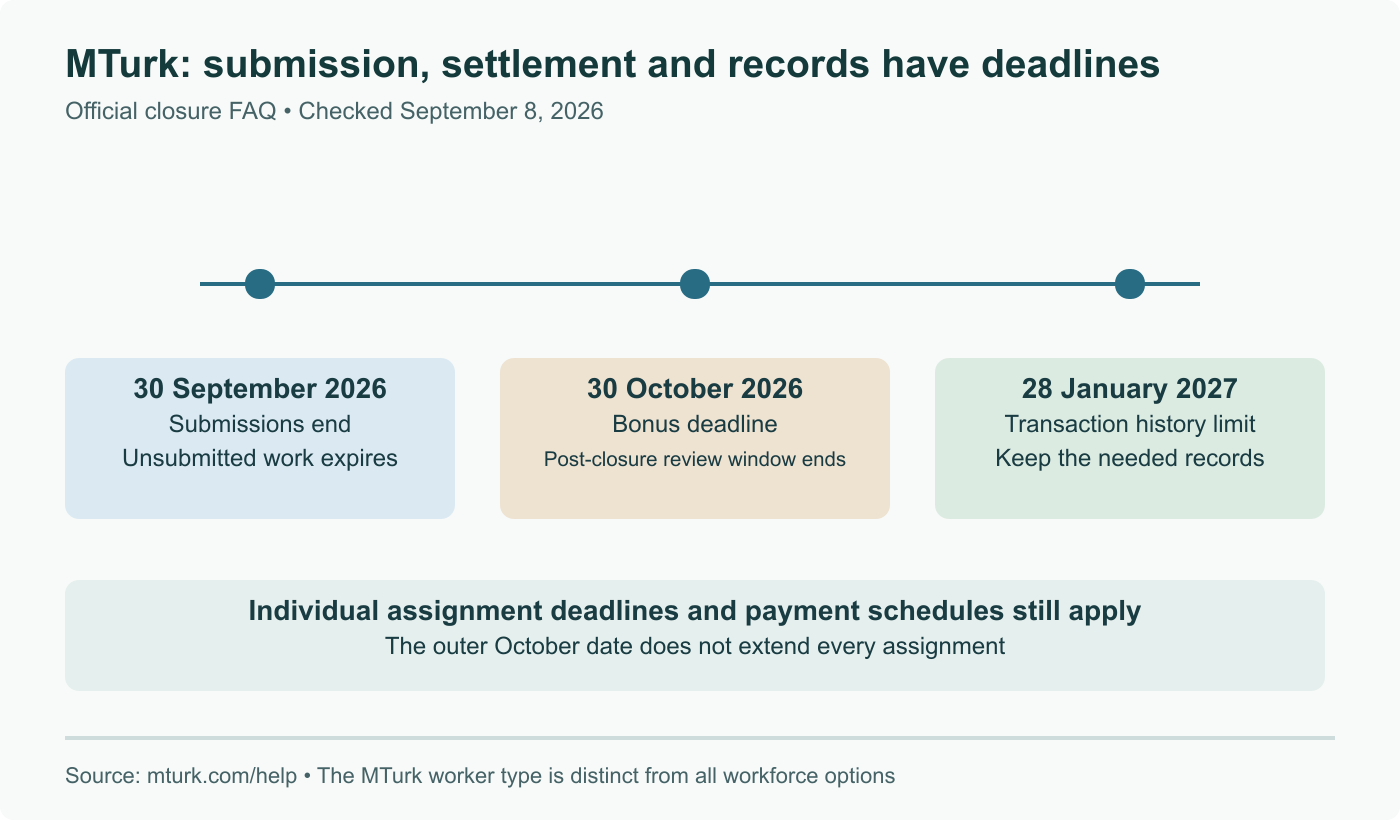
Amazon is closing Mechanical Turk on September thirtieth, 2026, twenty one years after it launched, and if you have a data pipeline that still posts Human Intelligence Tasks you have about five weeks to move it. The wind down has been visible since early July, when AWS said it would stop accepting new customers as of July thirtieth and would ship no further features. At its peak the marketplace connected more than five hundred thousand workers to micro tasks paid in cents. What replaced it is partly a set of specialised labelling companies and partly the models themselves, which now handle the classification work the platform was built to farm out.
The short answer
Amazon is shutting Mechanical Turk on September 30, 2026. AWS stopped accepting new customers on July 30, 2026 and said it would ship no new features while continuing security and availability work. The marketplace paid workers cents per Human Intelligence Task and peaked above five hundred thousand of them. Specialised labelling firms took the expert end of the market and models took the easy end. If a pipeline of yours still posts HITs, export your assignment and qualification data before the end of September.
Most of us met Mechanical Turk as a strange API: you made a call, and instead of a function running, a person somewhere answered your question for eleven cents. It was one of the odder things AWS ever shipped, and it is closing on September 30 after twenty one years.
The dates
AWS signalled this in early July. From July 30, 2026, no new customers. Existing customers could carry on, and AWS said it would keep investing in security and availability, but there would be no new features. That is the standard vocabulary of a service being wound down, and the confirmation came this week: the platform closes on September 30, 2026.
If you still have anything posting Human Intelligence Tasks, you have about five weeks. The export list is short and worth doing properly: completed assignment data, qualification records, and whatever worker identifiers your quality process relies on. None of that exists anywhere else once the service goes dark, and reconstructing a quality history is not something you can do afterwards.
What it was, and what it quietly became
The premise in 2005 was elegant. Some tasks are trivial for people and hard for software, so put an API in front of people. Requesters posted tasks, workers claimed them, and payment ran in cents per assignment. Jeff Bezos called it artificial artificial intelligence, which was funny and also exactly right about the architecture.
At its peak the marketplace had more than five hundred thousand workers on it. Labelled images, transcribed audio, survey responses, deduplicated product listings: a large amount of the training data that the current model generation was built on came through platforms shaped like this one. The joke about artificial artificial intelligence stopped being a joke somewhere around the point where it became the supply chain.
Why it lost
Two things happened at once, and they squeezed from opposite ends.
At the top of the market, specialised labelling companies took the work that mattered most. Scale AI, Mercor and Prolific built around vetted workers, managed quality and actual domain expertise, and that is what frontier model training needs. An open marketplace of anonymous micro workers was never structured to deliver a radiologist's judgement or a lawyer's reading of a contract clause, and that is where the money went.
At the bottom, the models ate their own inputs. Classification, deduplication, sentiment tagging, basic extraction: this was the bulk of the volume and it now costs a fraction of a cent in tokens with no scheduling, no quality sampling and no payment infrastructure. The generation of models trained partly on Mechanical Turk output can now do most of what Mechanical Turk was for.
That leaves the middle, and there is not much of a middle. A platform optimised for cheap, high volume, low judgement work lost the volume to automation and the judgement to specialists.
What to actually do about it
The migration question is not "which marketplace replaces this". It is "was this ever the right shape for my problem".
Start by classifying your own tasks. If what you were buying was classification, extraction, deduplication or basic tagging, benchmark a small model against a sample of your historical human results before you talk to any vendor. Open weight models at the 8 billion parameter mark are now genuinely capable at this kind of work, IBM's Granite 4.2 being this week's example, and they can run on your own hardware with your data staying put. If the model matches your old inter annotator agreement, you have removed a vendor rather than replaced one.
If your tasks needed real judgement, human preference data, or domain expertise, that is what the specialised vendors sell, and you should get quotes now rather than in the last week of September. Expect prices that reflect vetted workers rather than an open marketplace.
And if you have human review wired into a production path anywhere, audit it this week. Coverage this week linked the closure to a broader retreat from human in the loop tooling at Amazon, with SageMaker Ground Truth and Augmented A2I also reported to have closed to new signups on July 30. Verify that against the service documentation for the products you actually depend on, but the direction is not ambiguous.
The part worth sitting with
There is a neat, slightly uncomfortable symmetry here. A platform built to have humans do what software could not, which then supplied much of the training data that taught software to do it, is closing because the software can now do it.
That is not a tragedy and it is not a triumph, it is just the shape of the thing. Worth noticing, though, when the next piece of infrastructure quietly turns out to be a training set.
Sources and further reading
- Amazon service Bezos once called artificial artificial intelligence is shutting down, CNBC, August 25, 2026
- Amazon shutting down Mechanical Turk platform on Sept. 30, 2026, Quartz, August 26, 2026
- Amazon will stop accepting new customers for Mechanical Turk, TechCrunch, July 5, 2026
- Amazon is closing Mechanical Turk, the human workforce it sold as AI, The Next Web
Frequently asked questions
What is the actual timeline I need to plan against?
Two dates matter. On July thirtieth, 2026 AWS stopped accepting new customers, and said existing customers could carry on as normal while it continued investing in security and availability but would not introduce new features. On September thirtieth, 2026 the service closes. That gives anyone still running requester workflows roughly five weeks from the end of August to export what they need and cut over. The specific things to pull are your completed assignment data, your qualification records, and any worker identifiers your quality process depends on, because those are the parts that do not exist anywhere else once the platform goes dark.
What was Mechanical Turk actually for?
It was a marketplace for Human Intelligence Tasks, small pieces of work that people do better than software: labelling images, transcribing audio and video, filling in surveys, checking whether two product listings describe the same thing. Requesters posted tasks, workers picked them up, and the pay was typically cents per assignment. Jeff Bezos described it as artificial artificial intelligence, which was an accurate joke: the API looked like a service call and a person answered it. A great deal of the training data underneath the current generation of models passed through platforms shaped like this one.
Why did it decline?
Two pressures at once. Specialised labelling companies, including Scale AI, Mercor and Prolific, built businesses around vetted workers, managed quality and domain expertise, which is what frontier model training actually needs and which an open marketplace of anonymous micro workers was never structured to provide. At the same time, models got good enough to do the easy end of the work themselves. Classification, deduplication and basic tagging, which used to be the bulk of the volume, now cost a fraction of a cent in tokens. What is left is the hard, expert, high judgement end, and that market went to the specialists.
What should I replace it with?
It depends on what you were using it for, and the honest answer for a lot of workloads is a model rather than a person. If your tasks were classification, extraction, deduplication or basic tagging, benchmark a small model against a sample of your historical results before you go shopping for a vendor, because a model that matches your old accuracy at a tenth of the cost changes the question entirely. If your tasks needed real judgement, domain knowledge or genuine human preference data, that is what the specialised vendors sell and it is priced accordingly. The mistake is assuming the replacement has the same shape as the thing being replaced.
Are other AWS services affected?
Coverage this week tied the closure to a broader wind down of Amazon's human in the loop tooling, with SageMaker Ground Truth and Amazon Augmented A2I also reported to have stopped new signups on July thirtieth. Treat that as reported rather than as a schedule you should plan against, and check the AWS service documentation for the products you actually use before you commit to a migration date. The pattern is clear enough regardless: Amazon is stepping back from operating human annotation as a service, and anyone with human review wired into a production pipeline should confirm their own dependencies now rather than in September.