Anthropic released Claude Opus 5 on Friday, July twenty fourth, priced at five dollars per million input tokens and twenty five dollars per million output tokens. That is the same price as Opus 4.8 and half of what Fable 5 costs, and on several of the benchmarks Anthropic published, Opus 5 comes out ahead of Fable 5 rather than merely close to it. For anyone who pays an API bill every month, that is the part worth reading twice, because the cheaper tier stopped being the compromise tier. We went through what the published numbers actually say, where the model still trails, and what it changes for the way you route requests.
The short answer
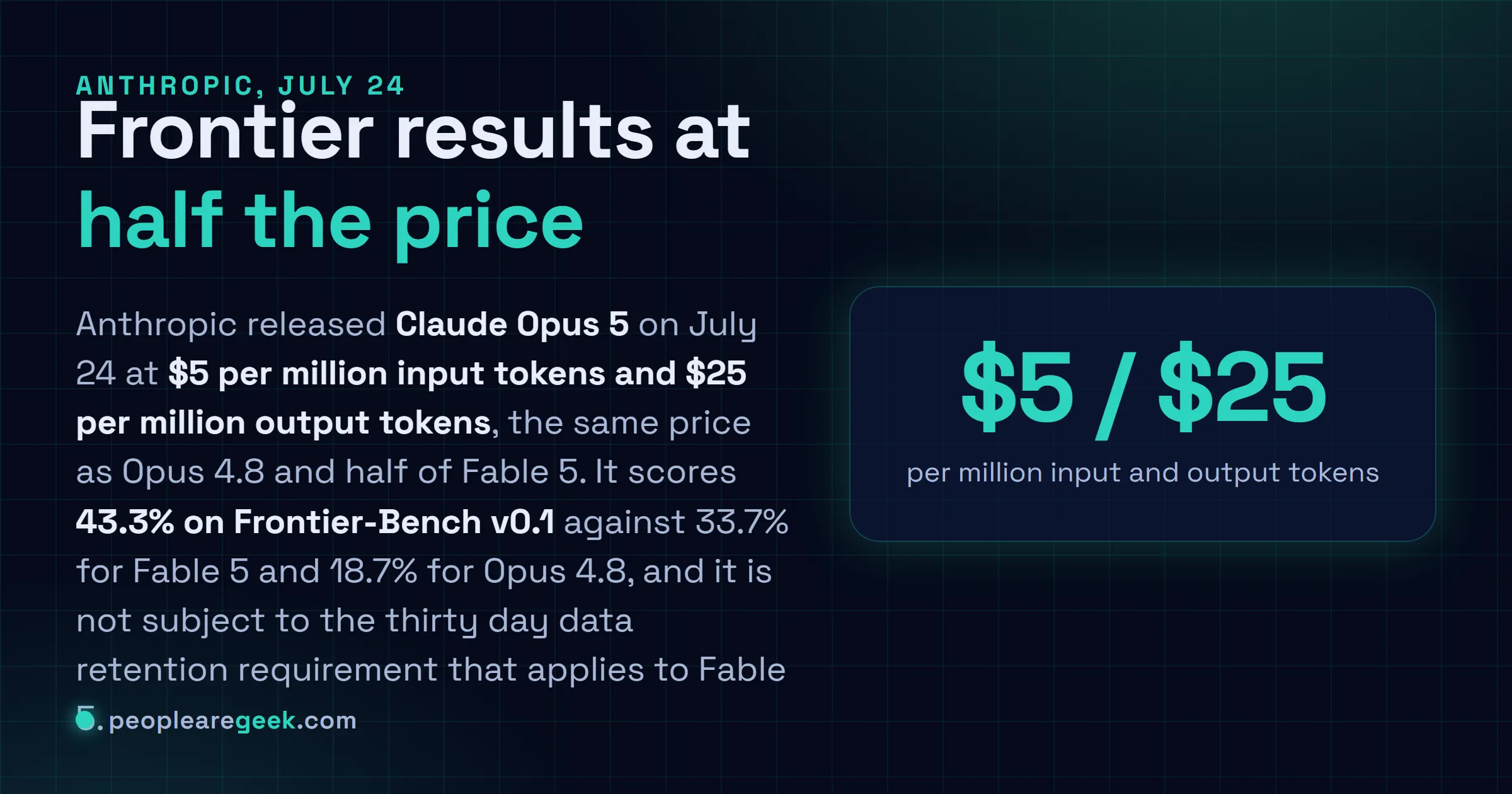
Anthropic released Claude Opus 5 on Friday, July twenty fourth, at five dollars per million input tokens and twenty five per million output tokens. That is half of Fable 5 and identical to Opus 4.8, the model it replaces. On the benchmarks Anthropic published it leads Fable 5 on most and ties on the rest, and it is not subject to the thirty day data retention requirement that applies to Fable 5. It is live on the API as claude-opus-5 and is now the default for Claude Max subscribers.
Model launches usually ask you to pick a side of a trade off. Faster or smarter. Cheaper or better. The Opus 5 announcement on Friday is interesting because it mostly declines to offer one, and for the practical purpose of deciding what your application should call next week, that matters more than any single benchmark number.
What the numbers say
Anthropic reports 43.3 percent on Frontier-Bench v0.1 for Opus 5. Fable 5 sits at 33.7 percent on the same test and Opus 4.8, the model this one replaces at the same price, sits at 18.7 percent. More than doubling your own previous generation while holding price flat is the headline the company clearly wanted, and the independent reading supports the direction: Artificial Analysis placed Opus 5 at 61 on its Intelligence Index, one point ahead of Fable 5.
The rest of the published set is consistent. On OSWorld 2.0, which measures agents driving a real desktop environment, Anthropic says Opus 5 beats Fable 5's best result at just over a third of the cost. On Zapier AutomationBench the pass rate is around one and a half times the next best model. On ARC-AGI 3 the reported score is three times the next best. The one place it does not win outright is CursorBench 3.2, where it lands within half a percent of Fable 5, which is a tie in everything but the ordering.
Take benchmark tables from any vendor with the usual caution. They are chosen by the party being measured. What makes this set harder to wave away is that the comparison being drawn is against the company's own more expensive model, which is not a flattering comparison to volunteer.

What it costs to run
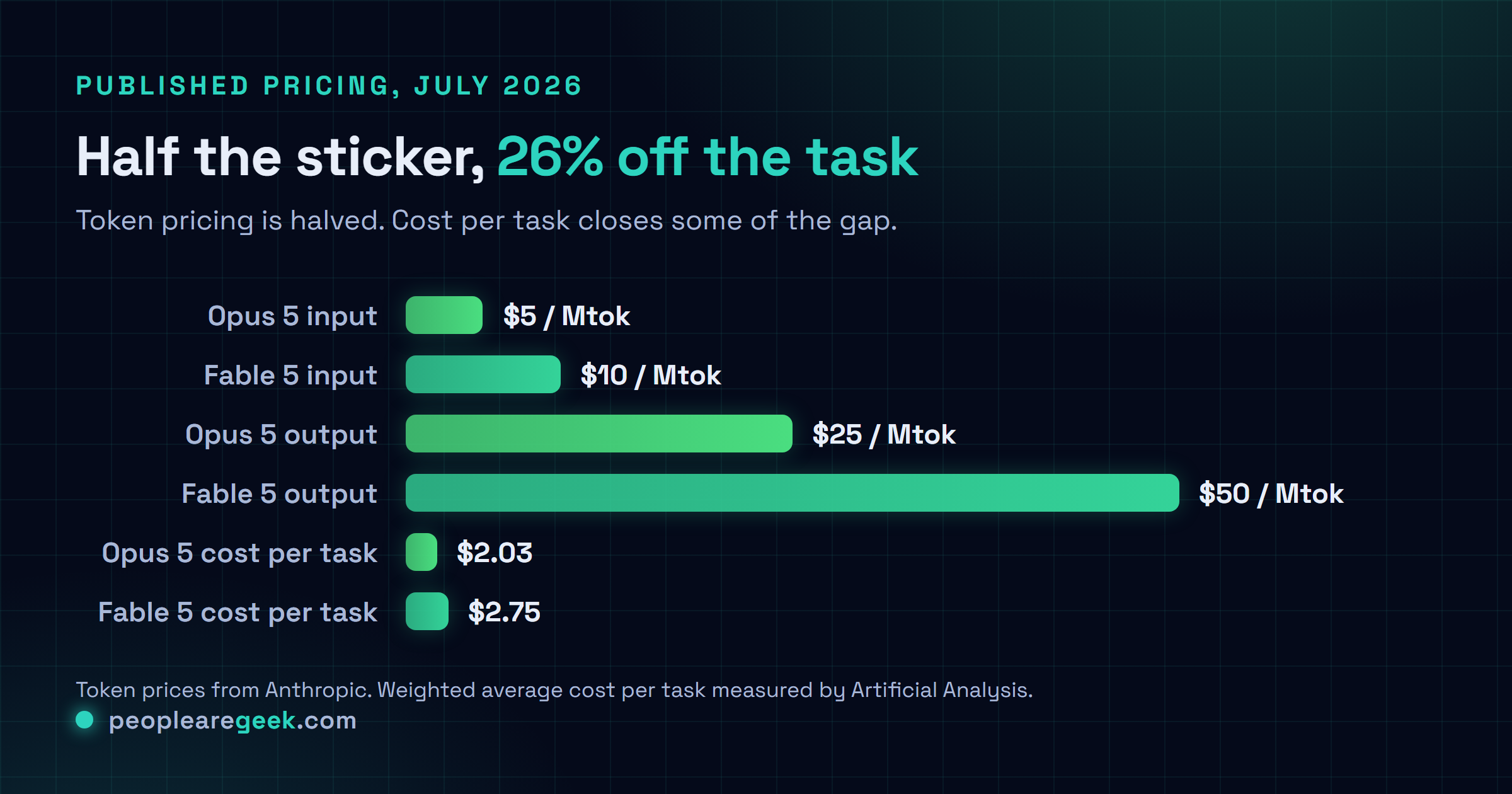
The sticker price is half, but the number that lands on your invoice is not, and the difference is worth understanding before you build a forecast on it. Artificial Analysis measured a weighted average cost per task of 2.03 dollars for Opus 5 against 2.75 dollars for Fable 5, which is a twenty six percent saving rather than fifty. Token pricing is only one input. How many tokens a model burns reaching an answer is the other, and reasoning models vary enormously on that axis depending on the effort level you request.
Anthropic says Opus 5 consumes fewer tokens across effort levels than its predecessor, and exposes the effort setting so you can trade capability against cost per call. That is the control worth wiring into your own code. A single model string with three effort levels behind a routing rule gives you more useful range than maintaining calls to three separate models.
The retention detail that will move procurement
One line in the announcement will matter more than any benchmark for teams inside regulated organisations. Opus 5 is not subject to the thirty day data retention requirement that applies to Fable 5.
If you have ever watched a model rollout stall in legal review, you know that retention terms are where these conversations die. Removing that requirement on the model that is also the cheaper one changes which conversation you are having internally. Confirm it against your own contract rather than a launch post, because retention terms differ by plan and by region, but it is worth checking rather than assuming the answer is the one you got last quarter.
How to decide
If you are on Opus 4.8, the decision is easy. Identical price, substantially better published results, same API surface. Change the model string, run your evaluation set, ship it.
If you are on Fable 5, resist the urge to treat this as a straight replacement. Build the comparison on your own traffic instead. Take a representative sample of real requests, run both models, and compare on the dimension your users actually feel rather than the dimension a benchmark measures. Log token counts alongside quality scores, because the cost per task figure above shows how much the token spend can close a price gap. If your own evaluation comes out level, the cheaper model wins by default, and half price at parity is a rare enough offer to be worth the afternoon it takes to verify.
Sources and further reading
- Anthropic: Introducing Claude Opus 5
- The Register: Anthropic debuts Opus 5 at half the price of its Fable sibling
- VentureBeat: Anthropic launches Claude Opus 5, a cheaper model for coding, agents and enterprise workflows
- TechCrunch: Anthropic launches Opus 5
Frequently asked questions
What does Claude Opus 5 cost compared with Fable 5?
Opus 5 is priced at five dollars per million input tokens and twenty five dollars per million output tokens. Fable 5 is ten and fifty, so Opus 5 is exactly half on both sides of the meter. It is also the same price as Opus 4.8, the model it replaces, which means the upgrade costs nothing at the token level. Artificial Analysis put a weighted average cost per task at 2.03 dollars for Opus 5 against 2.75 dollars for Fable 5, a gap that is narrower than the sticker price because the two models spend different numbers of tokens getting to an answer.
Is Opus 5 actually better than Fable 5, or just cheaper?
It depends which benchmark you look at, and Anthropic published several. On Frontier-Bench v0.1 Anthropic reports 43.3 percent for Opus 5 against 33.7 percent for Fable 5 and 18.7 percent for Opus 4.8, so it more than doubles its own predecessor. On OSWorld 2.0 it passes Fable 5 at just over a third of the cost, and on ARC-AGI 3 Anthropic reports a score three times the next best model. On CursorBench 3.2 it lands within half a percent of Fable 5 rather than above it. The fair summary is that Opus 5 leads on most of the published set and ties on the rest.
Where can I use it?
Opus 5 is available on the Claude API under the model identifier claude-opus-5, and across Claude.ai, Claude Code, Claude Cowork and the cloud partner platforms. It becomes the default model for Claude Max subscribers and the top model available on Claude Pro. There is also a Fast mode that runs at roughly two and a half times the default output speed for latency sensitive work. If you already call Anthropic models in production, this is a model string change rather than an integration project.
What is the data retention difference?
Opus 5 is not subject to the thirty day data retention requirement that applies to Fable 5. For teams whose legal or procurement review stalled on retention terms, that removes one of the common objections to putting a frontier class model in front of internal data. It is worth confirming the current terms against your own contract before you rely on it, since retention policy is the kind of thing that varies by plan and by region rather than by model alone.
Should I switch my production traffic over?
For most workloads currently sitting on Opus 4.8, yes, because the price is identical and the published gains are large. For workloads on Fable 5, treat it as a routing question rather than a replacement question. Run your own evaluation set through both, compare the answers you care about instead of the benchmarks somebody else chose, and check the token counts as well as the quality, since Anthropic says Opus 5 uses fewer tokens at comparable effort levels. If your evaluation comes out level, the cheaper model wins by default.