The reported jump in Anthropic’s quarterly revenue describes rapid growth. It does not, by itself, establish audited profit, cash generation or the terms that future API customers will receive.
What the source establishes
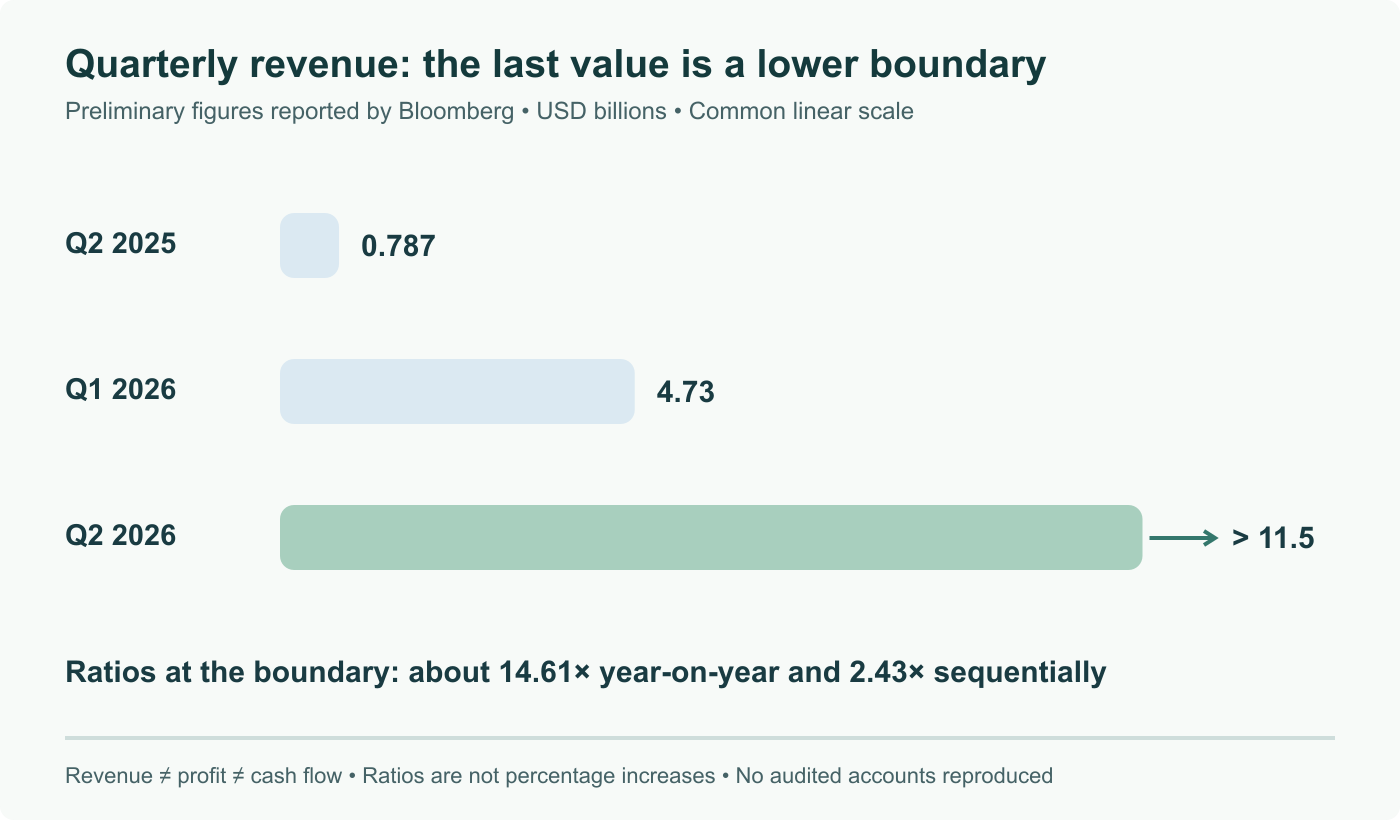
Bloomberg's August 14 report cites preliminary investor documents: Q2 revenue above $11.5 billion, versus $787 million a year earlier and $4.73 billion in Q1, with positive adjusted operating income. The figures could be revised. We have not reviewed the underlying investor documents or an audited reconciliation.
The public preview establishes the status of the numbers. Other outlets repeating the same report do not create several independent confirmations of the accounts.
A multiple is not a percentage increase
Using the reported Q2 lower boundary, the year-on-year revenue ratio is about 14.61 times and the sequential ratio about 2.43 times. These are ratios of new revenue to old revenue. For a percentage increase, subtract one before multiplying by 100. The actual figure is above the boundary, so the derived comparisons are lower-bound approximations too.
A smaller fictional example is easier to audit: going from $10 to $30 produces a 3× revenue level but a 200% increase. Calling that a 300% increase counts the original $10 twice. Our cover uses the reported quarterly values and labels the open upper end explicitly.
Annualizing a quarter multiplies its revenue by four. It does not forecast demand, retention or the timing of future sales. Comparing that result with an annualization based on one recent month also mixes time windows; similar totals are not independent proof that the business is healthy.
Adjusted operating income needs its definition
The earlier article suggested particular expenses were excluded, including model training. The accessible report does not provide that reconciliation, so those exclusions should not have been asserted.
To interpret an adjusted result, look for its starting accounting measure, every adjustment and the comparable periods. Operating income also differs from net income and cash flow. A business can report revenue before receiving payment, and expenditure on infrastructure can affect cash and accounting profit at different times.
For a technical buyer, company revenue does not answer whether a model supports a required feature, how a service behaves under load or what an agreement guarantees. Evaluate those against product documentation, service terms and your own representative tasks. The original predictions that listing would necessarily improve deprecation discipline or push a particular pricing model were speculative; a revenue report cannot establish those product outcomes.
Keep preliminary figures attributed to original reporting; distinguish revenue multiple, growth rate and annualization, remove invented operating-income exclusions and public-company product forecasts.