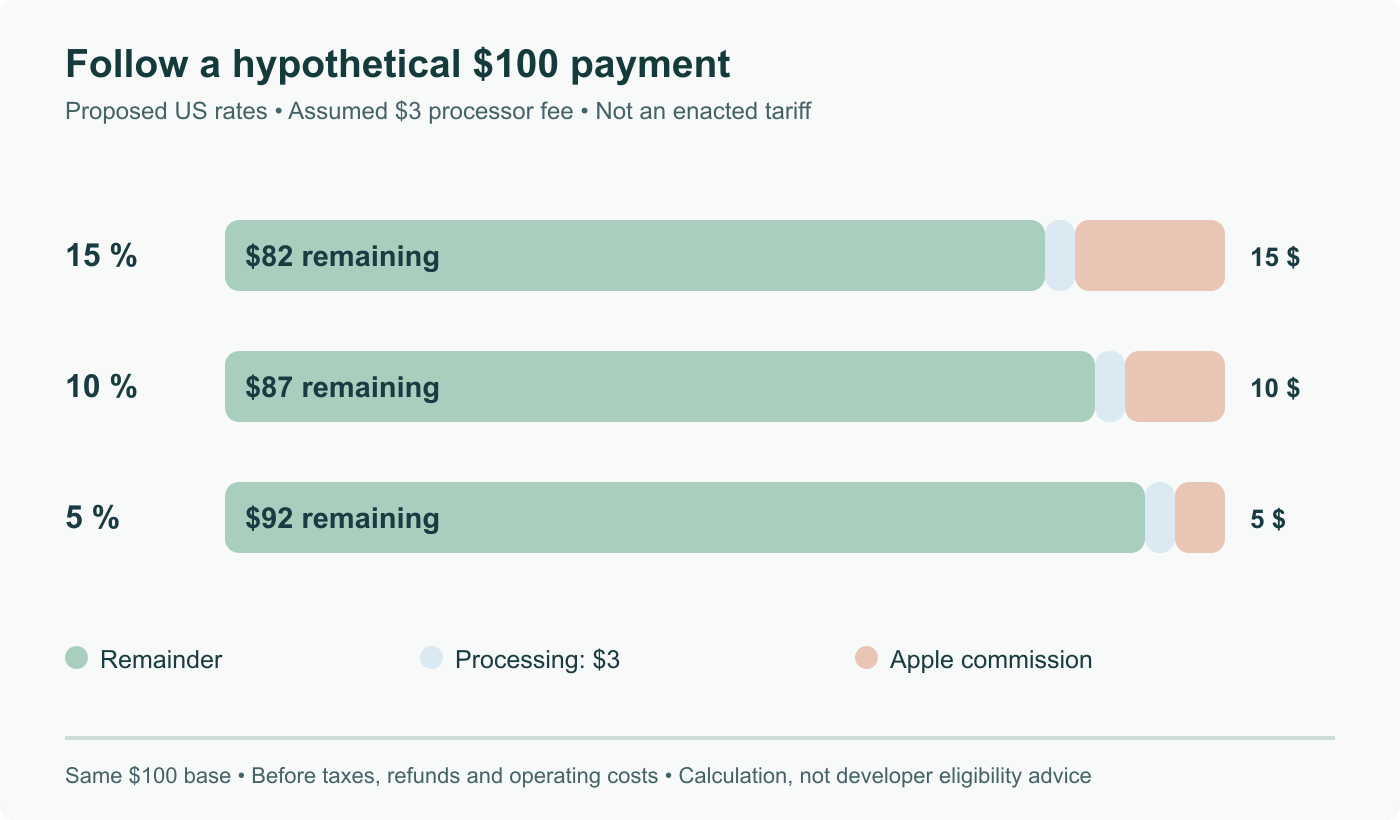
Apple filed a proposal with the US District Court for the Northern District of California on August 13, 2026 asking to charge developers a commission on purchases users make after tapping an external link inside an iOS app. The tiers are 15% for standard apps, 10% for subscription renewals and three partner programs, and 5% for Small Business Program members. Apple has been barred from collecting anything on those purchases since April 2025, when the court found it had willfully broken an earlier injunction with a 27% fee. Epic Games says the correct number under the appeals court reasoning is zero. If you sell anything through an iOS app, this filing decides your unit economics.
The short answer
Apple filed a proposed commission schedule with the US District Court for the Northern District of California on August 13, 2026, covering purchases users make through external links in iOS apps. The tiers are 15% for standard apps, 10% for subscription renewals and three partner programmes, and 5% for Small Business Program members. Apple has been barred from charging anything on those purchases since April 2025. Epic Games argues the figure should be zero and has about sixty days to contest the proposal.
For five years the question of what Apple can charge for a purchase it did not process has been argued in courtrooms rather than in pricing pages. This week Apple put a number on the table, and it is the number every iOS product plan has been waiting for.
What Apple filed
On August 13, 2026, Apple submitted a proposed commission structure to the US District Court for the Northern District of California, in the long running Epic Games v. Apple case before Judge Yvonne Gonzalez Rogers. The commissions apply when a user follows a link out of an iOS app and completes a purchase elsewhere.
Standard apps would pay 15%. The Video Partner Program, the News Partner Program, the Mini Apps Partner Program and subscription renewals would pay 10%. Small Business Program apps would pay 5%. Apple's argument for charging anything at all is that it should be permitted to charge fees on in app purchases as a means to recoup its investments in the tools, technology and services that developers use, and it framed its proposed rates against Google Play's equivalent link out schedule, which it gave as 20% standard, 15% for special programmes and 10% for subscriptions.
How we got to zero
The current rate on link out purchases is nothing, and that is not an oversight. Judge Gonzalez Rogers issued an injunction in 2021 requiring Apple to let developers steer users to outside payment methods. Apple complied by allowing the links and attaching a 27% commission to them, alongside disclosure screens designed to discourage anyone from tapping.
In April 2025 the court found that response to be willful non compliance rather than compliance, and barred Apple from collecting a commission on external purchases at all. That is the regime developers have been operating under since.
The Ninth Circuit then reversed the outright ban, which is the procedural detail that makes this week's filing possible. The appeals court did not bless a rate, it removed the floor of zero and sent the question of an appropriate commission back down. Apple has now answered that question with 15%, and Epic will answer it with 0%.
The parallel Supreme Court track
Also on August 13, 2026, the Supreme Court declined Apple's request to pause the lower court proceedings while its appeal is pending. Apple's brief there is due September 14, 2026. The practical effect is that the district court work continues on its own timetable rather than freezing, so the fee schedule fight and the appeal run side by side.
Epic's position is that Apple's five to fifteen percent range sits far outside the bounds the Ninth Circuit set, and that under the appeals court's own definition of necessary costs the permitted commission would be zero. Epic has roughly sixty days to contest the proposal formally and says it will bring expert testimony to do it.
What it means for anyone shipping an iOS app
The honest summary is that nothing has changed yet and everything might. Today you can link out and keep 100% of the transaction minus your own payment processing. That is the most favourable arrangement iOS developers have had, and it is explicitly temporary.
The planning move is to stop treating link out revenue as free. Take whatever spreadsheet holds your unit economics and add a scenario column for 15%, another for 5% if you qualify for the Small Business Program, and keep the 30% in app purchase column alive because that path is not going anywhere. If a product only works at 0%, that is worth discovering in August rather than in whatever month the ruling lands.
Two details are worth checking now rather than later. The Small Business Program threshold decides whether your link out cost triples, so confirm your standing rather than assuming it. And subscription renewals sit in the 10% tier regardless of programme, which changes the maths for anyone whose revenue is mostly renewals rather than first purchases.
Sources and further reading
- Apple proposes to take a 15% cut of purchases made outside the App Store, TechCrunch, August 14, 2026
- Apple proposes commissions of up to 15% for off App Store purchases in the US, 9to5Mac, August 13, 2026
- Apple's latest commission rates for external App Store purchases have not satisfied Epic, AppleInsider, August 13, 2026
- US Supreme Court clears path for App Store commission showdown, MacDailyNews, August 14, 2026
Frequently asked questions
What are the exact tiers Apple proposed?
Three of them, all applied to purchases a user completes after following an external link out of an iOS app. Standard apps, the ones normally paying 30% on in app purchases, would pay 15%. Apps in the Video Partner Program, the News Partner Program and the Mini Apps Partner Program would pay 10%, and so would subscription renewals regardless of programme. Apps qualifying for the Small Business Program, which covers developers under the annual revenue threshold Apple sets for it, would pay 5%. Apple presented these against Google Play's rates for equivalent link outs, which it gave as 20% standard, 15% for special programmes and 10% for subscriptions.
What is Apple allowed to charge today, while this is pending?
Nothing on link out purchases. In April 2025 Judge Yvonne Gonzalez Rogers found that Apple had willfully failed to comply with her 2021 injunction, which required Apple to let developers point users to outside payment options. Apple's response to that injunction had been a 27% commission on external purchases plus a set of friction inducing disclosure screens, and the court treated that as non compliance rather than compliance. The remedy barred Apple from taking a commission on those purchases at all. That bar is the status quo the current filing is trying to replace.
Why is Apple filing a fee schedule at all if a court already banned the fee?
Because the Ninth Circuit reversed the outright ban on commissions for linked out purchases, sending the question of what Apple may charge back to the district court rather than settling it at zero. That reversal is what opens the door to a number, and the number is what Apple is now proposing. Separately, on August 13, 2026 the Supreme Court declined Apple's request to pause the lower court proceedings while its appeal is pending, with Apple's Supreme Court brief due September 14, 2026. So the district court process runs on schedule, and this filing is Apple's opening bid in it.
What is Epic arguing?
That the range is far outside what the Ninth Circuit's reasoning permits, and that under the appeals court's definition of necessary costs Apple would charge zero. Epic has roughly a sixty day window to formally contest the proposal, and says it will bring expert testimony. The gap between the two positions is the entire question: Apple frames the commission as recouping its investments in the tools, technology and services developers use, while Epic frames a link out purchase as a transaction Apple did not process and therefore cannot bill for.
What should we do about it if we ship an iOS app?
Model it, do not wait for it. Build three columns in whatever pricing model you already keep: 0%, 5% or 10% or 15% depending on which tier you land in, and 30% for in app purchase. If your product only clears margin at 0%, you have a strategy problem rather than a pricing problem, and you want to know that now rather than after the court rules. Check specifically whether you qualify for the Small Business Program, because the difference between 5% and 15% on link outs is large enough to change a growth plan. And keep the in app purchase path working, since nothing in this filing removes it.