Apple Intelligence has been approved for launch in China, and the model behind it will be Alibaba's Qwen rather than anything Apple trained itself. The Cyberspace Administration of China cleared the service on July 15, 2026, after Apple agreed to route its Chinese AI features through Qwen across iOS, iPadOS, macOS and visionOS. Alibaba shares rose four percent in pre market trading on the news. Neither company has given a rollout date. For anyone building software that ships in more than one country, the interesting part is not the partnership itself. It is that a flagship feature now runs on a different model depending on where the user is standing.
The short answer
The Cyberspace Administration of China approved Apple Intelligence on July 15, 2026, after Apple agreed to run its Chinese AI features on Alibaba's Qwen model. The integration spans iOS, iPadOS, macOS and visionOS, and covers text and image understanding and generation. Alibaba's United States listed shares rose four percent in pre market trading and were up more than six percent later in the day. Apple had previously explored Baidu, DeepSeek and ByteDance models. No rollout date has been given. Apple booked twenty point five billion dollars in Greater China sales last quarter, up twenty eight percent, and has recently returned to second place in the Chinese smartphone market.
Apple has spent the better part of two years unable to sell its headline software feature in its second largest market. That ended on July 15, 2026, and the price of admission was giving up control of the model underneath.
What was approved
The Cyberspace Administration of China cleared Apple's AI services for the Chinese market on July 15, 2026. The approval follows an agreement under which Alibaba's Qwen model is integrated into Apple Intelligence across iOS, iPadOS, macOS and visionOS. The capabilities in scope are text and image understanding and generation, which is to say the core of what Apple Intelligence does elsewhere.
Alibaba's United States listed shares rose four percent in pre market trading and were trading up more than six percent later in the session. Neither company committed to a launch date, so the approval is a green light rather than a ship date.
Getting here took a while. Apple looked at Baidu, DeepSeek and ByteDance models before landing on Alibaba, and the Baidu discussions reportedly ran into trouble adapting the models to what Apple wanted for Chinese customers. Baidu capabilities may still show up in the finished service alongside Qwen.
The commercial stakes are easy to state. Apple booked twenty point five billion dollars in Greater China sales last quarter, up twenty eight percent year on year, and it recently climbed back to second place in the Chinese smartphone market. Shipping phones whose marquee software feature is greyed out in that market was not a position Apple could hold indefinitely.
Why a partner was the only option
If you have not followed Chinese AI regulation closely, the shape of the constraint is worth a paragraph, because it explains why this deal looks the way it does.
Generative AI services offered to the Chinese public have to be registered with and approved by the regulator, and approval attaches to the model. That makes the model a regulated component rather than an implementation detail you can swap at will. Apple could not ship the model that serves everyone else and file paperwork afterwards. It needed a model the regulator would clear, and the fastest path to that is a domestic provider that has already been through the process.
So the partnership is not really Apple buying capability it lacks. Apple has models. It is Apple buying regulatory standing, which is a different product, and one that only a domestic company can sell.

The pattern worth noticing
Here is the part we would take away if we shipped software in multiple countries.
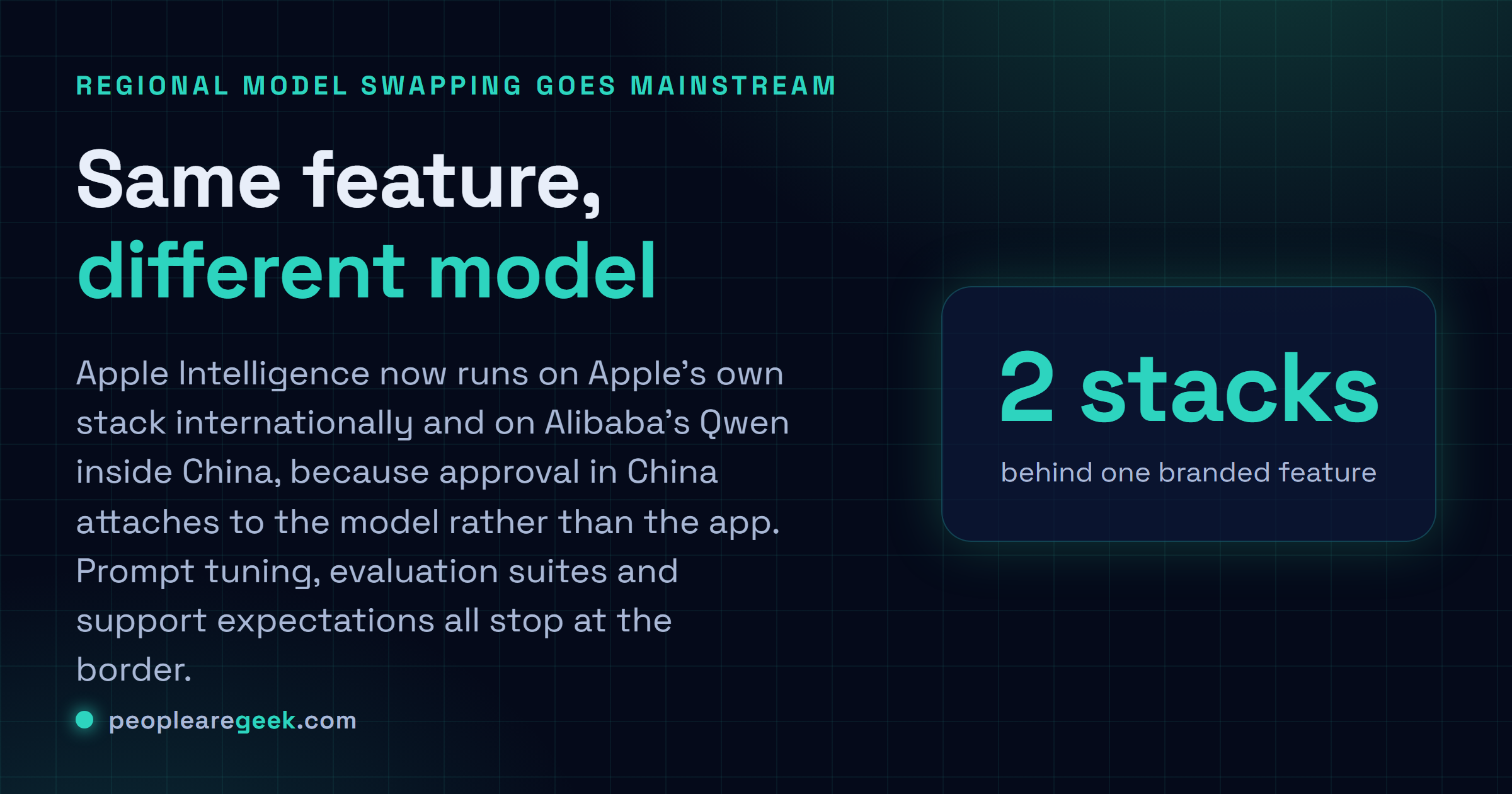
The same branded feature, on the same devices, now runs on a different model depending on which jurisdiction the user is in. Apple did not do this for latency or cost. It did it because the rules made the model a per market decision. Once the largest consumer software company on earth normalises that, it stops being an exotic arrangement and starts being an architecture other people copy.
That matters in three practical ways.
The first is that model specific prompt tuning does not survive the border. If you have spent months getting your prompts to behave against one model, none of that work transfers cleanly to a different model with different training and different moderation. You now maintain two sets, and they drift.
The second is evaluation. A test suite that proves your feature behaves is a test suite against one model. Swap the model per region and you need the suite to run against each one, with region specific expectations, because refusal behaviour and edge case quality will not match. Anyone who has tried to keep two model backends passing the same assertions knows the failure mode is rarely a dramatic break. It is a slow accumulation of small differences nobody owns.
The third is support and expectations. Users compare notes across borders. When the Chinese build phrases something differently or declines a request the international build accepts, that is a support conversation, and the honest answer is that the feature is not the same feature. Product pages that imply otherwise will age badly.
What we would actually do about it
The design lesson is not new, but this makes it concrete. If you are building AI features into anything that crosses jurisdictions, put a real abstraction between your product logic and the model, and assume from day one that the thing behind it will be swapped for reasons that have nothing to do with engineering. Regulation, partnership terms and availability will drive that choice more often than benchmarks will.
Keep the model identity visible in your telemetry, so that when quality complaints arrive you can tell which backend produced the output. Keep prompts and evaluations versioned per model rather than per feature. And resist the temptation to promise identical behaviour across regions in your documentation, because you will not be able to deliver it.
Apple just demonstrated that at the largest possible scale. The feature is the same. The model is not. Both of those things are now permanent.
Sources and further reading
- TechCrunch: Apple Intelligence approved for launch in China with Alibaba's Qwen AI
- CNBC: Alibaba's U.S. listed shares rise 4% after Qwen AI set to be integrated in Apple Intelligence
- The Next Web: Alibaba stock jumps 4% after Qwen is approved to run Apple Intelligence in China
Frequently asked questions
What did China approve and when?
On July 15, 2026, the Cyberspace Administration of China approved Apple's AI services for the Chinese market. The approval came on the back of an agreement to integrate Alibaba's Qwen model into Apple Intelligence across iOS, iPadOS, macOS and visionOS. The features cover text and image understanding and generation. Neither Apple nor Alibaba has published a rollout timetable.
Why does Apple need a Chinese partner at all?
Generative AI services offered to the public in China must be registered and approved by the regulator, and in practice that means the underlying model needs to be one the regulator has already cleared. Apple cannot simply ship the model that serves the rest of the world. Partnering with a domestic provider whose model is already approved is the route that works, which is why Apple spent a long time looking for the right one.
Did Apple consider other Chinese models?
Yes. Apple explored arrangements involving Baidu, DeepSeek and ByteDance models before settling on Alibaba. Reporting around the Baidu discussions pointed to difficulties adapting the models to Apple's requirements for Chinese customers. Baidu capabilities may still appear in the service alongside Qwen.
Does this mean Apple Intelligence works the same in China?
Not exactly, and that is the point worth holding onto. The feature names may match, but the model generating the output is a different one, trained differently and moderated against different requirements. Expect divergence in tone, refusal behaviour and edge case quality between the Chinese build and the international build, even where the user facing feature looks identical.
Why does this matter to developers outside China?
Because it makes regional model swapping a mainstream pattern rather than a niche one. If the largest consumer software company on earth ships the same feature on two different models depending on jurisdiction, the assumption that one model backs one feature everywhere is no longer safe to design around. That has consequences for prompt tuning, evaluation and support, which we cover below.