Nine of the largest technology companies have committed to roughly three trillion dollars of AI infrastructure spending that does not appear on their balance sheets, according to a Wall Street Journal analysis of securities filing footnotes published on August seventeenth, 2026. The split is one point two trillion dollars in leases that have not yet commenced and one point nine trillion in purchase commitments for chips, energy and datacenter infrastructure. For scale, the same companies reported about six hundred billion dollars of capital expenditure over their latest twelve month periods. If you plan capacity, price cloud contracts or forecast GPU availability, this footnote is more informative than any capex headline.
The short answer
A Wall Street Journal analysis published on August seventeenth, 2026 read the footnotes of nine large technology companies and found roughly three trillion dollars of AI related commitments that are disclosed but not recognised on the balance sheet. One point two trillion dollars of that is rent on leases that have not started. One point nine trillion is purchase commitments for chips, equipment and energy. Alphabet alone discloses eight hundred eleven billion dollars of purchase and contractual obligations, Meta three hundred forty seven billion in future leases. The total is about triple what the same companies carry as reported leases and long term borrowings.
We spend a lot of time on this site reading capital expenditure numbers, because capex is the closest public proxy for how much compute will exist next year. It turns out capex has been the wrong line to read.
Three trillion dollars, in the notes
The Wall Street Journal published an analysis on Monday, August seventeenth, 2026, based on the footnotes of the most recent securities filings from Alphabet, Amazon, Meta, Microsoft, Oracle, Nvidia, Broadcom, SpaceX and Advanced Micro Devices. Those footnotes disclose roughly three trillion dollars of commitments, overwhelmingly tied to AI infrastructure, that do not appear as liabilities on the face of the balance sheet.
The total breaks into two categories that behave quite differently. About one point two trillion dollars is future rent under leases that have not yet commenced: signed contracts on datacenter space that has not been handed over. About one point nine trillion dollars is purchase commitments, covering accelerators, equipment, energy and other services. Alphabet alone discloses eight hundred eleven billion dollars in purchase and contractual obligations. Meta reports three hundred forty seven billion dollars of future lease commitments.
Set that against what the same companies report as ordinary spending and the gap is the story. Capital expenditure across their latest reported twelve month periods runs to about six hundred billion dollars. The off balance sheet total is roughly five times that, and roughly triple what these companies carry as reported leases and long term borrowings combined. The uncommenced lease figure alone came in at about four times the level disclosed a year earlier, which is the single fastest moving number in the set.
None of this is concealment. It is standard accounting: a lease is recognised when it commences, not when it is signed, and multi year purchase agreements are disclosed in the notes rather than booked as debt. The obligations are real, contractual and public. They are simply in the section of the filing that most people scroll past.
Why an infrastructure engineer should care
The instinct is to file this under finance and move on. That would be a mistake, because these two categories are the best public forward indicator of compute supply that exists.
Capital expenditure is a rear facing measurement. It tells you what got built and paid for in a quarter that has already closed. Uncommenced leases and dated purchase obligations are forward facing: they tell you what has been contracted for delivery, and the maturity tables tell you roughly when. That is precisely the horizon that decides whether you sign a three year reserved commitment now or wait, whether you buy hardware or rent it, and whether it is reasonable to assume accelerator availability improves in your planning window.
Read that way, a one point two trillion dollar backlog of leases waiting to commence describes a specific operational situation: an enormous amount of capacity is contracted and not yet running. It matches what operators have been saying out loud, including Microsoft's own repeated statements that demand exceeds capacity, and it fits the gap we looked at yesterday between Microsoft's spending and the chips actually installed. Relief is scheduled, not delivered.
It also explains the financing structures that have filled our news pages this month. Commitments of this size have to be funded, and the mechanisms being used are exactly what you would expect: residual value guaranties like the one Nvidia signed for the PORTS-Pike campus, and compute collateralised debt programmes like the five hundred billion dollar facility Nvidia lined up with Wall Street. Those are not exotic financial engineering for its own sake. They are what a one point nine trillion dollar purchase pipeline looks like when it needs lenders.
Reading it yourself, in about ten minutes
This is a genuinely useful habit for anyone who has to defend a capacity forecast, and it does not require any finance background.
Open the latest 10-Q or 10-K for whichever provider you depend on and skip the headline statements entirely. Go to the notes and find the one titled commitments and contingencies. Inside it, two phrases matter. Leases that have not yet commenced tells you about contracted capacity not yet in service. Purchase obligations, usually a table broken out by year, tells you about the chip, energy and services pipeline.
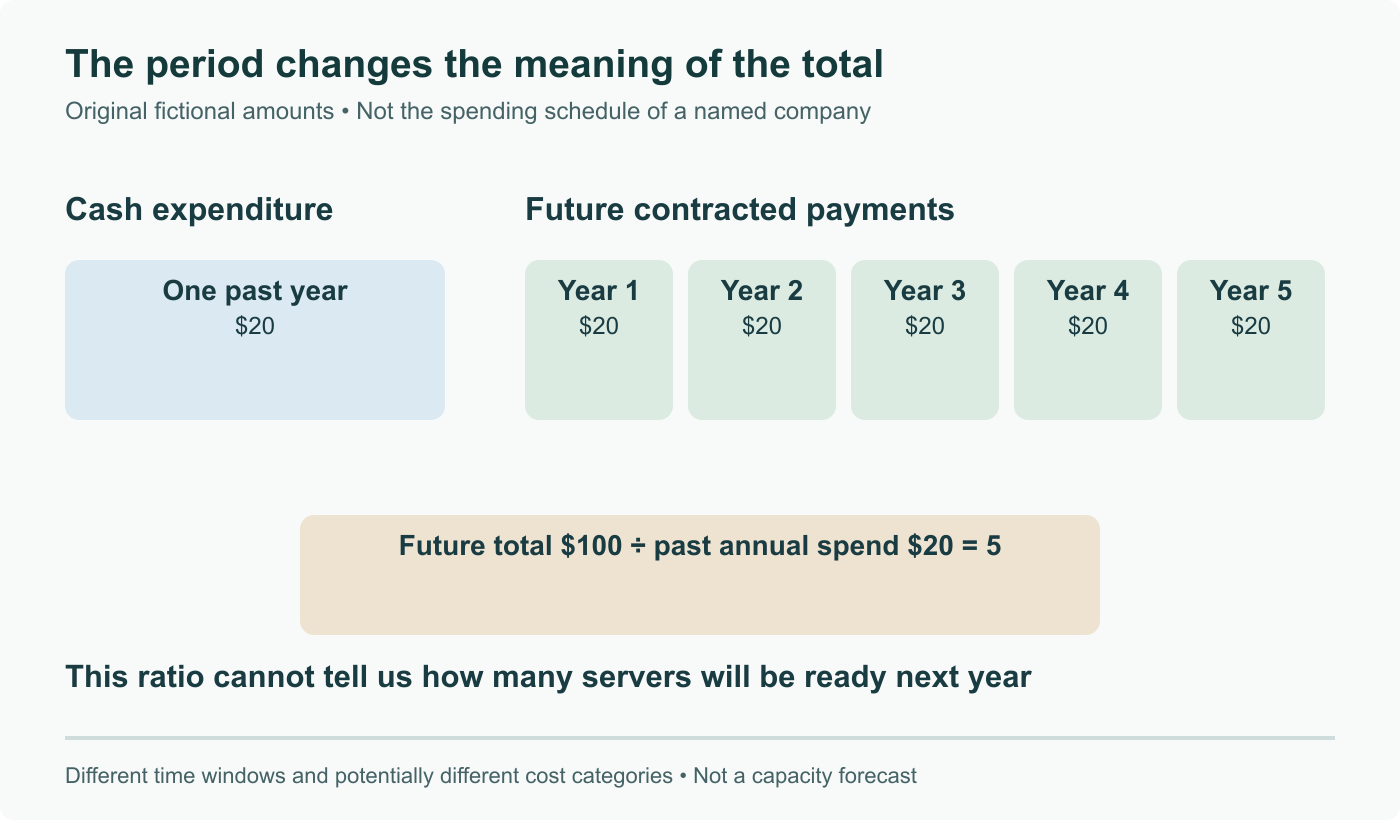
Then read the maturity columns rather than the total, because the total is close to meaningless on its own. Three hundred billion dollars spread over ten years and three hundred billion concentrated in the next two describe entirely different operating realities, and only the second one implies capacity arriving inside your planning horizon. Finish by comparing what you found against the capital expenditure line in the cash flow statement. The ratio between those two numbers, forward commitments over trailing spend, is the number worth tracking quarter to quarter. Across these nine companies it currently sits around five to one, and a year ago it was much lower.
That ratio is not a market prediction and we are not making one. It is an operational fact about how much compute has been contracted versus how much has been built, and it is the sort of thing you want on a slide when someone asks why you are recommending a longer commitment term.
Sources and further reading
- Why Big Tech's AI Spending Is $3 Trillion Higher Than It Seems, The Wall Street Journal, August 17, 2026
- Big Tech companies have $3T in hidden AI expenditures, Seeking Alpha, August 17, 2026
- Alphabet, Meta, and Microsoft Are Hiding $3 Trillion in Debt On the AI Boom's Hidden Ledger, Yahoo Finance, August 17, 2026
- Off-Balance-Sheet AI Debt Approaches $3 Trillion Across Tech Giants, Stratton Journal, August 2026
- Big Tech's $3 Trillion AI Spending Tab Comes Into Focus, Benzinga, August 17, 2026
Frequently asked questions
What exactly did the Wall Street Journal find?
In an analysis published on August seventeenth, 2026, the Journal read the footnotes of the most recent securities filings from nine companies: Alphabet, Amazon, Meta, Microsoft, Oracle, Nvidia, Broadcom, SpaceX and AMD. Together those footnotes disclose roughly three trillion dollars of commitments, largely tied to AI infrastructure, that are not recognised as liabilities on the face of the balance sheet. Two categories make up the total. About one point two trillion dollars is future rent on leases that have not yet commenced, meaning the building or the campus is not yet handed over. About one point nine trillion dollars is purchase commitments covering chips, equipment, energy and other services.
Why are these obligations not on the balance sheet?
Because under current accounting rules a lease is recognised when it commences, not when it is signed. If a company signs a fifteen year lease on a datacenter that will be delivered in 2029, the obligation is real and contractual, but the right of use asset and the corresponding liability only land on the balance sheet when the company actually takes possession. Purchase commitments work similarly: an agreement to buy accelerators or power over several years is disclosed in the notes rather than booked as debt. None of this is irregular or hidden in the wrongdoing sense. It is disclosed, it is in the filings, and it is simply in the part of the filing most readers skip.
How big are these numbers relative to what the companies report normally?
Large enough to change the picture. The three trillion dollar total is roughly triple what the same companies report as outstanding leases and long term borrowings on their actual balance sheets. It also dwarfs their reported spending: about six hundred billion dollars of capital expenditure across the latest reported twelve month periods. Individual figures make the point too. Alphabet disclosed eight hundred eleven billion dollars in purchase and contractual obligations. Meta reported three hundred forty seven billion dollars of future lease commitments. And the trend is steep: promises under leases that have not commenced were reported at about four times the level disclosed a year earlier.
What does this mean for someone planning cloud capacity or GPU supply?
It is the most direct forward signal on supply that is publicly available. Capital expenditure tells you what was built last quarter. Uncommenced leases and multi year purchase commitments tell you what has been contracted for delivery over the next three to five years, which is exactly the horizon that matters when you are deciding whether to sign a reserved instance term, buy hardware, or bet that spot GPU pricing softens. A one point two trillion dollar pipeline of leases waiting to commence says a great deal of capacity is contracted but not yet operational, which is consistent with what operators keep reporting: demand ahead of supply now, with relief scheduled rather than delivered.
How do I read this in a filing myself?
Open the most recent 10-Q or 10-K and go to the notes, not the statements. Look for a note titled commitments and contingencies, and inside it for two specific phrases. Leases that have not yet commenced gives you contracted future capacity. Purchase obligations or unconditional purchase commitments, usually presented as a table broken out by year, gives you the chip, energy and services pipeline. Read the maturity columns rather than only the total, because a three hundred billion dollar obligation spread across a decade and the same number concentrated in two years describe completely different operating realities. Then compare the total against the capital expenditure line in the cash flow statement.