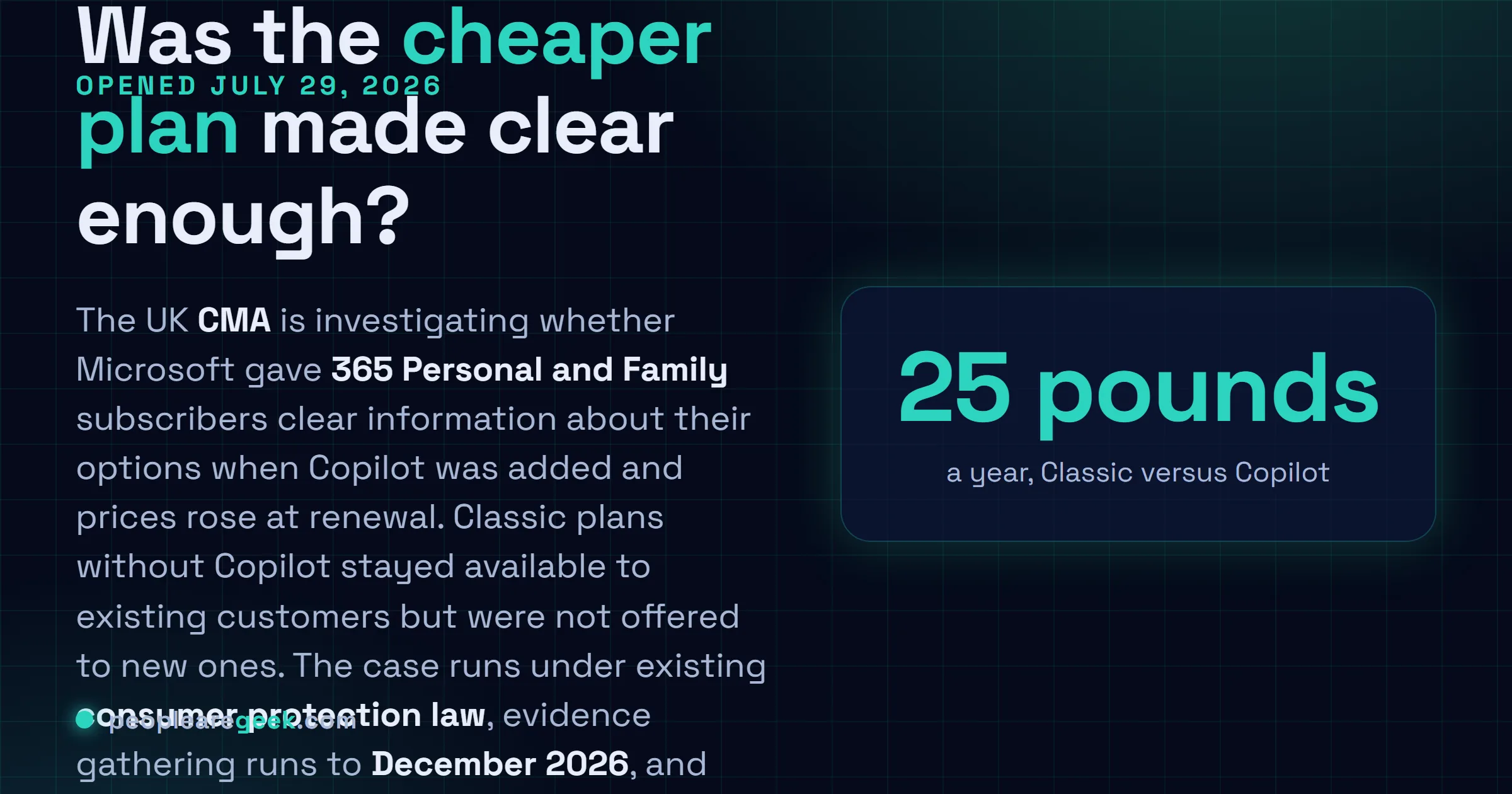
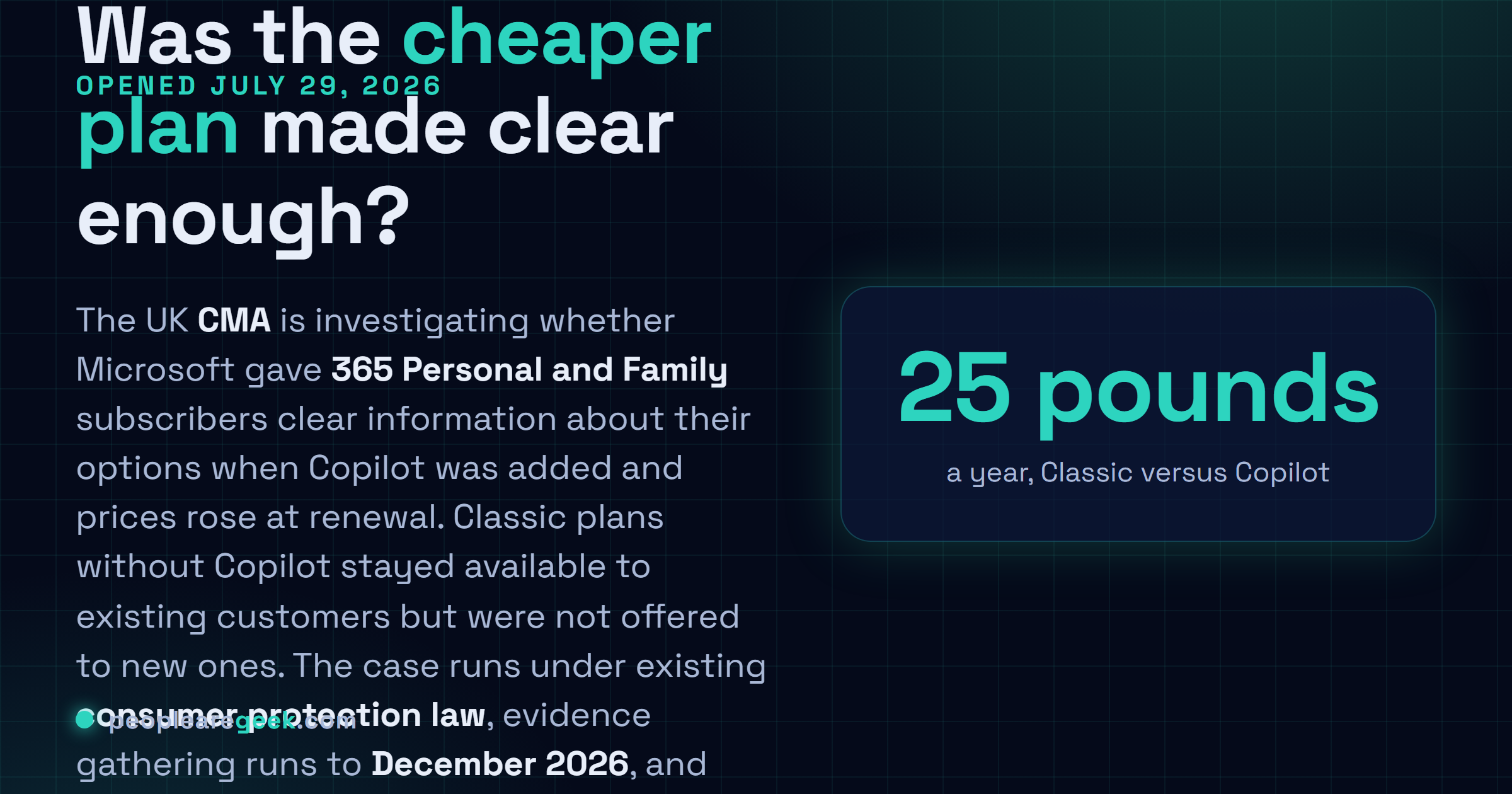
The UK Competition and Markets Authority opened an investigation on July 29, 2026 into how Microsoft handled the Copilot price increase on Microsoft 365 Personal and Family subscriptions. The question is not whether the price went up, which nobody disputes. It is whether existing subscribers were told clearly enough that a cheaper Classic plan without Copilot still existed, before they were renewed onto the pricier one. In the UK that gap is 25 pounds a year on Personal. The CMA is using existing consumer protection law rather than the new digital markets regime, it says the investigation is at an early stage, and regulators in Australia and Italy are looking at similar ground.
The short answer
The UK Competition and Markets Authority is investigating whether Microsoft gave Microsoft 365 Personal and Family subscribers clear information about their options when Copilot was added and prices rose. Copilot arrived on those plans in January 2025 at no immediate extra cost, and at renewal subscribers moved onto the more expensive plan unless they acted. Classic plans without Copilot stayed available to existing customers but were not offered to new ones. The case runs under existing consumer protection law, not the new digital markets regime. Evidence gathering continues through December 2026, and Australian and Italian authorities are examining similar ground.
Every software vendor is currently working out how to charge for AI features that cost real money to run. Most of them are arriving at the same answer, which is to put the feature into an existing subscription and raise the price of that subscription. What the CMA is now asking is a narrow and rather useful question about that manoeuvre: at the moment the price changes, how clearly does the customer have to be shown the door marked "no thanks"?
The sequence being examined
In January 2025 Microsoft added Copilot to Microsoft 365 Personal and Family. Existing subscribers got it mid term without paying more at that moment. The price change arrived at renewal, when subscribers were moved onto the plan that includes Copilot unless they actively chose otherwise.
There was an alternative. Microsoft kept Classic plans, without Copilot, at the previous price. Those plans remained available to existing subscribers, but they were not offered to new customers, and the regulator's concern is that existing subscribers were not given clear and timely information about their options.
The CMA's stated position is straightforward: when a business changes its subscription plans, customers need "clear and timely information about their options." That is the whole case in a sentence. It is about presentation of choice, not about the merits of Copilot or the fairness of the price.
The numbers

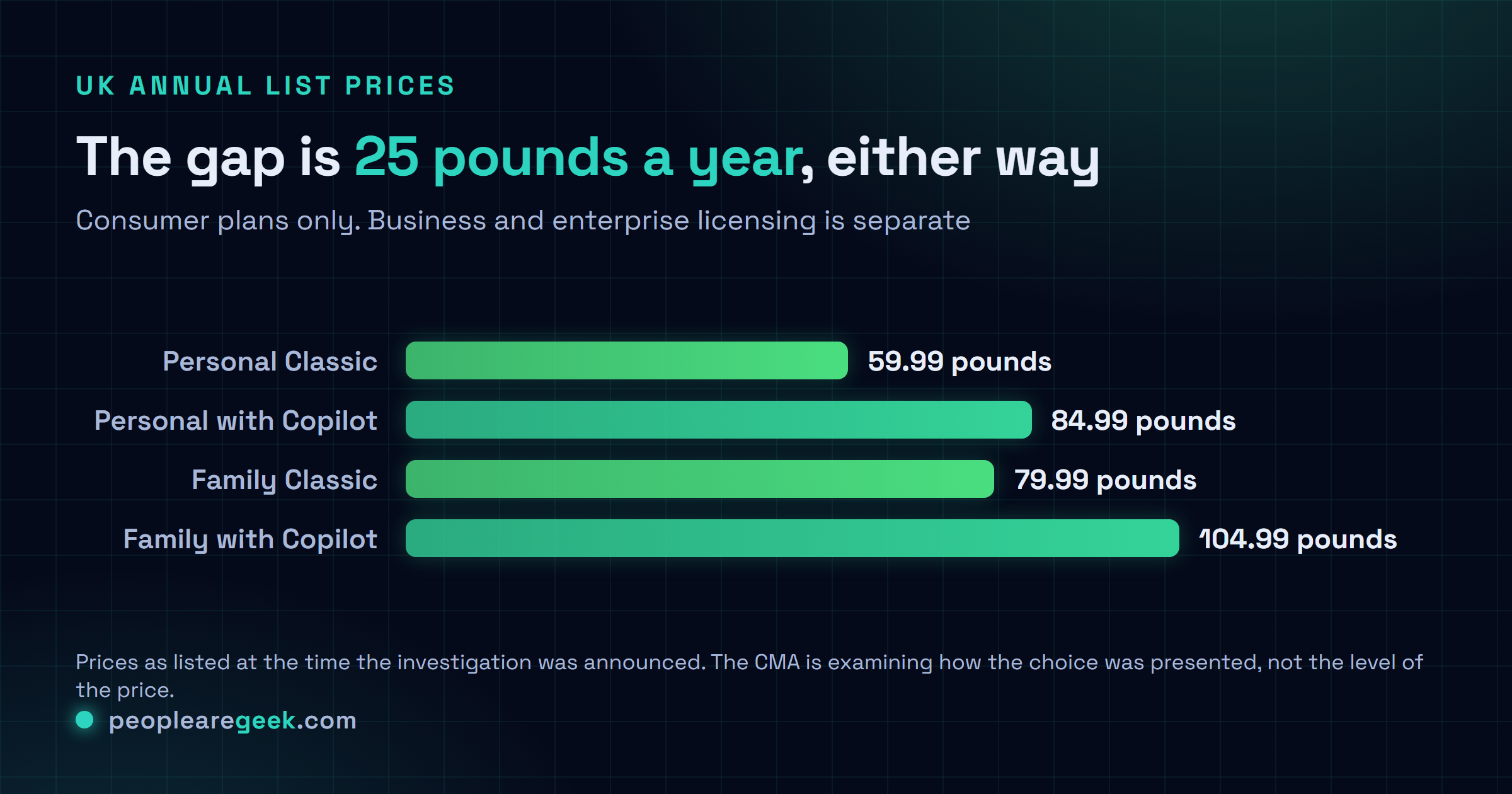
Personal with Copilot is 84.99 pounds a year against 59.99 for Classic. Family is 104.99 against 79.99. Twenty five pounds either way.
That is a small enough number that the individual harm, if any is eventually found, is modest. Consumer law cases of this kind are not really about the amount. They are about how many people were affected and whether the alternative was presented in a way a normal person would notice. Multiply 25 pounds by a consumer subscriber base and you get a figure that justifies a regulator's attention.
What this does not cover
This is consumer Microsoft 365, meaning Personal and Family. It is not Business Standard, not E3 or E5, and not the Copilot licences your organisation buys per seat. Those are separate products with separate pricing mechanics, and on the commercial side Copilot has generally been sold as an explicit add on rather than folded into a base plan at renewal.
So if you run a tenant, nothing here changes your position. Read it anyway, because the question the CMA is asking is one that will land on other vendors. A very large number of the tools your organisation pays for are currently rehearsing the same move, and "we added AI and raised the price at renewal" is about to be one of the most common billing events in enterprise software.
The regulatory shape of it
Two details matter for how seriously to take this.
First, the case is running under existing consumer protection law on unfair commercial practices, not under the Digital Markets, Competition and Consumers Act. That is a choice about which tool fits, and it means this is a consumer transparency case rather than a market power case.
Second, the CMA can seek up to 10 percent of global turnover for consumer law breaches. That ceiling is what gives a 25 pound question institutional weight. In practice, cases like this usually end in undertakings about how options are displayed, sometimes with redress, rather than at the ceiling.
The investigation is at an early stage. Microsoft has not been found to have done anything unlawful. Evidence gathering runs through December 2026, with a further update expected before the year ends. Authorities in Australia and Italy have been looking at Microsoft's communications around the same changes, which usually means any eventual fix gets applied globally rather than in one market.
Our read: whatever the outcome, the durable effect will be on the renewal flow. If regulators decide that bundling an AI feature into an existing subscription requires the cheaper option to be presented at the same moment, with the same prominence, that is a change every vendor will end up copying.
Sources and further reading
- The Next Web: UK regulator probes whether Microsoft misled 365 customers over Copilot price rises
- The Register: Microsoft faces competition probe over Copilot subscription price hike
- The Competition and Markets Authority
- Microsoft 365 plans and pricing for the UK
Frequently asked questions
What exactly is the CMA investigating?
Whether Microsoft broke UK consumer law in the way it communicated a subscription change, not whether the price itself was too high. In January 2025 Microsoft added Copilot to Microsoft 365 Personal and Family plans mid subscription without charging more at that moment. At renewal, subscribers were moved onto the plan that includes Copilot, at a higher price, unless they took action. Cheaper Classic plans without Copilot remained available to existing subscribers, but were not offered to new customers and were, in the regulator's framing, hard to find. The CMA suspects customers were not given clear information about their options when the change happened. It has not concluded that anything unlawful occurred.
What are the actual prices?
In the UK, Microsoft 365 Personal with Copilot is 84.99 pounds a year, against 59.99 pounds for Personal Classic, a difference of 25 pounds. Family with Copilot is 104.99 pounds a year, against 79.99 pounds for Family Classic, a difference of 25 pounds as well. Those are annual list prices at the time the investigation was announced. The absolute amounts are small, which is part of what makes the case interesting: consumer law cases about subscription clarity turn on the number of people affected and on whether the choice was presented fairly, not on the size of any individual increase.
Does this affect business and enterprise tenants?
No. The investigation is about Microsoft 365 Personal and Family, the consumer subscriptions. Business and enterprise plans are licensed and priced separately, and Copilot on those tiers has been sold as a distinct add on with its own per user pricing rather than being folded into the base plan at renewal. If you administer a tenant, nothing here changes your licensing position. The reason it is still worth reading is that the underlying question, how clearly a vendor must explain a mid contract change that bundles an AI feature into an existing subscription, applies to a great many products your organisation buys.
What powers does the CMA have here?
The investigation is being run under existing consumer protection law covering unfair commercial practices, rather than under the newer Digital Markets, Competition and Consumers Act. For consumer law breaches the CMA can seek penalties of up to 10 percent of a company's global turnover, which is the figure that makes these cases matter regardless of how small the individual price difference is. In practice, cases of this type more often end with undertakings about how choices are presented, and sometimes with redress for affected customers, than with a maximum penalty.
What happens next, and who else is looking?
The CMA has said evidence gathering continues through December 2026, with a further update expected before the end of the year. Nothing has been decided, and Microsoft has not been found to have broken any law. Separately, authorities in Australia and Italy have been examining Microsoft's communications around the same subscription changes, which is the pattern you tend to see when a global product change lands in several consumer protection regimes at once. If any of them reaches a conclusion, the practical result is usually a change to how the choice is presented worldwide rather than a change confined to one country.