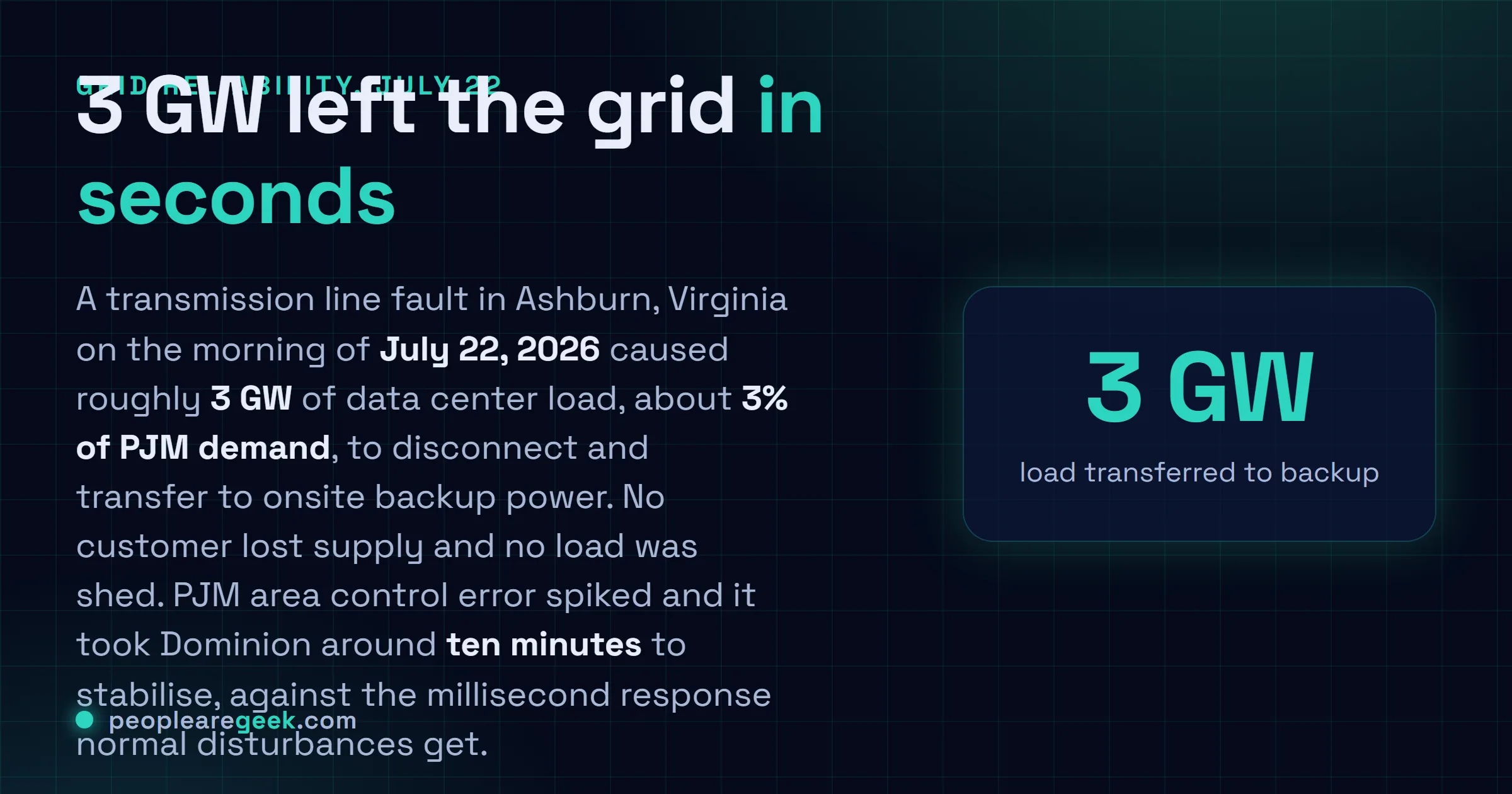
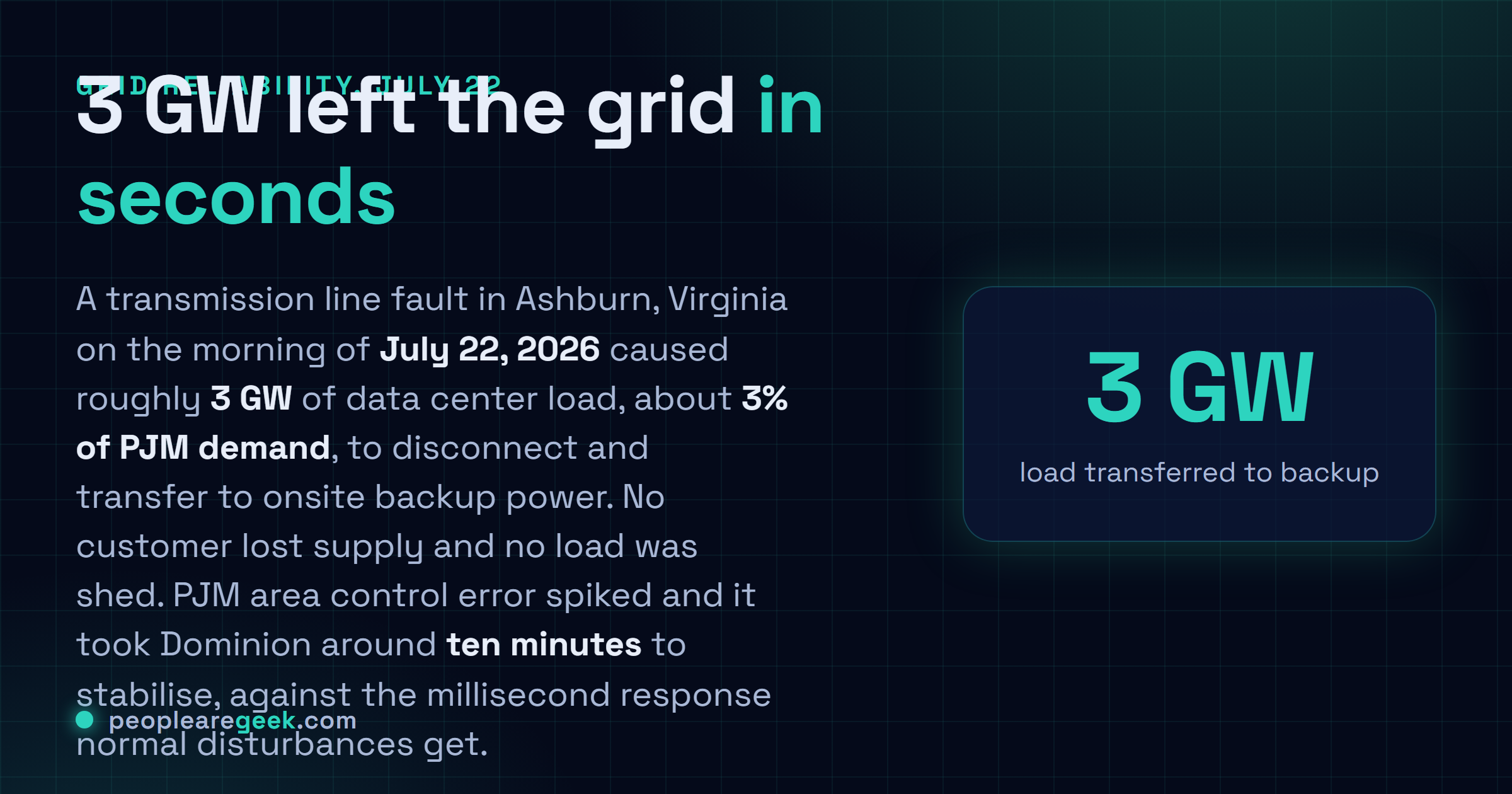
Just before eight in the morning on Wednesday, July twenty second, a transmission line faulted in Ashburn, Virginia. Within seconds, roughly three gigawatts of data center load disconnected from the grid and transferred to onsite backup power. That is about three percent of everything PJM was serving at that moment, gone from the demand side almost instantly. No customer lost power, no load was shed, and the facilities themselves rode through it exactly as designed. That is the uncomfortable part: every protection system did its job, and the aggregate result was still a disturbance that sensors picked up as far away as Chicago. We looked at what happened, why it is now a modelling problem rather than a facility problem, and what the August third deadline sitting behind it actually requires.
The short answer
A transmission line fault in Ashburn, Virginia on the morning of July twenty second caused roughly three gigawatts of data center load to disconnect and run on onsite backup power. No customer lost supply and no load was shed. PJM's area control error spiked and Dominion needed about ten minutes to stabilise the system. Voltage disturbances were measured as far away as Chicago. A NERC Level 3 alert issued in May already requires grid operators to complete seven actions on large computational loads by August third.
The story most infrastructure people know is the one where something fails and the redundancy saves you. This is the other one, where nothing fails, the redundancy fires exactly as designed, and the design turns out to have an emergent property nobody wrote down.
Three gigawatts, gone in seconds
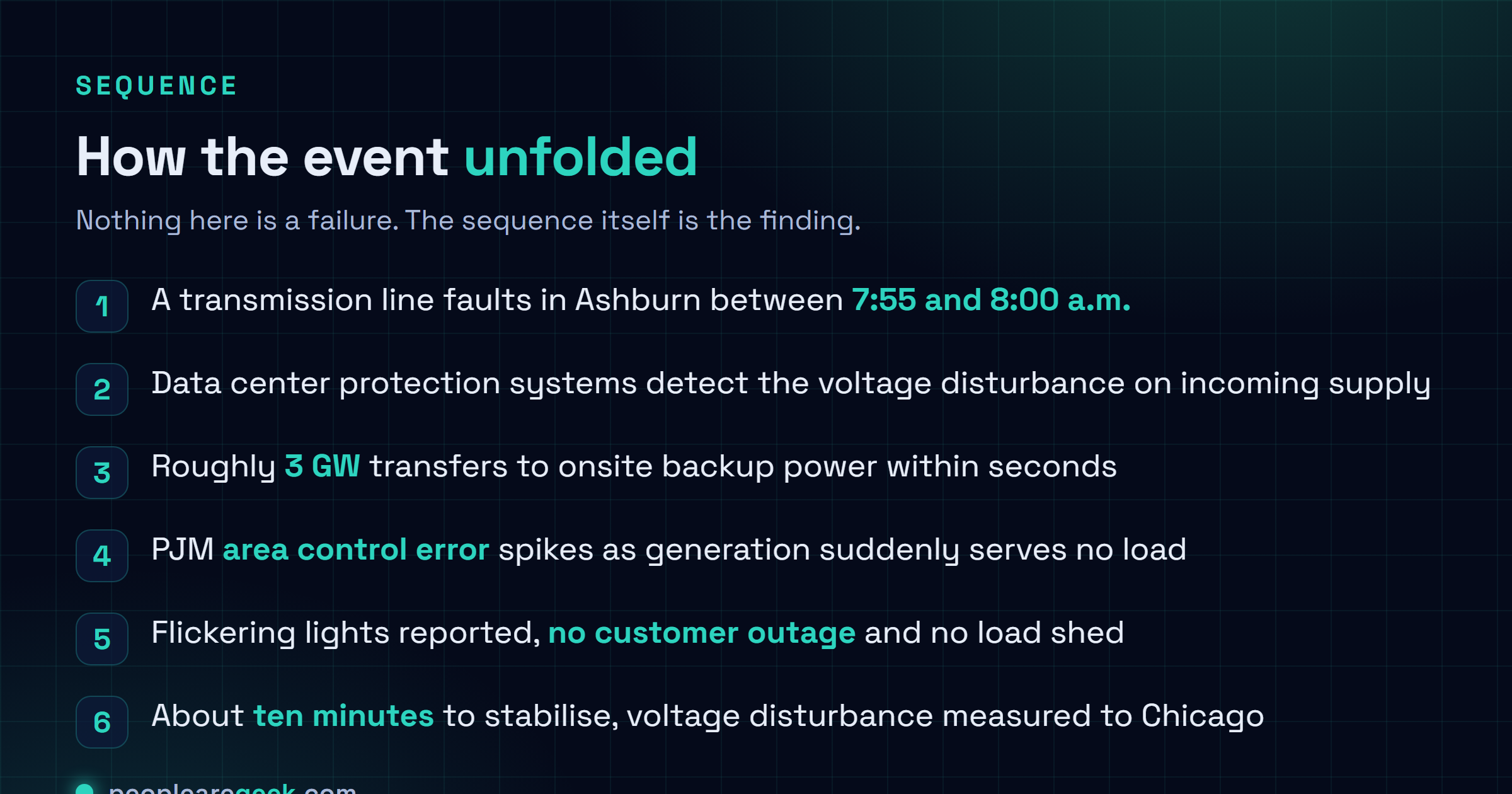
Ashburn is not a normal place to put a data center. It is the densest concentration of them on the planet, which is why the corridor has been called Data Center Alley since long before anyone was building gigawatt campuses. On the morning of Wednesday, July twenty second, a transmission line in that corridor faulted, somewhere in the window between 7:55 and 8:00.
A fault produces a voltage disturbance on the local network. Every serious data center watches its incoming supply for exactly that signature, because sustained abnormal voltage is one of the few things that can damage expensive equipment across a whole hall. The protection logic in that situation is not subtle, and it should not be: disconnect from the utility, transfer to backup, ride it out on your own generation.
That is what happened, at every facility that saw the disturbance, at the same time. Individually each transfer is a routine event that a site engineer would log and forget. Collectively, roughly three gigawatts of load left the PJM system inside a few seconds. Dominion Energy reported flickering lights in the area and no loss of supply to any customer. Nothing was shed. Nothing tripped that was not meant to trip.
Why a demand drop is a grid event
The intuition that makes this hard is that we think of power problems as supply problems. A generator trips, a line opens, capacity disappears, and the system scrambles to cover the gap. A load drop feels like the opposite, like the system getting an unexpected break.
It is not. A grid is a continuous balancing act between what is being generated and what is being consumed, and it is the mismatch that hurts regardless of which side moves. Generation that was serving three gigawatts a second ago is now serving nothing, and until operators can back it down, that energy has to go somewhere. Frequency drifts up. Voltage rises on the lines that were carrying the load. PJM's area control error, which is the running measurement of how far a balancing authority sits from where it should be, spiked visibly in the data.
The recovery is the number worth holding onto. Routine disturbances on a transmission system are corrected in milliseconds by automatic controls. This one took Dominion around ten minutes to stabilise. That is not a catastrophe, and nothing downstream of it went dark, but it is four orders of magnitude slower than the reflexes the system normally relies on.
The geographic reach makes the same point differently. A sensor network operator with about 1.4 million monitoring points recorded voltage disturbances from the Washington area to Chicago. Not outages, not damage: measurable disturbance, hundreds of miles away, from a load behaviour event.

The regulator was already here
None of this arrived as a surprise to the people who plan bulk power systems. NERC issued a Level 3 alert on May fifth, 2026, which is the highest of its three alert levels and mandates action rather than merely recommending it. The subject was precisely this: large computational loads dropping or oscillating in ways the planning models did not anticipate.
The assessment behind it was direct. NERC found that the entities involved generally did not have sufficient processes, procedures or methods to address emerging computational loads. In regulator language that is close to blunt.
The alert directs transmission planners, transmission operators, planning coordinators and balancing authorities to complete seven actions by August third, 2026. The list is worth reading as an engineer rather than as a compliance exercise, because it describes what the grid does not currently know about data centers:
Detailed modelling data and parameters for computational loads. Expected minimum and maximum consumption, plus what share of the total is IT load rather than cooling and everything else. Revised definitions for the thresholds that trigger a local area protection review, since the old thresholds were written for an era when a single interconnection request did not routinely arrive with a gigawatt attached. A commissioning process specific to data center facilities. Full load and no load testing, including voltage variance testing. And dynamic fault recording devices, so that the next event produces data rather than inference.
Read as a group, those seven items say something simple: the models treat a data center as a block of demand, and a data center is not a block of demand. It is a controller with its own protection logic and its own thresholds, and thousands of those controllers in one corridor share enough assumptions to act in unison.
What this changes for the rest of us
If you run a rack, a room or a floor, this changes nothing about your day. The behaviour under discussion only becomes a system level property when thousands of megawatts of it are correlated inside a single service territory, and your UPS transferring on a sag is not that.
If you operate at the scale where your utility talks to you about interconnection, expect the conversation to get more detailed. The data those seven NERC actions require has to come from facility operators, since nobody else has it. Load profiles by hour, IT versus mechanical split, and above all the actual settings on your protection relays, which is the parameter that decides whether your site rides through a disturbance or transfers away from it.
That last one is where the real question sits, and it is genuinely open. Voltage ride through requirements exist for generation, and have for decades, because the industry learned the hard way what happens when generators all disconnect at the same threshold. There is no equivalent settled standard for large loads. FERC has directed that large load interconnection reliability standards be developed by the end of 2026, so the question of who is allowed to disconnect, how fast, and at what voltage is going to get an answer.
The engineering tension is real and does not have an obvious resolution. A facility protecting hundreds of millions of dollars of equipment has every reason to disconnect early and ask questions later. A grid carrying three percent of its load in one correlated block has every reason to want those facilities to hold on a little longer. Both positions are correct. July twenty second is what it looks like when they meet.
Sources and further reading
- Data Center Knowledge: fault in Data Center Alley triggered a 3 GW load drop on PJM
- RTO Insider: line fault causes 3 GW in data center load to drop in Virginia
- Utility Dive: NERC issues a rare Level 3 alert over data center load losses
- Utility Dive: sudden data center load losses prompt NERC alert and recommendations
- RTO Insider: FERC directs large load standards by the end of 2026
Frequently asked questions
What actually happened on July twenty second?
A transmission line faulted in Northern Virginia between roughly 7:55 and 8:00 in the morning. Data centers in the area detected the resulting disturbance on their incoming supply and their own protection systems transferred them to onsite backup power, which is precisely what those systems exist to do. Because the concentration of facilities in that corridor is so high, the individual transfers summed to about three gigawatts of load leaving the grid at once. Dominion Energy reported flickering lights locally but no loss of supply, and no load was shed anywhere.
If nothing broke, why is this a problem?
Because a grid balances generation against demand continuously, and three gigawatts of demand vanishing in seconds is a balancing event even when it is nobody's fault. Generation that was serving that load is suddenly serving nothing, which pushes frequency and voltage in the wrong direction until operators correct it. PJM's area control error, the running measure of how far a balancing authority is from its target, spiked. It took Dominion around ten minutes to stabilise the system, against the millisecond scale response that normal disturbances get.
How far did the disturbance travel?
Further than the fault itself. A sensor network operator with roughly 1.4 million monitoring points reported voltage disturbances stretching from the Washington DC area to Chicago. That does not mean anything failed along that path. It means the event was large enough to be measurable across a wide area of the interconnection, which is the kind of signature that used to belong to generation trips rather than load behaviour.
Is this the first time this has happened?
No, and that is why the regulatory machinery was already moving before July twenty second. NERC issued a rare Level 3 alert on May fifth, 2026 covering exactly this class of event, after a run of incidents where data center loads dropped or oscillated unexpectedly. NERC's own assessment was blunt: the entities involved generally did not have sufficient processes, procedures or methods to address emerging computational loads.
What does the NERC alert require, and by when?
It directs transmission planners, transmission operators, planning coordinators and balancing authorities to complete seven actions by August third, 2026. They include collecting detailed modelling data and parameters for computational loads, gathering expected minimum and maximum consumption along with the IT load percentage, revising the thresholds that trigger a local area protection review, establishing a commissioning process for data center facilities, running full load and no load testing with voltage variance testing, and installing dynamic fault recording devices. The obligations land on the utility side rather than on facility operators directly, but the data has to come from somewhere.
Does any of this change how I should run my own racks?
For a single cabinet or a small room, no. The behaviour under discussion only becomes a system level issue when thousands of megawatts of it are correlated inside one corridor. If you operate at a scale where your utility asks you for load modelling parameters or commissioning test data, expect those requests to get more specific and more frequent, because your planner now has a deadline attached to collecting them.