Debian opened its LLM vote on August 15 and closed it on August 28. This article now explains both the ballot and the result, while preserving the original publication date.
The ballot included a default choice
The official election page records eight substantive proposals plus option 9, None of the above. The winner was option 5, Responsible Use of Generative AI. The proposal to change the Social Contract required 3:1; the other substantive options required a simple majority.
That makes “eight proposals” accurate, but “eight total ballot choices” incomplete. The default option matters because it lets a voter rank an unacceptable proposal below taking none of the proposed decisions.
Ranking has two separate jobs
Under Debian's constitution, appendix A.5, options must clear quorum and their required comparison against the default. The remaining choices are then compared pairwise using Debian's specified counting procedure. Equal rankings are allowed; a voter does not have to put every option in a strict sequence.
Consider a fictional voter ranking B first, the default second and A third. This expresses a preference for B over doing nothing, and for doing nothing over adopting A. Counting only the first choice would discard the second piece of information.
The restrictive amendment also lost a simple comparison
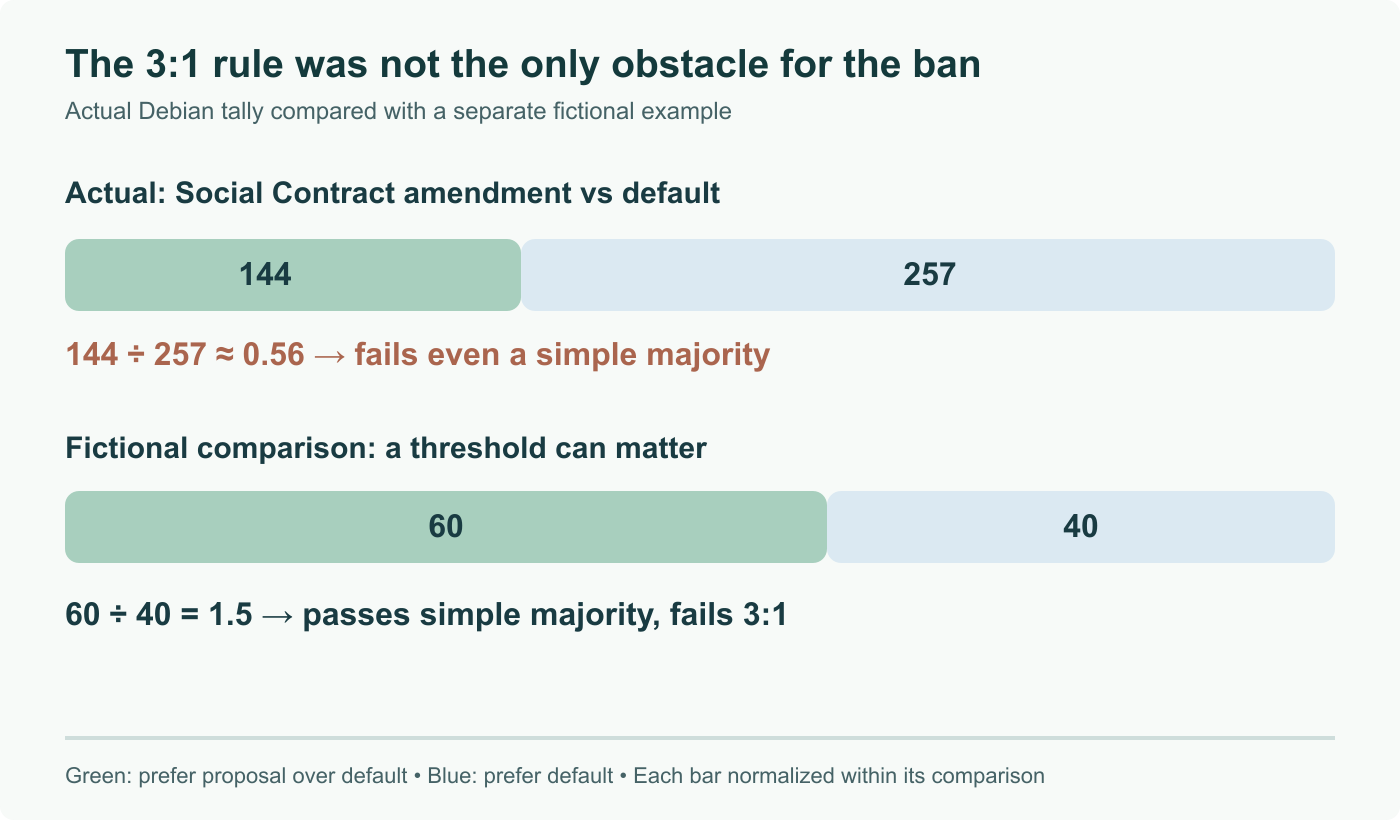
The published tally puts the Social Contract amendment at 144 preferences over the default, against 257 in reverse. Its ratio is approximately 0.56. It therefore failed even a simple majority; describing its defeat as merely an effect of the tougher 3:1 threshold would be misleading.
This is different from a hypothetical 60-to-40 comparison. That fictional proposal would pass a simple-majority comparison but fail a 3:1 requirement. Our illustration separates the actual numbers from that hypothetical example so the procedural distinction is visible.
The broader lesson is to test an explanation against the relevant row of the tally. A rule may be important in principle without being the deciding obstacle in the observed result. A ranked method also does not guarantee that every participant agrees with its winner.
Use the adopted text when contributing
The alternatives remain on the election page as a record of deliberation. They are not a combined list of rules now in force. Read our explanation of the adopted resolution for the practical implications, including contributor responsibility and encouraged disclosure.
For your own project, document the scope of any policy as carefully as its position on tools: source contributions, documentation, translations and imported upstream code can raise different review questions. A clear scope allows maintainers to assess an actual submission without having to infer a rule from a headline about another project's vote.
Preserve vote-opening history and add final outcome; correct eight proposals versus nine ballot choices, explain majority filtering and show ban also failed ordinary majority.